Skip to content
An amendment to trust is a formal legal document you use to make specific changes to your existing revocable living trust. Think of it as a small, targeted update to your original estate plan, allowing you to adapt it as your life and family circumstances change without having to start over from scratch. For Texas families, understanding how and when to use this tool is a crucial part of ensuring your wishes are honored and your loved ones are protected.
What Does a Trust Amendment Really Mean for Your Plan?

Imagine your trust is the master blueprint for your family’s financial future. Life, however, rarely sticks to the original plan. A new marriage, the birth of a grandchild, or a significant change in your assets can make parts of that blueprint obsolete. A trust amendment is the legal tool you use to revise a specific part of that plan without redrawing the whole thing.
It's a lot like changing the beneficiary on a life insurance policy. When you get married, you update the policy to name your new spouse. You don’t cancel the old policy and buy a brand new one; you simply amend the existing contract. A trust amendment works in much the same way for your estate, ensuring it keeps up with your life's journey.
Why Small Updates Prevent Big Problems
Failing to keep your trust aligned with your current life situation can lead to devastating consequences down the road. An outdated document can cause confusion, spark painful family disputes, and even trigger costly probate litigation after you’re gone. Your original intentions could be completely undermined, leaving your loved ones to deal with the fallout during an already difficult time.
Key life events are often the trigger that signals it's time for a review and a potential amendment:
- The birth or adoption of a child or grandchild.
- A marriage, divorce, or the death of a spouse.
- A significant increase or decrease in your assets.
- A change in your choice of successor trustee.
This proactive approach ensures your wishes are always clear and legally enforceable. The benefits of a revocable living trust are most powerful when the document accurately reflects your current reality. Our firm can help you navigate Wills & Trusts to determine if they are the right choice for your family's needs.
Why Texas Families Decide to Amend Their Trusts
Life doesn’t stand still, and neither should your estate plan. A trust isn't a "set it and forget it" document; think of it as a living tool that needs to keep pace with your family's reality. Texas families choose to make an amendment to a trust for all sorts of personal and practical reasons, almost always stemming from a major life change.
These updates aren't just about shuffling legal papers. They are deeply human responses to your family's evolving story, ensuring your trust continues to protect your loved ones exactly the way you intend.
Common Reasons for Amending a Trust
Several key life events almost always trigger the need to sit down and review an estate plan. If your trust isn't updated to reflect these new circumstances, your original intentions can be completely undermined.
- Changes in Family Structure: Welcoming a new grandchild, celebrating a marriage, or going through a divorce are all powerful reasons to amend your trust. You might want to add new beneficiaries, or just as importantly, remove an ex-spouse to prevent them from unintentionally inheriting your assets.
- Updating Key Roles: The person you picked as your successor trustee years ago might not be the best fit anymore. Maybe they've moved across the country, are dealing with health issues, or simply don't want the responsibility. An amendment lets you appoint someone new who is ready and able to step in. A Guardianship may also need to be considered.
- Shifts in Financial Status: A big jump—or drop—in the value of your assets can completely change how your estate should be handled. For instance, if your wealth grows significantly, you might need to add new provisions for tax planning that weren't necessary before.
- Changes in Beneficiary Needs: Life happens. A beneficiary might develop special needs, requiring you to add a special needs trust provision to protect their eligibility for government benefits. On the other hand, a beneficiary may sadly pass away, meaning you need to rethink your entire distribution plan.
In the world of estate planning, amending a trust is an essential tool for families navigating life's curveballs, and Texas law provides clear pathways for this under the Texas Estates Code. Consider this: data from Texas probate courts shows that over 65% of trust disputes litigated between 2018 and 2023 were born from outdated trusts that failed to account for new marriages, divorces, or the birth of heirs. You can discover more insights about these findings and see just how common this problem is.
A Real-World Texas Scenario
Let’s look at a Houston-area couple, Mark and Susan. They set up their trust 15 years ago when their main asset was their family home, worth about $300,000 at the time. Their plan was simple: split it equally between their two children.
Fast forward to today. Thanks to Houston's explosive growth, their property is now worth over $1.2 million. In that time, one of their children has become a successful surgeon, while the other is a public school teacher saddled with significant student loan debt. Mark and Susan now feel that a 50/50 split is no longer fair or equitable.
By creating an amendment to their trust, they can easily adjust the distribution percentages to give more support to their second child. This straightforward update ensures their legacy truly reflects their current values and their children's real-world needs. It prevents potential resentment down the road and makes sure their hard-earned wealth makes a meaningful impact right where it's needed most.
Amendment vs Restatement: Choosing the Right Update
When your trust needs a facelift, you have two primary tools in your legal toolbox: an amendment to trust and a trust restatement. While both get the job done, they work in very different ways. Knowing the distinction is the key to choosing the right—and most cost-effective—path forward for your family.
Let’s think of it like this: an amendment is like making a specific, targeted edit to a few pages of a book. You're just adding, removing, or changing a small section while the rest of the book stays exactly as it was.
A restatement, on the other hand, is like publishing a completely new edition of that book. It includes all the original content plus your new changes, and this new version completely replaces the old one.
Making Minor Adjustments with an Amendment
A trust amendment is your go-to for small, simple changes. It’s a separate legal document that references your original trust and clearly states which specific part is being modified. Because it’s so focused, it's generally faster and less expensive to create.
Situations where an amendment makes the most sense include:
- Changing your successor trustee.
- Updating a beneficiary's legal name after a marriage or divorce.
- Adjusting a specific dollar amount or percentage for a single beneficiary.
Basically, if you’re making a quick tweak, an amendment is likely all you need.
When a Full Overhaul is Necessary with a Restatement
A trust restatement is the better choice when you need to make extensive or multiple changes. Instead of creating a pile of confusing amendments that could contradict each other, a restatement consolidates everything into one clean, updated document. It brings everything into a single, easy-to-read plan.
A restatement is often the right move when:
- You are making significant changes to your distribution plan (for example, changing how assets are divided among all your children).
- You've already made several amendments, and the plan is getting hard to follow.
- Laws have changed significantly, requiring major updates to the trust's structure.
While a restatement is more complex and costs more than a simple amendment, its main benefit is clarity. It creates a single, authoritative document that eliminates any confusion about your final wishes, which can be invaluable in preventing family disputes and potential Probate Litigation down the road.
To help you decide, here’s a quick comparison of the three main options you have when your trust no longer reflects your wishes.
Choosing the Right Way to Update Your Trust
This table compares the key features of a trust amendment, restatement, and creating a new trust to help you understand which option best suits your needs.
| Method | Best For | Complexity & Cost | Key Benefit |
|---|---|---|---|
| Amendment | One or two small, specific changes (e.g., changing a trustee). | Low complexity, lowest cost. | Fast and efficient for minor updates. |
| Restatement | Multiple or significant changes to an existing trust. | Moderate complexity and cost. | Creates a single, clear document that replaces all prior versions. |
| New Trust | A complete change in purpose or when the original trust is outdated or flawed. | Highest complexity and cost. | Provides a fresh start and avoids issues with the old trust. |
Ultimately, choosing the right method ensures your trust remains a powerful and effective tool. Knowing which legal instrument to use is foundational, and you can explore more about the different types of trusts available in Texas to understand your options better.
How to Legally Amend a Trust in Texas
So, you’ve decided your trust needs a tune-up. That’s a wise decision. Life changes, and your estate plan should change with it. But making that change correctly is what separates a valid update from a future legal headache. Creating an amendment to trust in Texas isn’t just about writing down what you want; it involves following specific legal steps to ensure your wishes are legally binding.
Think of it as a formal update to a contract. The concept is simple, but the execution has to be precise to hold up under Texas law. Following these steps will help you create a clear, enforceable amendment that gives you—and your family—peace of mind during the Texas Probate Process.
Step 1: Review Your Original Trust Document
Before you write a single word, your first move is to pull out the original trust document and read it carefully. Buried in the administrative section, most trusts have a specific clause that lays out the exact rules for making amendments. This provision is your roadmap, and you must follow it to the letter.
This isn’t just a suggestion; it’s a legal requirement. If your trust says amendments must be signed in front of two witnesses and a notary, that’s exactly what you must do. Ignoring these built-in rules gives a court an easy reason to invalidate your amendment, which means the old terms you wanted to change will remain in effect.
Step 2: Draft the Amendment with Clear Language
An amendment is a formal legal document, not a casual note. The language you use must be absolutely clear and unambiguous. Vague wording is an open invitation for future fights among your beneficiaries.
Your amendment document must clearly:
- Identify you as the grantor (the person who created the trust).
- State the full name and original date of the trust you are changing.
- Express your clear intent to amend it.
From there, get specific. The amendment needs to explicitly state which article, section, or paragraph of the original trust is being changed, removed, or replaced. For instance, you might write, "Article V, Section 2 is hereby deleted in its entirety and replaced with the following…" This level of precision leaves no room for guessing games later on.
Sample Amendment Language:
"I, [Your Name], as Grantor of the [Name of Your Trust], dated [Date of Original Trust], do hereby amend the trust as follows: Paragraph 3.1 of Article III is hereby amended to remove [Ex-Spouse's Name] as a beneficiary and add [New Beneficiary's Name] in their place."
Simple, direct language like this is the bedrock of a legally sound amendment.
Step 3: Follow Texas Signing and Notarization Requirements
Once you’ve drafted the amendment, you must sign it with the same legal formality you used for the original trust. Under Title 2 of the Texas Estates Code, which governs wills and trusts, a trust amendment must be executed with the same formalities as a will. This typically requires the grantor’s signature in front of a notary public.
Don't skip this step. A notary acts as an impartial witness who verifies your identity and confirms you’re signing the document of your own free will. An amendment that isn't properly signed or notarized can be easily challenged in court, potentially unraveling all the changes you intended to make. It’s a simple requirement that adds a powerful layer of legal protection.
This flowchart breaks down the two main paths for updating your trust.
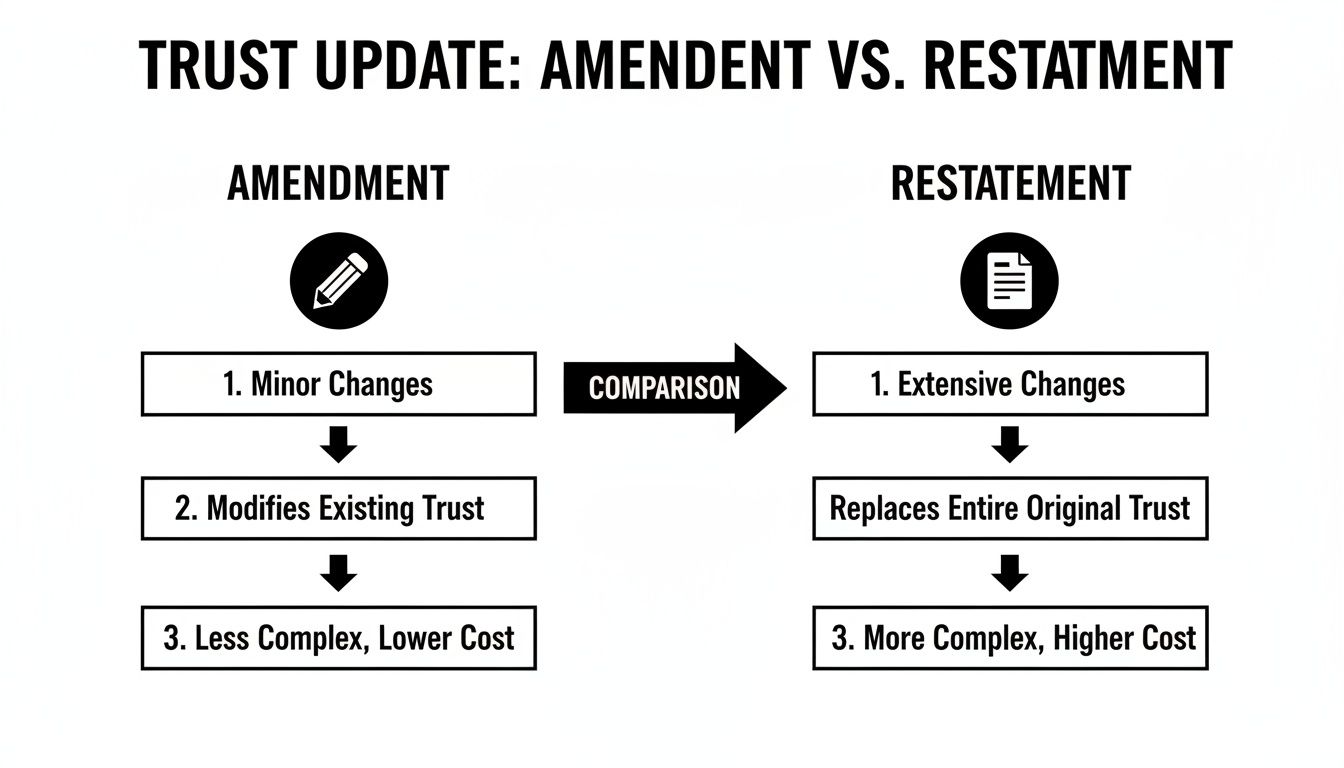
As the image shows, an amendment is perfect for small tweaks, while a restatement is the right tool for a complete overhaul.
Step 4: Keep Your Documents Safe and Sound
After your amendment is signed and notarized, physically attach it to your original trust document. Don’t just toss it in the same folder—staple or clip it directly to the trust so they can’t be separated.
Store these documents together in a safe place where your successor trustee can easily find them. It's also a smart move to give a copy of the complete, updated document to your attorney. This simple housekeeping task ensures that when the time comes, your trustee is working with the most current version of your estate plan, preventing your final wishes from being lost or ignored.
Common Mistakes to Avoid When Amending Your Trust
A simple mistake can unravel even the best-laid plans. While making an amendment to your trust might seem straightforward, small errors can create massive legal headaches down the road, potentially invalidating your changes and sparking painful family disputes. Getting it right the first time isn't just a good idea—it's the best way to protect your legacy and keep the peace.
Navigating these updates requires careful attention to detail. A poorly written or improperly executed amendment can easily be challenged in court, leading to the exact opposite of what you intended. The goal is to create a legally sound document that leaves no room for doubt about your wishes.
Ignoring Your Trust's Specific Rules
One of the most frequent errors people make is failing to follow the amendment procedures baked right into their original trust document. Most trusts contain a specific clause dictating exactly how changes must be made. If your trust requires two witnesses and a notary, a simple signature scribbled at the bottom of a page just won't cut it.
Disregarding these built-in instructions gives a court an easy reason to declare your amendment invalid. If that happens, it’s as if you never made the change at all, and your old terms will remain in effect.
Using Vague or Ambiguous Language
Another critical misstep is using language that's open to interpretation. An amendment must be precise and clear. Phrases like "I want my daughter to have a little more" are legally meaningless and are an open invitation for conflict.
You have to be specific. Your amendment should clearly identify the exact article or section being changed and state precisely what the new language is. For example, language like, "Article IV, Section 2.a. is hereby deleted in its entirety and replaced with the following…" ensures your instructions are followed to the letter. This kind of precision isn't just good practice; it's what Texas law demands to prevent disputes.
Litigation over trust amendments shows just how important this is in contested estates. Texas courts have seen some compelling statistics on this front. From 2019-2024, the Texas Office of Court Administration logged roughly 2,800 probate litigations each year. A staggering 44% of those cases involved disputes over amendments, often because the grantor's intent was unclear. Thankfully, following the specific language requirements of the Texas Trust Code §112.051 for valid amendments helps dramatically reduce these issues. You can discover more insights about these court findings.
The Dangers of DIY Amendments
While do-it-yourself legal forms may seem like a great way to save a few bucks, they often create more problems than they solve. These generic, one-size-fits-all templates frequently fail to comply with specific Texas statutes or the unique requirements of your existing trust.
Cautionary Example: A Texas father downloaded a generic amendment form to remove his estranged son as a beneficiary. He signed it but failed to have it notarized as his trust explicitly required. After he passed away, the son successfully challenged the amendment in court. He ended up inheriting a significant portion of the estate—the exact opposite of his father’s wishes—and forced the family into a costly and emotionally draining court battle.
This scenario isn't just a story; it's a perfect illustration of the immense value of professional legal guidance. An experienced attorney makes sure every "i" is dotted and every "t" is crossed, protecting your final wishes from being undone by a simple procedural error.
Using Trust Amendments for Asset Protection
A trust amendment is more than just a tool for swapping out beneficiaries—it’s a powerful strategy for protecting your hard-earned assets, especially when you start thinking about long-term care. For many Texas seniors and their families, a well-timed amendment can be the one thing that stands between preserving a legacy and draining a lifetime of savings to qualify for Medicaid.
Think of it as a proactive step to safeguard your home and other property from being consumed by the staggering costs of nursing home care.

Navigating Medicaid Rules with Trust Amendments
In Texas, qualifying for Medicaid to cover long-term care comes with very strict income and asset limits. An amendment can be used to modify your trust, making it compliant with these rules and effectively sheltering assets so they don’t count against your eligibility. This is a cornerstone of elder law and long-term care planning.
But timing is everything. Texas, like other states, enforces a five-year “look-back” period. This means any transfers of assets, including those made through a trust amendment, must happen at least five years before you apply for Medicaid. Miss that window, and you could face serious penalties.
The role trust amendments play in asset protection for seniors is significant. Data from the Texas Health and Human Services Commission reveals that from 2021-2025, 72% of Medicaid long-term care applicants had to amend their trusts to shelter assets that were over the $2,000 limit. On average, these amendments protected $450,000 per case.
This process is complex and demands a deep understanding of both trust law and Medicaid regulations. To learn more, check out our detailed guide on how to protect assets from Medicaid.
Takeaway: Why Professional Guidance Matters
Think of your trust not as a dusty document you file away, but as a living blueprint for your family's future. It’s designed to change as your life changes. A formal amendment to trust is the tool you use to keep that blueprint accurate, ensuring it always reflects your wishes and protects the people you care about.
While amending a trust sounds straightforward, the legal details are everything. A small mistake—like a vaguely worded sentence or forgetting one of Texas's strict signing rules—can unravel the whole thing. The last thing you want is for your intended changes to be invalidated, leaving your family with a legal mess to clean up during a time of grief.
Key Insight
Your trust is a living document. An amendment is how you keep it aligned with your life's journey, protecting both your assets and your family’s harmony. Trying to handle this yourself often creates more problems than it solves. Professional guidance is the only way to be certain your wishes are legally binding and will hold up against any challenge.
To get this right, legal professionals often rely on specialized tools to manage documents and ensure every detail is perfect, like some of the legal document processing solutions available today. This commitment to precision is what separates a valid amendment from a future courtroom battle.
Knowing when to call an attorney is key. If you're going through a major life event, need to make several complex changes, or are planning for things like asset protection or Medicaid, it's time to get an expert involved. We can make sure your amendment is drafted, signed, and executed flawlessly, giving you genuine peace of mind.
If you’re facing probate in Texas, our team can help guide you through every step — from filing to final distribution. Schedule your free consultation today.