Skip to content
Abuse of power of attorney isn’t just a legal phrase—it’s a breach of trust when someone you rely on for help mishandles your loved one’s money. At the Law Office of Bryan Fagan, PLLC, we know Texas families often feel overwhelmed and worried. If you suspect an agent is taking advantage, catching the problem early can protect assets and keep family relationships intact.
In this guide, we’ll explain what abuse looks like under Texas Estates Code Titles 2 & 3, show you how to spot warning signs, and lay out the clear steps you can take—from gathering bank statements to working with a probate attorney—to stop misuse and recover assets. We aim to simplify complex probate terms, reassure grieving families, and provide step-by-step guidance for each stage of the process.
Key Takeaway: Acting at the first sign of trouble under Texas law can halt financial exploitation, preserve your family’s legacy, and restore peace of mind.
Why Abuse Of Power Of Attorney Matters

Imagine Mary, a devoted daughter who manages her elderly father’s bills. She starts moving large chunks of his savings into her own account, thinking she’s “helping” cover medical costs. Soon, his nest egg is gone—and so is the sense of security every family deserves.
Not every misstep is obvious. Watch for these red flags:
- Large unexplained withdrawals from joint accounts
- Frequent transfers into the agent’s personal bank without any clear purpose
- Lavish gifts or perks for the agent—think surprise vacations paid with the principal’s funds
- Missing statements or bills that keep the principal from spotting discrepancies
Each warning sign points to possible financial exploitation. The sooner you act, the easier it is to limit losses and reclaim control.
Key Aspects Of POA Abuse At A Glance
| Misconduct | Impact on Estate | Immediate Response |
|---|---|---|
| Unauthorized transfers | Depleted savings, unpaid obligations | Freeze accounts and request transaction logs |
| Excessive fees or gifts | Loss of capital, unfair enrichment | Demand a full accounting and review POA terms |
| Signature forgeries | Invalid transactions, legal disputes | Authenticate signatures and file a contest |
| Ignoring principal’s wishes | Breach of duty, family friction | Enforce POA limitations and seek court protection |
For a deeper dive into curbing an agent’s powers, check our Texas Probate Process page.
Under Texas Estates Code Chapter 751, agents owe strict fiduciary duties. If those duties are breached, you can ask the court to remove or restrict the agent’s authority. Our team at the Law Office of Bryan Fagan, PLLC, has seen every trick in the book. We’ll review your POA documents, highlight hidden risks, and move swiftly to protect your loved one’s assets.
Next Steps For Families
- Review all account activity monthly for anything out of the ordinary.
- Confirm significant transactions directly with the principal when possible.
- Call a seasoned probate attorney the moment you spot irregularities.
Key Insight: Acting at the first hint of misuse under Texas Estates Code can halt ongoing exploitation and safeguard your family’s legacy.
Power Of Attorney Fundamentals
Granting a power of attorney (POA) means you choose someone to handle your finances or decisions if you can’t. You outline exactly what they can—and cannot—do in a written document.
Common POA Types Include:
- Durable POA – Continues even if you lose capacity.
- Springing POA – Kicks in only after a medical professional confirms incapacity.
- Limited POA – Covers a specific task, like selling real estate.
Key Legal Requirements
Under Texas Estates Code Title 2, a valid POA must:
- Reflect the principal’s true intent
- Show that the principal had capacity when signing
- Be notarized or witnessed by two disinterested parties
These steps make the document harder to challenge later.
Activation And Limits
| POA Type | When It Starts | When It Ends |
|---|---|---|
| Durable | Immediately upon signing | Upon revocation or principal’s recovery |
| Springing | After medical certification | When a doctor issues a release |
| Limited | As defined in the document | Once the specified task is done |
Real-World Example
Linda heads overseas for three months and gives her daughter a limited POA to close on her home. That narrow scope stops any other financial decisions.
Agent Versus Executor And Guardian
- An agent acts only while the principal is alive and under the POA’s terms.
- An executor steps in after death to settle the estate.
- A guardian may be appointed by a court if no valid POA exists.
Agents carry a fiduciary duty—they must follow the principal’s instructions and Texas law.
Learn more about activation triggers in our guide on power of attorney basics.
Think of a POA like a safety key—it only unlocks under the right conditions.
Spotting POA Abuse Warning Signs

Money can vanish through routine transactions. Catching misuse early can save families from significant losses.
Common warning signs:
- Large Unexplained Withdrawals: Sudden chunks of cash moving out often signal diversion.
- Lavish Gifts Or Expenses: Designer purchases or vacations masked as estate costs.
- Missing Or Delayed Statements: Withholding records hides questionable activity.
Real-World Examples
In one Texas case, an agent wrote a $10,000 check for “home repairs” but spent it on a Caribbean vacation. The principal never saw receipts. Another family matched bank statements to a calendar and uncovered dozens of $200 payments to a travel agency for personal trips.
| Warning Sign | What It Might Mean | Immediate Step |
|---|---|---|
| Large withdrawals | Unauthorized asset diversion | Freeze accounts and request logs |
| Gifts to agent | Personal enrichment | Demand full accounting |
| Statement gaps | Concealed activity | Obtain missing records |
Studies show 3.5% to 5.2% of seniors face financial exploitation, with as many as 44 cases undetected for each one reported. Learn more on nimss.org.
Audit Bank Statements
- Gather 12 months of bank and credit-card statements.
- Highlight transactions that look out of place.
- Cross-reference each entry with bills and calendars.
- Spot repeat payments to unknown parties.
- Log dates, amounts, and notes in a spreadsheet.
Under Texas Estates Code Title 3, agents owe strict duties. Breaches can lead to surcharge actions and removal under Section 751.151.
Tracking Gift Records
- Check Gift Letters: Legitimate gifts come with written authorization.
- Review Vendor Receipts: Match receipts to known vendors.
- Confirm With The Principal: Ask directly about any large expenses.
Agents must keep records under Texas Estates Code Chapter 751. Failure to do so creates strong grounds for legal action.
When To Seek Legal Help
Persistent discrepancies call for professional guidance.
- Visit our Probate Litigation page for contested probate and agent removal.
- Act quickly to file contested probate or guardian petitions.
From evidence gathering to court filings, our attorneys guide you through each step. Swift action can halt exploitation and recover assets.
Key Insight: Early detection of POA abuse safeguards both assets and family trust. Review records regularly and involve legal counsel at the first sign.
Texas Law On POA Abuse And Remedies
Texas law is clear: agents must act in your best interest. Under Estates Code Titles 2 & 3, the rules cover POA creation and the agent’s duties once in office.
Title 3, Chapter 751 sets the fiduciary standard. An agent who crosses the line—by siphoning funds or making unauthorized decisions—faces court action, from removal to forced repayment. Title 2 ensures POAs are properly notarized, clearly written, and signed by a competent principal.
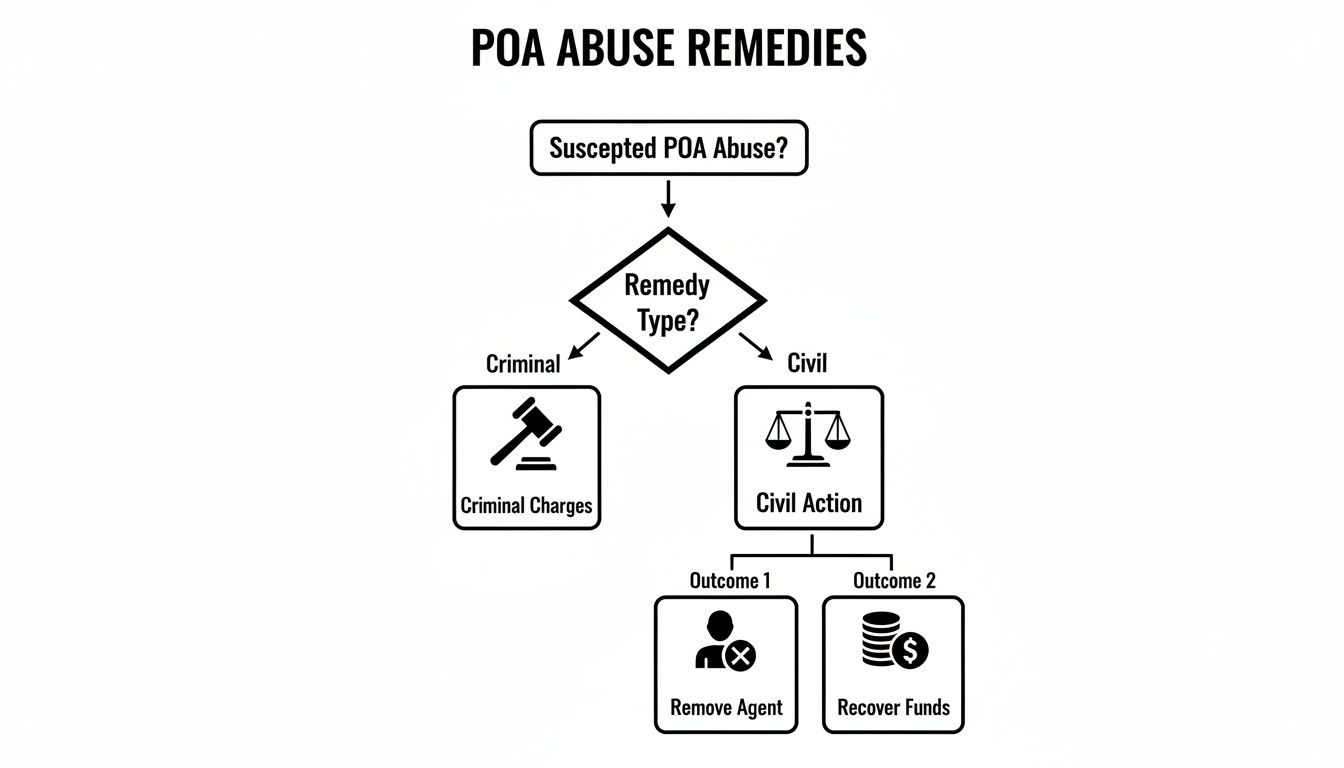
Civil Remedies And Filing Steps
When an agent betrays your trust, you can pursue civil remedies:
- Agent Removal – Petition under Estates Code § 751.152 to strip the agent’s authority.
- Surcharge Action – Seek repayment of losses caused by misconduct.
- Fund Recovery – Freeze accounts and obtain judgments to claw back assets.
“Swift civil action stops further harm and puts your loved one’s estate back on track.”
A hearing usually follows within 30 days. You can ask for a temporary freeze on bank accounts to protect remaining funds.
Steps to launch a civil case:
- Gather the POA document, bank statements, and correspondence.
- File your removal petition with the county clerk.
- Serve the agent and interested parties.
- Attend the hearing with organized evidence.
- Request temporary restraining orders and asset freezes.
These steps follow Title 3 and align with Civil Practice & Remedies Code § 16.004(a) deadlines.
Criminal Penalties For Financial Exploitation
Misusing a POA can also be a crime under Texas Penal Code § 32.53 if the victim is elderly or disabled:
- Losses over $2,500 become a state jail felony.
- Adding fraud or forgery can lead to prison time, fines up to $10,000, and restitution.
| Suspected POA Abuse | Civil Action Path | Criminal Reporting Path |
|---|---|---|
| Breach of Duty | File petition in probate court | Report to Adult Protective Services |
| Unauthorized Transfer | Request surcharge and asset freeze | Contact local law enforcement |
| Forged Signatures | Challenge POA validity under Title 2 | File an exploitation complaint with APS |
Adult Protective Services (Human Resources Code § 48.002) can investigate and refer criminal charges if they find evidence of exploitation.
Deadlines And Statute Limitations
- Civil claims for breach of fiduciary duty must be filed within four years (CPRC § 16.004(a)).
- Criminal charges for financial exploitation carry a two-year statute of limitations from discovery.
Revoking a problematic POA has its own timetable. Learn more in our guide on revoking a power of attorney.
When agents hide their tracks, Texas courts apply the discovery rule, extending deadlines until you uncover misconduct.
Key timing tips:
- Discovery Rule Extension: Clock starts when abuse is discovered.
- Emergency Petitions: Fee waivers may apply for urgent guardianship or removal.
- Revocation Notices: Send written notice to the agent and file with the county clerk.
Probate courts often issue protective orders within a week of filing to lock down assets. For personalized guidance on deadlines, reach out to our team.
Key Insight: Early legal intervention under Estates Code Titles 2 & 3—or the Penal Code—can prevent further losses and preserve your family’s legacy.
Check out our Texas Probate Process overview and explore our Probate Litigation services to learn how the Law Office of Bryan Fagan, PLLC can protect your loved one’s estate.
Gathering Evidence And Filing Steps
Families often feel lost gathering proof that an agent overstepped. The sooner you collect evidence, the more likely you are to succeed.
Begin by requesting bank and credit card statements for at least the past year. Contact your financial institutions directly and ask for monthly statements and transaction logs.
At the same time, speak with anyone who noticed odd withdrawals. Signed affidavits from witnesses add real weight under Texas evidence rules.
- Bank Records: Monthly statements showing deposits, withdrawals, and transfers.
- Credit Card Logs: Detailed purchase histories and cash advances.
- Affidavits: Written, sworn statements from family or friends.
- Correspondence: Emails or letters that document changes in instructions.
- Court Subpoenas: Formal requests (subpoena duces tecum) to compel records.
Lay out these items in a clear inventory. This roadmap shows which documents to highlight and which to subpoena.
Cataloging Suspected Transactions
Organize entries in a simple table with date, description, amount, and notes.
| Date | Transaction | Amount | Notes |
|---|---|---|---|
| 01/15/2024 | ATM withdrawal | $5,000 | No receipt found |
| 03/02/2024 | Wire transfer | $2,500 | Paid to unknown vendor |
Stick this chart to your petition as an exhibit. It turns a pile of statements into a clear story.
Subpoenaing Financial Records
Under Texas law, you can request a subpoena duces tecum. Your lawyer will file Form SW-36 (or the county’s equivalent) with the clerk.
- Draft the subpoena with your case caption and evidence summary.
- File at the county clerk’s office.
- Serve the subpoena on the bank or issuer by certified mail.
- Follow up after 21 days if records haven’t arrived.
This process can take weeks, so plan ahead. Accurate service details prevent objections.
Filing Your Complaint
Once evidence arrives, file your petition in probate court. Attach your inventory chart, affidavits, and subpoena returns.
Most attorneys use Form No. 157 to remove an agent or Form 158 for surcharge actions. Check with the county clerk for local requirements.
| Action | Deadline Civil | Deadline Criminal |
|---|---|---|
| Breach discovery | 4 years (CPRC §16.004) | 2 years from discovery |
| Fraudulent acts | 4 years | 2 years |
Texas gives you four years for civil claims and two years for criminal charges. Remember the discovery rule may pause these deadlines.
After you file, sort original documents in date order. Scan and back up everything. Label folders clearly and include an evidence index so your attorney can hit the ground running.
Maintaining Your Timeline
Put every deadline and hearing on a shared calendar. A single missed date can cost your right to challenge the abuse.
- Set email alerts three months before key civil deadlines.
- Confirm receipt of subpoenas and file service affidavits promptly.
- Log each call or email with banks and institutions.
- Update your attorney weekly to refine strategy.
Staying on top of details eases stress and shows the court you’re organized. Early coordination with your lawyer paves the way for smoother filings.
Refer to Texas Estates Code § 751.103 when listing required accountings. Showing knowledge of the statute makes your petition more persuasive.
Key Insight: A well-organized evidence package—with clear charts, affidavits, and subpoena returns—builds credibility and speeds the court’s review. Track deadlines and communications to eliminate surprises and protect your family’s interests.
Preventing POA Abuse Through Smart Planning
A little foresight today can stop abuse before it starts. Choosing the right POA and adding checks protects everyone involved.
Comparing Durable And Springing POAs
| Feature | Durable POA | Springing POA |
|---|---|---|
| Activation Timing | Immediately on signing | Upon medical certification |
| Incapacity Coverage | Continues after incapacity | Halts until trigger |
| Oversight Needs | Higher, immediate monitoring | Activation check needed |
| Ideal Use Case | Continuous management | Medical event planning |
For example, someone in early dementia may need a durable POA to avoid delays. Anyone wary of premature control might choose a springing POA.
Embedding Additional Safeguards
Layer in extra guardrails:
- Dual Signatures: Require two signatures for significant withdrawals.
- Co-Agents: Split decisions so no single agent has full power.
- Bank Co-Signers: Involve a banker to vet large transactions.
- Transaction Limits: Cap withdrawals per period to flag unusual spending.
These measures fall under Texas Estates Code Section 752.101 and signal that misuse won’t be ignored.
Monitoring And Reviews
Make an annual audit part of your routine:
- Gather statements for the past 12 months.
- Highlight irregular withdrawals or gifts.
- Log observations in a simple chart.
Aim for a yearly review with a trusted advisor or independent fiduciary. Comparing statements side by side and checking in with the principal creates a documented trail.
Family Conversation Guide
A clear chat about POA roles can avoid surprises. Try this script:
“I’m entrusting you with my accounts. Let’s agree on regular updates and joint signatures for big transfers.”
Tailor it to your family’s style. Clear expectations now prevent headaches later.
Learn more about safeguards in our guide on living wills and power of attorney. When you need another layer, explore Guardianship or Wills & Trusts services.
Key Insight
Top three planning steps:
- Choose the right POA type
- Embed dual or co-agent safeguards
- Schedule annual reviews under Texas law
Implementing these steps lowers risk and builds confidence. Reach out for a personalized plan that fits your family.
Consider Maria’s story: She signed a durable POA with dual signatures and required an annual CPA audit. Each year, her son and the CPA reviewed transactions together. That simple plan, backed by Texas law, gave Maria real peace of mind.
Starting the conversation early and putting agreements in writing can save heartache later. Contact us today to draft, review, and register your POA documents correctly.
Conclusion And Next Steps
Granting power of attorney is one of the most significant decisions you’ll make for your family’s future. Vigilance is your best defense against misuse and protects your loved one’s estate.
Now, let’s highlight the Key Takeaways:
- Spot Red Flags like unexplained withdrawals or missing statements.
- Gather Clear Evidence: bank records, affidavits, subpoenas.
- Seek Legal Help Early to remove an abusive agent or recover assets.
Key Insight: Early action under the Texas Estates Code can halt financial exploitation before losses mount.
Three-Step Action Plan
- Review Accounts Monthly for any unusual activity.
- Assemble Documentation and timelines of suspicious transactions.
- Consult a Probate Attorney or protective services for relief.
Families facing loss deserve support and clarity—you don’t have to handle POA disputes alone.
For more details on probate steps and estate planning, visit our Texas Probate Process and Wills & Trusts service pages.
Ongoing Support
Addressing potential abuse can feel overwhelming during such a difficult time. We listen closely, explain each step, and fight to restore your loved one’s security.
If you suspect misuse of power of attorney against a vulnerable family member, act now. Delays only complicate recovery and limit your legal options.
We bring compassion and clarity—always.
If you’re facing POA challenges in Texas, our team truly can guide you through every step, from filing to final resolution.
Schedule Your Free Consultation Today.
Frequently Asked Questions
What Steps Should I Take If I Suspect My Agent Is Misusing Funds?
- Gather bank and credit card statements from the past 12 months and look for odd withdrawals.
- Under Texas Estates Code § 751.151, demand a full accounting from your agent.
- If discrepancies persist, file a petition to remove the agent under Title 3, Chapter 751.
- Call our office for a free case review.
How Long Do I Have To File A Civil Suit?
In Texas, a breach of fiduciary duty suit must be filed within four years (CPRC § 16.004(a)). If wrongdoing was concealed, the discovery rule may extend this deadline. For criminal charges under Texas Penal Code § 32.53, you generally have two years from when the abuse was uncovered.
Can I Revoke Or Replace An Agent?
Yes—if the principal is still mentally competent, they can revoke a POA at any time:
- Draft a written revocation notice.
- Deliver it to the current agent.
- File it with the county clerk (Texas Estates Code § 751.101).
If the principal loses capacity, interested parties can ask the court to appoint a guardian under Title 3, which overrides or replaces the original agent.
What Evidence Is Strongest In Court?
Courts look for a clear, chronological paper trail. Your best evidence includes:
- Bank statements with detailed transactions
- Credit card logs showing spending patterns
- Vendor invoices or gift‐letter records
- Email chains confirming instructions
- Affidavits from family members or caretakers
Key Insight: Organizing each transaction in a timeline under Texas Estates Code strengthens both civil and criminal claims.
Next Steps For Support
Building a solid case can feel overwhelming. Our team at the Law Office of Bryan Fagan, PLLC will:
- Walk you through evidence collection and documentation
- Advise on civil petitions or criminal referrals
- Assist with account freezes and temporary injunctions
Explore our Probate Litigation or Guardianship services for specialized help. Contact us at the first sign of trouble to protect your family’s assets and peace of mind.
If you’re facing probate in Texas, our team can help guide you through every step — from filing to final distribution. Schedule your free consultation today.
Law Office of Bryan Fagan, PLLC
https://www.txprobatelawyer.net