Thinking about the future can feel like a heavy weight, but trust and estate planning is genuinely one of the most powerful ways to shield the people you care about most. It's not about creating a legal burden; it's about leaving behind a clear, simple set of instructions to care for your family when you no longer can. This guide, written in plain English, will help Texas families understand how to protect their legacy and provide for their loved ones with compassion and clarity.
Why Trust and Estate Planning Is an Act of Love
So many Texas families put off creating an estate plan. It's easy to think it’s something only for the super-wealthy or the elderly. But the truth is, it’s a fundamental act of compassion for anyone with people they love and want to protect.
Without your specific instructions, the State of Texas makes these critical decisions for you. And it doesn't do it with your family's unique needs in mind—it follows a rigid, impersonal legal formula.
What Happens Without a Plan
If you pass away without an estate plan, Texas law takes over. Specifically, the rules on intestate succession found in the Texas Estates Code, Title 2, will dictate exactly who gets your assets. This process almost always leads to outcomes you never would have wanted. Your home, your savings, and everything you've worked for could be divided in ways that spark conflict and create lasting rifts between your loved ones.
Let's look at a common, heartbreaking scenario:
- A young couple with minor children. If they both pass away in an accident without a will naming a guardian, a court must step in and decide who will raise their children. This often kicks off a lengthy, expensive, and deeply painful legal battle between well-meaning relatives, all while the children are trying to grieve. A simple will could have prevented every bit of that turmoil.
This is exactly why we see trust and estate planning as an act of love. It’s about you taking control to shield your family from unnecessary hardship during what is already an incredibly difficult time. A solid plan gives you peace of mind, because you know your wishes for your property—and more importantly, for your children—will be honored. You can learn more about how a will can be the first line of defense in our detailed guide on the importance of creating a will in Texas.
When you put your intentions down in writing, you’re handing your family a clear roadmap to follow. You remove the agonizing burden of them having to guess what you would have wanted, which frees them up to focus on healing instead of fighting legal battles. This thoughtful preparation is one of the greatest gifts you can ever leave behind.
Understanding Wills Versus Trusts in Texas
At the heart of every effective Texas trust and estate planning strategy, you'll find two powerhouse tools: Wills & Trusts. While they both spell out your wishes for your assets, they operate in completely different ways. Getting a handle on these differences is the first real step toward picking the right path for your family.
Think of a Last Will and Testament as a formal, one-way letter you write directly to the Texas probate court. This document doesn’t do anything until after you’ve passed away. It’s your final instruction manual, spelling out who gets your property, who you want to be the guardian for your minor children, and who you’re naming as the executor to see it all through.
But because a will is essentially a letter to the court, it has to go through the official, court-supervised process we call probate. This means your will becomes a public document, and the whole ordeal of validating it and distributing assets can drag on for months—sometimes even years—while racking up significant costs.
The Role of a Living Trust
A living trust, on the other hand, is a completely different animal. It’s more like a private, protective container you create for your assets while you’re still alive. You set up the trust and then transfer ownership of your property—your house, bank accounts, investments—into it. You name a trustee (which is usually you at first) to manage those assets for the people you’ve chosen as beneficiaries.
Here’s the game-changer: this "container" is a private legal entity that just keeps on existing after you’re gone. Since the trust owns the assets—not you personally—there’s nothing for the probate court to get its hands on. This setup lets your family sidestep the public, slow, and often expensive probate process entirely, making for a much faster and more private transfer of your legacy.
Executor vs. Trustee: What’s the Difference?
These two roles are often confused, but their authority and responsibilities are worlds apart. It all comes down to where their power comes from.
- An Executor is the person you name in your will to steer your estate through the probate process. Their power isn’t automatic; it’s officially granted by a probate judge through a document called Letters Testamentary, as laid out in the Texas Estates Code § 301.001. Their job is to round up your assets, pay off your debts, and hand out what’s left according to your will, all while the court looks over their shoulder.
- A Trustee is the person or institution you appoint to manage the assets inside your trust. Their authority comes directly from the trust document itself. They can step in and take charge the moment you become incapacitated or pass away—no court permission needed. They have a long-term duty to manage and distribute the trust’s assets exactly as you’ve instructed.
Comparing Wills and Trusts in Texas at a Glance
Making the right choice between a will and a trust can feel overwhelming. To simplify things, we've broken down their core differences in this side-by-side comparison. This table highlights how each tool handles key aspects of estate planning in Texas, from probate avoidance to privacy.
| Feature | Last Will and Testament | Living Trust |
|---|---|---|
| When It's Active | Only after death | Immediately upon creation |
| Probate Required? | Yes, it must go through probate court. | No, assets in the trust avoid probate. |
| Privacy | Becomes a public court record. | Remains a private document. |
| Cost to Create | Generally lower upfront cost. | Higher upfront cost to set up and fund. |
| Incapacity Planning | Does not manage assets if you're alive but incapacitated. | Allows a successor trustee to manage assets if you're incapacitated. |
| Asset Transfer | Executor distributes assets after probate is complete. | Successor trustee distributes assets immediately after death. |
| Guardian for Minors | The only place to legally name a guardian. | Cannot be used to name a guardian for minor children. |
| Complexity | Simpler to create. | More complex to create and maintain (requires funding). |
While this table offers a great overview, the best tool for you depends entirely on your personal goals and family situation. For many Texans, a combination of both a will and a trust provides the most comprehensive protection.
A Real-World Example
Let’s look at Maria, a widowed homeowner in Dallas with two adult children and a modest investment portfolio.
- Scenario with a Will: If Maria only leaves a will, her executor has to file it with the probate court. The court will oversee the entire process: validating the will, creating an inventory of her home and investments, notifying creditors, and finally, distributing what's left. The whole thing could easily take nine months or longer, and every detail becomes public information.
- Scenario with a Trust: Now, imagine Maria had placed her home and investments into a living trust. Upon her death, her chosen successor trustee could take control immediately. That trustee could then sell the home, manage the investments, and distribute the money directly to her children according to the trust’s rules—all without a single court filing or public announcement.
The choice between these essential tools really boils down to what you value most: privacy, speed, or simplicity. While a will is a non-negotiable part of any plan (especially for naming guardians), a trust offers a level of control and efficiency for managing and transferring assets that a will simply can’t match. Digging into your options, like the guidance we provide on Wills & Trusts, can bring much-needed clarity.
Navigating the Texas Probate Process with Confidence
For a family grieving a recent loss, the word “probate” can sound downright intimidating. But it doesn't have to be. Our goal is to cut through the legal jargon and show you that at its heart, probate is just the official, court-supervised process of validating a will, settling a loved one's final affairs, and distributing their assets the way they wanted.
Think of it as the legal system's way of double-checking that everything is handled correctly, transparently, and fairly. It gives the executor a clear roadmap to follow, which protects both the estate and the beneficiaries from potential mistakes or arguments down the line. With the right guidance, it’s a perfectly manageable journey.
This visual captures the simple, loving intention behind all of this—organizing your documents to protect your family.
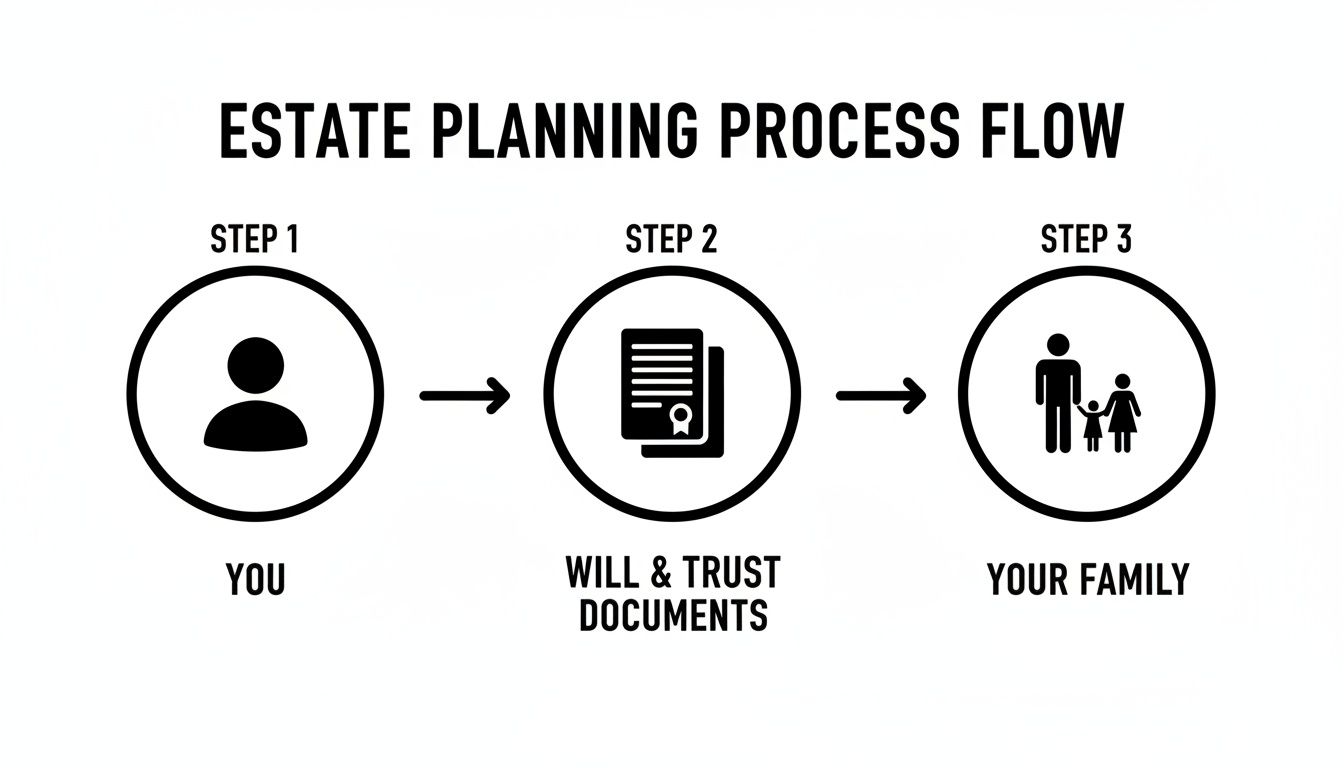
A thoughtful plan really is the bridge that ensures your legacy is passed on smoothly, without confusion or conflict.
The Steps of Texas Probate
The entire process is laid out in the Texas Estates Code, Title 2. While every family's situation is a bit different, the general roadmap stays the same. With a good attorney, this becomes a series of clear, actionable steps, not an overwhelming ordeal.
Filing the Will: The journey starts when the executor takes the will and an application for probate to the right Texas court. One of the very first documents needed to get things moving is a death certificate. For a deeper look at this crucial record, you can read more about Understanding the Texas Death Certificate and Why It Matters.
Validating the Will: Next, the court holds a hearing to make sure the will is legally valid. If the will was drafted and signed correctly, this is usually just a quick formality.
Appointing the Executor: The judge officially appoints the executor named in the will and issues a document called Letters Testamentary. This piece of paper is critical—it grants the executor the legal power to act for the estate.
Managing the Estate: From there, the executor gets to work. They'll create an inventory of all the assets, formally notify creditors about the death, and use estate funds to pay off any outstanding debts or taxes.
Distributing the Assets: Once all the bills are paid, the executor distributes the remaining assets to the beneficiaries, exactly as the will instructs.
Independent Administration: The Texas Advantage
Here's some good news. Texas law offers a streamlined probate process called independent administration. As laid out in Texas Estates Code § 401.001, this lets the executor handle most estate tasks—like paying bills or selling property—without having to ask the court for permission every single time. Most well-drafted Texas wills specifically ask for this, which makes our probate system much faster and cheaper than in many other states.
A Realistic Scenario: Following a Daughter’s Journey
Let’s look at a real-world example. Imagine Sarah, a daughter in Houston whose father just passed away. He left a will that named her as executor and requested independent administration. Even while grieving, Sarah feels a duty to make sure his wishes are honored.
She hires an attorney to help her file her father’s will with the court. After a short, straightforward hearing, she receives her Letters Testamentary. Armed with that authority, she can now access his bank accounts to pay final medical bills and list his house for sale. Thanks to independent administration, she doesn't have to run back to the judge for approval on these routine tasks.
A few months later, the house is sold and all debts are settled. Sarah then distributes the remaining money to herself and her brother, just as their dad wanted. The probate process gave her a clear framework, turning what could have been an overwhelming burden into a series of manageable steps. The process was straightforward because her father planned ahead. Our team helps families just like Sarah’s every single day, and we have a deeper guide available on the Texas Probate Process that explains these steps in even more detail.
Choosing the Right Trust for Your Family's Needs
Trusts aren't a one-size-fits-all solution; they’re more like a custom toolkit you can build to protect your family and your assets. While the word "trust" might sound formal or complicated, just think of it as a secure container you design to hold and manage your property according to a very specific set of instructions—your instructions. Getting to know the different types of trusts is the first step in creating an effective trust and estate planning strategy here in Texas.
Your journey starts with a fundamental choice between two main categories of trusts. This single decision will define how much control you keep over your assets during your lifetime and how much protection those assets will have from the outside world.
Revocable vs. Irrevocable Trusts
Most people start with a Revocable Living Trust. Think of this trust as a flexible extension of your will. You create it, you move your assets into it, and you can change it, add to it, or even completely tear it up whenever you want. Its main job is simple: to hold your assets so they can pass directly to your loved ones after you’re gone, privately and without ever setting foot in a probate court.
On the other end of the spectrum is an Irrevocable Trust. This one is permanent. Once you create it and transfer assets into it, you generally can’t change your mind or take the assets back. That might sound intimidating, but its permanence is actually its greatest strength. By giving up that control, you legally separate the assets from your personal estate, which can create a powerful shield against creditors, lawsuits, and, in some cases, estate taxes.
So, which is right for you? It all comes down to your goals. Do you need a plan that can adapt as your life changes, or is your main priority building an unbreakable wall around your family’s inheritance?
Trusts Designed for Specific Family Situations
Beyond that first big choice, trusts can be crafted with incredible precision to solve unique family challenges. These specialized tools are where trust and estate planning moves from being a legal process to a compassionate, practical solution for real-life worries.
Here are just a few examples of how they work for Texas families:
- Special Needs Trusts: Let's say you have a child with a disability who depends on government benefits like Medicaid or Supplemental Security Income (SSI). If you leave them a direct inheritance, it could push their assets over the very strict government limits and disqualify them from the support they need to live. A Special Needs Trust avoids this disaster. It holds their inheritance for them, and a trustee you appoint can use the money to pay for things that improve their quality of life—like specialized therapy, education, or travel—without ever putting their essential benefits at risk.
- Spendthrift Trusts: We all know someone who is wonderful but just isn't great with money. You want to provide for them, but you’re worried a big, lump-sum inheritance would be gone in a year. This is where a Spendthrift Trust comes in. It protects them from themselves and from any creditors who might come calling. The trustee you choose can make regular, managed payments for their living expenses, ensuring the inheritance provides long-term security instead of a short-lived windfall.
- Testamentary Trusts: This is a trust that doesn’t exist until after you pass away; it's actually created inside your will. It's a very common tool for parents with young children. It allows you to leave assets for your kids that will be managed by a trusted adult until they reach an age you decide is appropriate—say, 25 or 30.
These instruments aren't just for the ultra-wealthy. They are practical, powerful tools for everyday Texans who want to protect a family business, provide for a blended family, or make sure long-term care needs are covered. For a closer look at these and other options, you can find more information on our firm’s Wills & Trusts page.
Planning for Incapacity with Essential Documents
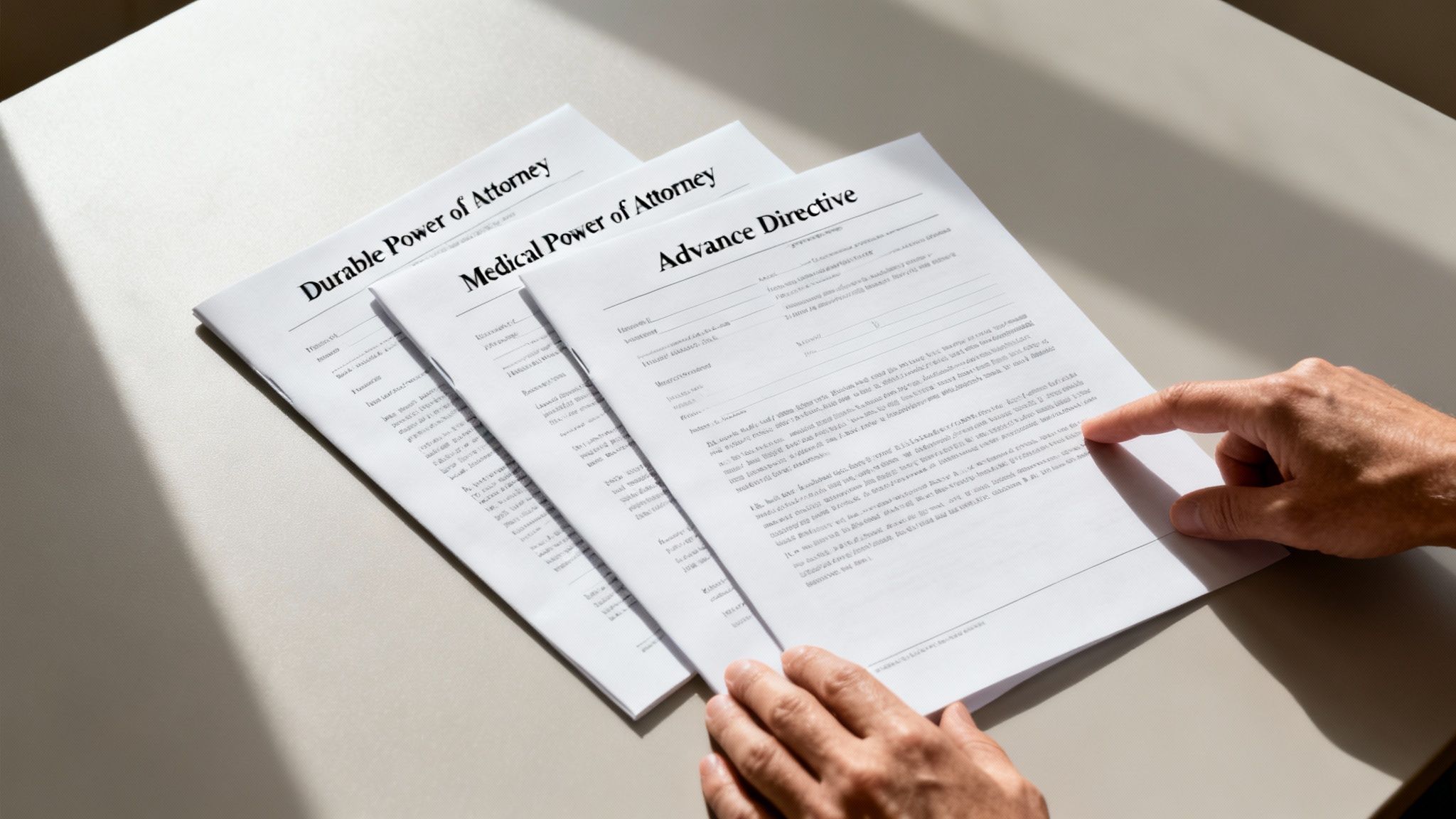
A solid trust and estate plan does more than just figure out who gets what after you’re gone. The best plans also protect you and your family while you're still alive, particularly if you ever become unable to make decisions for yourself. This is known as planning for incapacity, and it’s one of the most important—and often overlooked—parts of the process.
What happens if an illness or injury leaves you unable to communicate? Without a plan, your family would have no choice but to go to court and ask a judge to appoint a guardian to manage your affairs. This Guardianship process is often public, expensive, and incredibly stressful for everyone involved.
Thankfully, there’s a much better way. A few key legal documents can prevent this nightmare entirely, making sure control stays with the people you’ve chosen, not a stranger in a black robe.
The Three Pillars of Incapacity Planning
Here in Texas, a strong incapacity plan is built on three foundational documents. Each one serves a different but equally crucial purpose, working together to ensure your financial and personal well-being are handled exactly how you want.
- Durable Power of Attorney: This document lets you name a trusted person—your "agent"—to handle your financial life if you can't. They can pay your mortgage, manage investments, and take care of business on your behalf. It’s the tool that keeps your financial world turning without a judge’s intervention.
- Medical Power of Attorney: This is where you appoint an agent to make healthcare decisions for you when you’re unable to speak for yourself. This person can talk with your doctors and approve treatments, ensuring your medical care is guided by someone who knows your values.
- Advance Directive to Physicians (Living Will): Think of this as your voice when you don't have one. It lays out your specific wishes for end-of-life medical care, giving clear instructions on things like life support. This document removes an agonizing burden from your loved ones’ shoulders.
A Real-World Scenario Protecting a Parent
Let's imagine a woman named Sarah whose father, Mark, has a severe stroke. He’s hospitalized and can’t communicate his wishes. But Mark was a planner. Because he had a complete estate plan, Sarah, whom he named as his agent, can step in immediately.
Using the Durable Power of Attorney, she accesses his bank account to pay the mortgage and incoming medical bills. Armed with the Medical Power of Attorney, she consults with his doctors and confidently approves the recommended treatment plan, knowing it's what he would have wanted.
Now, picture that same scenario without those documents. Sarah would be facing a legal mess. She'd have to petition a court for guardianship—a process that could drag on for months and cost thousands of dollars. All the while, Mark's bills would be piling up, and critical medical decisions could be delayed. Mark’s foresight protected both his dignity and his daughter's peace of mind. To dig deeper into these vital tools, you can learn more about a Texas living will and power of attorney.
Takeaway: Your Plan is Your Legacy
Let's bring everything we've talked about together into a clear path forward. If there's one thing to take away from all this, it's that trust and estate planning is a fundamental act of care for the people you love most. It’s your chance to provide security and peace of mind—to leave behind a legacy of thoughtfulness, not a mess of confusion.
We’ve covered a lot of ground: the critical differences between wills and trusts, why avoiding the public spectacle of probate is often a wise move, and the absolute necessity of having documents like Powers of Attorney in place for incapacity. While the details might seem complex at first glance, the journey itself is straightforward when you have compassionate guidance. You now have the knowledge to move from simply thinking about this to taking action.
Moving Forward with Confidence
You’re not alone in recognizing the importance of getting a plan in place. The Trusts & Estates industry has seen major growth, with revenue climbing at a compound annual rate of 8.8% over the past five years to an estimated $290.1 billion in 2025. This surge shows a rising awareness of how crucial estate planning is. Interestingly, projections show a potential market dip after 2025, which really highlights why now is the time for Texas families to act and secure their futures. You can explore more data on this growing industry trend on ibisworld.com.
Key Insight: Your estate plan is the final, most important gift you can give your family. It replaces uncertainty with a clear roadmap, allowing your loved ones to focus on healing instead of navigating a complex legal system alone.
Your next step is simple: a no-obligation conversation about your unique family situation. You don't need to have all the answers before you call us—that's our job. We're here to help you find them. Whether you need a straightforward will, a protective trust, or guidance through a loved one's estate, our experienced team is ready to help.
If you’re ready to protect your legacy and give your family the gift of clarity, our compassionate attorneys are here to guide you through every step.
Frequently Asked Questions About Estate Planning in Texas
When you start looking into trust and estate planning, a lot of practical questions pop up right away. To help you feel more confident as you begin, we’ve put together some of the most common questions we hear from Texas families, along with clear, straightforward answers.
Do I Need an Estate Plan if I Am Not Wealthy?
Absolutely. This is probably the biggest myth in estate planning. A plan is about so much more than money—it's about protecting the people you love and making sure your wishes are honored, no matter how much is in your bank account.
Think about it this way: an estate plan is the only legal way you can name guardians for your minor children. It’s also how you tell your family what kind of medical care you want if you can't speak for yourself. These are critical decisions for every family, wealthy or not.
How Much Does It Cost to Set Up an Estate Plan?
The cost really depends on what you need. A simple will that just names a guardian for your kids is going to be very different from creating a complex web of trusts to handle business assets.
But here’s the thing: the investment you make in planning today is just a fraction of what your family could end up paying later. Without a plan, they could be on the hook for expensive court fees, the high cost of Probate Litigation, and the emotional strain of family fights over property. We believe in transparent pricing and offer a free initial consultation to walk you through all your options.
Can I Use an Online Template to Create My Will?
We strongly advise against it. Using a DIY or online template for something this important is a huge gamble. Texas has very specific legal rules for a will to be considered valid, all laid out in the Texas Estates Code. These rules cover everything from how it must be signed to who has to witness it.
Key Insight: A tiny, unintentional mistake on an online form can invalidate your entire will. This can throw your family into the exact legal mess and conflict you were trying so hard to avoid in the first place.
Getting professional guidance from an experienced attorney ensures your documents are legally sound and actually protect your family’s future. That’s a level of peace of mind a template just can't offer.
How Often Should I Update My Estate Plan?
A good rule of thumb is to sit down with your attorney and review your plan every 3-5 years. But the most important time to update your plan is after a major life event.
You should schedule a review right away if you experience:
- A marriage or divorce
- The birth or adoption of a child
- A significant change in your financial situation (good or bad)
- The death of a spouse, beneficiary, or named executor
- A move to another state with different laws
Your trust and estate planning documents should always be a current reflection of your life and your wishes. An outdated plan can sometimes be as problematic as having no plan at all.
If you’re facing probate in Texas, our team can help guide you through every step — from filing to final distribution. Schedule your free consultation today.