When a loved one dies, families rarely walk into probate thinking a conflict is coming. It usually starts with one hard conversation about a house, a bank account, a handwritten note, or a parent’s final wishes. Then grief mixes with suspicion, old hurts return, and what should be an orderly legal process begins to feel personal.
That is where probate mediation texas matters. In many estates, the issue is not just who is legally right. The issue is how to solve a dispute without turning a family loss into a family fracture. Texas probate courts recognize that reality, and families should too.
When Family Disagreements Cloud a Loved One’s Final Wishes
Two siblings may read the same will and come away with very different beliefs about what their parent intended. One may focus on equal division. The other may focus on years of caregiving and promises made privately. A third family member may not be angry at all, only confused about why the executor has not moved faster.
Those disagreements are common in probate. They also become dangerous quickly when real estate, heirlooms, or blended family dynamics are involved.

A familiar example looks like this. A mother dies owning a home, some savings, and personal property with sentimental value. One child wants to sell the house. Another wants time to keep it in the family. A third believes the will does not reflect what their mother wanted near the end of her life. Nobody starts out trying to be unreasonable. They are grieving, they are tired, and they are interpreting the same events through different histories.
Why court is often the worst first move
A courtroom can resolve legal rights. It does not do much to repair relationships.
Texas courts strongly encourage probate mediation, and judges in many counties require it before a case can go to trial. Many probate mediation cases result in a full or partial agreement, while contested probate litigation can last 12 to 36 months and consume 20 to 30% of an estate’s value, according to this discussion of mediation versus litigation in Texas probate.
For many families, that trade-off is sobering. The estate pays for delay. The family pays for the fight.
Where confusion often starts
Disputes do not always come from a contested will. Sometimes they begin because a person died without one, and family members are surprised by how property passes under intestate succession laws. While that link discusses another state’s framework, it helps show why families often misunderstand who inherits when no clear estate plan exists. In Texas, those questions should be reviewed under the Texas Estates Code.
Property is often the spark. If the estate includes a house, land, or mineral interests, conflict can escalate fast. Families dealing with that issue often benefit from practical guidance on avoiding family disputes over real estate in Texas probate.
Takeaway: In probate, the legal dispute is only part of the problem. The emotional setting matters, and mediation gives families a way to address both at once.
What Probate Mediation Means in a Texas Context
Probate mediation is a structured negotiation. A neutral third party, the mediator, helps the people involved try to reach an agreement. The mediator does not act like a judge. The mediator does not decide who wins.
A better comparison is this. Litigation is a referee blowing the whistle and imposing the rules. Mediation is a skilled facilitator helping both sides find a workable path across a dispute that otherwise keeps everyone stuck.
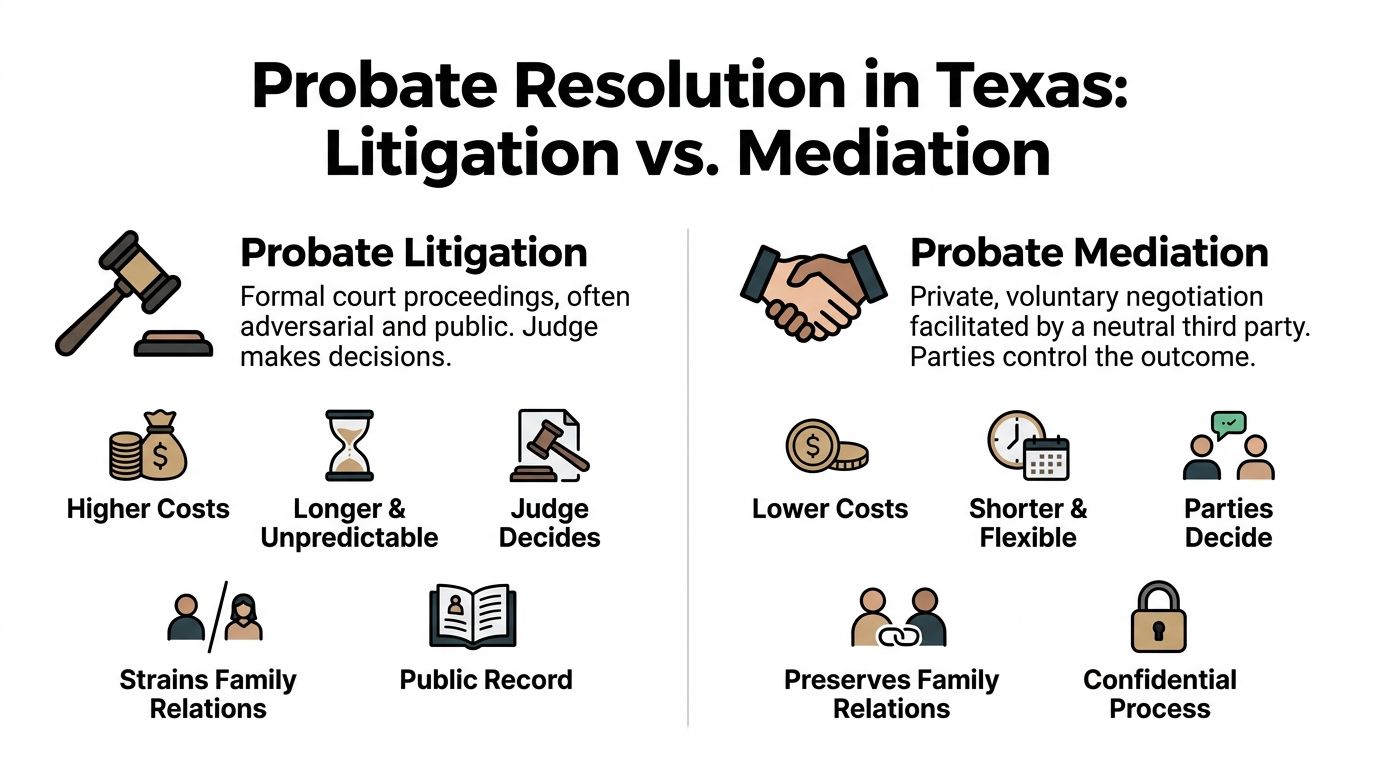
Probate mediation is a private negotiation process in which the parties keep control of the outcome, instead of handing that control to a judge after a public fight.
The legal basis in Texas
Texas probate courts have authority under Texas Estates Code §31.001 to order mediation or other forms of alternative dispute resolution. That matters because many families assume mediation is informal or optional in the sense of being legally unimportant. It is not.
Under Texas practice, courts can direct parties into mediation on motion by a party or on the court’s own initiative. Practitioner reports summarized in this Texas probate mediation overview state that 70 to 85% of sessions result in a binding settlement agreement.
That legal framework sits within the broader probate system under the Texas Estates Code, especially Titles 2 and 3, which govern the administration of estates, the authority of personal representatives, creditor handling, and distribution issues. In plain English, those laws tell us who has authority, what paperwork must be handled, and how disputes fit into the probate process.
What mediation covers
Mediation can help resolve disputes involving:
- Will contests involving claims of undue influence, lack of capacity, or improper execution
- Executor disputes when heirs believe the personal representative is not acting transparently
- Asset division problems involving real estate, business interests, or personal property
- Heirship disagreements when relatives dispute who should inherit
- Guardianship-related issues in matters tied to incapacity and family conflict
Families who want a broader overview of this option can review the practical discussion at benefits of mediation in estate disputes.
Why confidentiality changes the tone
Mediation is generally confidential under Texas Civil Practice and Remedies Code §154. That privacy matters in probate because families often need room to speak candidly without turning every allegation, apology, or concession into part of the public record.
In practical terms, confidentiality helps in three ways:
| Issue | In litigation | In mediation |
|---|---|---|
| Communication | Parties often posture for court | Parties can speak more frankly |
| Family history | Sensitive facts may become public | Difficult issues stay private |
| Solutions | Judge applies legal remedies | Parties can build flexible terms |
A judge may be able to order a sale, remove an executor, or admit a will. A mediated agreement can also address move-out dates, buyout terms, access to family photos, division of keepsakes, and the timing of distributions.
That flexibility is often the difference between a legal result and a workable one.
The Texas Probate Mediation Process Step by Step
Families feel more comfortable with mediation once they understand what will happen. Most probate mediations follow a recognizable pattern, even though every estate has its own facts.

How mediation gets started
A probate mediation can begin in two ways.
One path is voluntary. The family, through counsel, agrees to try mediation before the case becomes more expensive and more hostile.
The other path is court-driven. A probate judge orders the parties to mediate under Estates Code §31.001. That is common in contested matters.
Either way, you should treat the mediation date like a real legal deadline. It is not a casual meeting. It is a chance to resolve the dispute before the estate spends more money and everyone hardens their position.
Choosing the mediator
The mediator should understand probate disputes. Estate cases are not ordinary business cases. Family conflict, fiduciary duties, wills, trusts, accountings, and title issues create a different dynamic.
Look for a mediator who can manage:
- Emotional tension without losing control of the process
- Complex assets such as ranch land, businesses, or mineral interests
- Probate-specific legal issues including executor duties and distribution problems
- Multi-party disputes where several heirs or branches of a family are involved
A retired judge may be a fit in some cases. In others, a mediator with deep probate practice experience is more useful, especially where the fight is less about formal courtroom procedure and more about family deadlock.
Preparing before the session
Good mediation starts before anyone walks into a conference room or logs onto Zoom.
You and your attorney should gather the documents that define the dispute. That usually includes the will, any codicils, inventories, account statements, deeds, correspondence, prior court filings, and any evidence supporting your position.
A strong preparation file often includes:
- A position statement explaining the dispute and your requested outcome
- A timeline of major events, especially if capacity or undue influence is being alleged
- An accounting summary if the executor’s conduct is under scrutiny
- Settlement options ranked from most preferred to acceptable fallback positions
Practical tip: Go into mediation knowing your bottom line and your acceptable alternatives. If you do not know what you can live with, frustration will make that decision for you.
What the day usually looks like
Most Texas probate mediations use shuttle mediation. In that format, the parties sit in separate rooms with their lawyers, and the mediator moves back and forth between them. According to this explanation of estate mediation practice in Texas, shuttle mediation is the most common technique, and the process can cut resolution time from 12 to 24 months in litigation to just a few days.
That structure helps families who do not want direct confrontation. It also allows the mediator to test arguments privately, challenge unrealistic expectations, and carry settlement proposals without every exchange turning into a personal argument.
Later in the process, some mediations begin with a joint opening or use a short group meeting for introductions and ground rules.
A short overview can help you visualize the setting:
What gets negotiated
The legal dispute is only one part of the discussion. The mediator may work through practical terms such as:
- Who receives which property
- Whether an asset is sold or bought out
- Whether an executor remains in place
- How debts, taxes, and expenses are paid
- When distributions happen
- What releases each side signs
Mediation often works better than trial. Courts decide legal claims. Mediated agreements can solve operational problems that sit behind those claims.
If an agreement is reached
When the parties settle, the terms are reduced to writing. In probate disputes, that written settlement needs care. It should be complete, clear, and signed before anyone leaves.
Depending on the case, the agreement may later be presented to the court and tied into dismissal papers, agreed orders, or probate filings. Rule 11 principles matter because loose oral understandings are a poor substitute for a precise written agreement.
If no agreement is reached
A mediation is still useful even when the case does not fully settle.
The parties may narrow the issues, exchange information, or resolve only one piece of the dispute, such as personal property, accounting production, or temporary control of an asset. That kind of progress can still lower the cost and stress of the next stage.
How to Prepare for a Successful Probate Mediation
Preparation changes outcomes. Families who treat mediation like a serious legal event usually make better decisions than families who arrive hoping the mediator will somehow fix everything for them.
A useful way to think about preparation is this. You are not only preparing your argument. You are preparing your judgment.
Build your mediation file
Start with the documents that matter most.
- Estate papers: Gather the will, codicils, trust documents if any exist, letters testamentary or letters of administration, and court filings.
- Financial records: Pull bank statements, deeds, tax returns, loan information, accountings, and lists of debts.
- Communication history: Save texts, emails, letters, or notes that help explain what happened or why a dispute arose.
- Personal property lists: If the fight involves heirlooms or household contents, create a written inventory with photos where possible.
If you are the executor or administrator, your records need to be especially clean. Under the Texas Estates Code, a personal representative owes duties to the estate and the beneficiaries. In plain English, that means you must be able to explain what you did, why you did it, and where the money went.
Clarify your goals before the session
Not every goal belongs at the same level.
Some positions are legal. Others are emotional. Both matter, but they should not be confused.
Ask yourself:
- What must be protected?
That might be your inheritance rights, your role as executor, or a challenge to a questionable will. - What would be nice to preserve?
Maybe it is family land, a business interest, or access to photographs and keepsakes. - What can you trade?
Flexibility on timing, choice of assets, or reimbursement structure often creates room for settlement.
Key point: A party who knows the difference between an important issue and a painful but movable issue usually negotiates better.
Understand your BATNA
Lawyers often use the term BATNA, which means Best Alternative to a Negotiated Agreement. In everyday language, it means this: if mediation fails, what happens next?
That answer may be a will contest, a discovery fight, an accounting demand, a removal action against the executor, or a hearing over property control. Your attorney should help you weigh the strengths and weaknesses of that next step.
A good BATNA analysis keeps two mistakes in check:
- Overconfidence, where a party assumes the judge will see everything exactly as they do
- Fear-based settlement, where a party gives away too much to end the stress
Use a realistic family scenario
Consider two heirs who inherit equal interests in a family business. One worked in the business for years. The other lives out of state and wants immediate cash. If they litigate, the case may become a fight over valuation, management, compensation, and whether the business should be sold.
In mediation, they may create a more customized solution. One heir can retain operational control while buying out the other over time, with security terms and deadlines. A court may not craft that arrangement for them in the same way.
That is the practical strength of mediation. It creates room for structure, not just verdicts.
Prepare yourself, not just your paperwork
A successful mediation also depends on how you show up.
- Stay focused on outcomes: Old family grievances may explain the conflict, but they do not always solve it.
- Expect discomfort: A serious settlement discussion can feel frustrating, especially when the other side says things you believe are wrong.
- Use private caucus well: Tell your attorney and the mediator what matters most, what concerns you, and what authority you do or do not have.
- Leave room for dignity: Families settle more often when nobody is forced into a public surrender.
For some clients, one option is working with counsel who handles both negotiation and contested estate matters, including firms such as Law Office of Bryan Fagan, PLLC, which assists Texas families with probate administration and dispute resolution.
Common Disputes Resolved Through Probate Mediation
Not every probate dispute belongs in mediation. Some cases require urgent court action. But many common estate conflicts are well suited for it.
Will contests and influence claims
A family member may believe a late-in-life will resulted from pressure, isolation, or confusion. Another may believe the document reflects the decedent’s true wishes.
Those cases are emotionally loaded. Mediation gives each side a controlled setting to evaluate risk, witness credibility, and the cost of pressing forward.
Executor conflict
An executor can become the center of the dispute even when the underlying problem is mistrust between beneficiaries.
Common complaints include delayed communication, poor recordkeeping, refusal to share information, or concern that estate funds were mishandled. In mediation, the parties can address whether the executor stays in place, whether accountings will be produced, and how future administration will be supervised.
Real estate and buyout disputes
A house, ranch, or parcel of land can trigger sharp conflict.
One heir may want to keep the property. Another may need cash. A third may believe the property has been undervalued. Mediation can address listing terms, buyout formulas, occupancy deadlines, repair responsibilities, and sale procedures.
Sentimental personal property
Some of the fiercest fights involve items with little market value and enormous personal value.
Jewelry, furniture, military records, photo albums, and family collections often become symbols of love, loyalty, or perceived favoritism. A judge has limited time for that kind of conflict. Mediation has more room for a rotation system, item selection process, or agreed distribution list.
Debt, expense, and reimbursement disagreements
Probate disputes also arise when one relative paid funeral costs, mortgage payments, taxes, or caregiving expenses and expects repayment from the estate.
The conflict usually is not just about money. It is about whether that person acted as a helper, a volunteer, or someone entitled to reimbursement. Mediation allows the family to address documentation, fairness, and timing without turning every payment into a formal courtroom battle.
What works: Specific proposals, good records, and a willingness to separate emotional history from legal responsibility.
What does not: Broad accusations, hidden documents, and a demand that every disagreement be treated as a moral judgment.
Key Insight and The Role of Your Attorney
The central point is simple. Mediation works best when families treat it as a strategic legal process, not a group therapy session and not a casual compromise meeting.
The mediator is neutral. That neutrality is useful, but it has limits. The mediator does not protect your inheritance rights, evaluate your legal exposure for you, or draft strategy from your side of the table.
Your attorney does that.
A probate lawyer helps you decide when to settle, when to hold firm, what evidence matters, and whether the final terms solve the problem. That matters in both ordinary administrations and contested matters connected to Probate Litigation or planning documents such as Wills & Trusts.
If you are weighing representation, practical guidance on how to choose the right probate attorney in Texas can help you evaluate fit, communication style, and experience.
Key insight
- A mediator manages the conversation
- Your attorney protects your position
- A written settlement protects the future
Families who skip legal counsel sometimes settle the immediate argument but create a new one in the paperwork. That is a costly mistake.
Frequently Asked Questions about Texas Probate Mediation
Families usually ask the same practical questions once mediation becomes real. Those questions deserve direct answers.

How much does probate mediation cost in Texas
Mediator fees in Texas probate matters often range from $250 to $500 per hour, usually split evenly among the parties, and a full-day session is often far cheaper than a single court hearing, according to this Texas probate mediation discussion.
The total cost depends on the size of the dispute, the number of parties, the mediator selected, and how prepared everyone is. Attorney time also matters. A well-prepared mediation usually costs less than a poorly prepared one because the parties spend less time sorting out basic facts in the room.
Who pays for mediation
In many cases, the parties share the mediator’s fee. Sometimes the court order or the mediated agreement addresses allocation differently.
Your attorney should clarify this in advance. Do not assume the estate will automatically pay all costs. That answer often depends on the posture of the case and the terms being negotiated.
Is mediation confidential
Yes, mediation is generally treated as confidential in Texas. That privacy gives families room to discuss difficult facts and settlement options without turning every statement into public court material.
That said, the final agreement itself must be drafted carefully if it will be filed with the court or incorporated into probate orders.
Is a mediated settlement agreement final
It can be. The agreement must be written properly and signed with care.
In practice, a vague handwritten note or an incomplete email chain is not the same thing as a fully developed settlement agreement. The document should identify the property, the obligations, the deadlines, releases, tax handling where relevant, and what happens if someone fails to perform.
What if someone refuses to settle
Then the case continues.
Mediation does not guarantee resolution. But even when the parties do not fully settle, the process often narrows the dispute. That alone can make the next phase of probate more efficient.
Can low-income families find affordable mediation
Yes. Families concerned about affordability should know that lower-cost options may exist. Nonprofit organizations such as the Harris County Dispute Resolution Center may offer subsidized mediation, sometimes on a sliding scale. Parties can also file a motion asking the court to order ADR and ask about low-cost or pro bono options, especially in smaller estates.
Do I need a lawyer if a mediator is involved
Yes, in most contested probate matters that is the safer course.
The mediator is not your advocate. If the dispute involves a will challenge, executor conduct, heirship questions, guardianship issues, or property allocation, your lawyer helps you understand the legal consequences of any proposal before you sign it.
Can mediation happen remotely
Yes. Many probate disputes can be mediated by Zoom or similar platforms, which is especially helpful when heirs live in different cities or different states.
That convenience can reduce scheduling friction and make it easier for everyone with settlement authority to attend.
If you’re facing probate in Texas, our team can help guide you through every step, from filing to final distribution. Schedule your free consultation today with Law Office of Bryan Fagan, PLLC.