When a loved one passes away, the last thing your family needs is to get tangled up in a lengthy, public court proceeding. Dealing with grief is hard enough without the added stress of legal complexities. This is exactly where understanding a non probate asset can be a lifesaver for Texas families.
Simply put, a non probate asset is property that transfers directly and automatically to its new owner upon death. It doesn't need a judge's permission or have to go through the formal Texas probate process.
Understanding the "Fast Pass" for Your Assets

Think of a non probate asset as having a pre-approved "fast pass" for your estate. While other assets are stuck in the long line at the probate court, these assets get to skip right to the front, moving directly to your designated loved ones.
This distinction is one of the most powerful concepts in estate planning and administration. The magic behind it is a legal instruction you set up during your lifetime—like a beneficiary designation on a life insurance policy, a joint ownership agreement on a bank account, or placing property into a living trust.
How This Works in Practice
When you name a beneficiary on your retirement account or set up a bank account as "Payable-on-Death" (POD), you're creating a binding contract. This contract tells the financial institution exactly what to do: transfer the funds directly to that person when you pass away.
This transfer happens completely outside the authority of a will and the supervision of a probate court. For Texas families navigating an already difficult time, this process offers some huge advantages:
- Speed: Beneficiaries can often access these assets in just a few weeks, not months or years. All it usually takes is a death certificate and proper ID.
- Privacy: The transfer is a private transaction between the financial institution and the beneficiary. Probate, on the other hand, is a public court record for anyone to see.
- Reduced Costs: By steering clear of the formal court process, you sidestep the associated court fees, administrative costs, and often, significant attorney's fees that come with probate.
Understanding which assets require probate is the first step toward building an estate plan that actually works for your family. By strategically using tools like beneficiary designations, you empower your loved ones to bypass unnecessary delays and stress. These instruments are governed by specific Texas laws, and setting them up correctly is the key to ensuring your legacy is handled exactly as you intend, providing immediate support when they need it most.
How Non-Probate Assets Simplify Estate Settlement
The single greatest advantage of a non-probate asset is its power to sidestep the formal, often painfully slow, Texas probate system. For families grappling with the emotional fallout of a loss, this direct transfer route provides immediate relief and financial stability when it's needed most.
When you peel back the layers, you see why this strategy is a cornerstone of modern estate planning. It really boils down to three huge wins: speed, savings, and privacy.
The Contrast Between Speed and Delay
When an asset is tied up in probate, its distribution is entirely at the mercy of the court's calendar. An executor must be officially appointed by a judge, creditors have to be formally notified, and legal waiting periods must be respected—all procedures laid out in Title 2 of the Texas Estates Code. This process can easily drag on for months, and for more complicated estates, it can stretch into years.
A non-probate asset, on the other hand, operates on a completely different clock.
- Quick Access to Funds: A beneficiary named on a 401(k) or a life insurance policy can typically claim those funds within weeks, not months. The process usually just involves submitting a death certificate and a claim form.
- Continuity for Loved Ones: This swift access to cash can be a lifeline for covering immediate needs like funeral costs, mortgage payments, or just daily living expenses, preventing a financial crisis for your family.
This stark difference in timing is a game-changer. While probate timelines can run from six months to several years, properly structured non-probate assets usually transfer value in a matter of days or weeks. The sheer size of the professional services sector focused on probate avoidance—a market that generated roughly $290.1 billion in 2025 revenue—shows just how much families want to use these more direct tools. You can learn more about the financial side of estate planning from Allianz's global wealth report.
Protecting Your Family’s Privacy
Another massive benefit of using non-probate assets is privacy. The probate process is a public affair. That means anyone can walk into the courthouse and pull the file on an estate, viewing the will, a list of assets, their estimated value, and who got what.
For many families, keeping their financial business private is a top priority. By using tools like trusts, joint ownership, and beneficiary designations, you ensure that the transfer of your wealth remains a quiet, family matter. This distinction highlights how thoughtful planning delivers not just speed and cost savings, but also confidentiality and much-needed peace of mind. To make sure your estate is handled with this level of care, exploring options like Wills & Trusts is an important first step.
Common Types of Non-Probate Assets Explained
Knowing what a non-probate asset is in theory is one thing. Being able to spot these powerful tools in your own financial life is what truly matters for effective estate planning. These aren't complicated legal loopholes; they're common, everyday financial products designed to make life much easier for your family down the road.
Each one works by creating a direct, contractual path for your assets to follow, letting them sidestep the Texas probate court entirely.
Think of it this way: your estate is like a train station. Some assets are ticketed for the long, scenic route through probate court, with all its stops and inspections. Non-probate assets, on the other hand, have an express ticket straight to your beneficiaries.
This simple diagram shows those two tracks. A non-probate asset takes the direct route, avoiding the court supervision required for everything else.
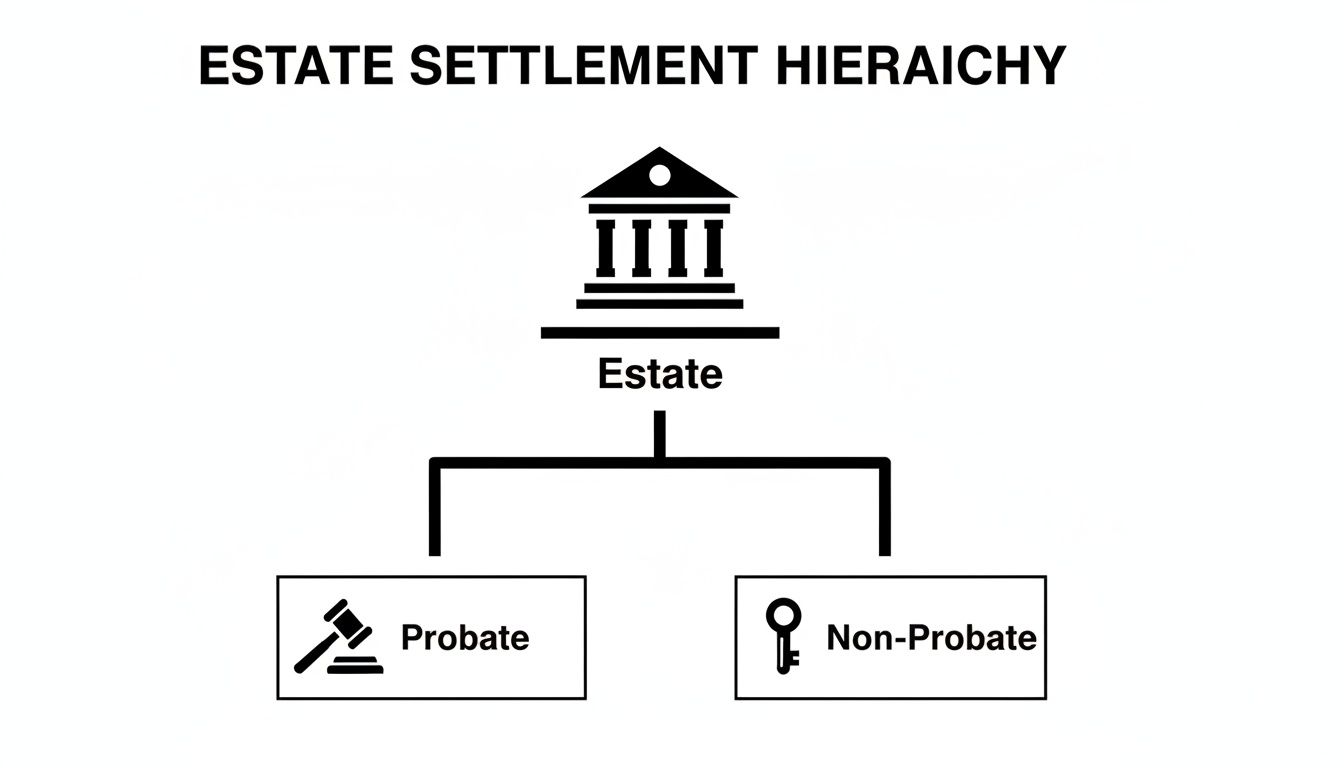
As you can see, the "key" to a faster, more private settlement is choosing the non-probate path wherever you can through smart planning.
Accounts with Beneficiary Designations
Many of the most common non-probate assets are financial accounts where you simply name a person (or several people) to inherit the funds directly. This is nothing more than a contractual agreement between you and the bank or financial institution. It’s incredibly powerful.
Here are the ones you'll see most often:
- Life Insurance Policies: This is the classic example. The death benefit from a life insurance policy is paid directly to the beneficiaries you named in the policy documents. It doesn't go to your estate, and it doesn't wait for a judge's permission.
- Retirement Accounts (401(k)s, IRAs): Just like life insurance, these accounts pass directly to the beneficiaries you've designated. This is a critical point that often causes confusion, and you can learn more about how IRAs or 401(k)s avoid probate in Texas in our detailed guide.
- Payable-on-Death (POD) Bank Accounts: You can add a POD designation to just about any checking or savings account. The money is 100% yours during your lifetime. But upon your death, the named beneficiary can claim it right from the bank with a death certificate and their ID.
- Transfer-on-Death (TOD) Brokerage Accounts: This works exactly like a POD account but applies to stocks, bonds, and other securities held in a brokerage account.
Setting these up is usually as simple as filling out a one-page form. For your loved ones, the claims process is just as straightforward, giving them access to critical funds in weeks, not the months or years probate can take.
Property Ownership and Special Deeds
It's not just about accounts. The way you title your property can also turn it into a non-probate asset. This is especially important for high-value assets like your home or other real estate.
Property Held as Joint Tenancy with Right of Survivorship
When two or more people own property as "joint tenants with right of survivorship," it means they share equal ownership. When one owner passes away, their share automatically transfers to the surviving owner(s).
This is a very common way for married couples to own their home, but it can be used by any co-owners. The transfer is automatic by operation of law—no probate needed.
Texas Transfer-on-Death Deeds (TODDs)
Recognized under the Texas Estates Code, Chapter 114, a Transfer-on-Death Deed (TODD) is a simple but powerful tool for Texas real estate. You sign and file a deed now that names a beneficiary to inherit your property when you pass away.
The best part? You keep full ownership and control during your lifetime. You can sell it, mortgage it, or change your mind without needing the beneficiary's permission. After your death, the beneficiary just files a simple affidavit to take title. The house never has to see the inside of a probate courtroom.
To help you see the difference in how these assets transfer, here’s a quick comparison.
How Assets Transfer With and Without Probate in Texas
| Feature | Probate Assets (e.g., House in Will) | Non-Probate Assets (e.g., Life Insurance) |
|---|---|---|
| Transfer Method | Court-supervised process based on a will or state law. | Direct transfer based on a contract (e.g., beneficiary form). |
| Timeline | Months, sometimes years, depending on complexity. | Typically days or weeks after providing a death certificate. |
| Privacy | Public record. Filings are open for anyone to see. | Private. The transfer is between the institution and the beneficiary. |
| Cost | Involves court fees, legal fees, and administrative costs. | Usually no cost to the beneficiary to claim the asset. |
| Control | The court and the executor control the distribution process. | The beneficiary works directly with the financial institution. |
The table makes it clear: non-probate assets offer a path that is faster, cheaper, and more private for your loved ones.
Assets Held in a Living Trust
A revocable living trust is one of the most flexible and comprehensive tools for avoiding probate. The process is straightforward: you create a trust document and then re-title your major assets—your house, bank accounts, investments—into the name of the trust.
You stay in complete control as the trustee during your lifetime. When you pass away, a successor trustee you've already named steps in to manage and distribute the assets exactly as your trust document instructs. Because the trust owns the assets—not you personally—there is nothing for the probate court to oversee.
A Real-World Texas Estate Scenario
To really see how these legal ideas play out, let's walk through a story that feels all too familiar for many Texas families. We’ll follow the Garcia family from Houston as they navigate the loss of their patriarch, Mr. Garcia, and begin the tough job of settling his estate. This story brings the difference between a probate asset and a non-probate asset into sharp focus.

Mr. Garcia’s daughter, Maria, was named the executor in his will. Already overwhelmed with grief, she now had the daunting task of managing his final affairs. She knew her father had a will, but she had no idea where to even begin.
The Lifeline of Non-Probate Assets
As Maria started sifting through her father's paperwork, she found two crucial documents: a life insurance policy and a statement for his 401(k) retirement account. On both, her father had clearly named her as the sole beneficiary. This was her first encounter with the power of a non-probate asset.
She called the insurance company and the 401(k) administrator, expecting a long, complicated ordeal. The process was anything but. All they asked her to provide was:
- A certified copy of her father’s death certificate.
- A completed claim form from each company.
- Her own personal ID.
Within three weeks, the full life insurance death benefit was deposited directly into her bank account. The 401(k) funds followed not long after. This money was a lifeline. It allowed her to cover the funeral, pay off her father’s last medical bills, and handle other immediate costs without having to dip into her own savings or wait for a court's permission.
This experience gave Maria a small but significant sense of relief during an otherwise crushing time. The process was private, fast, and free of the legal hoops she was about to face with his other property.
The Contrast of the Probate Process
While the non-probate assets were settled quickly, the rest of Mr. Garcia's estate was a different story entirely. His most significant assets were his paid-off home in Harris County and a classic car he'd lovingly restored. Neither had a beneficiary designation. Neither was held in a trust. They were titled solely in his name and were only addressed in his will.
This meant they were probate assets, and Maria had no choice but to start the formal Texas Probate Process. She had to hire an attorney, file the will with the Harris County probate court, attend a hearing to be officially appointed as executor, and publish a notice to any potential creditors.
The home and the car were effectively frozen. She couldn’t sell them, transfer the titles, or do anything until the court granted her the authority through documents called Letters Testamentary. This dragged on for several months and came with court fees, legal costs, and a public record of her family's private affairs.
The Garcia family’s story paints a clear picture. The non-probate assets provided immediate stability and peace of mind, working exactly as Mr. Garcia had planned. In contrast, the probate assets were locked behind a slow, public, and expensive court process, adding a layer of stress to an already painful chapter in their lives. His foresight in setting up just those two non-probate assets made an immeasurable difference.
Strategic Planning to Minimize Probate in Texas
Navigating an estate after a loved one has passed is one thing, but proactively planning your own is a completely different challenge. When you shift your mindset from managing assets after a loss to strategically arranging them beforehand, you can build a remarkably efficient and private estate plan. The key is using non-probate assets as the cornerstone to minimize court involvement and shield your family’s privacy.
The whole point is to make sure your assets get where you want them to go—smoothly, quickly, and according to your exact wishes. This takes more than just writing a will. It involves actively managing how your property is titled and who you’ve designated to receive it.
The Critical Role of Reviewing Beneficiary Designations
Your life isn’t static, so why should your estate plan be? That beneficiary designation form you filled out for your life insurance policy or 401(k) is a powerful legal contract. But if it’s left to gather dust, it can become dangerously outdated and lead to consequences you never intended.
Certain life events should trigger an immediate review of these designations:
- Marriage or Remarriage: You probably want your new spouse to be a primary beneficiary, but an old form could accidentally leave those assets with an ex-partner or another relative.
- Divorce: While Texas law sometimes voids a designation to an ex-spouse, you should never rely on that. It's far safer to proactively update your forms to reflect your new reality.
- Birth or Adoption of a Child: You’ll almost certainly want to include new children in your estate plan to ensure they are provided for.
- Death of a Beneficiary: If your primary beneficiary passes away and you haven’t named a contingent (or backup) beneficiary, that asset could be forced right back into probate—defeating the entire purpose of the designation.
Periodically reviewing these forms is one of the simplest yet most impactful things you can do. It’s the best way to ensure your assets go to the right people without a judge getting involved.
Using a Revocable Living Trust as a Probate Shield
For your most significant assets—like your home, investment properties, or a large brokerage account—a Revocable Living Trust is an incredibly effective shield against probate. Think of a trust as a private container you create to hold your property.
You start by transferring the title of your assets into the trust's name. Don't worry, you remain in complete control as the trustee during your lifetime. When you pass away, a successor trustee you've already chosen steps in to distribute the assets according to your private instructions, completely outside the probate court system. For anyone looking to bypass probate with real estate, a trust is invaluable. A great resource on this is this guide on buying and selling real estate using a trust.
These non-probate tools have become the primary way people transfer wealth. With some global studies estimating that over $29 trillion will be transferred in the United States alone in the coming decades, these strategies are more critical than ever.
While these tools are powerful, they have to be set up correctly to work. "Funding" a trust or updating a beneficiary is a precise legal action. Getting professional guidance is the only way to ensure your plan is airtight and your family is truly protected. You can learn more about these strategies in our complete guide on how to avoid probate in Texas.
Key Insight for Texas Families
Navigating the world of estate planning can feel like a maze, but understanding one powerful concept—the non probate asset—can light the way and protect your family’s future. It’s the key to building a plan that delivers genuine security and peace of mind.
If you remember one thing, let it be this: non-probate assets go directly to the people you choose, completely bypassing the court system. That simple truth can save your loved ones a tremendous amount of time, money, and heartache during an already difficult time.
Putting Your Plan into Action
To make this knowledge work for you, boil it down to these essentials:
- Beneficiary Forms Are Powerful Contracts: Think of the forms for your life insurance, 401(k), IRA, and bank accounts (POD/TOD) as legally-binding instructions. They create a direct pipeline for your assets, and importantly, they will always override what your will says.
- Trusts Offer the Ultimate Shield: For major assets like your home, investment properties, or a significant portfolio, placing them in a revocable living trust is the gold standard. It keeps them out of the probate court’s public record and avoids crippling delays.
- Review Your Designations—It's Not Optional: Life never stands still. A marriage, divorce, or the birth of a child should be an immediate trigger to review and update every single one of your beneficiary designations. Failing to do so can lead to unintentional and often tragic outcomes.
One of the most impactful things you can do for your family costs nothing but a few minutes of your time: regularly reviewing and updating your beneficiary forms. It’s a simple act that ensures your assets go to the right people at the right time, without court interference, just as the Texas Estates Code intends.
Taking these steps transforms your estate plan from a stack of papers into a living strategy that safeguards everything you’ve worked for. By making smart, proactive decisions now, you’re not just passing on assets—you're leaving a legacy of clarity and support for the people you love most.
Frequently Asked Questions About Texas Non-Probate Assets
Navigating the details of estate planning can stir up a lot of questions. As attorneys who work with Texas families every day, we've heard just about all of them. This section offers clear, straightforward answers to some of the most common questions we get, helping you move forward with confidence.
Getting these key points right can prevent costly mistakes and ensure your wishes are honored exactly as you intend.
Can a Will Override a Beneficiary Designation in Texas?
No, it absolutely cannot. This is one of the most critical and frequently misunderstood points in all of estate planning.
Think of a beneficiary designation on an account like an IRA, 401(k), or life insurance policy as a binding legal contract between you and that financial institution. This contract takes priority over any instructions you leave in your Last Will and Testament. Even if you wrote a will yesterday saying "all my assets go to my son," a beneficiary form you filled out ten years ago naming your daughter will control that specific account. The contract wins, every time.
Do Non-Probate Assets Avoid Creditor Claims?
Not always. This is another area where non-probate assets offer big benefits but aren't a magic shield. While these assets successfully sidestep the probate court process, they are not automatically protected from the legitimate claims of creditors against the estate.
Texas law does provide specific protections for certain assets. For instance, life insurance proceeds paid to a named beneficiary generally have strong protections against the deceased's creditors under the Texas Insurance Code. However, funds in a Payable-on-Death bank account might be reachable by creditors if the main probate estate doesn't have enough money to cover its debts. An experienced attorney can clarify which of your assets are protected in your specific situation.
What Happens If My Beneficiary Dies Before Me?
This exact scenario is why naming contingent (or secondary) beneficiaries is so important. If your primary beneficiary passes away before you do and you haven't named a backup, that asset often loses its non-probate status.
Without a living beneficiary to receive it, the asset is typically paid directly to your estate. This forces it straight into the probate process, subjecting it to all the delays, costs, and public scrutiny you originally wanted to avoid. Regularly reviewing and updating both your primary and contingent beneficiaries is a simple step that keeps your entire estate plan on track and working as designed.
Proactive planning is really about anticipating these "what if" scenarios. By naming both primary and contingent beneficiaries and reviewing them after any major life event, you create layers of protection that ensure your assets transfer smoothly and privately, no matter what the future holds. This simple act is one of the most powerful steps you can take to safeguard your family's future.
If you’re facing probate in Texas, our team can help guide you through every step — from filing to final distribution. Schedule your free consultation today.