When your family is dealing with a loss, the last thing you want to face is a complicated and confusing legal process. In Texas, probate doesn't always have to be long or intimidating. A simplified process called a muniment of title is designed to make things easier for certain estates. Think of it as an express lane at the courthouse—it validates a will and transfers property to beneficiaries without the need for a full, drawn-out administration.
This guide will walk you through what a muniment of title is, who qualifies, and how it can provide a clear, efficient path for your family during a difficult time.
A Simpler Path to Transferring Property

After a loved one passes, getting tangled in a long legal battle is the last thing anyone needs. A muniment of title offers a more direct route to settling an estate, but it only works in specific situations. The purpose of this process is to have a court legally recognize a valid will and then use that will as the official evidence—or "muniment"—of who now owns the deceased’s property.
In plain English, the court's order acts as a new deed, officially transferring assets like a house or a car to the people named in the will. It completely bypasses the need to appoint an executor to manage the estate, which is why it’s often much faster and less expensive than traditional probate.
Realistic Scenario: The Miller Family
Let’s walk through a realistic example. Imagine the Miller family in Houston. Their father recently passed away, leaving a clear, valid will that names his two adult children as the sole heirs to his estate. His main assets are his home, his car, and a checking account. Crucially, he had no outstanding debts—no credit card bills or medical expenses. The only debt is his home mortgage, which is a “secured debt” and doesn't disqualify the estate.
In this case, the Millers don't need an executor to pay off creditors or handle complex finances. Their only goal is to get the house and car legally put in their names. This is the perfect situation for a muniment of title in Texas. By filing the will as a muniment of title, they can:
- Avoid full administration: They skip appointing an executor and the ongoing court supervision that comes with it.
- Save time and money: The process is typically resolved much faster and costs significantly less than full probate.
- Achieve their goal: They receive a court order that acts like a deed, allowing them to officially take ownership of the house.
This legal tool was created for straightforward situations like this one. It gives families a clear, efficient path forward so they can focus on grieving and healing, not legal red tape.
Does Your Loved One's Estate Qualify?
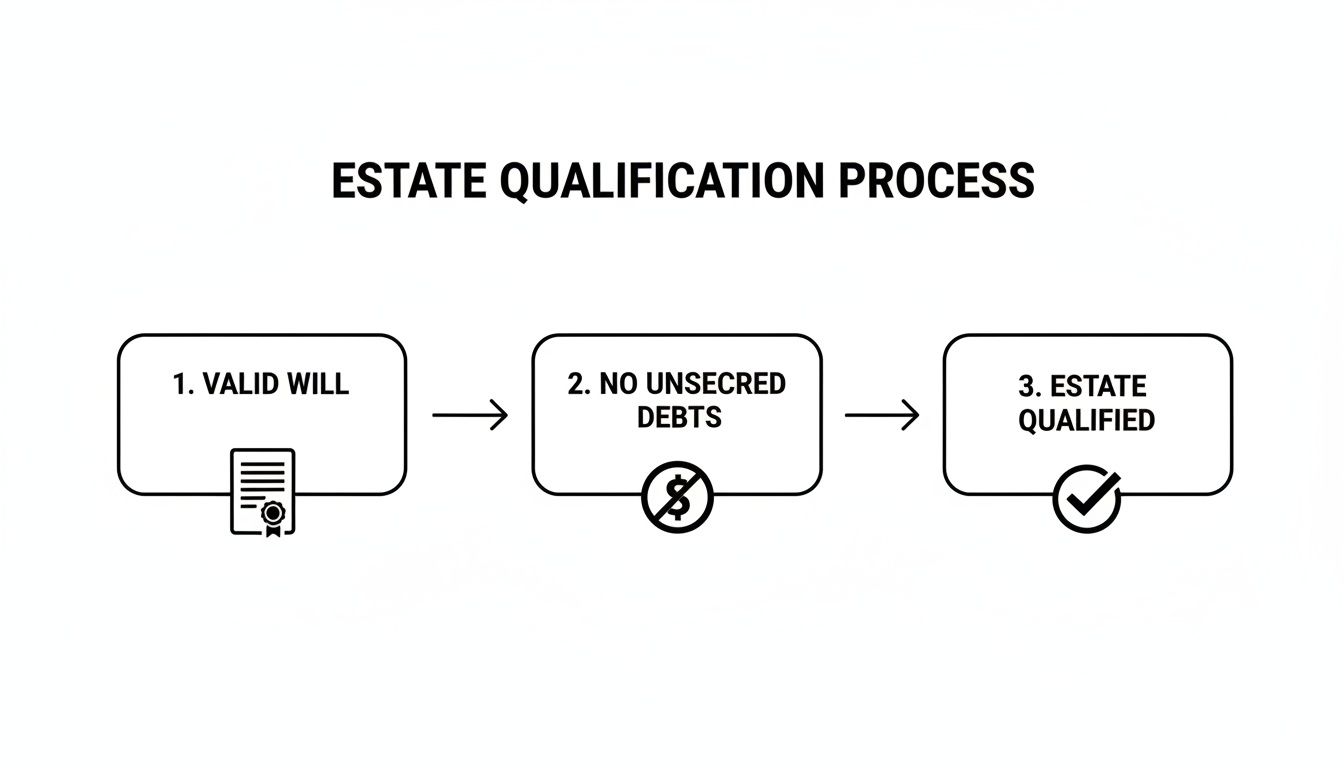
To determine if a muniment of title is the right path, you only need to answer two key questions. First, did your loved one leave behind a valid, original will? Second, does the estate owe any debts that aren't tied to specific property, like a house or a car?
Answering these questions provides the clarity needed to know whether this simpler probate alternative is an option for your family. The legal basis for this process is found in the Texas Estates Code, Title 2, Subtitle F, Chapter 257. Let's break down what those qualifications mean in simple terms.
The Two Pillars of Qualification
Think of a muniment of title as a process that stands on two essential pillars. If one is missing, the entire structure isn't viable.
A Valid Will: This is non-negotiable. The court must have the original will, properly signed and witnessed according to Texas law. This document is the bedrock of the entire process, as the court’s role is to officially recognize it as your loved one's final wishes for their property.
No Unsecured Debts: This is where many estates are disqualified. The estate cannot have any outstanding unsecured debts. These are debts not backed by collateral. Common examples include credit card balances, personal loans from a friend or bank, and lingering medical bills.
It's important to distinguish this from a mortgage on a home or a loan on a vehicle. Those are secured debts, and they do not disqualify an estate from using a muniment of title. The property itself acts as collateral for the loan, putting it in a different legal category. For estates with very few assets and no will, you might also look into a Texas Small Estate Affidavit.
The Critical Four-Year Window for Filing
Time is another major factor in probate. Texas law generally requires that a will be filed for probate within four years of the person's death. Missing this deadline can create significant complications.
However, the muniment of title offers a unique and powerful exception. A will can still be admitted as a muniment of title even after the four-year window has closed, provided the person applying can prove they weren't at fault for the delay. This provision can be a lifeline for families who discover a will years later or faced circumstances that made a timely filing impossible.
Key Takeaway
Qualification for muniment of title isn't about the size of the estate. It all comes down to the type of assets and debts involved. An estate with a multi-million dollar home but zero unsecured debts could easily qualify, while a much smaller estate burdened with significant credit card debt would not.
Navigating the Muniment of Title Process Step by Step
Understanding the legal roadmap for settling an estate can bring a huge sense of relief. For a muniment of title, the process is designed to be direct and efficient. Let’s walk through each stage so you know what to expect.
Step 1: Preparing and Filing Your Application
The journey begins by filing an Application to Probate Will as a Muniment of Title. This official document is submitted to the appropriate Texas probate court—usually in the county where your loved one resided. It is a formal request asking the court to legally recognize the will as the official tool for transferring property.
The application must contain specific information required by the Texas Estates Code, including your loved one's date of death, the names and addresses of every beneficiary in the will, and a sworn statement confirming the estate has no unsecured debts. The original will must be attached. Once filed with the county clerk, the legal process officially begins, and the court will schedule a hearing.
Step 2: The Court Hearing and Judge's Order
The court hearing is a critical but typically straightforward step. The main purpose is for a judge to review the application and the will. You or your attorney will provide brief testimony to prove the will is valid and that all legal requirements have been met.
The judge will verify a few key things:
- The person who created the will has passed away.
- The court has proper jurisdiction over the case.
- The will was executed with all necessary legal formalities.
- The estate does not owe any unsecured debts (like credit card bills).
If the judge is satisfied, they will sign a court order admitting the will to probate as a muniment of title. This order is the powerful legal document that enables the property transfer.
Step 3: Finalizing the Property Transfer
Receiving the signed order from the judge is a major milestone, but there is one final, crucial step. To officially transfer ownership of any real estate, like a family home, you must obtain a certified copy of both the will and the court’s order.
You will then file these documents with the county clerk's office in the county's official property records. This action creates a clear, public "chain of title," proving that the property has legally moved from your loved one's name into the names of the beneficiaries. That recorded order essentially serves as the new deed.
Let’s return to the Miller family. The two children and their attorney attended a brief court hearing, answered a few simple questions, and the judge signed the order. Their attorney then filed the order with the county property records. Just like that, they became the official, legal owners of their father's house. This streamlined path provided closure and legal certainty without the stress of a lengthy, court-supervised administration. For help with any part of the Texas Probate Process, our experienced team is here to guide you.
If you’re facing probate in Texas, our team can help guide you through every step — from filing to final distribution. Schedule your free consultation today.
Comparing Texas Probate Alternatives
To fully appreciate why a muniment of title might be the right path for your family, it helps to see how it compares to other common ways of handling an estate in Texas. A clear look at the differences in cost, time, and complexity can empower you to make an informed decision for your loved one's estate.
Muniment vs. Independent Administration
The single biggest difference between a muniment of title and a full independent administration is the role of the executor. In an independent administration, the court appoints an executor (or administrator) to take charge of the entire estate. This person is responsible for gathering assets, notifying creditors, paying off debts, and distributing what’s left to the heirs.
That process is far more involved. It requires the executor to publish notices to potential creditors and file a detailed inventory of the estate's assets with the court. While it’s the standard method for handling estates with debts or complex assets, it is also more time-consuming and expensive.
A muniment of title, on the other hand, skips the executor role entirely. There is no "administration." The court simply validates the will, and its order acts as the legal key to transfer property. This is precisely why it’s only available for estates with no unsecured debts—if there are no creditors to pay, there is no need for an executor.
Muniment vs. Small Estate Affidavit
A Small Estate Affidavit (SEA) is another streamlined option, but it has a strict financial cap. As defined in the Texas Estates Code Chapter 205, an SEA can only be used if the estate's value (not including the homestead and other exempt property) is $75,000 or less. Crucially, it can only be used when there is no will.
A muniment of title has no such value limit. An estate worth millions in real estate can use the muniment of title process as long as it meets the two core requirements: a valid will and no unsecured debts. This makes it an incredibly powerful tool for estates of any size that have their affairs in order. If you're exploring your options, you can learn more about how to avoid probate in Texas.
Comparing Texas Probate Options at a Glance
To make it even clearer, let's put these three primary Texas probate alternatives side-by-side.
| Feature | Muniment of Title | Independent Administration | Small Estate Affidavit |
|---|---|---|---|
| Executor Required? | No | Yes | No |
| Is a Will Needed? | Yes, it is required. | Yes, if one exists. | No, only for no-will cases. |
| Asset Value Limit? | No limit. | No limit. | Yes, $75,000 (non-exempt). |
| Court Involvement | Minimal (one hearing). | Moderate (ongoing duties). | Minimal (filing only). |
| Best For | Debt-free estates with a valid will, of any size. | Estates with debts, complex assets, or needing an executor. | Small estates with no will and limited assets. |
The right choice depends on the facts. An estate with a valid will and no debt is a prime candidate for the speed and simplicity of a muniment of title.
The Real Benefits for Your Family
Opting for a muniment of title can bring tangible relief to your family during a difficult time. This method was designed to bypass the common stressors of probate, allowing you to focus on healing instead of paperwork.

A Faster Path to Closure
One of the most compassionate aspects of a muniment of title in Texas is its speed. A traditional probate can easily stretch on for a year or longer, but a muniment of title is often finalized in just a few months. Historically, Texas probate could be a bottleneck, but today, estates that qualify for this process are often resolved in just 2-4 months. You can discover more insights about the evolution of Texas probate on texasguardianshiplawyer.net.
This accelerated timeline means your family gains legal ownership of property, accesses necessary funds, and finds closure much sooner—an invaluable emotional benefit.
Significant Cost Savings
Probate can be expensive. A huge advantage of the muniment of title process is its affordability. The savings come from a few key areas:
- No Executor Fees: Since the court does not appoint an executor, you avoid the fees or commissions normally paid for their services.
- Reduced Attorney's Fees: The process is far less complex and requires fewer court filings, which almost always results in lower legal costs.
- Fewer Court Costs: With minimal court involvement, associated filing and administrative fees are a fraction of what they are in a full administration.
These savings ensure that more of your loved one's estate goes directly to the beneficiaries, just as their will intended.
Simplicity and Privacy
A full probate administration is a public affair, involving court supervision over nearly every step. For many families, this feels intrusive and adds to their stress.
The muniment of title process is far simpler. It typically involves just one straightforward court hearing. There's no requirement to formally notify creditors or file a detailed public inventory of every asset, which keeps your family's financial matters much more private. Understanding how this fits into a bigger picture, especially for those considering high net worth estate planning, can highlight its advantages.
By using a muniment of title, the Miller children in our example saved thousands in fees and finalized the estate in under three months. This allowed them to take ownership of their childhood home and focus on honoring their father's memory instead of being bogged down in a legal process.
Your Key Takeaway on Muniment of Title
The most important thing to remember is that a muniment of title acts as a legal bridge. It connects a valid will directly to the transfer of property, allowing you to bypass the long journey of a full estate administration.
It is a powerful, efficient tool created for Texas estates where the deceased left a clear will and had no unsecured debts. This process simplifies settling an estate, saving families immense time and money.
Your Immediate Next Steps
Your path forward can be clearer with a little preparation. Before seeking legal advice, try to focus on these two initial tasks:
- Locate the Original Will: This document is the absolute foundation of the process.
- List Assets and Debts: Create a simple list of your loved one's property and any known debts to get a general picture.
With this information, you’ll be prepared for a focused consultation with an experienced probate attorney who can quickly assess your situation and confirm if a muniment of title in Texas is the right path for your family.
Key Insight
Muniment of title is not a workaround for a complicated estate; it's a purpose-built solution for a straightforward one. The process is designed to honor a loved one's wishes with maximum efficiency and minimal court involvement, providing families with a direct path to closure.
Whether you need help with the Texas Probate Process, establishing a Guardianship, creating foundational Wills & Trusts, or navigating complex Probate Litigation, our team has the experience to guide you.
If you’re facing probate in Texas, our team can help guide you through every step — from filing to final distribution. Schedule your free consultation today.
Common Questions About Muniment of Title
Even with a good understanding of the basics, real-world questions often arise. Below are some of the most common questions we hear, with straightforward answers to provide further clarity.
What Happens If We Find a Debt After Starting?
This is a practical concern. What if you’ve already filed for a muniment of title, and then an old credit card statement or medical bill appears?
The primary requirement for a muniment of title is that the estate has no unsecured debts. If such a debt is discovered, the court may determine that a muniment of title is no longer appropriate. Often, this means the case must be converted into a more traditional estate administration to properly handle paying the creditor. This is why a thorough, upfront financial review with an attorney is so critical—it helps avoid these kinds of surprises.
Can We Use Muniment of Title for Property in Multiple Counties?
Yes, absolutely. This is a common scenario where a muniment of title in Texas is highly effective. For example, if your mother owned her home in Harris County and a vacation property in Galveston County, the process handles this efficiently.
You file the application in the county where your loved one resided. Once the judge signs the order, you obtain certified copies of both the order and the will. You then simply file those certified documents in the real property records of each county where real estate is located. This officially updates the chain of title in all relevant locations.
Is an Attorney Really Necessary?
While a muniment of title is simpler than a full administration, navigating it alone can lead to costly mistakes. The Texas Estates Code has specific rules for the application, hearing, and final filings that are easy to miss.
An experienced probate attorney ensures that all requirements are met, the paperwork is filed correctly, and common pitfalls are avoided. They are also invaluable if you encounter issues with out-of-state banks or other institutions unfamiliar with this unique Texas procedure. Hiring a lawyer provides peace of mind that the process is done right the first time, preventing future title problems.
While some might consider an affidavit of heirship for a straightforward estate, a muniment of title provides a much stronger, court-backed transfer of title when there's a valid will.