Skip to content
When a loved one passes away, being named the executor of their will is a profound responsibility. In Texas, the first legal step in fulfilling that duty is obtaining Letters Testamentary—the official court document that grants you the legal authority to manage their estate. Think of it as the key that unlocks your ability to settle your loved one's final affairs according to their wishes.
Navigating this process while grieving can feel overwhelming, but understanding the steps can provide clarity and reassurance. This guide will walk you through what Letters Testamentary are, why they are essential, and the step-by-step process for obtaining them in Texas.
The Role And Power Of Letters Testamentary
When you're named as the executor in a will, it’s a common misconception that you can immediately start managing the deceased's affairs. In reality, banks, mortgage companies, and other financial institutions won't recognize your authority based on the will alone. They need official proof from a Texas probate court that you are the legally appointed executor. That proof is the Letters Testamentary.
Without this crucial document, your hands are tied. You won't be able to:
- Access or close the deceased’s bank accounts.
- Sell their house or other real estate.
- Pay their final bills or negotiate with creditors from estate funds.
- Distribute assets like stocks, bonds, or personal property to the beneficiaries named in the will.
Unlocking Your Authority As Executor
The moment the court issues Letters Testamentary, your role is transformed. You are no longer just the nominated executor; you are the court-appointed executor with full legal authority. These letters empower you to take control of the estate's assets, pay its debts, and ultimately distribute the remaining property to the heirs as outlined in the will.
This often involves managing real estate, and a key part of that is understanding what a probate listing entails, as these property sales happen under strict court supervision.
To illustrate the importance of this document, here’s a breakdown of what an executor can—and can't—do before getting those letters.
Executor Authority Before vs After Receiving Letters Testamentary
| Action | Authority Without Letters Testamentary | Authority With Letters Testamentary |
|---|---|---|
| Access Bank Accounts | None. Banks will not grant access. | Full authority to access, manage, and close accounts. |
| Pay Estate Debts | Limited. Can pay from personal funds but cannot use estate assets. | Full authority to use estate funds to pay creditors. |
| Sell Real Estate | None. Cannot list, sell, or transfer property. | Full authority to sell property as per the will or court order. |
| Talk to Creditors | Informal only. Can notify them of the death but cannot negotiate on behalf of the estate. | Full authority to negotiate, dispute, or settle claims. |
| Distribute Assets | None. Cannot give property or money to beneficiaries. | Full authority to distribute assets to the rightful heirs. |
As you can see, obtaining Letters Testamentary is the single event that empowers you to perform your duties.
What Happens If There Is No Will?
It’s easy to confuse Letters Testamentary with a similar document called Letters of Administration. They serve the same function—granting someone authority over an estate—but apply in different scenarios.
Letters Testamentary are issued when there is a valid will naming an executor. If a person dies without a will (this is known as dying "intestate"), the court will appoint an administrator and issue Letters of Administration. Our firm provides a detailed guide explaining the key differences between Letters Testamentary vs Letters of Administration.
Key Insight: Letters Testamentary are more than just paperwork. They are the court's official certification of your authority, transforming you from the person named in a will into the legally recognized executor of an estate. Without them, you cannot legally act on the estate's behalf.
Getting Your Letters: A Walk Through the Texas Probate Process
Obtaining Letters Testamentary is a structured journey through the Texas probate court system. We understand that court proceedings can feel intimidating, especially during a time of grief. However, the process is methodical and designed to ensure the deceased's wishes are honored correctly.
Think of Letters Testamentary as the legal "key" that unlocks an estate's assets, giving the executor the authority they need to move forward.
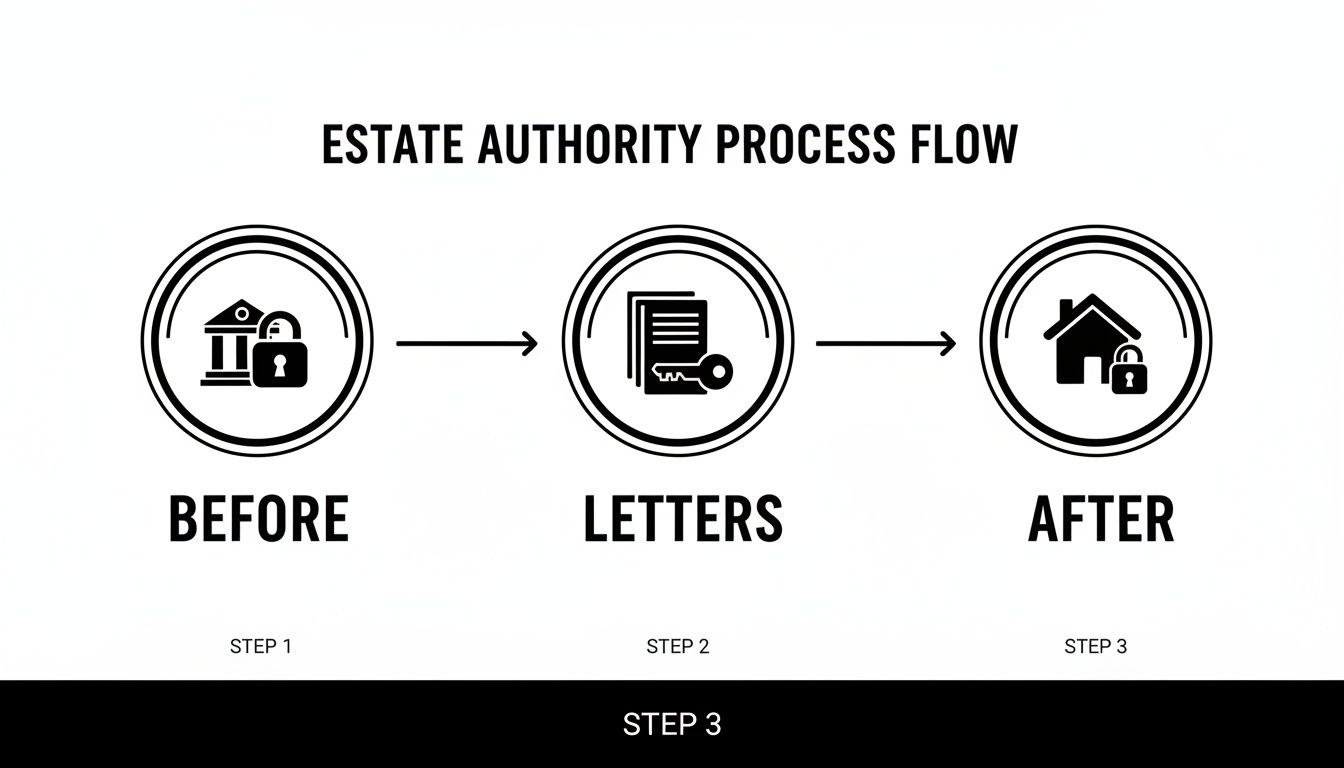
As this shows, the letters are the central piece of the puzzle, converting the intent of the will into real legal power to manage and distribute the estate.
Step 1: Filing the Application
Your first step is to file an "Application to Probate Will and for Issuance of Letters Testamentary" with the probate court in the county where your loved one resided. This formal request asks the court to legally validate the will and officially appoint you as the executor.
Along with the application, you must submit two critical documents: the original will and a certified copy of the death certificate. These form the foundation of your probate case. The court needs the original will to verify its authenticity and the death certificate as legal proof of death. For more details on these initial steps, see our guide on how to probate a will in Texas.
Step 2: The Waiting Period and Public Notice
Once your application is filed, a mandatory waiting period begins. Under the Texas Estates Code, Section 258.001, a will cannot be probated until at least the 11th day after the application is filed. This delay serves a vital purpose: public notice.
The county clerk will post a public notice at the courthouse announcing that a probate application has been filed. This "posting" is designed to inform anyone with a potential interest in the estate—such as creditors or potential heirs—that the process has started, giving them a fair opportunity to come forward.
Step 3: A Real-World Scenario: An Executor in Harris County
Let’s consider a realistic situation. Maria's father passed away in Houston, and his will named her as the executor of his Harris County estate. His primary assets included his home in the Heights, a savings account, and an investment portfolio.
Maria’s attorney filed the application to probate her father’s will, and the Harris County Clerk posted the required notice. The two-week waiting period felt stressful for Maria, who was anxious to pay her father's bills and secure his home. Her attorney compassionately explained that this step is a non-negotiable legal safeguard designed to ensure the process is transparent and fair to all parties. This reassurance helped Maria feel more in control during a difficult time.
Step 4: The Court Hearing: Proving Up the Will
After the waiting period, the court schedules a hearing. This is typically a brief, straightforward proceeding, not a dramatic courtroom battle. The judge's goal is to confirm two things: that the will is valid and that you are qualified to serve as executor.
During the hearing, you (or your attorney) will present testimony to "prove up" the will. This involves confirming:
- The person who made the will has passed away.
- Less than four years have passed since their death.
- The court has jurisdiction (the deceased lived in that county).
- The will was executed correctly according to Texas law.
- You are qualified and not disqualified from serving as executor.
The judge will then ask you to take an Oath of Executor. This is a sworn promise that you will faithfully carry out your duties under the will and Texas law. It is a formal commitment and a pivotal moment in the probate process.
Step 5: Posting a Bond (If Necessary)
In some cases, the court may require you to post a bond. This is like an insurance policy that protects the estate’s beneficiaries and creditors from potential mismanagement.
However, most well-drafted Texas wills include a provision that waives this bond requirement. If the will states "no bond required," the court will almost always honor that wish, simplifying the process and saving the estate money. If a bond is required, its cost is paid from estate funds, not your personal funds.
Once these steps are completed, the judge will sign an order admitting the will to probate. Shortly after, the clerk will issue your official Letters Testamentary. You now hold the legal key to the estate.
Gathering Your Essential Documents and Confirming Eligibility

Before filing with the court, taking time to gather the right documents and confirm your eligibility will make the entire process smoother and prevent frustrating delays.
Confirming Your Eligibility to Serve
Even if a will names you as executor, you must be legally qualified. The Texas Estates Code, Section 304.003, outlines who is disqualified from serving. You generally cannot act as an executor if you are:
- A minor (under 18 years of age).
- An incapacitated person.
- A convicted felon, unless you have been pardoned or had your civil rights restored.
- A person the court finds "unsuitable."
The "unsuitable" category gives the judge discretion. If there's evidence of a conflict of interest or other issues that could harm the estate, a judge might find someone is not the right fit. For most named executors, however, this is not an issue.
Assembling the Non-Negotiable Documents
Once you've confirmed your eligibility, you'll need three core documents to begin the probate process.
1. The Original Signed Will
The court requires the original, signed will—not a copy. While probating a copy is sometimes possible, it is a far more complex and expensive legal process.
- Practical Tip: Look for the will in places your loved one kept important papers, such as a home safe, a safe deposit box, or with their estate planning attorney. An attorney can help you get a court order to open a safe deposit box if needed.
2. A Certified Copy of the Death Certificate
The court needs official proof of death. You must obtain a certified copy of the death certificate, which has a raised seal from the issuing government office. A photocopy is not acceptable.
- How to Get One: You can order certified copies from the Texas Bureau of Vital Statistics or the county clerk's office where the death occurred. We recommend ordering 5-10 copies, as various institutions will require one.
3. The Probate Application
This is the formal legal document filed with the court. It contains essential information about the deceased, the will, the beneficiaries, and the estate. This document must be filled out with absolute precision to meet the court's strict requirements.
Getting these three items right is fundamental. For a more exhaustive checklist, see our guide on the required documents for a probate case.
Common Challenges and How to Handle Them
Even with careful preparation, unexpected issues can arise. Knowing how to navigate these challenges can keep the process moving forward.
When The Original Will Is Missing
If you cannot find the original will, Texas law presumes the person who made it (the testator) destroyed it with the intent to revoke it. Overcoming this presumption is difficult but possible under Texas Estates Code, Section 256.054. To probate a copy, you must prove to the court:
- Why the original cannot be produced.
- The will's contents, confirmed by a credible witness.
- That the testator did not revoke the will.
This requires a high legal standard and the help of an experienced probate attorney.
If The Named Executor Cannot Serve
What happens if the executor named in the will has passed away, is ill, or declines the role? Most well-drafted wills name an alternate or successor executor. If you are next in line, you can step up. If no alternate is named, the court will appoint a suitable administrator, typically a beneficiary, to manage the estate.
Key Insight: A will isn't invalidated just because the named executor cannot serve. The court’s priority is to honor the testator’s wishes, and it will ensure someone qualified is appointed to do so.
Navigating Family Disputes And Will Contests
Grief can sometimes lead to family disagreements that escalate into a formal will contest. This is a lawsuit challenging the will's validity and can bring the probate process to a halt. Common grounds for contesting a will in Texas include:
- Lack of Testamentary Capacity: Arguing the testator was not of sound mind.
- Undue Influence: Claiming someone manipulated the testator.
- Improper Execution: Asserting the will was not signed or witnessed correctly.
If you anticipate a family dispute, seeking immediate guidance on probate litigation is your most critical next step. An experienced attorney can help protect the estate and navigate these difficult situations with compassion and authority.
When You Might Not Need Full Probate In Texas
Full probate isn't always necessary. Texas law offers several simpler, more direct alternatives for less complex estates, which can save your family significant time, money, and emotional strain.

Muniment of Title: The Debt-Free Solution
A Muniment of Title is a streamlined process for estates where the main asset is real estate and there are no outstanding debts (other than a mortgage). Under Texas Estates Code Chapter 257, the court officially recognizes the will as a public record of who now owns the assets, effectively transferring title without a full administration.
Small Estate Affidavit: For Modest Estates
If an estate's total value is $75,000 or less (excluding the homestead and other exempt property) and there is no will, heirs can use a Small Estate Affidavit (SEA). This sworn statement is filed with the court and, once approved, allows heirs to collect assets directly from banks and other institutions, bypassing probate entirely.
Letters of Administration: When There Is No Will
When someone dies without a will and their estate is too large for an SEA, the court appoints an administrator and issues Letters of Administration. This document gives the administrator the same legal authority as an executor to manage and distribute the estate according to Texas succession law.
Comparing Texas Estate Settlement Options
| Method | When It's Used | Typical Timeline | Key Outcome |
|---|---|---|---|
| Letters Testamentary | There is a valid will, and an executor needs full authority for a complex estate with debts and multiple assets. | 6 months to 2+ years | Executor gains full control to pay debts and distribute assets as the will directs. |
| Letters of Administration | There is no will, and an administrator needs full authority for a complex estate. | 6 months to 2+ years | Administrator gains full control to pay debts and distribute assets per state law. |
| Muniment of Title | There's a valid will, but the estate has no debts (except a mortgage). | 2-4 months | The will is legally recognized, transferring property ownership without an executor. |
| Small Estate Affidavit | There is no will, and the estate is valued at $75,000 or less (excluding the homestead), with no debts. | 1-2 months | Heirs can collect assets directly without full probate. |
An experienced probate attorney can help you determine the most efficient and cost-effective legal strategy for your family.
Takeaway: Key Insights For Texas Executors
Navigating your duties as an executor can feel overwhelming, but the process is manageable with the right guidance. Here are the essential takeaways for every Texas executor:
- Letters Testamentary Are Your Legal Authority: Without this court-issued document, you have no power to act on behalf of the estate.
- Preparation is Key: Gathering the original will and a certified death certificate before you file is a non-negotiable first step that prevents delays.
- Professional Guidance is Crucial: The probate process has many rules and potential pitfalls. An experienced attorney can help you avoid costly mistakes, especially if family disputes arise. Our firm can guide you through the Texas Probate Process with care.
- Full Probate Isn't Always Required: Simpler estates may qualify for alternatives like a Muniment of Title, saving time and money.
Your role as an executor is a great responsibility, but you do not have to handle it alone. For broader questions about protecting vulnerable family members, you may also find our resources on Guardianship and Wills & Trusts helpful.
Answering Your Questions About Texas Letters Testamentary
It is completely normal to have questions as you begin this process. Here are straightforward answers to some of the most common concerns we hear from families.
How Long Does It Take To Get Letters Testamentary In Texas?
In a straightforward case, you can generally expect to receive letters testamentary within four to eight weeks after filing the application. However, timelines can be extended by a busy court, difficulty locating heirs, or a will contest. A complete and accurate initial filing is the best way to avoid unnecessary delays.
What Is The Cost To Get Letters Testamentary?
The total cost includes court filing fees (typically a few hundred dollars) and attorney's fees. Attorney's fees may be a flat fee or billed hourly. In some cases, the court may also require an executor's bond. We believe in transparency and will discuss the entire fee structure with you during your initial consultation.
Can I Get Letters Testamentary Without A Lawyer?
While it is legally possible to represent yourself (pro se), it is strongly discouraged. The Texas Estates Code is complex, and the procedural rules and deadlines are strict. A small mistake can derail your case, leading to delays and increased costs. Hiring an experienced probate attorney is an investment in ensuring the process is handled correctly and efficiently.
If you’re facing probate in Texas, our team can help guide you through every step — from filing to final distribution. Schedule your free consultation today.