Searching for a "last will and testament sample texas" is a crucial first step in protecting your family's future. A thoughtfully prepared will is more than a legal document; it is a profound act of love, ensuring your final wishes are honored and your loved ones are cared for when you are gone.
We understand that planning for the future can feel overwhelming, especially when grieving or contemplating difficult possibilities. This guide is designed to provide clear, compassionate explanations about what a Texas will looks like, why it is so important, and how it serves as your voice for the people you love most.
Why Every Texas Family Needs a Will
Imagine the heartbreak of a family grieving a loved one, only to be thrown into a confusing and expensive legal maze because no will was left behind. This scenario, known as dying "intestate," means the State of Texas—not you—decides who inherits your property and, most critically, who raises your minor children. It is a situation no one wants for their family.
The Consequences of Not Having a Will
Without a will, the Texas Estates Code imposes a rigid, one-size-fits-all formula for distributing your assets. This can lead to outcomes you never would have intended.
A Realistic Scenario: Consider a blended family where a husband passes away without a will. He has two children from a previous marriage and owns a home with his new wife. Under Texas intestacy law, his children could inherit a portion of the family home, forcing his grieving spouse to co-own her home with her stepchildren. This often creates immense financial strain and emotional conflict during an already painful time.
The hard truth is that most Americans are unprepared. A 2024 survey from Caring.com revealed that only 32% of Americans have a will. This means a majority of adults are leaving their families vulnerable to state probate laws that can drag on for months and accumulate thousands in unexpected fees.
Takeaway: Creating a will is not just a legal task—it is a final gift to your family. It provides clarity, security, and peace of mind during what will be an incredibly difficult time, allowing your loved ones to focus on healing instead of navigating a legal battle.
Taking Control of Your Legacy
A will is your voice after you’re gone. It gives you the power to make crucial decisions now, so your family doesn't have to guess what you would have wanted. With a properly drafted will, you can:
- Appoint an Executor: Choose a trusted person to manage your estate, pay final bills, and distribute your assets according to your instructions.
- Name a Guardian for Minor Children: This is arguably the most vital reason for parents to have a will. You decide who will raise your children, not a judge. Our firm can help you navigate the complexities of Guardianship.
- Designate Beneficiaries: Clearly state who receives what, from your home and savings to cherished family heirlooms.
- Simplify the Probate Process: A valid will can make the Texas Probate Process significantly smoother, faster, and less expensive for your loved ones.
This guide provides an annotated sample will to show you exactly how these pieces fit together, empowering you to protect your family’s future. For more background, you may find our article on understanding the importance of wills in Texas estate planning helpful.
Taking a Look at a Sample Texas Last Will and Testament
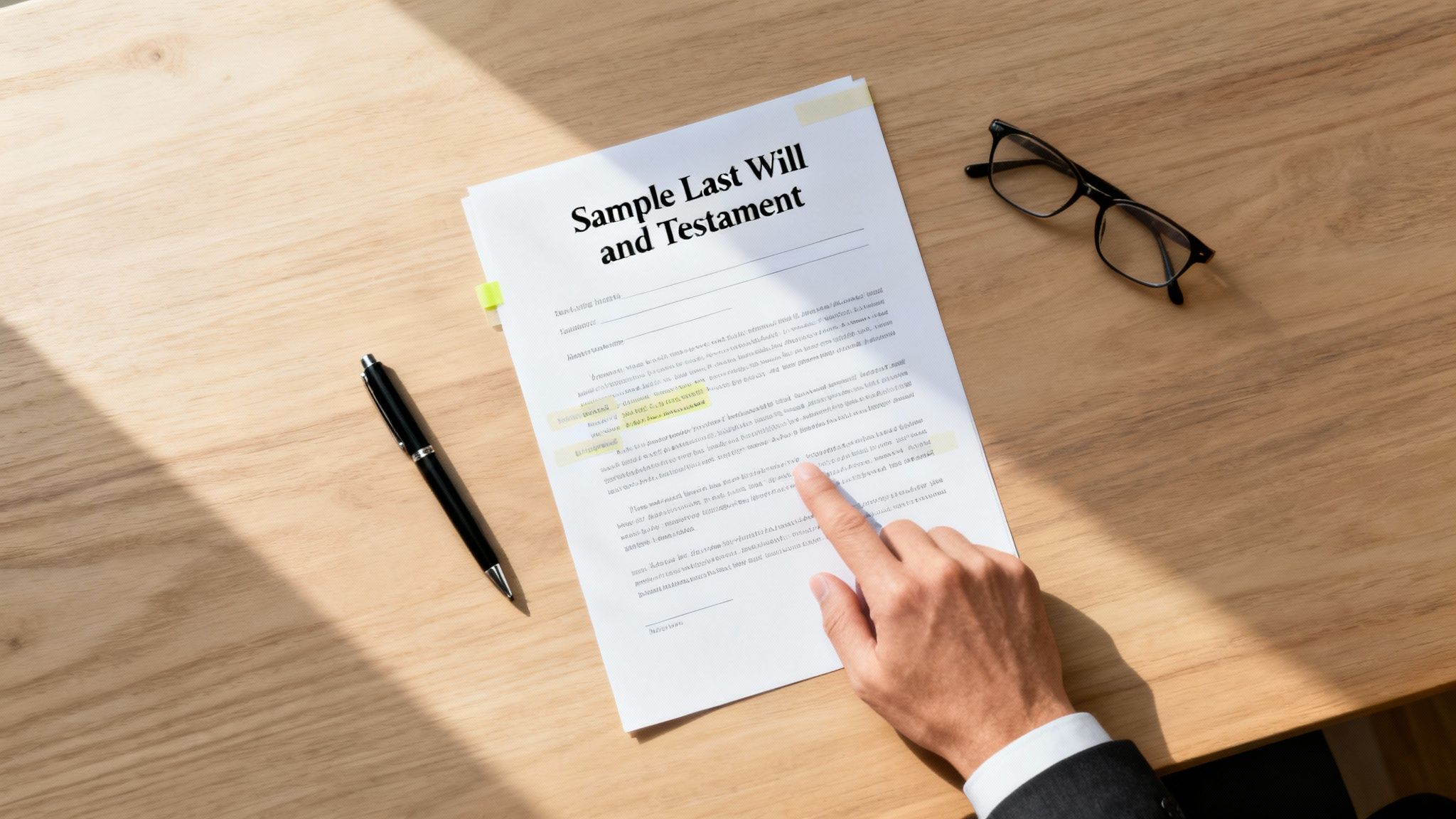
Seeing a real last will and testament sample Texas families can understand is the best way to demystify the process. A will is not an intimidating document filled with jargon; at its heart, it is a clear set of instructions for your loved ones.
Let's walk through a simple sample together, piece by piece, to see how it works.
A Quick Disclaimer: This sample is for educational purposes only and is not a substitute for legal advice from a qualified attorney. Your will should be tailored to your specific family and financial circumstances.
The Opening Declaration
Every Texas will begins with a formal introduction, often called the exordium clause.
Sample Text:
"I, Jane Doe, a resident of Harris County, Texas, being of sound mind, do hereby declare this to be my Last Will and Testament, revoking all prior wills and codicils."
This opening statement accomplishes three critical tasks:
- Identifies You: It states your full name and county of residence, which establishes the correct court jurisdiction for probate.
- Confirms Your Capacity: The phrase "being of sound mind" affirms your testamentary capacity—a legal requirement under the Texas Estates Code showing you understand you are making a will.
- Wipes the Slate Clean: This is vital. It legally cancels any old wills or amendments (codicils), preventing confusion and potential legal challenges later.
Appointing an Executor
Next, you name your Executor—the person or institution you trust to carry out your will's instructions.
Sample Text:
"I appoint my spouse, John Doe, as the Independent Executor of my estate. If John Doe is unable or unwilling to serve, I appoint my sister, Mary Smith, as the successor Independent Executor."
Your Executor is the captain of the ship, responsible for navigating your estate through the probate process. Their duties include gathering assets, paying debts, and distributing the remainder to your beneficiaries. Naming a successor is a crucial backup plan, as life is unpredictable.
Naming a Guardian for Minor Children
For parents of young children, this is the most important clause in the entire will. It is where you name the person you want to raise your children if both parents pass away.
Sample Text:
"If my spouse does not survive me and I leave minor children, I appoint my brother, David Roe, as Guardian of the person and estate of my minor children. If he is unable to serve, I appoint my cousin, Susan Jones, as successor Guardian."
This is your chance to ensure your children are cared for by someone you know and trust. Without this designation, a court will make the decision for you, and it may not be the person you would have chosen.
If you'd like to see different ways this can be structured, you might find our overview of sample Texas will forms helpful.
Specific Bequests and Gifting Property
After appointing key individuals, the will details who gets what. This often starts with specific bequests—gifts of particular items to specific people.
Sample Text:
"I give my collection of antique watches to my nephew, Robert Smith. I give my 2023 Ford Explorer, VIN [Vehicle Identification Number], to my daughter, Emily Doe."
Clarity is essential here to prevent arguments. Including specific details, like a VIN for a car or a clear description of an heirloom, helps your Executor identify and distribute assets correctly.
Distributing the Rest of Your Estate
After specific gifts are made and all estate debts are paid, what remains is called the residuary estate. The residuary clause dictates who receives everything else.
Sample Text:
"I give all the rest, residue, and remainder of my estate, of whatever nature and wherever located, to my spouse, John Doe, if he survives me. If my spouse does not survive me, I give my entire residuary estate to my children, in equal shares."
This clause acts as a critical safety net, catching any assets you didn't specifically mention or acquired after writing the will. Without it, that property could be distributed according to Texas intestacy laws, which may conflict with your wishes.
Powers Granted to the Executor
To perform their duties effectively, your Executor needs legal authority. This section grants them specific powers, often by referencing the Texas Estates Code.
Sample Text:
"I grant my Independent Executor the power to sell, lease, or mortgage any real or personal property of my estate without court order, as permitted for Independent Executors under the Texas Estates Code."
Granting these powers for an independent administration is a significant advantage in Texas. It allows your Executor to manage the estate with minimal court supervision, saving your family time, money, and stress during the Texas Probate Process.
The Final Signatures and Self-Proving Affidavit
The will concludes with your signature, the date, and the signatures of two credible witnesses who watched you sign. Attached is a special document called a Self-Proving Affidavit—a sworn statement signed by you and your witnesses before a notary public.
Key Insight: The Self-Proving Affidavit is a game-changer under Texas law. It allows the court to accept the will as valid without requiring the original witnesses to testify. For your grieving family, this makes starting the probate process much simpler and less stressful.
This guided tour of a last will and testament sample Texas document shows it is a logical, structured plan. Each clause works together to create a clear roadmap that protects your family and honors your wishes.
The Three Pillars of a Legally Sound Texas Will
A sample will is a great starting point, but it's the execution—the signing, witnessing, and notarizing—that breathes legal life into it. The formalities required by Texas law are not mere suggestions; they are strict rules designed to protect your final wishes from being challenged or invalidated in court.
Getting these details right is everything. Let’s walk through the three pillars that support a rock-solid Texas will.
Pillar One: In Writing and Signed by You
This first requirement is the foundation of a valid will. Under Texas Estates Code § 251.051, a will must be in writing. A verbal promise or video message is not legally binding. It must be a tangible document.
Most importantly, you—the testator (the person making the will)—must sign it. This signature confirms the document contains your final instructions. If you are physically unable to sign, Texas law permits someone to sign on your behalf, but it must be done in your presence and at your direction.
Pillar Two: Attested by Two Credible Witnesses
This is where many DIY wills fail. Your signature must be attested to by two credible witnesses, both at least 14 years old.
"Attested" means they must physically sign the will in your presence. This is a critical step. It signifies they watched you sign (or acknowledge your signature) and that you appeared to be of sound mind and acting voluntarily. Their signatures serve as proof of the will's proper execution.
Key Insight: Choosing your witnesses is incredibly important. A beneficiary named in your will should never serve as a witness. This can create a legal nightmare and potentially void any gift intended for that witness, as outlined in the Texas Estates Code. Always choose disinterested parties—people who have nothing to gain from the will.
For a deeper look into what can make a will legally unenforceable, we cover several critical scenarios in our guide on what invalidates a will in Texas.
Pillar Three: The Self-Proving Affidavit
While not technically required for a will to be valid, skipping this pillar is a significant mistake. A self-proving affidavit is a separate statement attached to your will that you and your witnesses sign before a notary public.
In this sworn statement, everyone affirms that all legal procedures were correctly followed during the signing ceremony. This simple, notarized document is invaluable during probate. It allows the court to accept the will without the delay and expense of locating the original witnesses to testify in person. This small step saves your family immense time, money, and stress.
To ensure your will is ironclad, it's helpful to have a clear summary of what Texas law demands.
Key Requirements for a Formal Texas Will
| Requirement | Plain-English Explanation | Relevant Texas Estates Code Concept |
|---|---|---|
| In Writing | The will must be a physical document, not a verbal agreement. | Formal Will Requirements |
| Signed by Testator | You must sign the will, or have someone sign it for you in your presence and at your direction. | Testator's Signature |
| Two Credible Witnesses | Two witnesses (at least 14 years old) must sign the will in your presence. | Attestation by Witnesses |
| Self-Proving Affidavit | A notarized statement where you and witnesses swear the signing was done correctly (optional but highly recommended). | Proof of Will in Court |
Following these steps transforms your wishes into a powerful legal instrument that a Texas court will uphold.
A Note on Holographic Wills
You may have heard of a "holographic will," a unique exception to the witness rule in Texas. A holographic will is one written entirely in your own handwriting. If the entire document is in your handwriting, the Texas Estates Code states it does not need witnesses.
However, relying on a holographic will is risky. They are frequently challenged in court over issues of handwriting authenticity, unclear language, or missing essential clauses, like naming an executor or a guardian. While legally recognized, a formal will with two witnesses and a self-proving affidavit is always the safest, most reliable way to protect your family.
Customizing Your Will for Your Family's Needs
A sample will is a solid framework, but every family’s story is unique. The true power of a will comes from tailoring it to protect your specific family structure and financial situation. It is the core of a larger strategy designed to provide lasting security for the people you love.
Advanced tools like pour-over wills and testamentary trusts can be incorporated to handle specific needs and create a comprehensive safety net.
Using a Pour-Over Will with a Living Trust
Many Texas families use a living trust to manage assets and avoid the public nature of probate. But what about assets you forget to transfer into the trust? A pour-over will acts as a failsafe.
This special type of will has one simple job: to "pour" any assets left in your individual name at your death into your pre-existing living trust. This ensures no asset is left behind and that everything is managed according to the rules you laid out in your trust.
Creating Protections with a Testamentary Trust
A testamentary trust is created inside your last will and testament and only comes into existence after your death. It is an incredibly powerful tool for protecting vulnerable beneficiaries.
You might use a testamentary trust to:
- Safeguard inheritances for minor children. Instead of a child receiving a large sum of money at age 18, the trust can hold and manage those assets. A trustee you appoint can make distributions for their health and education until they reach a more mature age you choose, like 25 or 30.
- Provide for a loved one with special needs. A carefully structured trust can hold assets for a beneficiary with a disability without jeopardizing their eligibility for crucial government benefits like Medicaid or SSI.
- Protect assets from a beneficiary's creditors or divorce. If you are concerned about a beneficiary's spending habits or a rocky marriage, a trust can shield their inheritance from being lost to poor decisions or legal battles.
These trusts are increasingly important for families with significant assets, especially with potential tax law changes. The 2026 sunset of the federal estate and gift tax exemption is set to slash the current $13.61 million per person exemption by about half. This shift could push many more estates into the 40% federal tax bracket, making tools like testamentary trusts essential for preserving wealth. You can discover more insights about the estate and gift tax law.
What Happens After a Will Is Signed
Creating and signing your will is a monumental act of foresight, but it is the first step on a longer journey. When the time comes, the will enters a formal, court-supervised process known as probate.
Probate is not something to fear; it is the official activation of your instructions. It is the legal process of validating your will and giving your chosen Executor the authority to act on your behalf. The court ensures your debts are settled and your assets are transferred to the right people, just as you directed.
This is where your diligence in creating a proper will pays off. A well-drafted will with a self-proving affidavit can make the probate process in Texas significantly smoother for your grieving family.
The Executor's Role in Texas Probate
The first step in probate is for your named Executor to file an application with the court. Once the will is validated, the court issues a critical document called Letters Testamentary.
Letters Testamentary are the official court orders granting your Executor the legal power to manage your estate. With this document, they can access bank accounts, communicate with financial institutions, and begin settling your affairs.
Guided by the Texas Estates Code, their duties typically include:
- Notifying Beneficiaries: Informing all individuals named in the will that probate has begun.
- Publishing Creditor Notice: Formally notifying potential creditors so they can submit claims against the estate.
- Inventorying Assets: Creating a detailed list of everything you owned, from real estate to personal belongings.
Independent Administration: The Texas Advantage
Texas law offers a streamlined form of probate called independent administration. If your will specifically requests it, your Executor can manage most estate business—like paying bills and distributing assets—without needing a judge’s permission for every step.
Key Insight: Independent administration is a significant benefit of a professionally drafted Texas will. It dramatically reduces court oversight, which saves your family a tremendous amount of time, legal fees, and stress. It is one of the most compassionate gifts you can give your loved ones.
This infographic shows how different estate planning tools can be structured, from a basic will to more complex instruments that offer greater protection.
This visual highlights how a foundational will can evolve. Beyond traditional wills, other estate planning tools like trusts play a crucial role, especially when navigating the process of selling a house in a trust after death.
Once all assets are gathered and debts are paid, the Executor's final duty is to distribute the remaining property to your beneficiaries as you instructed, bringing your thoughtful planning to its conclusion.
The Importance of Professional Guidance
While this guide provides a solid starting point, a last will and testament sample Texas families find online can never replace personalized legal advice. Generic templates are a risky shortcut; they often miss the nuances of Texas law and cannot account for unique family dynamics. The consequences can be devastating.
A professionally drafted will is more than a document—it is a shield, carefully crafted to protect your family and ensure your final wishes are honored, not debated.
Protecting Your Family from Uncertainty
It's a sobering fact that less than half of American adults have a valid will. This oversight forces over 1.2 million probate cases into the court system annually, often creating incredible stress for families.
In Texas, dying without a will means the state’s rigid "intestacy" rules decide who inherits your property. These laws rarely align with personal wishes and often spark costly and emotionally draining Probate Litigation among loved ones.
Working with an experienced attorney ensures your intentions are translated into a legally sound plan. To see just how widespread this issue is, you can learn more about estate planning statistics.
Our job is to help you create a powerful legal strategy that brings you and your family lasting peace of mind. With our deep expertise in Wills & Trusts, we ensure every detail is handled with the care it deserves.
Key Insight: Your will is your final act of love and care for your family. Getting it done right provides clarity and security, preventing legal fights during a time of grief and making the Texas Probate Process as smooth as possible.
If you’re ready to protect your family's future, our team is here to guide you through every step.
Schedule your free consultation today.
Common Questions We Hear About Texas Wills
Estate planning can feel overwhelming. To provide clarity, here are straightforward answers to questions we often hear from Texas families.
Can I Write My Own Will in Texas?
Yes, you can. Texas law recognizes a will written entirely in your own handwriting, known as a holographic will. These do not require witnesses but must meet very specific rules under the Texas Estates Code to be valid.
However, the more important question is should you? DIY wills are a significant gamble. They often contain vague language or miss legal formalities, which can spark the very family disputes you were trying to prevent. A professionally drafted will is always the safest way to ensure your wishes hold up in court.
How Often Should I Update My Will?
Think of your will as a snapshot of your life—it needs updating when the picture changes. We recommend reviewing your will every 3-5 years.
More importantly, you must update it immediately after any major life event, such as:
- Marriage or divorce.
- The birth or adoption of a child.
- The death of a beneficiary or your named Executor.
- A significant change in your financial situation.
An outdated will can lead to unintended and heartbreaking consequences, leaving your loved ones without the security you intended to provide.
What Happens If I Move to Texas With a Will From Another State?
Generally, Texas recognizes a will as valid if it was legally valid in the state where it was signed.
However, a valid will is not necessarily an optimized one. We strongly recommend having your will reviewed by a Texas attorney after you move. Texas offers unique probate advantages, like independent administration, which can make settling an estate much faster and cheaper. An out-of-state will won't be drafted to leverage these local benefits, and a few simple updates can save your family significant hassle.
Does Having a Will Let My Family Avoid Probate?
This is a common misconception. A will does not avoid probate—its purpose is to guide the probate court. Probate is the formal legal process of proving your will is authentic, paying estate debts, and transferring property to your named beneficiaries.
A clear, well-drafted will is the key to making that process smooth, fast, and less expensive. It acts as a detailed instruction manual for the court, not a pass to skip the process. To learn more, see our guide on the Texas Probate Process.
If you’re facing probate in Texas, our team can help guide you through every step — from filing to final distribution. Schedule your free consultation today.