Thinking about the future can feel overwhelming, especially when it comes to securing your family's financial well-being. One of the most powerful tools you can use is a living trust. It's not just a legal document; it's a private agreement that gives you control over your property during your lifetime and ensures a smooth, private transition of your legacy when you're gone.
This guide provides a plain-English explanation of how to set up a living trust in Texas, helping you understand the process and make informed decisions for your loved ones.
Why Every Texas Family Should Understand Living Trusts

There’s a common myth that trusts are only for the ultra-wealthy. This is a huge misconception that keeps hardworking Texas families from using one of the most effective estate planning tools available. A living trust isn't about how much money you have; it's about maintaining control, ensuring your family's privacy, and protecting your loved ones from unnecessary stress and expense during an already difficult time.
Let’s consider a realistic scenario: the Garcia family in Houston. They own their home, have retirement savings, a shared investment account, and a small catering business. Without a trust, if something happened to both parents, their assets would likely be frozen and tangled up in the court system. This public process, governed by the Texas Estates Code, can be painfully slow and expensive, leaving their children in limbo.
The Real-World Impact of Probate
Probate is the court-supervised process of validating a will, paying debts, and distributing what's left. While it sounds straightforward, the reality for many families is often public, costly, and emotionally draining. A living trust is specifically designed to sidestep these downsides.
- It’s Public: Probate is a public record. This means your will, the value of your assets, and who gets what becomes accessible to anyone.
- It’s Slow: The Texas Probate Process can easily drag on for six months to over a year, and even longer if disputes arise. During this time, your family's access to critical assets can be severely limited.
- It’s Expensive: Attorney fees, court costs, and other administrative expenses can take a significant bite out of the inheritance you intended for your loved ones.
A living trust, on the other hand, operates completely outside of probate court, allowing for a private, efficient, and almost always less expensive transfer of your assets. You can learn more about the specific reasons to set up a trust and see how it shields your family's future.
Gaining Peace of Mind Through Planning
Let’s go back to the Garcia family. By creating a revocable living trust, they could transfer ownership of their house, business, and investment accounts into the name of the trust. Day-to-day, absolutely nothing changes—they still manage and use these assets exactly as they did before. Legally, however, the trust now owns them.
If they become incapacitated, their chosen successor trustee—a responsible adult child or a trusted sibling—can step in immediately to manage their finances without any court intervention. When they pass away, that same trustee simply follows the instructions left in the trust document and distributes the assets to their beneficiaries. No court, no delays, no public record. This compassionate approach provides stability when your family needs it most.
Making the Foundational Decisions for Your Trust

Before you ever see a legal document, creating a living trust starts with a few core decisions. Think of it as drawing the blueprint for your family's future security. These choices will dictate exactly how your trust works, who's in charge, and who ultimately benefits from your life's work.
Getting these details right from the beginning is everything. It’s less about navigating dense legal jargon and more about thinking through your family's unique dynamics and what they'll need down the road.
Choosing Between Revocable and Irrevocable Trusts
One of the first forks in the road is deciding between a revocable and an irrevocable trust. For the vast majority of Texas families, the revocable living trust is the most practical choice. The name says it all—it's "revocable," meaning you can change it, amend it, or even cancel it completely as long as you're alive and well.
This flexibility is its biggest selling point. Life changes, and so should your estate plan. With a revocable trust, you can add or remove property, switch beneficiaries after a new marriage or a family fallout, or pick a different trustee. You stay in the driver's seat.
An irrevocable trust, on the other hand, is set in stone. Once you move assets into it, you generally cannot take them back or change the terms. While these trusts offer powerful perks—like asset protection from creditors or advanced estate tax planning—they’re rigid tools designed for very specific situations. You can explore the nuances of different types of trusts in our detailed guide.
Understanding the Key Roles in Your Trust
Every trust has three main players. When you first set up your revocable living trust, you'll likely wear all three hats.
- The Grantor (or Settlor): That’s you. You're the one creating the trust and putting your assets into it.
- The Trustee: This is the manager. They’re responsible for handling the trust's assets according to the rules you lay out. While you're alive and capable, you will be your own trustee.
- The Beneficiary: This is who the trust is for. During your lifetime, you are the primary beneficiary. All the assets in the trust are there for your use and benefit.
These roles are clearly defined within Title 3 of the Texas Estates Code. The real power of a living trust kicks in when you can no longer act as your own trustee due to incapacity or death.
Selecting Your Successor Trustee
This is easily one of the most important decisions you’ll make. The successor trustee is the person or institution that steps into your shoes to manage the trust when you can’t. Their job is to follow your instructions to the letter, managing your assets and distributing them to the people you’ve chosen.
A successor trustee has a fiduciary duty—the highest legal standard of care—to act in the best interests of the beneficiaries. This is a huge responsibility that demands honesty, good judgment, and organizational skill.
Choosing the right person means looking at the whole picture. You might consider a responsible adult child, a trusted sibling, or a professional corporate trustee like a bank's trust department. The best choice is someone financially savvy, impartial, and able to handle the role during what will likely be a difficult time for the family. It's always a good idea to name at least one alternate, just in case your first choice is unable to serve.
Living Trust vs. Will: How They Compare for Texas Families
Many Texas families wonder whether a living trust is truly better than a traditional will. While both are powerful estate planning tools, they serve different primary purposes. A will is a public document that must go through the court-supervised probate process, while a trust keeps your affairs private and avoids probate entirely.
Here's a straightforward comparison:
| Feature | Living Trust | Will |
|---|---|---|
| Probate Avoidance | Yes. Assets in the trust bypass probate. | No. A will must go through the probate process. |
| Privacy | Private. The terms are not public record. | Public Record. Becomes a public document once filed in court. |
| Incapacity Planning | Yes. The successor trustee can manage assets if you're incapacitated. | No. Requires a separate Durable Power of Attorney. |
| Control After Death | High. Can manage assets for beneficiaries for years. | Limited. Assets are typically distributed outright. |
| Cost to Create | Higher upfront cost. | Lower upfront cost. |
| Complexity to Manage | Requires funding (transferring assets into the trust). | Simpler to create, but probate can be complex for heirs. |
| Out-of-State Property | Yes. Avoids separate probate in other states. | No. Requires a separate "ancillary probate" for each state. |
For many families, especially those with real estate or a desire for privacy and control, the benefits of a living trust are compelling.
Drafting the Legal Documents for Your Texas Trust
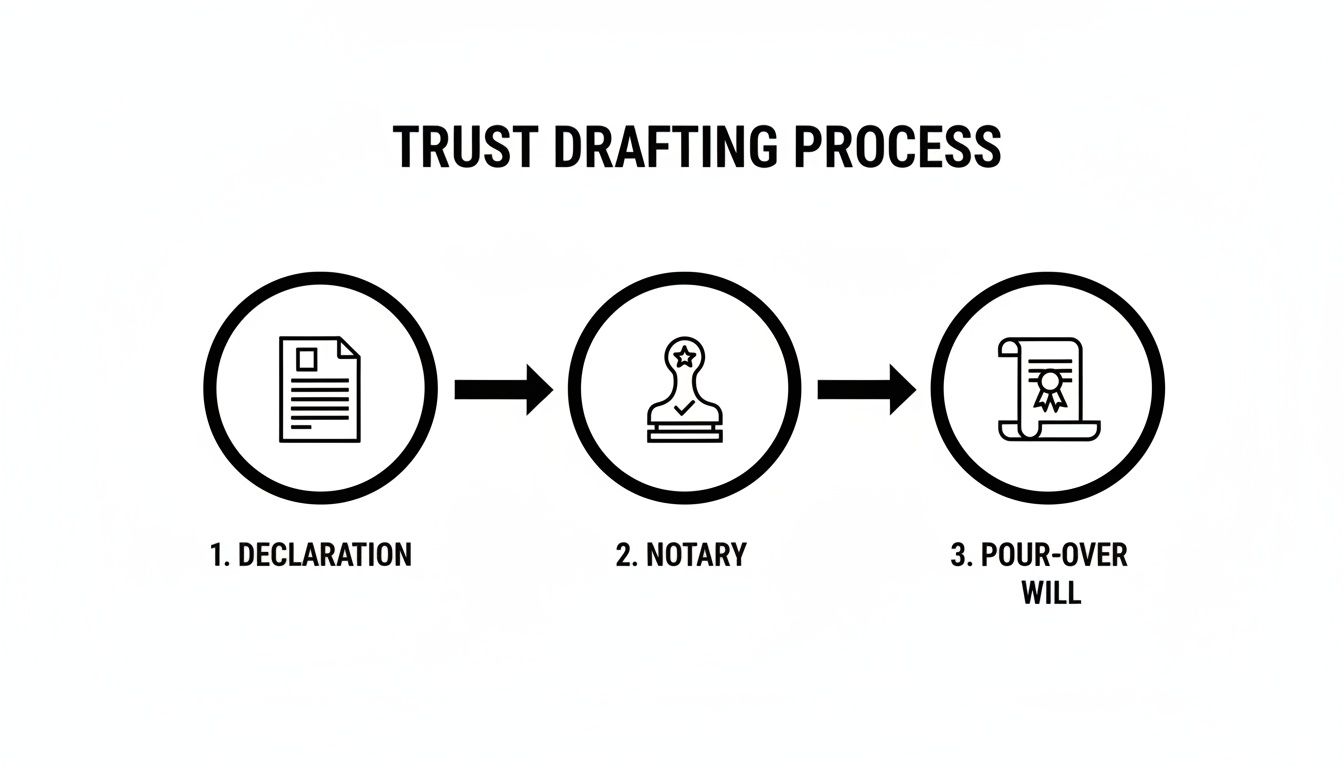
Once you’ve settled on the big-picture decisions—who gets what, when, and who’s in charge—it’s time to create the legal documents. This is where your vision for your family’s future gets translated into legally binding instructions. The main document is the Declaration of Trust, but a solid plan needs a few supporting documents to ensure nothing falls through the cracks.
The Declaration of Trust: Your Rulebook
The Declaration of Trust is the heart of your estate plan. It’s a detailed legal agreement that lays out every rule for managing and distributing your assets. Clear, specific instructions are your best defense against future confusion and family disputes.
Under the Texas Estates Code, this document must clearly identify the key players: you (the Grantor), your Trustee and Successor Trustee, and your Beneficiaries. It must also spell out the specific powers your trustee has. Can they sell real estate? Can they continue running your business? Defining these powers ahead of time prevents your trustee from having their hands tied.
Most importantly, the Declaration of Trust contains your distribution instructions. You can be as simple or as detailed as you want.
- You might instruct your trustee to distribute everything to your children in one lump sum when they turn 25.
- Or, you could get more specific, allowing funds to be used for a grandchild's college tuition but not for a risky business venture.
- You can even build in protections to shield a beneficiary's inheritance from creditors or a future divorce.
This is your chance to ensure your legacy is used exactly how you intend.
The Pour-Over Will: Your Safety Net
Even with careful planning, it’s easy to acquire a new asset and forget to formally move it into your trust. This is where a pour-over will becomes an indispensable safety net.
A pour-over will is a special type of last will and testament that works with your living trust. Its only job is to "catch" any assets that were left outside of your trust when you die and "pour" them into it.
Imagine you opened a new investment account last year and forgot to title it in the name of your trust. Without a pour-over will, that account gets stuck in the Texas Probate Process. With one, the will directs your executor to transfer the account into your trust, making sure it gets distributed according to your master plan.
Executing Your Trust: The Final Legal Step
In Texas, a trust document isn't legally valid until it's signed and notarized. This is a critical formality you can't skip. You will sign the Declaration of Trust in front of a notary public, who will verify your identity and witness your signature. Unlike a will, a living trust in Texas does not require witnesses—the notarization is the key step that makes the document legally enforceable.
Powers of Attorney: Planning for Incapacity
A living trust is fantastic for managing your assets if you become incapacitated, but it can’t make healthcare decisions for you or handle financial matters outside the trust. That's why any complete estate plan must include two other vital documents.
- Durable Power of Attorney for Finances: This document lets you appoint an agent to manage financial tasks not covered by the trust, like signing tax returns or dealing with Social Security.
- Medical Power of Attorney: Here, you name a trusted agent to make healthcare decisions on your behalf if you’re ever unable to communicate them yourself.
Together, these documents create a comprehensive plan that protects you and your assets during your lifetime.
The Critical Step: Funding Your Living Trust
Creating a beautifully drafted Declaration of Trust is a significant achievement, but it's only half the battle. A trust that hasn't been "funded" offers zero protection.
Think of it this way: a living trust is like an empty vault. It exists legally, but it holds no value until you fill it. That process of filling the vault is called funding the trust.
An unfunded or partially funded trust is one of the biggest reasons estate plans fail. Any assets left outside the trust don't get its protections. Instead, they'll almost certainly be forced through the public, time-consuming Texas Probate Process. This single oversight can completely unravel your hard work, leaving your family to face the very court system you wanted to avoid.
How to Transfer Your Assets into the Trust
"Funding" simply means retitling your assets from your individual name into the name of the trust. This makes the trust the legal owner, with you acting as the trustee who maintains complete control. Let's walk through a step-by-step guide.
Imagine Maria and David, a Dallas-area couple who just created "The Garcia Family Revocable Living Trust." Their major assets include their home, two checking accounts, a brokerage account, and personal belongings. Here is what they need to do:
Real Estate Deeds and Trust Funding
First, their house. Maria and David must sign and file a new deed with the county clerk. The current deed likely lists them as "Maria and David Garcia." The new deed will transfer ownership from themselves as individuals to "Maria and David Garcia, Trustees of The Garcia Family Revocable Living Trust dated [date of signing]."
This step is non-negotiable for avoiding probate on real property. You can read our guide on using trusts to manage real estate in Texas for more details.
Bank and Investment Accounts
Next, Maria and David will visit their bank and brokerage firm. They'll need a copy of their trust document (or a shorter document called a Certificate of Trust) to retitle their accounts.
- Checking & Savings: The account statements will now show the trust as the owner. They'll still use their debit cards and write checks just like before.
- Non-Retirement Brokerage Accounts: Stocks, bonds, and mutual funds will also be held in the trust's name. This is crucial for ensuring their portfolio can be seamlessly managed by their successor trustee.
Assigning Personal Property
For items that don’t have a title—like furniture, art, jewelry, and family heirlooms—you use a document called a General Assignment of Personal Property. This simple but powerful document formally states that you are transferring all of your tangible personal property into your trust. It's a catch-all that makes sure these sentimental and valuable items are covered.
The Critical Role of Beneficiary Designations
Some assets, like life insurance policies and retirement accounts (401(k)s, IRAs), pass directly to the people named on their beneficiary designation forms. These designations override both a will and a trust.
It is absolutely crucial to review and update these forms. For a life insurance policy, you might name the trust as the primary or secondary beneficiary. This gives your successor trustee the cash needed to pay final expenses and distribute the rest according to your trust's rules.
Retirement accounts are a special case due to complex tax rules. More often than not, it's best to name individuals directly as beneficiaries. However, for specific goals, like providing for a minor child, naming the trust might be the right move. This is one area where professional legal and financial advice is essential to avoid negative tax consequences.
Busting the Biggest Myths About Trust Costs and Taxes
Two things often stop Texas families from setting up a living trust: the perceived cost and a cloud of myths. People hear "living trust" and immediately think of sprawling estates, complicated legal maneuvers, and bills only a millionaire could afford.
That’s simply not the reality. A living trust is a practical tool for any family looking to protect what they’ve built. It is a one-time investment in your family's future peace of mind. You’re paying a manageable fee now to save your loved ones from the financial drain and emotional turmoil of probate court later.
Myth #1: "Trusts Are Only for the Super Rich"
This is the most persistent and damaging myth. If you own a home in Texas, have a 401(k), or run a small business, your estate is substantial enough to get tangled in the probate system. A trust isn't about the size of your bank account; it's about maintaining control, ensuring privacy, and making things efficient for the people you leave behind.
The current federal estate tax exemption is a staggering $13.99 million per person, but that number is irrelevant for most folks. The real focus should be on avoiding the probate process itself. Research shows that many middle-income Americans believe they don't have enough assets to bother with planning. This is a costly mistake. Even a modest estate can be diminished by probate fees and delays. You can find more on these estate planning roadblocks at eisneramper.com.
Myth #2: "A Trust Will Complicate My Taxes"
Another major source of confusion is taxes. People worry that putting their house or savings into a trust will trigger a nightmare of new tax forms. With a revocable living trust, your tax situation stays almost exactly the same.
Here’s the simple breakdown:
- You don’t need a new tax ID. As long as you're alive, the trust uses your personal Social Security number for everything.
- Your income taxes don’t change. Any income the trust assets generate gets reported on your personal Form 1040 just like it always has.
- There are no gift tax issues. Since you can pull assets back out of a revocable trust whenever you want, moving property into it isn't considered a taxable gift by the IRS.
For tax purposes, the IRS sees your revocable trust as an extension of you. The focus stays where it should be: on protecting your legacy and making things easier on your family.
Key Takeaways for Securing Your Family's Legacy
Figuring out how to set up a living trust is one of the most powerful and compassionate things you can do for your family. It’s about taking control, replacing uncertainty with a clear plan, and ensuring your legacy brings security, not stress. A well-designed living trust gives you privacy and ensures your wishes are followed exactly as you intended, all without dragging your family through unnecessary court battles.
Your Step-by-Step Checklist for a Rock-Solid Trust
A successful living trust boils down to a few critical actions:
- Make Smart Decisions Upfront: Choose a responsible, trustworthy successor trustee who can handle the job with integrity.
- Get the Legal Details Right: Your trust documents must be airtight and comply with the Texas Estates Code. Vague language can open the door to family fights and legal challenges, including potential Probate Litigation.
- Fund Your Trust—Completely: This is the most important step. You must retitle your house, bank accounts, and other property into the name of the trust to give it power.
- Don't Go It Alone: The cost of a mistake is far greater than the cost of getting it right. An experienced attorney ensures your trust is built to last.
Key Insight
A living trust isn't just about what happens after you die. It's a living document that protects you now. If you become incapacitated, your chosen successor can step in to manage your affairs, completely avoiding a costly and public court-ordered Guardianship. A trust is a central part of a complete estate plan, which should also include documents like Wills & Trusts and powers of attorney.
Taking these steps today is an investment in your family's peace of mind for years to come. You're creating a clear, private, and efficient path for them to follow when they need it most.
If you’re facing probate in Texas, our team can help guide you through every step — from filing to final distribution. Schedule your free consultation today.