Coming to the difficult realization that a parent might need a legal guardian is an emotional, confusing journey. If you’re here, you’re likely asking, “How do I get guardianship of my parent in Texas?” The whole process starts with one critical, court-mandated step: proving your parent is legally incapacitated and can no longer make safe decisions for themselves.
Think of it as a protective measure, not a punishment. It’s a process designed to shield a vulnerable loved one from harm when they can no longer protect themselves. At The Law Office of Bryan Fagan, we understand the delicate nature of this situation and are here to provide clear, step-by-step guidance for Texas families.
When Is Guardianship for a Parent Truly Necessary?
Deciding to pursue guardianship is one of the most profound and difficult choices an adult child can make. It’s a step born out of love and concern, usually after you’ve seen a pattern of behavior that puts your parent at serious risk. This isn’t about taking control; it’s about providing essential protection when they can no longer protect themselves.
In Texas, the law sees guardianship as a significant intervention because it removes a person’s fundamental right to make their own choices. Because of this, it is always considered a last resort. The courts will only grant a guardianship if there are no less restrictive alternatives available and you have clear, convincing evidence of a genuine need.
Understanding Incapacity in Texas
The Texas Estates Code has a very specific definition for an incapacitated person. In plain English, this isn’t about occasional forgetfulness or a few bad decisions. It refers to an adult who, because of a physical or mental condition, is substantially unable to:
- Provide their own food, clothing, or shelter.
- Care for their own physical health.
- Manage their personal financial affairs.
This legal standard has to be met with compelling proof, which almost always includes a detailed medical evaluation from a physician. The court’s primary focus is always on the well-being of the person in question, who is called the “Proposed Ward.”
A common reason families seek guardianship is a parent’s diagnosis with a progressive condition like Alzheimer’s. If you’re navigating this, it can be helpful to review resources for understanding Alzheimer’s disease to better grasp the symptoms and stages.
A Scenario Illustrating the Need
Consider Maria, whose 80-year-old father, David, lives alone. For months, she noticed small things—unpaid bills stacked on the counter, missed doctor’s appointments.
But the situation escalated when she discovered David had sent thousands of dollars to a telemarketing scam, convinced he had won a prize. He couldn’t recall the details and became agitated when Maria questioned him. A medical evaluation later confirmed he was in the mid-stages of dementia, impairing his judgment. This single incident crystalized the problem: David could no longer manage his finances safely, making him a prime target for exploitation. For Maria, this was the moment she knew she had to explore legal options to protect him.
Two Key Types of Guardianship
When you head down this path, it’s vital to know the different kinds of protection available. Texas law splits guardianship into two main forms.
Here’s a quick breakdown to help you see the difference:
Types of Guardianship in Texas at a Glance
| Type of Guardianship | What It Covers | When It’s Used |
|---|---|---|
| Guardian of the Person | Personal & medical care, living arrangements, day-to-day well-being. | When a parent can no longer make safe decisions about their health or daily life. |
| Guardian of the Estate | Finances, property, investments, and protecting assets from fraud. | When a parent is unable to manage their money, pay bills, or is vulnerable to financial exploitation. |
In many situations, like Maria’s with her father, a court might appoint one person to serve in both roles. However, the court will only grant the specific powers absolutely necessary to protect the Proposed Ward, sticking to the principle of using the least restrictive means possible, as required by the Texas Estates Code.
The demand for these protections is growing. Nationally, the adult guardianship system oversees approximately 1.3 million adults and $50 billion in assets, showing just how many families face this challenge.
Navigating the Texas Guardianship Legal Process
Once you’ve made the tough call that guardianship is the only path forward, you’re probably wondering what the legal road ahead looks like. The Texas court system has a very specific, structured process designed to protect your parent’s rights while determining if they are legally incapacitated. It can feel overwhelming, but when you break it down into steps, it’s much more manageable. The journey officially begins the moment you prepare and file a formal application with the court.
This simple visual breaks down the foundational steps: starting with a concern, defining the legal need for guardianship, and finally, taking formal action in court.
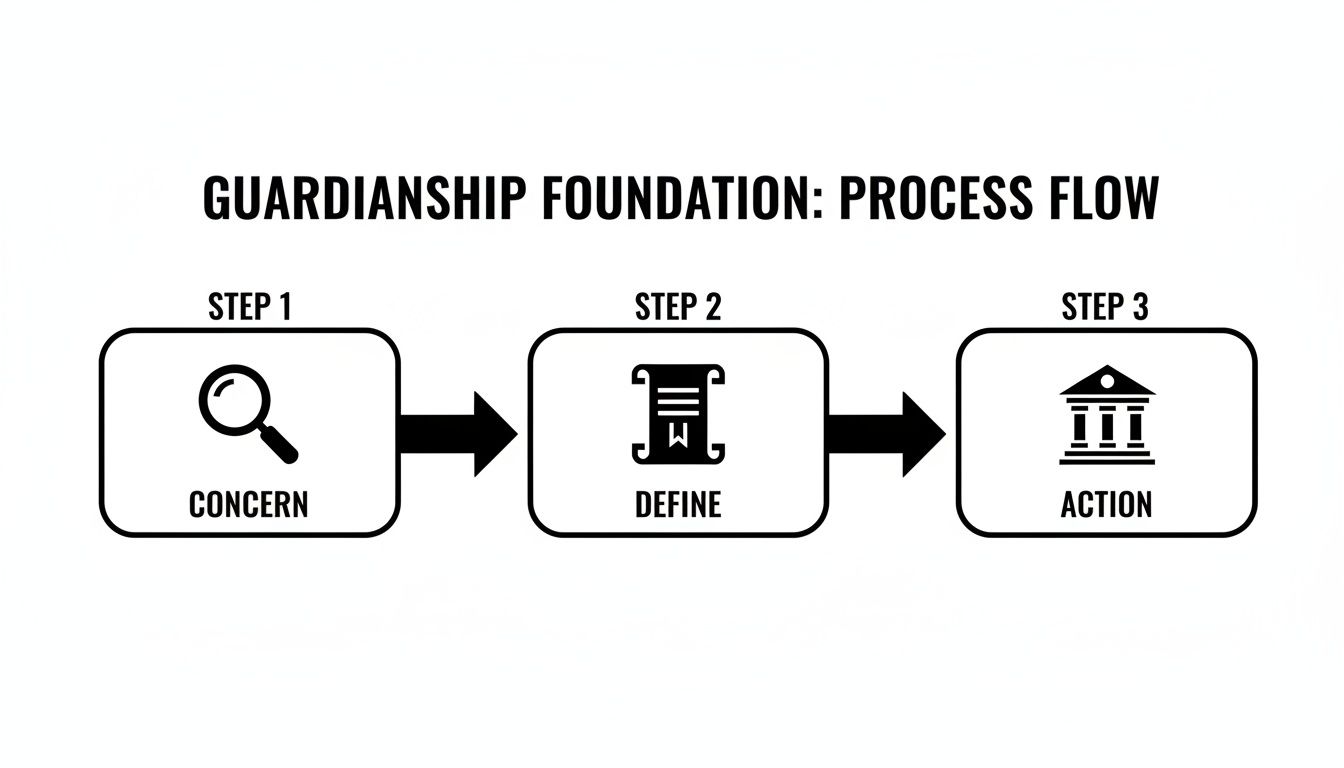
Each step is deliberate and designed to keep your parent’s well-being at the center of the process, moving from a personal observation to an official legal proceeding.
Step 1: Filing the Application and Essential Paperwork
The starting point for any guardianship case is filing an Application for Appointment of Permanent Guardian. This is typically filed in the county court where your parent lives. This isn’t just a simple form; it’s a detailed legal document that has to include very specific information required by the Texas Estates Code, Chapter 1101.
You’ll need to provide details like:
- Your name and relationship to your parent (the proposed ward).
- Your parent’s name, birthdate, and current address.
- A clear, factual statement explaining exactly why guardianship is necessary.
- The type of guardianship you’re seeking (of the person, of the estate, or both).
- A general description of your parent’s assets and financial situation.
Accuracy here is non-negotiable. Any mistakes or missing information can cause serious delays or even get your application thrown out, forcing you to start the clock all over again.
Step 2: The Role of the Attorney Ad Litem
Right after you file the application, the court will appoint an attorney ad litem. This is one of the most critical safeguards in the entire system. The ad litem is an independent lawyer whose only job is to represent your parent.
Key Insight: The attorney ad litem is not on your side or any other family member’s side. Their sole duty is to be the voice for your parent, advocating for their wishes, rights, and best interests. Think of them as the court’s eyes and ears on the ground.
This attorney will meet with your parent face-to-face, explain what’s happening in plain language, and get a feel for their physical and mental state. Afterward, they’ll file a formal report with the court detailing their findings and giving their professional recommendation on whether guardianship is the right move and who should be the guardian.
Step 3: Securing the Physician’s Certificate of Medical Examination
The absolute cornerstone of any guardianship case is the medical proof. In Texas, this proof comes in a very specific format: the Physician’s Certificate of Medical Examination (CME). This isn’t just any doctor’s note; it’s an official court form that must be filled out by a licensed Texas physician who has examined your parent within the last 120 days.
The CME needs to be detailed, describing the nature, degree, and severity of your parent’s incapacity. It should spell out their ability (or inability) to handle daily life—things like managing medications, cooking meals, and making sound financial choices. A vague or incomplete CME is one of the fastest ways to have a guardianship application fail. The doctor’s objective assessment gives the court the medical evidence it needs to make a legally sound decision.
Step 4: Preparing for the Court Hearing
The final major step is the court hearing. This is where a judge will review all the paperwork and listen to live testimony before making a final decision. As the person applying for guardianship, you will have to testify.
Be ready to answer questions about:
- Why you believe your parent is incapacitated.
- Specific, real-world examples of their inability to care for themselves or manage their finances.
- Why less restrictive options, like a power of attorney, won’t work in this situation.
- Your own qualifications and fitness to serve as a guardian.
The attorney ad litem will also be there to represent your parent. And if your parent wants to fight the guardianship, they have every right to attend the hearing and speak for themselves. In the end, the judge’s decision will come down to one thing: what is proven to be in the best interest of the proposed ward. You can dive deeper into the process by reading our complete guide on legal guardianship in Texas.
How to Prove Incapacity in a Texas Court
Proving your parent’s incapacity is the absolute heart of any guardianship case in Texas. This isn’t just a legal hurdle; it’s often the most challenging and emotionally delicate part of the entire process. A judge can’t grant a guardianship based on your word alone—they need clear, convincing evidence that your parent can no longer safely care for themselves or manage their own affairs.

The legal standard here is quite specific. You have to show the court that your parent is substantially unable to provide for their own food, clothing, or shelter, care for their physical health, or handle their finances. Let’s walk through how to build a strong, compassionate case that meets this high bar.
The Cornerstone of Your Case: The Physician’s Letter
While your personal testimony is powerful, the most critical piece of evidence is the Physician’s Certificate of Medical Examination (CME). As we’ve mentioned, this is a formal document signed by a Texas physician who has recently examined your parent. It provides the court with an objective, expert medical opinion.
Think of this letter as more than just a formality. The doctor needs to detail the specific nature, degree, and severity of your parent’s condition. A well-written CME will draw a direct line from a medical diagnosis—like advanced dementia or a debilitating stroke—to your parent’s inability to perform specific daily tasks.
Key Insight: A vague or incomplete CME is one of the most common reasons a guardianship application gets denied. The judge leans heavily on this medical assessment to understand the full picture, so making sure the physician provides a thorough, detailed report is absolutely essential.
Gathering Compelling Evidence Beyond the Doctor’s Note
Medical evidence is crucial, but it’s only part of the story. You also need to paint a clear picture of your parent’s day-to-day struggles with real-world examples. The court needs to see the practical impact their condition is having on their life.
This is where your role as an observer becomes vital. Start keeping a detailed journal or log of specific incidents that show their inability to function safely on their own.
Examples of Incidents to Document:
- Health and Safety: Note any instances of wandering, falls, missed medication doses, or forgetting to turn off the stove.
- Financial Management: Record any unpaid bills, strange or large purchases, susceptibility to scams, or difficulty balancing a checkbook.
- Daily Living: Document poor hygiene, a lack of food in the home, spoiled food in the refrigerator, or an inability to keep their living space clean and safe.
- Cognitive Decline: Write down examples of severe memory loss, confusion about the time or place, or an inability to recognize close family members.
These detailed records transform your general concerns into compelling evidence. This isn’t just a challenge for Texas families; it’s a global issue. In Japan, for instance, a rapidly aging population has put immense pressure on its guardianship system, with dementia cases expected to reach 5.53 million by 2025. You can read more about these global legal challenges and find that systems worldwide rely on strong evidence to protect their aging citizens.
A Real-World Scenario: Documenting Incapacity
Let’s look at a practical example. Mark’s father, Henry, was diagnosed with early-stage Alzheimer’s. At first, he seemed to be managing well. But then, Mark started noticing unsettling signs.
Instead of just worrying, Mark started a simple log in a notebook:
- October 5: Found a stack of unopened, past-due utility bills on the coffee table. Dad said he “forgot” to pay them.
- October 12: Neighbor called to say Dad was walking down the street in his pajamas at 6 AM, looking for his childhood home.
- October 20: Discovered Dad’s pill organizer was full for the past three days. He couldn’t remember if he’d taken his heart medication.
- November 2: Received a call from his bank’s fraud department. Dad had given his credit card information to a “lottery official” over the phone.
When Mark decided to pursue guardianship, this journal became powerful testimony. It gave the court a clear, chronological account of Henry’s declining ability to manage his own life. It was no longer just a son’s subjective opinion but a documented pattern of behavior that proved the need for protection. Your careful observations, when presented clearly, are invaluable in helping the judge make the right decision for your parent’s well-being.
Exploring Less Restrictive Alternatives to Guardianship
Texas law is crystal clear on this point: guardianship should be the absolute last resort. Because it involves removing a person’s fundamental rights, the courts demand that you explore every other less intrusive option first. Before you even think about filing a guardianship application, you must be ready to stand before a judge and explain precisely why these powerful, less restrictive tools aren’t a good fit for your parent’s situation.
More often than not, families can achieve the same protective goals without ever stepping into a courtroom for a guardianship hearing, especially if they plan ahead. These tools empower your parent to choose who they trust to make decisions for them, preserving their dignity and autonomy long before a crisis hits.
Powers of Attorney: The Foundation of Proactive Planning
The most common—and most effective—alternatives to guardianship are powers of attorney. These are simple but powerful legal documents that your parent signs while they still have the mental capacity to understand them. They appoint a trusted “agent” to act on their behalf if and when they can’t.
There are two primary types you absolutely need to know:
- Durable Power of Attorney: This document gives a trusted person the authority to manage your parent’s financial life. This isn’t just about paying bills; it can include managing bank accounts, selling property, and handling investments. The word “durable” is the key here—it means the document stays in effect even if your parent later becomes incapacitated.
- Medical Power of Attorney: This appoints a healthcare agent to make medical decisions if your parent is unable to communicate their own wishes. This is the person who will consent to treatments, speak with doctors, and access critical medical records on their behalf.
These documents are proactive, not reactive. They must be signed before your parent loses the ability to make their own decisions. To get this right, it’s vital to understand the critical difference between power of attorney and guardianship.
Advance Directives and Supported Decision-Making
Beyond the core powers of attorney, a few other tools can provide critical support and guidance, often eliminating the need for a full guardianship altogether.
A Living Will, known in Texas as a Directive to Physicians, is a document that clearly outlines your parent’s wishes for end-of-life medical care. It instructs doctors on whether they want life-sustaining treatments used or withheld if they have a terminal or irreversible condition. This powerful document speaks for your parent when they cannot, ensuring their deepest values are honored.
Another modern alternative is a Supported Decision-Making Agreement. This is a formal agreement, recognized under Texas law, that allows a person with a disability to select trusted advisors—like family members or friends—to help them understand their options and make their own choices. The individual keeps all their legal rights, but they have a formal support system to help them process information and communicate their decisions.
Key Insight: The core difference between these alternatives and guardianship is consent. With powers of attorney and other directives, your parent chooses who helps them. In a guardianship, the court makes that choice for them after they’ve been deemed unable to choose for themselves.
When Alternatives Are No Longer an Option
So, when does guardianship become the only path forward? The answer almost always comes down to two things: timing and capacity.
Let’s look at two very different real-world scenarios:
- The Proactive Planner: Sarah’s mother, at age 75 and in perfect health, worked with an attorney to create a comprehensive estate plan. She signed a Durable Power of Attorney appointing Sarah as her financial agent and a Medical Power of Attorney naming her as her healthcare agent. Years later, when her mother suffered a stroke and could no longer communicate, Sarah stepped in immediately. She paid bills from her mom’s account and made crucial medical decisions without any court involvement. The plan worked exactly as intended.
- The Sudden Crisis: David’s father, on the other hand, developed a rapid-onset dementia without any legal documents in place. He started giving money away to strangers and refusing necessary medical care. Because he no longer had the mental capacity to understand and sign a power of attorney, David’s only option to protect him from harm was to petition the court for guardianship.
This is exactly why we urge families to have these conversations early. Proactive planning is the single best way to avoid the emotional and financial cost of a court-mandated guardianship. Exploring a robust plan with our guidance on Wills & Trusts can make all the difference.
Managing Family Disputes and Contested Guardianships
Ideally, the decision to pursue guardianship is a united family effort, but the reality is often much messier. When siblings can’t agree on a parent’s condition or who should be in charge, the process can spiral into a painful and legally exhausting battle. A contested guardianship doesn’t just add paperwork; it adds layers of stress to an already emotionally charged situation.

These disputes rarely pop up out of nowhere. They’re often rooted in long-standing family dynamics, resentments, and deeply personal histories. Understanding what usually triggers these fights can help you see potential conflicts coming and navigate them more effectively.
Common Triggers for Guardianship Disputes
Family blow-ups over guardianship often stem from different perceptions, relationships, and financial anxieties.
Here are some of the most frequent sources of disagreement we see in our practice:
- Differing Perceptions of Decline: The sibling who lives nearby sees mom’s daily struggles and growing confusion. The sibling who lives out of state only talks to her on good days and thinks a guardianship is a dramatic overreaction.
- Distrust Among Siblings: If there’s a history of bad blood, one sibling might suspect the other is just trying to get control of the inheritance or freeze them out of their parent’s life.
- Suspicions of Financial Exploitation: Sometimes, a family member will fight a guardianship because they believe the person applying has been mismanaging dad’s money or isn’t acting in his best interest.
- Disagreement on Care: Siblings might have fundamentally different ideas about what’s best for a parent. Should they stay at home with 24/7 care, or is an assisted living facility the safer option? These are huge, emotional decisions.
When these disagreements can’t be resolved, the case officially becomes a contested guardianship. It’s no longer a straightforward proceeding—it’s now a full-blown lawsuit.
What Happens in a Contested Guardianship Case
A contested case is a whole different ballgame. The court has to step in and act as a referee, and the process becomes far more formal and evidence-driven, much like a trial.
Key Insight: In a contested guardianship, the judge’s focus is always on the Proposed Ward. The court’s only job is to determine two things based on the evidence presented: Is the parent truly incapacitated, and if so, who is the most suitable person to serve their best interests?
This means the legal battle can get intense. You can expect more aggressive legal steps, including:
- Depositions: Attorneys for each side will question witnesses—family members, doctors, caregivers—under oath.
- Discovery: Both sides can formally demand documents and evidence from each other, like financial records, medical reports, or emails.
- Formal Trial: If the family can’t reach an agreement, the case heads to trial. A judge will hear testimony, review all the evidence, and make the final decision.
A Real-World Scenario: Sibling Disagreement
Let’s look at a common scenario. Two brothers, Tom and Mike, are at odds over their mother, Eleanor. Tom, who lives with Eleanor, sees her daily confusion and the stack of unpaid bills on her desk. He files for guardianship to protect her.
Mike, who lives across the country, objects. He’s convinced Tom is just trying to seize control of their mother’s estate. The case is now contested.
The court requires both brothers to back up their claims with evidence. Tom brings a detailed journal of his mother’s memory lapses and financial mishaps, along with her doctor’s official medical certificate. Mike presents phone records, arguing his mother sounds perfectly fine during their weekly calls.
Ultimately, the judge leans on the objective medical evidence and the report from the independent attorney ad litem, who met with Eleanor and confirmed her incapacity. The court grants the guardianship but, to avoid fueling more family conflict, appoints a neutral, third-party professional as guardian.
To learn more about the specific grounds and procedures for challenging a guardianship, our guide on how to contest a guardianship in Texas probate court provides even more detail. This scenario shows just how critical skilled legal guidance becomes when navigating these difficult family conflicts, ensuring the parent’s well-being remains the top priority.
Wrapping Up: Your Next Steps on This Difficult Path
The road to securing guardianship for a parent is one of the toughest journeys an adult child will ever take. It’s a path layered with complicated emotions and legal hurdles that can easily feel overwhelming. The process is demanding for a reason—it’s designed to protect your parent’s fundamental rights, requiring absolute proof of incapacity before a court will step in.
Remember, Texas law always treats guardianship as a last resort. Before you even file, the court will want to know that you’ve explored every less restrictive alternative, like a Medical Power of Attorney or a Durable Power of Attorney. If your parent’s condition has moved past the point where those documents can help, then the legal process must be followed to the letter, from filing the initial application to presenting irrefutable evidence at the hearing.
You Don’t Have to Walk This Path Alone
We get it. This is an incredibly stressful time. The weight of making these kinds of decisions for a loved one is immense, and you shouldn’t have to carry that burden by yourself. Having the right legal guidance can make all the difference, offering you clarity and confidence when you need it most.
Takeaway: Seeking guardianship is ultimately an act of love and protection. The legal system is built to make sure it’s the right and only choice for your parent’s well-being. A compassionate attorney ensures your case is handled correctly while you focus on what really matters—your family.
Our team has helped countless Texas families navigate this difficult terrain. We manage the legal complexities of the Texas Probate Process so you can concentrate on your parent’s care. Whether you need help with a Guardianship, want to plan ahead with Wills & Trusts, or need to resolve family disputes through Probate Litigation, we’re here to support you.
If you’re facing probate or guardianship in Texas, our team can guide you through every step—from the first filing to the final court order. Schedule your free consultation today.
Your Top Questions About Texas Guardianship, Answered
When families start exploring guardianship, a lot of practical questions come up. It’s a significant step, and it’s natural to have concerns. Below are straightforward answers to some of the most common things families ask when considering guardianship for a parent in Texas.
How Much Does It Cost to Get Guardianship in Texas?
The cost of a guardianship can swing pretty dramatically depending on how complex things get. You’ll have some standard expenses right out of the gate, like court filing fees and the cost to have legal notices served. The court will also appoint an “attorney ad litem” to represent your parent, and that attorney’s fee is another required cost.
On top of that, you’ll have the fees for your own lawyer. A significant portion of the total cost will be for your legal counsel. The good news is that in most cases, these expenses are paid directly from your parent’s estate, since the entire process is for their benefit and protection. An uncontested guardianship is always going to be far less expensive than a contested one, which can quickly become a costly legal battle.
Can My Parent Fight the Guardianship?
Yes, absolutely. Both the U.S. Constitution and Texas law protect your parent’s fundamental rights throughout this process. A person facing guardianship (the “proposed ward”) has the right to show up at the hearing, ask for a jury trial, and cross-examine any witnesses.
Most critically, they have the right to their own attorney. The court appoints an attorney ad litem whose job is to advocate for what your parent says they want. If your parent clearly states they don’t want a guardian, their attorney is legally obligated to fight the guardianship application on their behalf.
What Are My Responsibilities as a Guardian?
Taking on the role of a guardian is a serious commitment with strict legal duties. What you’ll be responsible for depends on whether you’re appointed as a guardian of the person, the estate, or both. It’s a profound responsibility.
- Guardian of the Person: You’re in charge of your parent’s physical well-being. This means making decisions about their medical care, where they live, and their day-to-day personal needs.
- Guardian of the Estate: Your focus is on managing your parent’s finances. You’ll need to pay their bills, protect their assets from being wasted, and invest their money prudently.
No matter which role you have, all guardians must file a detailed annual report with the court. This report provides an update on your parent’s condition and, if you’re managing their money, a full accounting of every single financial transaction you made for them.
If you’re facing probate in Texas, our team can help guide you through every step — from filing to final distribution. Schedule your free consultation today.