When a loved one passes away, the task of finding their will can feel overwhelming on top of everything else. We understand this is a difficult time, and our goal is to provide clear, step-by-step guidance to help you navigate this process with confidence and care. The good news is that you don't have to turn the house upside down immediately. Most people keep their most important documents in just a few predictable places.
The first step is always a methodical search of their home, focusing on where they handled their financial and personal affairs.
Your First Steps to Find a Loved One's Will
Think like they did. Where did they keep tax returns, car titles, or bank statements? The will is almost certainly nearby.
Start by checking these common spots:
- A home safe or a fireproof box
- The drawers of a personal desk or home office
- A specific folder or filing cabinet where other important papers are stored
Realistic Scenario: We once worked with a family who found their father's will tucked inside a dusty box of old tax records from ten years prior. It was the last place they thought to look, but it proves that being thorough is absolutely critical. Don't overlook anything in their personal files.
Contact Key Advisors
If a careful search of the home comes up empty, your next move is to reach out to the professionals your loved one trusted. The most likely person to have a copy—or even the original document—is their estate planning attorney. It’s standard practice for law firms to keep original wills for their clients for safekeeping.
Their accountant or financial advisor are also great resources. While they are bound by confidentiality, they can usually confirm if they are aware of a will and point you in the right direction once you provide a death certificate and proof of your relationship. In Texas, it’s estimated that as many as 30% of original wills are held by the law firm that drafted them, making this a crucial step in your search. You can find more data on how legal documents are managed in reports on eDiscovery trends from electroiq.com.
This flowchart breaks down the search process into a clear, logical path.
As you can see, the process starts with the most personal and accessible locations before expanding to professional contacts and official records.
To help you stay organized, here’s a quick checklist of the best places to start looking.
Where to Begin Your Search: A Quick Checklist
| Location Type | Specific Places to Look | Expert Tip |
|---|---|---|
| Personal & Home | Home safe, fireproof box, desk drawers, filing cabinets, safe deposit box. | Check inside folders labeled "Taxes," "Insurance," or "House Documents." Wills are often filed with related paperwork. |
| Professional Advisors | The deceased's estate planning attorney, accountant, or financial advisor. | Always start with the attorney who drafted the will. They are the most likely to hold the original or have a digital copy. |
| Official Records | The County Clerk's office in the county where the person lived. | This is less common, but some people file their will for safekeeping. It's a quick phone call that's worth making. |
This checklist covers the most common places a will is found. Systematically working through these locations will give you the best chance of finding the document quickly.
Check With the County Clerk
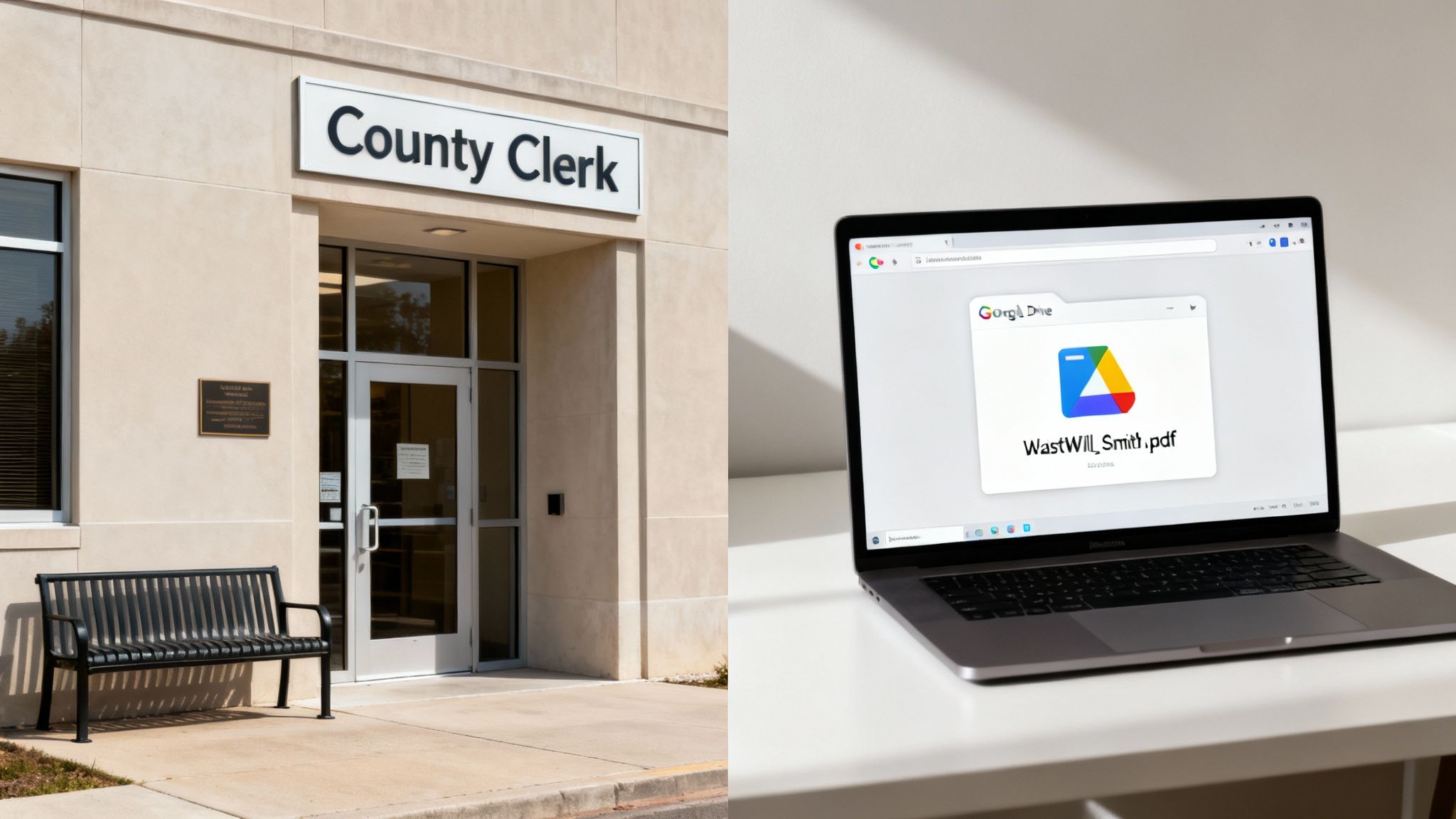
It’s not the most common practice, but some people choose to file their will for safekeeping with the county clerk in their county of residence. It’s a simple check that can sometimes save you a lot of time and effort. A quick phone call is all it takes.
If you do locate the will through any of these methods, the next step is to understand the Texas probate process, which is the formal court procedure required to validate the will and officially settle the estate.
Searching Official Records and Digital Spaces
When the usual spots—personal papers, safe deposit boxes, and professional advisors—come up empty, it's time to broaden your search. The next phase involves digging into official records and the deceased's digital life. It requires a more methodical approach, but this is often where a missing will finally turns up.
Your first official stop should be the county clerk’s office in the Texas county where your loved one lived. It’s not as common today, but some people still file their original will with the clerk for safekeeping. A simple phone call or visit can sometimes end the entire search right then and there.

The Role of County Probate Courts
Historically, wills were almost always filed with the county probate courts right after death. While the eDiscovery market is now projected to hit $22.65 billion by 2028, signaling a massive shift to digital, the county clerk remains a critical resource for Texas families.
Under Title 2 of the Texas Estates Code, a will generally must be filed for probate within four years of the person's death, making the clerk’s records a primary repository. You can take a closer look at this process in our guide on how to find probate records in Texas.
To give you a sense of volume, Harris County courts handled over 5,000 probate cases in 2023 alone. A surprising number of those involved tracking down a lost will or sorting out a contested one.
Expanding the Search to Digital Assets
These days, it's just as important to check your loved one's digital footprint. More and more people store copies of critical documents, including their wills, in digital formats.
Your digital search should cover a few key areas:
- Personal Computers and Hard Drives: Start by searching for files named “will,” “estate plan,” or “last testament.” Don't just check document folders; look on the desktop and in the downloads folder, too.
- Email Accounts: Run a search in their inbox and sent folders. You might find emails exchanged with their attorney, which could include drafts or even a scanned copy of the fully signed will.
- Cloud Storage Services: People lean heavily on services like Google Drive, Dropbox, and iCloud to back up their most important files. Log in and see what you can find.
Let's walk through a realistic scenario. Imagine you're searching your mother's laptop and find a folder labeled "Important Docs." Inside, there's a PDF scan of her signed and witnessed will. Now, a scanned copy usually isn't enough to open probate—the court will want the original "wet ink" document.
But that PDF is a goldmine. It names the lawyer who drafted it and the people who witnessed it. This single digital file gives you the exact leads needed to track down the original document, potentially saving your family months of legal headaches and uncertainty. This situation is becoming incredibly common and shows just how vital a thorough digital search can be.
What to Do Immediately After You Find the Will
Finding your loved one’s will is a significant moment of relief and clarity, but it’s also the first step in a formal legal process. Before you do anything else, protect the document itself. Do not unstaple, make notes on, or alter the will in any way. A court might see any changes, no matter how innocent, as tampering, which can create a huge, unnecessary headache.
Once the original will is safe, the next step is to begin the probate process. In plain English, probate is the formal court procedure where a judge confirms the will is valid and officially gives the person named as Executor the authority to manage the estate. The Executor is simply the person the deceased trusted to carry out their final wishes.
Starting the Probate Process in Texas
The probate court’s main job is to make sure the will is authentic and legally sound. After the will is filed and validated, the court issues a document called Letters Testamentary. Think of this as the Executor’s official permission slip. It gives them the legal power to handle crucial tasks, like accessing bank accounts, dealing with creditors, and eventually distributing property to the heirs.
Getting your head around these initial steps can make the whole journey feel a lot more manageable. For a deep dive, you can check out our guide on the Texas Probate Process.
Let's walk through an example. Imagine "Sarah" is named the Executor in her father’s will. After she finds the document, she contacts a probate attorney. Together, they file the will with the proper county court and submit an Application for Probate. As required by the Texas Estates Code, legal notices are then sent to all beneficiaries named in the will.
After a brief waiting period and a court hearing, the judge confirms the will is valid and officially appoints Sarah as Executor. The court then issues her the Letters Testamentary. With this document in hand, Sarah can finally open an estate bank account, start collecting her father’s assets, and begin the work of settling his final affairs according to his wishes. While the process varies by location, learning about the steps for how to probate a will in Ontario can offer a different perspective on how wills are legally validated elsewhere.
Navigating The Path When No Will Can Be Found
Discovering that a loved one passed away without a will adds a heavy layer of uncertainty to an already difficult time. When this happens, it’s known as dying intestate. This doesn't mean chaos will follow. Thankfully, the State of Texas has a clear, default set of rules for how property gets distributed.

These rules, laid out in Chapter 201 of the Texas Estates Code, are called intestacy laws. Think of them as a substitute will created by the state. They outline a strict hierarchy for who inherits and in what proportion, based entirely on the deceased person's family structure at the time of their death.
Understanding Texas Intestacy Laws
The state’s primary goal with these laws is to pass property to the closest living relatives. For example, if the person who passed was married and only had children with that surviving spouse, the spouse generally inherits all the community property (assets acquired during the marriage). But things get much more complicated with blended families.
Consider this common scenario: A man passes away, leaving behind his second wife and two adult children from his first marriage. Under Texas intestacy laws, here’s how his estate would be divided:
- His surviving spouse keeps her half of the community property.
- The deceased's half of the community property is inherited by his children, not his new spouse.
- His separate property (assets he owned before the second marriage or received as a gift or inheritance) is also split. His spouse receives one-third, and his children from the first marriage share the remaining two-thirds.
As you can see, the default rules may not align at all with what your loved one would have wanted. This is exactly why having a well-drafted will is so critical. You can learn more in our detailed guide on probate procedures in Texas when there is no will.
Legal Tools For Estates Without a Will
Without a will, you'll need a court to legally establish who the heirs are. Texas provides a couple of different tools for this, and the right one depends on the estate's complexity. For much simpler estates, an Affidavit of Heirship might be an option. This is a sworn statement filed in the public records that identifies the heirs. While it’s less expensive than a full court proceeding, it's a weaker solution. Many banks won't accept it, and it can cause headaches when trying to sell real estate.
Will vs No Will: A Comparison of Next Steps in Texas
| Scenario | Primary Legal Process | Who Manages the Estate? | How Assets Are Distributed |
|---|---|---|---|
| A Valid Will Is Found | Probate of Will | The Executor named in the will. | According to the specific instructions written in the will. |
| No Will Can Be Found | Intestate Administration & Determination of Heirship | A court-appointed Administrator. | According to Texas intestacy laws, based on family relationships. |
The differences are stark. A will gives the deceased control over who manages their estate and who inherits their property. Without one, the state makes those decisions for them, and the outcome isn't always what the family expects. An experienced probate attorney can help you determine the right path for your family's situation and navigate the legal requirements efficiently.
Key Takeaway
When you're grieving, the last thing you want is a scavenger hunt. But finding a will can feel exactly like that. The key is to be methodical. Start with the obvious places—the home office, safes, and filing cabinets—before you broaden your search to professional advisors and official county records.
And don't just look for paper. We're living in a digital world, so cloud storage accounts and email archives are now common places to find crucial documents. Even a scanned copy can give you the leads you need to track down the original.
The Value of Professional Guidance
While you can certainly handle the initial search yourself, the legal road ahead is paved with Texas-specific complexities. It doesn’t matter if you find one will, multiple versions, or no will at all—the next steps you take are critical and can have permanent consequences for your family. This is where professional guidance isn't just helpful; it's essential.
The laws in the Texas Estates Code are intricate, covering everything from the four-year time limit for probate to the exact procedures for handling an estate when someone dies without a will (intestate). Going it alone can easily lead to costly mistakes, missed deadlines, and a mountain of unnecessary stress for your family.
Key Insight: An experienced probate attorney is more than just a legal advisor; they are your guide and advocate. Bringing one in early ensures you follow the right procedures, protects you from personal liability, and offers compassionate support when you need it most.
Hiring an attorney can stop a difficult situation from spiraling into a legal crisis. They will help you understand all your options, whether it’s navigating the formal Texas Probate Process, establishing a Guardianship, or handling a dispute through Probate Litigation. Of course, the best way to avoid these problems is to build a solid estate plan with Wills & Trusts from the start.
Our firm is here to provide that expert guidance. We’ll help you make sense of your duties and make sure you don't have to walk this path alone.
If you’re facing probate in Texas, our team can help guide you through every step — from filing to final distribution. Schedule your free consultation today.
Frequently Asked Questions About Locating a Will in Texas
The search for a will can bring up a lot of questions, especially when you run into roadblocks. Trying to figure this all out while grieving is tough, so we’ve put together answers to some of the most common questions we hear from Texas families. Our goal is to give you clear, straightforward information to help you move forward.
What if I Find Multiple Wills?
It's surprisingly common to find more than one will, especially if your loved one updated their estate plan over the years. In Texas, the law is pretty clear: the most recently executed will is the one that counts, as it almost always includes language revoking any older versions.
But don't just assume the newest one is legally sound. For a will to hold up in court, it must meet the standards of the Texas Estates Code, Section 251.051. It has to be:
- In writing.
- Signed by the person who made it (the testator).
- Witnessed by two credible individuals, both over 14, who also sign it in the testator's presence.
Whatever you do, do not throw any of these documents away. Every version you find should be reviewed by a probate attorney. Sometimes, a technical issue with the newest will could make an older one valid again. Only a legal professional can sort through them, determine which document meets all the statutory requirements, and advise on which one the court will likely uphold.
How Long Do I Have to Probate a Will in Texas?
The Texas Estates Code sets a firm deadline. You generally have four years from the date of death to file the will with the probate court. Waiting longer than that creates a significant legal challenge.
If you miss the four-year cutoff, you'll have to prove to the court that you weren't "in default" for the delay. This means you need a very good, legally acceptable reason for not filing sooner—and it’s a tough argument to win.
If the court refuses to accept the late will, the estate will be treated as if no will ever existed (intestate). The assets will then be divided according to state law, which might be the last thing your loved one wanted. This strict timeline is exactly why you need to act quickly once you find the will.
Can I Get into a Safe Deposit Box to Look for a Will?
Yes, but you can’t just walk into the bank and demand they open it. Texas law provides a specific, court-supervised way to access a safe deposit box when you're searching for a will.
The process involves petitioning the court for an order to examine its contents, usually by presenting a death certificate and filing a formal application. A judge can then issue an order that allows you to open the box in the presence of a bank employee for the sole purpose of finding a will.
Key Insight: If a will is found inside the box, the bank is legally required to deliver it directly to the court clerk or the person named as the executor. An experienced probate attorney can help you file the correct paperwork to get the court order, ensuring the search is done legally and properly.
What Is the Difference Between an Executor and an Administrator?
While their duties are very similar, the main difference comes down to how they get the job.
An Executor is the person specifically named in a will to manage the estate and carry out the deceased's wishes. The testator chose them for the role.
An Administrator is appointed by the court when there is no will (intestacy) or if the named executor in the will can't or won't serve.
Both have a fiduciary duty—a legal obligation to act in the best interests of the estate and its beneficiaries. Their tasks are largely the same: gather assets, pay off debts, and distribute what's left. The key distinction is that an executor follows the roadmap left in the will, while an administrator has to follow the inheritance rules set by Texas law.
If you’re facing probate in Texas, our team can help guide you through every step — from filing to final distribution. Schedule your free consultation today.