If you're wondering whether you can cancel a power of attorney, the answer is a firm yes—as long as you have the mental capacity to make that call. Think of it as your right to change your mind. Formally, this is done by creating a legal document called a Revocation of Power of Attorney.
Your Right to Change Your Mind
Life is unpredictable. The trusted arrangements you made yesterday might not be the right fit for today. Granting someone a Power of Attorney (POA) is a significant act of trust, but it’s not set in stone.
As the person who created the document (the “principal”), you always hold the power to change or cancel it, provided you are mentally competent. This authority is a cornerstone of Texas estate planning, ensuring you remain in the driver's seat of your own personal, financial, and medical decisions.
Common Reasons for Revoking a Power of Attorney
People decide to cancel a Power of Attorney for all sorts of deeply personal and practical reasons. There's no right or wrong motivation; what matters is that the arrangement no longer serves your best interests.
In our practice, we see this happen for several common reasons:
- A relationship sours: A once-trusted relationship with the agent (the person you appointed) may have broken down due to a disagreement, divorce, or just a simple falling out.
- Trust is lost: You might start to worry that the agent isn't acting in your best interest, is mismanaging your finances, or simply can no longer be trusted with such critical responsibilities.
- The agent can't serve anymore: The person you chose may have passed away, become ill, moved far away, or even just told you they no longer want the responsibility.
- Your needs have changed: Maybe you appointed an agent to handle a specific, temporary situation—like a long hospital stay—that has now been resolved, making the POA unnecessary.
- Someone better comes along: Perhaps another family member or a professional is now in a better position to act as your agent, and you want to appoint them instead.
Understanding the Document You're Cancelling
Before you jump into the cancellation process, it helps to know exactly what you’re revoking. A POA is a legal document that gives a person you choose—your agent—the authority to act on your behalf. The two most common types in Texas are:
- General Power of Attorney: This gives your agent broad authority but automatically becomes invalid if you become incapacitated (unable to make decisions for yourself).
- Durable Power of Attorney: This is the go-to for most estate plans because it stays in effect even if you become incapacitated. That durability is exactly why it's so critical to ensure the person you appoint is completely trustworthy. You can learn more by exploring our detailed guide on what is a Power of Attorney.
Key Takeaway: The single most important factor in your ability to cancel a POA is your legal capacity. In plain English, this just means you must be able to understand the nature and consequences of your decision. If you understand what a POA is, who your agent is, and what it means to take that power away, you have the capacity to cancel it.
The Official Process for Revoking a POA in Texas
Deciding to cancel a Power of Attorney isn't something people do lightly. It’s a serious move, and if you don't follow the right steps, your attempt to revoke it won't be legally effective. The process in Texas is clear-cut, but you have to pay close attention to the details. It all boils down to creating a formal document called a Revocation of Power of Attorney.
This isn't just a simple letter you dash off. Think of it as a legal notice that formally shuts down the authority you gave your agent. For it to hold up, the document needs to be in writing and contain very specific information that leaves zero room for misinterpretation.
Crafting Your Revocation Document
The revocation document needs to be created with the same seriousness as the original POA. Under Title 2 of the Texas Estates Code, the law is very clear: your revocation must be signed and acknowledged before a notary public, just like the original document was. This isn't just red tape; it's a legal safeguard to ensure the decision is deliberate and legally sound.
Getting this document right is critical. Here’s a rundown of what your written notice must include.
Key Elements for Your Revocation Document
To ensure your Revocation of Power of Attorney is valid in Texas, it must contain specific information. This table breaks down what you need and why each piece is so important.
| Component | Description | Why It's Important |
|---|---|---|
| Your Full Legal Name | As the principal, your name should appear exactly as it did on the original POA. | This clearly identifies you as the person who is canceling the authority. |
| Agent's Full Legal Name | The complete legal name of the person you appointed as your agent. | Avoids any confusion about which agent's powers are being terminated. |
| Date of Original POA | The specific date the Power of Attorney you are canceling was signed. | This pinpoints the exact document being revoked, especially if multiple POAs exist. |
| Unambiguous Statement | A clear, direct declaration that you are revoking all authority. | Wording like, "I hereby revoke the Durable Power of Attorney dated [Date], in which I appointed [Agent's Name] as my agent," leaves no doubt about your intent. |
Each of these elements works together to create a legally binding document that protects your decision. For many families, this isn't just a legal transaction; it often marks the end of a trusted arrangement and can come with a lot of emotional weight.
A Realistic Scenario One Family Faced
Let's look at a real-world example to illustrate the process. Maria, an 80-year-old widow in Houston, signed a durable POA five years ago, naming her oldest son, David, as her agent. At the time, he lived just a few miles away and was the obvious choice to manage her finances if she ever needed help.
But life changes. David recently took a new job and moved out of state. Around the same time, Maria's daughter, Sofia, moved back to Houston to be closer to her. After thinking it over, Maria decided Sofia was now in a much better position to handle local banking and healthcare matters. The family dynamic had simply evolved.
Maria felt guilty and was worried about hurting David’s feelings, but she knew it was the practical thing to do. We helped her draft a clear Revocation of Power of Attorney for David and, in the same sitting, create a new POA naming Sofia as her agent. It was a proactive step that ensured her affairs would remain in the hands of someone who could give her immediate, local help. This step-by-step guidance provided her reassurance during a sensitive family transition.
The reasons for revoking a POA can be as simple as a change in life circumstances or as painful as a breach of trust.

Whether your needs evolve, relationships change, or trust is broken, you always have the right to reassess and change your arrangements.
Legal Formalities Are Non-Negotiable
The core process for canceling a power of attorney is fairly consistent across the country: it hinges on a formal written notice from a mentally competent principal. The Ohio State Bar Association confirms a principal can revoke a financial POA at any time as long as they have the mental capacity to do so. The revocation usually has to be signed, and many states—Texas included—require it to be notarized or witnessed with the same formality as the original POA.
Key Takeaway: Simply telling your agent "you're fired" or tearing up your copy of the POA is not enough. The revocation is only legally effective once you have a formal, written, signed, and notarized document, and you have properly notified the agent and any relevant third parties.
Because the legal rules have to be followed to the letter, many people find it helpful to get professional guidance. To navigate the complexities of state laws and make sure every requirement is met, you might choose to engage lawyers on demand. This ensures your revocation is handled correctly from the start, protecting you from potential headaches down the road.
Notifying Your Former Agent and Key Institutions
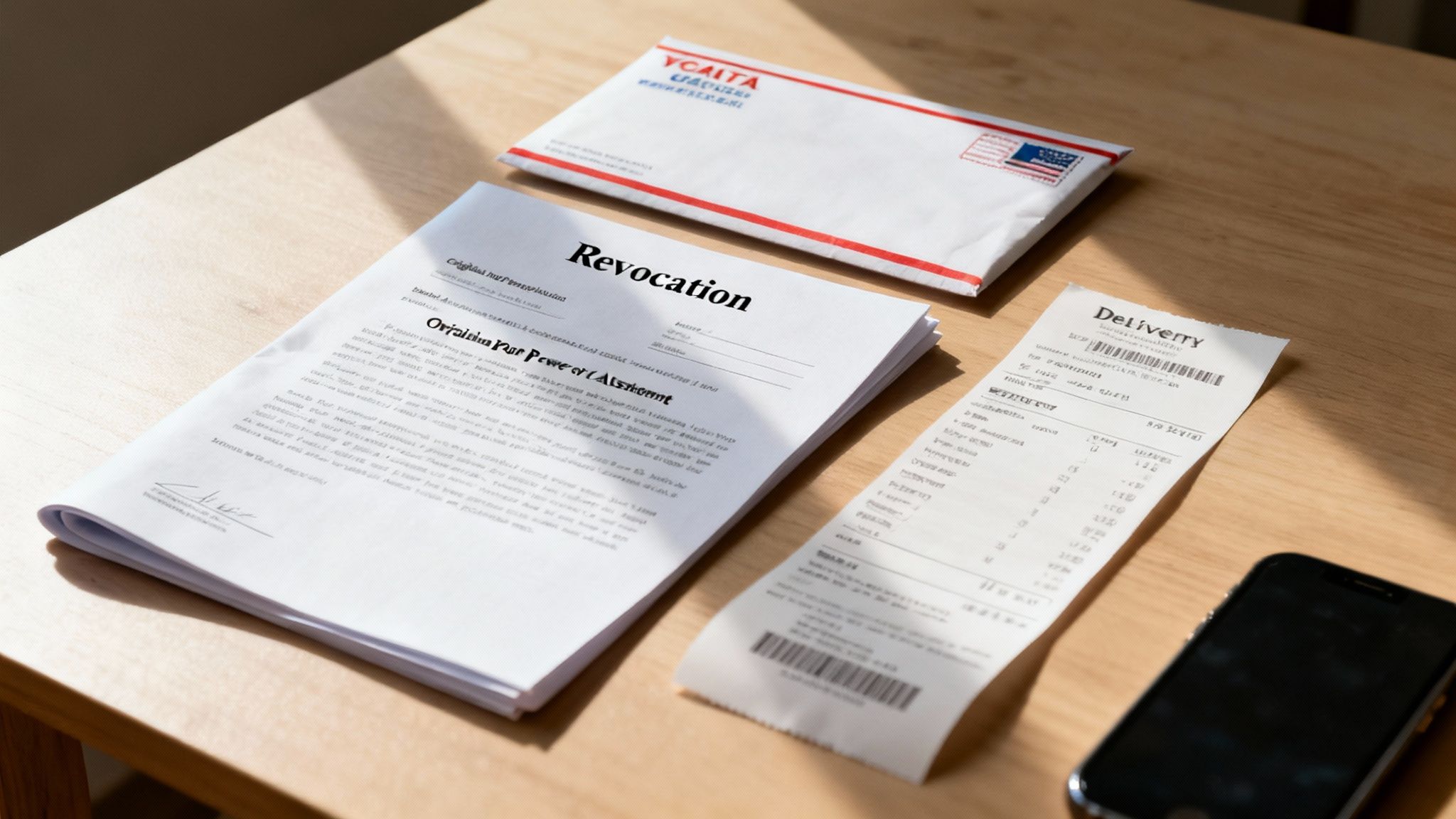
Getting a revocation document signed and notarized is a huge first step, but it’s only half the battle. Simply filing it away in a drawer does nothing to legally protect you. For the cancellation to actually mean anything, the people who were relying on the old POA have to be officially told it's no longer valid.
Think of it this way: your bank has no idea you’ve changed your mind unless you tell them. Until they receive notice, they are legally protected if they continue to follow instructions from your former agent. This communication phase is what makes the revocation real and locks down your assets.
Delivering the News to Your Former Agent
The very first person you must notify is the agent whose authority you're revoking. We understand this can be an uncomfortable conversation, especially if the change is due to a loss of trust or a family disagreement. But it's a non-negotiable legal step.
You have to provide your former agent with a signed copy of the Revocation of Power of Attorney. While you could hand-deliver it, we strongly recommend using a method that creates an undeniable paper trail.
- Certified Mail with Return Receipt: This is the gold standard, hands down. Sending the document via certified mail gives you a tracking number and, more importantly, a signed receipt proving the exact date and time your former agent received the notice. That little green card is powerful evidence if any disputes pop up later.
This step formally puts the individual on notice that their legal authority to act for you has ended. From that moment forward, any action they take using the old POA could be considered fraudulent.
Informing All Third Parties
Next up, you need to make a list of every single person, company, or institution that has a copy of the original POA or has ever done business with your agent. This is a critical move to head off any unauthorized transactions.
Your list should include places like:
- Banks and credit unions
- Financial advisors and investment firms
- Insurance companies
- Doctors, hospitals, and other healthcare providers
- The Social Security Administration or Department of Veterans Affairs
- Your accountant or tax preparer
- Anyone else your agent might have dealt with on your behalf
You must send a copy of the signed and notarized revocation to each of these third parties. This action officially informs them that the agent no longer has the authority to touch your accounts, make decisions, or manage your affairs. Until they get this notice, they can continue to honor the old POA in good faith.
The Special Rule for Real Estate in Texas
If the Power of Attorney you're canceling gave your agent the power to buy, sell, or manage real estate, there's an extra, mandatory step here in Texas. According to the Texas Estates Code, Title 2, Subtitle P, you must file the Revocation of Power of Attorney in the county property records.
This is done at the same county clerk’s office where the original POA might have been recorded. Filing the revocation creates a public record that the agent’s authority over your property has been wiped out. This is a crucial step to protect you from any attempt by a former agent to fraudulently sell or mortgage your property.
This process reflects a global trend toward creating more transparent and secure legal systems. For example, Russia modernized its legal framework for cancelling a power of attorney to include an electronic register that automatically notifies all interested parties of a revocation. You can find more details about how digital legal processes are evolving to reduce fraud by reviewing insights on simplified POA revocation procedures.
Key Takeaway: Notification isn't just a suggestion; it is the act that gives your revocation legal force with the outside world. Failing to notify your former agent and third parties can leave you vulnerable to unauthorized actions, even after you've signed the paperwork. Documenting every notification is your best defense.
By methodically informing every relevant party, you create a protective shield around your personal and financial life, ensuring your decision to cancel the power of attorney is respected by everyone involved. If you're facing a tough situation or feel overwhelmed by this, especially when it involves complex assets or a potentially uncooperative agent, getting some guidance can provide immense peace of mind.
Handling a Noncompliant Agent After Revocation

You’ve done everything by the book. You prepared a formal revocation, had it notarized, and sent copies to your former agent and every financial institution. But what if the agent just… keeps going? This is a terrifying and deeply serious situation, but you are not powerless.
When a former agent ignores a legal revocation, they've crossed a line. They are no longer just acting without authority—they may be committing fraud or financial abuse. This is the moment to act decisively to protect yourself from further harm, and it’s when having an experienced attorney in your corner becomes absolutely critical.
The First Response: A Formal Demand Letter
The first official move to stop a rogue agent is typically a formal demand letter sent by your attorney. This isn't just a strongly worded note; it's a powerful legal tool with specific goals. The letter will state in no uncertain terms that the Power of Attorney has been legally revoked.
It will then demand that the agent immediately cease and desist all actions on your behalf and insist on the return of any of your property they still possess.
For many, receiving a letter like this from a law firm is enough to make them stop. It eliminates any claim of ignorance ("I didn't know!") and creates a clear paper trail showing you’ve put them on notice.
Escalating the Matter When Necessary
If the demand letter is ignored and the agent continues their unauthorized actions, it's time to get the courts involved. You simply can't afford to wait and see what they do next. This is where Probate Litigation can come into play, even while you're still living.
Your attorney can file a lawsuit asking a judge to intervene immediately. A court has the power to issue a temporary restraining order or an injunction—a legally binding order that forces the former agent to halt their activities on the spot.
Beyond just stopping them, you can ask the court for other remedies:
- Enforce the Revocation: The court can issue a declarative judgment that officially confirms your revocation is valid and legally binding, leaving no room for argument.
- Demand a Full Accounting: You have the right to ask the judge to order the ex-agent to provide a detailed report of every single transaction they made while acting under the POA. This is often how mismanagement or theft comes to light.
- Recover Stolen Assets: If that accounting reveals that your money or property was improperly spent or transferred, the court can order the agent to return it or pay you back.
Key Takeaway: A former agent who continues to act after you've revoked their authority isn't just being difficult; they are breaking the law. The Texas court system provides powerful tools to enforce your rights, but you must act swiftly to prevent irreversible financial or personal damage.
A Global Concern: The Misuse of Power
Sadly, the abuse of authority by an agent is a widespread problem that extends far beyond Texas.
In the United Kingdom, for example, the Court of Protection received 721 applications to remove or censure attorneys in 2018-2019 alone—a staggering 55% increase from the prior year. The majority of these cases involved misconduct, like agents making improper gifts to themselves or failing to act in the principal's best interests. You can read more about the record-high actions taken against attorneys to understand the scale of this issue.
This data underscores just how important it is to have a plan for what to do if an agent refuses to step down. If you find yourself in this incredibly difficult position, remember that you have legal recourse. Working with a compassionate probate attorney can help you navigate the court system and hold a noncompliant agent accountable for their actions.
Your Texas Power of Attorney Revocation Checklist
Taking back control by canceling a Power of Attorney can feel overwhelming, especially if you're already in a stressful situation. To make it manageable, we've put together a practical checklist. Think of it as your step-by-step roadmap to legally and effectively revoke a POA here in Texas.
This isn't just about paperwork; it's about protecting yourself. Remember, as the person who created the POA (the principal), you hold the power. You have the absolute right to cancel it whenever you want, as long as you have the mental clarity to understand what you're doing.
First, A Quick Self-Check on Capacity
Before you take another step, ask yourself a few simple questions. Do you understand what a Power of Attorney is? Do you know who your agent is and what authority you gave them? Do you grasp the consequences of taking that authority away?
If you can confidently answer "yes," then you have the legal capacity required under Texas law to move forward. This is the cornerstone of your right to revoke.
Next, Draft the Formal Revocation Document
Now it's time to create the official "Revocation of Power of Attorney." This isn't just a letter—it's a formal legal instrument that must be taken seriously.
Your document needs to be precise and include:
- Your full legal name as the principal.
- The full legal name of the agent whose power you are revoking.
- The date the original Power of Attorney was signed.
- A clear, direct statement that you are revoking all authority granted in that specific POA.
The most critical part? You must sign the revocation in front of a notary public. Just like when you created the original POA, this notarization is a non-negotiable legal requirement in Texas. Don't skip it.
Then, Execute a Flawless Communication Plan
A signed revocation sitting in a drawer has zero legal effect. The real power comes from notifying the right people. This is where the revocation becomes legally binding and truly protects you from any further actions by your former agent.
-
Notify the Former Agent: You must send a copy of the notarized revocation to the person you just fired. We always recommend using certified mail with a return receipt. This creates an undeniable legal record that they received it, which can be invaluable if they try to act on your behalf later.
-
Notify All Key Third Parties: Sit down and make a list of every single bank, financial institution, doctor's office, or advisor who has a copy of the old POA or has ever dealt with your agent. Each one needs to receive a copy of the revocation.
-
Record the Revocation with the County Clerk: This step is absolutely mandatory if the original Power of Attorney granted authority over real estate. You must file the revocation in the property records of the county where the property is located. Under the Texas Estates Code, this is what officially prevents unauthorized sales or transfers of your property.
Key Takeaway: Notification isn't just a courtesy; it's the action that legally terminates the agent's power. Without proper notice, banks, doctors, and other institutions might be legally protected if they continue to follow the old agent's instructions, not knowing their authority has been cancelled.
Your Action Plan: A Simple Checklist
To keep things organized and ensure you don't miss a critical step, use this checklist as your guide. It's a simple way to track your progress and confirm everything is handled correctly.
Revocation Action Checklist
| Action Item | Status (To-Do / Complete) | Notes |
|---|---|---|
| Confirm Capacity | Confirmed I understand the decision and its impact. | |
| Draft Revocation Document | Included my name, agent's name, and original POA date. | |
| Sign and Notarize | Signed in front of a licensed Notary Public. | |
| Send to Former Agent | Sent via certified mail with return receipt requested. | |
| Notify Financial Institutions | Sent copies to all banks, credit unions, and investment firms. | |
| Notify Healthcare Providers | Sent copies to all doctors, hospitals, and clinics. | |
| Notify Other Third Parties | Sent copies to any other relevant people or organizations. | |
| Record with County Clerk (if real estate) | Filed in the correct county property records. |
Following these steps methodically ensures the revocation is legally sound and effectively communicated, closing the door on the old agent's authority.
This checklist provides a clear path forward. But if you're dealing with a difficult family situation or just want the peace of mind that comes from knowing it’s done right, you don't have to handle it alone. Our team has helped countless Texas families navigate these exact steps, and we're here to help you too.
Common Questions About Cancelling a Power of Attorney
When it's time to cancel a power of attorney, practical questions almost always come up. Families often find themselves navigating sensitive situations, like a divorce or a loved one's declining health, and they want to be sure they're making the right moves.
At The Law Office of Bryan Fagan, we've heard just about every question in the book. Below are some of the most common ones, with clear, plain-English answers to give you confidence in handling these nuanced situations under Texas law.
Can I Cancel a POA If My Spouse Is the Agent and We Are Getting Divorced?
Yes, and you absolutely should—immediately. This is a critical step to take as soon as divorce proceedings begin.
Here's a common misconception: many people assume filing for divorce automatically cancels a Power of Attorney granted to a spouse. In Texas, it does not.
To protect your assets, bank accounts, and legal independence, you must formally revoke the document in writing. This is one of the very first things you should discuss with your attorney, as it ensures your soon-to-be-ex-spouse can't legally access your finances or make binding decisions for you during what is often a contentious time.
What If I Lost the Original Power of Attorney Document?
This is a common worry, but thankfully, you don't need the original document to cancel it. The new "Revocation of Power of Attorney" is the legally controlling document and effectively overrides the old one you can't find.
The key here is to be as specific as possible in your new revocation notice. If you can remember it, include the approximate date the original POA was signed. Even more important is being thorough in notifying your former agent and every single bank, financial institution, or medical provider that might have a copy on file. It's this comprehensive notification that makes the cancellation stick, even without the original paper in hand.
What Happens If the Principal Loses Mental Capacity?
This is where things get much more complicated. Under the Texas Estates Code, a person must have the mental capacity to understand their actions to legally sign a revocation document. If they've already lost that capacity, they can no longer cancel a POA on their own.
So what happens if the agent is acting improperly or against the principal's best interests at this stage? Concerned family members usually need to turn to the court system for help.
The primary legal remedy is to petition a court to establish a Guardianship. Once a judge appoints a guardian, that person has the legal authority to manage the incapacitated person's affairs and can ask the court to formally invalidate the problematic Power of Attorney. This process is designed to protect a vulnerable person from potential abuse or financial mismanagement. The rules surrounding a durable power of attorney for health care also become critical in these scenarios. Your estate plan, including any Wills & Trusts, should account for these possibilities.
Key Takeaway: A Power of Attorney automatically terminates the moment the principal passes away. The agent's authority is immediately extinguished. At that point, the executor named in the will (or an administrator appointed by the court) takes over management of the estate through the Texas Probate Process.
Do I Need a Lawyer to Cancel a Power of Attorney?
While it’s legally possible to draft and file a revocation yourself, it’s not something we recommend. The process is filled with potential pitfalls that can have serious financial and legal consequences if you get something wrong.
Working with an experienced attorney ensures your revocation is legally solid under Texas law. They'll make sure all notification steps are handled correctly and documented, and they can provide immediate support if your former agent refuses to cooperate. It’s a small investment that provides significant peace of mind and can prevent major legal headaches down the road.
If you’re facing probate in Texas, our team can help guide you through every step — from filing to final distribution. Schedule your free consultation today.