When a loved one passes away, the discovery of their will can bring relief—or it can open a floodgate of painful questions. If you find yourself looking at a will that seems completely out of character for the person you knew, you might be asking whether they were truly of "sound mind" when they signed it.
This process, known as challenging testamentary capacity in Texas, isn't about questioning someone's intelligence or their entire life. It’s about asking a very specific, legally defined question: did the person who made the will (the "testator") have the required mental clarity at the exact moment they signed it? Texas law is surprisingly focused on this single point in time. It doesn't demand perfect health or a flawless memory, but it does require a fundamental level of understanding.
Dealing with a questionable will while grieving is a heavy burden. Our goal is to provide clear, compassionate guidance to help you understand your rights and what to expect.
What Is Testamentary Capacity In Texas?

When you're grieving, the last thing you want to do is try to decipher dense legal jargon. Put simply, testamentary capacity is the legal standard for having a "sound mind" to make a valid will. The person offering the will for the Texas Probate Process has the initial job of proving it's valid, but any "interested party"—like a child, spouse, or other heir who was unexpectedly left out—can challenge it.
This is a crucial distinction because a diagnosis like Alzheimer's or dementia doesn't automatically mean a will is invalid. We have seen cases where a person was in significant cognitive decline but had moments of clarity. For a Texas court, the question isn't about their overall health history. It's about their specific mental state when their hand held the pen.
The Three-Prong Test for Capacity
So, how does a court decide? Texas law, guided by the Texas Estates Code (Title 2), boils it down to a specific three-part test. To have testamentary capacity, the testator had to understand three things at once when they signed the will.
To make it easier to grasp, here’s a breakdown of the three prongs a testator must satisfy.
The Texas Three-Prong Test For Testamentary Capacity
| Legal Requirement | Plain-English Explanation | Example Question To Consider |
|---|---|---|
| Understand the Act | They knew they were signing their will—a legal document that would give away their property after death. | Did Mom know this paper was her will, or did she think she was just signing a medical form? |
| Understand the Property | They had a general sense of what they owned, like their house, bank accounts, or other major assets. No need for a detailed spreadsheet, just a basic awareness. | Did Dad remember he owned the family ranch, or had his memory faded to the point where he'd forgotten about it? |
| Understand the People | They could recognize their closest family members, especially those who would normally inherit from them (like a spouse or children). | When signing, could Grandma name her children, or was she confusing them with people from her past? |
If the evidence shows the person couldn't grasp all three of these elements when the will was signed, a court can declare it invalid. This area of Probate Litigation is incredibly dependent on the specific facts of each case.
A Realistic Scenario: The Concerned Daughter
Imagine Sarah’s father, who had moderate dementia, signed a new will just weeks before his passing. The new will leaves his entire estate to a neighbor Sarah barely knows, completely disinheriting her and her brother. Sarah remembers her father being confused about what year it was and often forgetting her name during that time.
In this scenario, Sarah would have grounds to challenge the will. Her attorney would focus on gathering evidence—medical records, caregiver notes, and testimony from family—to show that on the day he signed the will, her father likely did not meet all three prongs of the Texas test for capacity. He may not have understood who his natural heirs were (his children) or the full extent of his property.
These situations are emotionally brutal. One day you’re mourning a parent, and the next you’re grappling with the shock of being written out of their Wills & Trusts. On the other hand, you might be the executor trying to honor their last wishes while a disgruntled relative tries to tear the will apart. At The Law Office of Bryan Fagan, we've guided countless families through these delicate disputes, and we know they require both legal clarity and genuine compassion.
How To Gather Evidence Of Incapacity
Realizing a loved one may have signed a will without the mental clarity to understand it is a gut-wrenching experience. It’s an emotional conclusion to come to, but in the eyes of a Texas probate court, your suspicions—no matter how valid—are not evidence. To move from a deeply held belief to a successful will contest, you have to build a case brick by brick with solid proof.
The entire goal is to paint a clear, undeniable picture of the testator's mental state around the exact time the will was signed. This isn't about a single bad day or a general diagnosis. It’s about connecting the dots to show they simply could not meet the legal standard for capacity on that specific day. This requires a meticulous pre-litigation investigation to gather the compelling proof you'll need.
Step 1: Create a Timeline of Decline
Evidence in a capacity case is almost never a single "smoking gun." Instead, it’s a mosaic of documents, records, and observations that, when pieced together, tell an undeniable story of cognitive decline. Your first job is to start building a timeline. Think back to when your loved one’s behavior first started to change and what specific incidents now stand out in your memory.
This timeline becomes the roadmap for the formal evidence you’ll need to secure. The most powerful proof often includes:
- Medical Records: These are the absolute cornerstone of most capacity challenges. You need to get your hands on records from every treating physician—primary care doctors, neurologists, psychiatrists, and especially any hospital admission or discharge notes. Look for diagnoses like dementia, Alzheimer's, or other neurocognitive disorders. Notes from doctors or nurses documenting confusion, memory loss, or paranoia are incredibly powerful.
- Pharmacy Logs: Don't underestimate the impact of medication. A complete list of prescriptions from the pharmacy can reveal if the testator was taking powerful psychoactive drugs, heavy pain medications, or other substances known to cloud judgment and impair thinking.
- Personal Writings: Sometimes, the person's own words are the most damning evidence. Gather any emails, text messages, handwritten letters, or even social media posts from the time period in question. If they reveal a clear pattern of confusion, delusional thinking, or an inability to communicate coherently, they serve as direct proof of their mental state.
Step 2: Identify Witnesses with Firsthand Knowledge
While documents are critical, it's the testimony from people who witnessed the decline firsthand that brings the evidence to life for a judge or jury. A Texas court will want to hear from individuals who interacted with your loved one. This isn’t just limited to family; often, the most credible witnesses are those who have no financial stake in the outcome of the case.
Start making a list of potential witnesses who can speak to the testator's condition. This might include:
- Caregivers and Nurses: Professional caregivers, home health aides, and hospice nurses often keep detailed daily logs. They can provide objective testimony about the person’s orientation to time and place, memory lapses, and day-to-day behavior.
- Friends and Neighbors: People who saw the testator regularly can testify to noticeable changes in their personality, social withdrawal, or bizarre actions that were completely out of character.
- Financial and Legal Professionals: A banker who flagged strange transactions or an old family lawyer who refused to draft a new will due to capacity concerns can be an incredibly compelling witness for your case.
Gathering these different types of proof can feel overwhelming, which is why having a clear strategy from the start is so important. For a deeper dive into what courts are looking for, you can learn more about the evidence needed to contest a will in our comprehensive guide. The key is to begin early and be methodical. The more complete and detailed the picture you can present, the stronger your position will be when challenging testamentary capacity in a Texas court.
Navigating The Texas Will Contest Process
The thought of a formal legal battle is daunting, especially when you're grieving. But understanding the step-by-step process for challenging a will based on lack of testamentary capacity in Texas can make the entire journey feel less overwhelming. This isn't about being adversarial for its own sake; it's about making sure your loved one’s true wishes are honored.
Here’s what you can expect:
- Filing the Application to Probate: The process kicks off when someone, typically the executor named in the will, files an "Application to Probate Will."
- Filing the Will Contest: If you have legitimate concerns about the testator's mental state when the will was signed, this is your signal to act. You can file a formal will contest in the same probate court, officially stating your objections and the reasons behind them.
The Critical Importance Of Timing
In a will contest, time is not on your side. The Texas Estates Code §256.204 sets a strict statute of limitations. Generally, you have just two years from the date the will is officially admitted to probate to file your challenge. That might sound like a lot of time, but evidence goes stale, witnesses' memories fade, and estate assets can get distributed, making a later contest significantly harder to win.
From a strategic standpoint, acting before the will is even probated is almost always the better move. Filing your contest early allows you to present your evidence before the court has made any initial judgment on the will's validity. It puts you on the offensive.
A challenge for lack of testamentary capacity often goes hand-in-hand with a claim of undue influence—it’s a powerful one-two punch. The two claims are becoming more common, which is why acting fast is so critical.
Stages Of A Will Contest Lawsuit
Once you file the contest, the case moves into the litigation phase. While every case has its own unique twists and turns, the process is structured to let both sides build their arguments and present them to the court.
Here’s what you can generally expect:
- Discovery: This is the formal fact-finding stage. It’s where your attorney will gather evidence using tools like written questions (interrogatories), requests for documents (especially medical and financial records), and depositions (sworn testimony taken out of court).
- Motions: Throughout the lawsuit, either side can file motions asking the court to make specific rulings. A common one is a "motion for summary judgment," where the estate’s attorney might argue you don't have enough evidence to even proceed to trial and ask the judge to dismiss the case.
- Mediation and Settlement: Most cases settle before trial. Mediation is a formal process where a neutral third party helps both sides negotiate a resolution.
- Trial: If the case doesn't settle or get dismissed, it goes to trial. This is where all the evidence and witness testimony are presented to a judge or jury, who will make the final call on whether the will is valid.
The image below breaks down the key types of evidence you’ll be hunting for during the discovery phase.
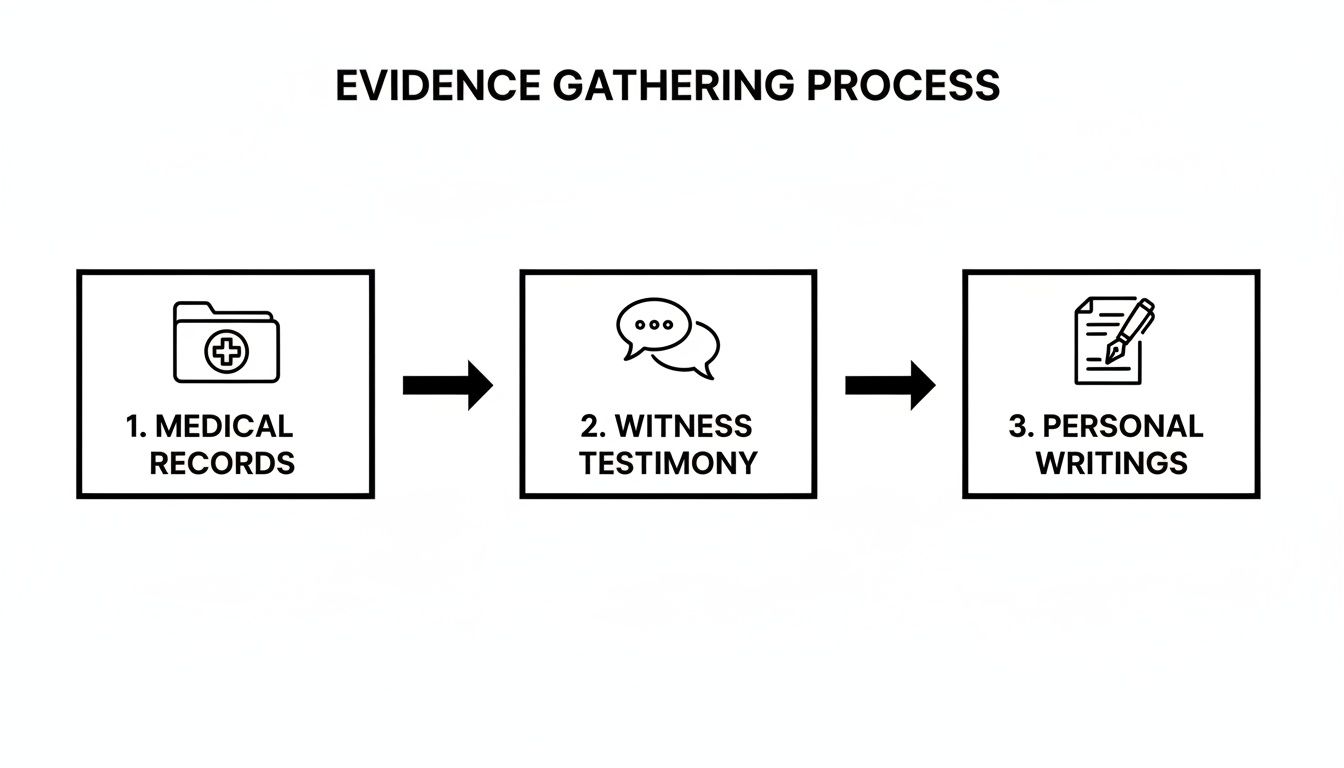
A strong case is built by weaving these three threads—medical proof, personal accounts, and the testator’s own words—into a clear and compelling story for the court. For a more detailed look at the entire journey, you might want to read our guide on how to contest a will and win.
Common Defenses In A Capacity Challenge
When you challenge a will based on a loved one's mental state, you're not just telling your side of the story—you're going up against a defense designed to protect that will at all costs. An executor has a legal duty to uphold the document they believe is valid, and they will come prepared. Knowing their playbook ahead of time is critical to building a case that can withstand the pressure.
The estate’s defense will almost always zero in on the exact moment the will was signed. The drafting attorney and the witnesses who were in the room that day will likely take the stand and paint a picture of someone who was clear, decisive, and fully aware. Their testimony is incredibly powerful because Texas courts are most concerned with that specific "snapshot in time," not necessarily the weeks or months of confusion that came before it.
The "Lucid Interval" Argument
One of the toughest defenses to beat is the concept of a lucid interval. This legal argument doesn't deny that your loved one suffered from dementia, Alzheimer's, or another cognitive issue. Instead, it argues that on the day the will was signed, they experienced a temporary window of clarity—a lucid moment where they were perfectly capable of understanding their actions.
This is a clever defense because it sidesteps your medical evidence of a long-term decline. The other side will argue that the diagnosis isn't the whole story. To counter this, you can’t just point to a medical chart. You need to show that your loved one's condition was so severe and persistent that a true lucid interval was medically impossible or highly unlikely.
The Power of Attorney and Witness Testimony
The most convincing evidence for the defense often comes from the professionals who helped create the will. Here’s what you can expect them to say:
- The Drafting Attorney: This is often the star witness for the defense. The attorney will recount their conversations with the testator, describing how they discussed assets, family dynamics, and final wishes. They will state that, in their professional opinion, the person absolutely met the legal standard for capacity.
- The Witnesses: The two people who witnessed the signing will be asked to recall the event. They will almost certainly testify that the testator appeared to be of sound mind and wasn't being pressured by anyone. This testimony gets an extra boost if the will includes a self-proving affidavit, which adds a layer of formal validation.
A Real-World Example: The Neal v. Neal Case
To see just how powerful these defenses are, look no further than the 2021 Texas case, Neal v. Neal. Florene Neal was diagnosed with vascular dementia in 2011. A year later, in January 2012, she signed a new will that cut out two of her sons. Those sons challenged the will, using her official dementia diagnosis as their primary evidence.
Despite the clear medical diagnosis, the court upheld the will. Why? The deciding factor was the testimony of a single person: the drafting attorney. He described having long, coherent conversations with Mrs. Neal on the very day she signed the will. The court decided his testimony was enough to prove she had a sound mind during a lucid interval. The sons lost.
This case is a stark reminder of just how high the bar is for challenging testamentary capacity in Texas. A diagnosis alone is rarely enough. You need overwhelming evidence that can defeat compelling, firsthand testimony from the other side, including from professionals involved in related matters like a Guardianship.
Key Insights For Heirs And Executors

Navigating a will dispute is one of the most emotionally draining and financially costly experiences a family can go through. Whether you're an heir who suspects a loved one was not of sound mind when they signed their will, or you're the executor tasked with defending it, the path forward is rarely clear.
This situation puts immense pressure on everyone involved. It can fray family bonds at a time when you need support the most, all while demanding you make careful, strategic legal decisions. This isn’t just about winning an argument; it’s about finding a resolution during a period of grief and upheaval.
Your Role As An Heir
If you’re an heir who believes a will is invalid because of a loved one's lack of capacity, the single most important thing on your side is time—but only if you use it wisely. You must act fast.
Evidence disappears, memories fade, and estate assets can get tied up or distributed, making it much harder to set things right later on.
Your job is to build a rock-solid timeline of the facts. This means you need to get organized, and you need to do it now.
- Gather Evidence Immediately: Start collecting everything you can find. This includes medical records, pharmacy logs showing prescription changes, and personal communications like emails, texts, or voicemails that paint a picture of cognitive decline.
- Identify Key Witnesses: Make a list of people outside the immediate family who saw the testator regularly. Think caregivers, neighbors, financial advisors, or doctors. Their unbiased observations about the person's mental state can be incredibly powerful in court.
- Talk to a Lawyer Early: An attorney can quickly assess the strength of your claim and make sure you don't miss critical deadlines, like the two-year statute of limitations for contesting a will under the Texas Estates Code.
Your Duty As An Executor
As an executor, your position is just as tough, but your responsibilities are different. You have a fiduciary duty—a legal obligation to act in the best interest of the estate—to defend the will as it was written and to protect the estate’s assets. This doesn’t mean you have to be hostile, but it does mean you must be diligent.
When a will is challenged, your primary duties include:
- Defending the Will: You must use estate funds to hire legal counsel and mount a defense against the capacity challenge. This is not optional; it’s a core part of your role.
- Staying Neutral in Family Fights: While defending the will, you must remain impartial in any disputes between beneficiaries. Your ultimate loyalty is to the estate itself, not to any one person.
- Communicating Transparently: You need to keep all beneficiaries in the loop about the litigation's progress, its costs, and its potential outcomes. Their inheritance is on the line, and they have a right to be informed.
This is a delicate balance, especially if you’re also a beneficiary. The court will scrutinize every decision you make, so getting professional guidance is not just a good idea—it’s essential. The complexities of this dual role are exactly why executors often need an experienced Probate Litigation attorney in their corner.
Takeaway: For heirs, a successful challenge depends on swift and thorough evidence gathering. For executors, the key is to honor your duty to defend the will with integrity and transparency. For both sides, the most crucial step is hiring an experienced lawyer who can provide empathetic guidance, protect your rights, and help you find the best path toward resolution.
Ultimately, these disputes are about honoring the true wishes of the person who has passed. It’s not just about winning a case but about finding clarity and closure for your family. Whether you are worried about a parent's will, need help with a Guardianship, or are planning your own Wills & Trusts, our firm is here to help.
If you’re facing probate in Texas, our team can help guide you through every step — from filing to final distribution. Schedule your free consultation today.
Frequently Asked Questions About Texas Will Contests
When you're grieving, the last thing you need is a legal battle over a will. But when something about a loved one’s final wishes just doesn’t feel right, questions and confusion can add a heavy burden to an already painful time.
We've gathered some of the most common questions we hear from Texas families navigating the complexities of a will contest. Our goal is to give you direct, straightforward answers from our experience in the probate trenches.
Can a Will Be Challenged If My Parent Had Alzheimer’s?
This is a question we hear almost every day. A diagnosis of Alzheimer's or dementia is a powerful piece of evidence, but it doesn't automatically mean a will is invalid in Texas. The court's primary focus isn't on the long-term diagnosis itself, but on the testator's mental state at the exact moment they signed the will.
Think of it this way: someone with dementia can have good days and bad days. If they signed the will during a "lucid interval"—a brief period of mental clarity—a Texas court might rule they had the necessary testamentary capacity.
To succeed in challenging testamentary capacity in Texas, you have to do more than just point to a medical diagnosis. You need to gather evidence showing that when the will was signed, the disease had progressed so far that they couldn't understand their actions, their property, or who their family members were.
What's the Difference Between Incapacity and Undue Influence?
These two claims often go hand-in-hand in a will contest, but they are legally distinct. Understanding the difference is crucial for building a strong case.
Lack of Testamentary Capacity is about the testator’s internal state of mind. Was their mind clear enough to legally execute a will? The evidence here centers on things like medical records, cognitive tests, and testimony from people who witnessed their confusion, memory loss, or disorientation.
Undue Influence is about external pressure. This claim argues that another person used manipulation, threats, or deceit to force the testator to create a will that reflects the influencer’s wishes, not their own. Evidence might include a suddenly isolated loved one, an abrupt and unnatural change in the estate plan, or an "opportunistic" new friend's heavy involvement in getting the will made.
Key Insight: Think of these two claims as two sides of the same coin. A person with diminished mental capacity is far more vulnerable to being manipulated. That’s why it’s common—and often a smart strategy—to plead both grounds when challenging a will in a Texas probate court. The most compelling cases often show how a vulnerable mind was taken advantage of.
How Much Does It Cost to Contest a Will in Texas?
There’s no easy answer to this, because the cost of a will contest can swing wildly depending on how complex the estate is and how much the other side is willing to fight. It's important to go in with a clear-eyed view of the potential financial investment.
Legal fees for Probate Litigation are usually structured in one of a few ways:
- Hourly Billing: Your attorney charges for their time at a set hourly rate. This is a very common arrangement, but the costs can add up fast if the dispute gets heated and requires a lot of investigation or a full trial.
- Flat Fee: For simpler, uncontested probate matters, a flat fee might be an option. This is almost unheard of for will contests because they are so unpredictable.
- Contingency Fee: If your case is particularly strong, an attorney might take it on a contingency basis. This means they only get paid a percentage of what you recover if you win. It makes pursuing a claim more accessible, but lawyers are extremely selective about the cases they'll accept this way.
On top of attorney's fees, you also have to factor in other litigation costs. These include court filing fees, the cost of hiring expert witnesses (like a doctor to review medical records), deposition costs, and other court-related expenses.
A case that settles early on will cost dramatically less than one that drags out all the way to a jury trial. The best first step is to schedule a consultation to review the specific facts of your situation and get a realistic sense of what it might cost to see your claim through.
If you’re facing probate in Texas, our team can help guide you through every step — from filing to final distribution. Schedule your free consultation today.