Yes, you can dispute a will in Texas. This legal process, known as a will contest, is a crucial safeguard built into Texas law. It’s there to make sure that the document being presented as a final testament truly reflects your loved one’s wishes and wasn't the result of manipulation, fraud, or a loss of mental clarity.
When you're already grieving, the last thing you want is to discover a will that just doesn't feel right. It can add a profound layer of confusion and pain to an already difficult time. We want you to know you're not powerless. Texas law, particularly the Texas Estates Code, provides a clear path forward for exactly these kinds of situations.
Your Path to Disputing a Will Starts Here

Challenging a will isn't about starting a family fight; it's about seeking the truth. Think of a will contest as a formal request for the court to investigate whether a will is legally legitimate. If you have a legitimate reason to believe the document is invalid, filing a contest is the first step toward ensuring fairness and protecting your family member's real legacy.
The Two Pillars of a Will Contest
Before a court will even hear your case, you have to clear two initial hurdles. Consider these the non-negotiable entry requirements for contesting a will in Texas:
- You must have "standing." In plain English, this means you need to be an "interested person." You can't just be a concerned friend; you must have a direct financial or legal stake in the estate. This usually includes heirs, beneficiaries named in a previous will, or creditors.
- You must have valid "grounds." You can't challenge a will just because you feel left out or disagree with the distribution of assets. You need a legally recognized reason, like concrete evidence that the person was coerced, mentally incapable, or tricked when they signed the document.
These two requirements are in place to filter out frivolous lawsuits and ensure the court’s time is spent on genuine disputes. The entire Texas Probate Process is designed to be methodical, protecting both the final wishes of the person who passed and the rights of their potential heirs.
For a quick overview of what's involved, this table breaks down the key components you'll need to understand.
Quick Guide to Contesting a Will in Texas
| Key Element | Plain-English Explanation | Texas Legal Reference (Example) |
|---|---|---|
| Standing | You must be a "person interested" in the estate, meaning you have a financial stake that will be affected by the will's outcome. | Texas Estates Code §22.018 |
| Grounds | You need a valid legal reason for the challenge, such as undue influence, lack of capacity, fraud, or improper execution. | Case Law (e.g., Rothermel v. Duncan) |
| Statute of Limitations | Generally, you have two years from the date the will is admitted to probate to file a contest. The clock is ticking. | Texas Estates Code §256.204 |
| Burden of Proof | The person contesting the will has the responsibility to prove their claims with sufficient evidence. The court won't do it for you. | Texas Estates Code §256.152(b) |
This table provides a snapshot, but each element has layers of legal detail that are critical to a successful contest.
Why Will Contests Happen in Texas
Will contests are far more common than most people realize. In Harris County alone, probate courts saw over 5,000 new cases filed in 2023. Based on our experience, it's not unusual for 15-20% of probated estates to involve some level of dispute, often revolving around claims of undue influence or a lack of mental capacity. This reflects a growing trend seen in dispute resolution worldwide, as noted in this 2023 statistical report.
For families caught in this situation, time is of the essence. Under Texas Estates Code §256.204, you generally have a strict two-year deadline from the date the will is officially accepted by the court (admitted to probate) to file your challenge. Miss that window, and your chance to contest may be gone forever.
Who Has the Legal Right to Contest a Will
Before you can even begin to challenge a will in a Texas courtroom, you have to answer one critical question: do you have the right to be there? You can’t dispute a will just because you disagree with it or feel the outcome is unfair. The court has a gatekeeper rule, and it’s called having “standing.”
In the world of Texas probate, standing means you must be what the Texas Estates Code calls an “interested person.” This isn’t about your emotional connection to the person who died. It’s a cold, hard financial question. You must have a direct property or financial stake in the estate that would be affected if the will were thrown out.
Are You an Interested Person?
So, who gets past the velvet rope? The law is pretty specific to prevent distant relatives or disgruntled friends from clogging up the courts. An "interested person" is someone whose financial position would change, for better or worse, depending on the will's fate.
This typically includes a few key groups:
- Spouses and Children: As the most direct heirs under Texas inheritance law, a spouse or child almost always has standing to challenge a will.
- Beneficiaries in a Previous Will: Were you named as a beneficiary in an earlier, valid will, only to be cut out or have your share reduced in the latest version? If so, you likely have standing because invalidating the new will could restore your inheritance.
- Creditors: In some situations, a creditor who is owed a legitimate debt by the deceased might have standing, especially if the new will is structured in a way that puts their ability to get paid back in jeopardy.
A Common Scenario: Disinheritance
Let’s put this into a real-world story. Imagine an elderly father with two adult children, Maria and David. For decades, his will has been simple and clear: his estate is to be split equally between them. But in the final weeks of his life, while Maria is caring for him, a new will mysteriously appears. This one leaves everything to just Maria, completely disinheriting David.
In this classic and painful situation, David absolutely has a financial interest. If he can prove the new will is invalid, he stands to inherit his half of the estate under the old, long-standing will. This gives him the legal standing to step into court and ask the tough questions. It’s the crucial first step in any Probate Litigation.
Valid Grounds for Disputing a Will in Texas
Reading a loved one's will should bring a sense of peace and closure. But what happens when it just feels… wrong? If the document you're looking at is shockingly different from what you were always told, or if it seems to ignore a lifetime of promises, it’s natural to wonder if you have any power to challenge it.
The short answer is yes, you can. But in Texas, you can't contest a will just because you feel hurt or believe you deserved a bigger share. The law demands you have legally valid reasons—known as “grounds”—to prove the will itself is invalid. This standard is high, and for good reason: it’s designed to protect the final wishes of people who are no longer here to defend themselves.
Let's walk through the most common grounds that Texas courts recognize in a will contest.
Lack of Testamentary Capacity
One of the most common reasons to challenge a will is a lack of testamentary capacity. In plain English, this means the person who created the will (the testator) wasn't of "sound mind" when they signed it. This isn't about having a few senior moments or being a little forgetful; it's a specific legal test.
To have the capacity to sign a will, the testator had to have understood a few key things at that moment:
- That they were signing a will and what a will does.
- A general idea of what property they owned.
- Who their closest family members were (the people who would naturally inherit).
- How all these pieces fit together into their plan to give away their property.
If a serious medical condition like advanced dementia, psychosis, or the heavy influence of medication made it impossible for them to grasp these concepts, the will could be thrown out. You can dive deeper into the specific requirements in our detailed guide on the grounds for contesting a will in Texas.
Undue Influence
This is a tough one. Undue influence is when someone is so intensely manipulated or pressured by another person that the will they sign reflects the influencer's wishes, not their own. It’s far more than just giving advice or making a suggestion—it's coercion that essentially hijacks the testator's free will.
Think about this scenario: An elderly father, recently widowed and feeling isolated, becomes completely dependent on a new caregiver. That caregiver slowly starts cutting off contact with his children, takes over his bank accounts, and constantly badgers him to change his will and leave them everything. If he finally relents and signs a new will, that document wasn't a product of his true wishes but of overwhelming undue influence.
Improper Execution
Texas has very strict, formal rules for how a will must be signed and witnessed. These aren't just suggestions; they are legal requirements designed to prevent fraud and confirm the will is authentic. Under the Texas Estates Code, Title 2, Subtitle C, a typical will must be:
- In writing.
- Signed by the testator (or someone else signing for them, in their presence and at their direction).
- Signed by two credible witnesses, who must be at least 14 years old and sign it in the testator’s presence.
If any of these steps were bungled—for instance, if there was only one witness, or if the witnesses signed it a week later when the testator wasn't even there—the will can be invalidated for what’s called improper execution.
Fraud or Forgery
Finally, a will can be challenged because of outright deception. Forgery is exactly what it sounds like: someone faked the testator's signature on the document. Fraud is a bit different. This is when the testator was tricked into signing the will, either by being told it was a different document or by having its contents based on lies someone told them.
Proving these claims requires clear and convincing evidence. For example, a recent case highlighted in a report on Texas legal statistics involved reversing a $10 million bequest after evidence of dementia was presented. In Bexar County alone, probate courts handled 2,800 cases in 2023, with 18% being contested. Of those challenges, 28% resulted in the will being modified or overturned, with lack of testamentary capacity being a key factor in 40% of successful contests. You can review more about these trends in this dispute resolution statistics report. Success in these cases often hinges on expert handwriting analysis or uncovering a deliberate scheme of deception, making them some of the most challenging—and critical—fights in probate court.
The Will Contest Process Step by Step
Knowing you have the right to challenge a will is the first step. Actually doing it? That can feel intimidating, but it's a structured legal path designed to get to the truth. Think of it as a roadmap for getting answers and, hopefully, a fair resolution.
Let's walk through the key stages you can expect when contesting a will in Texas.
Step 1: Hiring a Probate Litigation Attorney
This isn't just your first step—it's your most important one. Contesting a will is a highly specialized field, requiring knowledge of the Texas Probate Process, Wills & Trusts, and potentially even Guardianship matters. You need an attorney who lives and breathes probate litigation.
An experienced probate litigator will be your guide and your champion. They'll listen to your story, evaluate the strength of your claim, and explain your legal rights in plain English. Most importantly, they know the procedural minefield, including the critical deadlines that can make or break your case.
Step 2: Filing the Lawsuit
Once you and your attorney decide to move forward, the will contest officially begins. This is done by filing a lawsuit in the proper probate court. This formal document, often called a petition, lays out who you are (an "interested person") and the legal grounds for your challenge—whether it's undue influence, lack of capacity, or another reason.
Filing the lawsuit puts the court and all other parties on notice. It’s the legal system's way of raising a red flag and saying, "Hold on, we need to take a closer look at this will."
Step 3: Gathering Evidence During Discovery
This is where the real work begins. The discovery phase is essentially a formal investigation where your attorney digs for the facts needed to prove your case. It’s a methodical process that turns suspicions into hard evidence.
This can involve a few key tools:
- Depositions: Questioning key people under oath. This could be the witnesses who signed the will, the doctor who treated your loved one, or the very person you believe exerted undue influence.
- Requests for Production: Formally demanding important documents. Think medical records showing cognitive decline, financial statements revealing unusual transactions, or even private emails and text messages that tell the real story.
- Interrogatories: Sending written questions that the other side must answer truthfully and under oath.
The goal here is simple: to find the proof that backs up your claims. Every piece of evidence is gathered to build a case around the core reasons a will might be invalid.
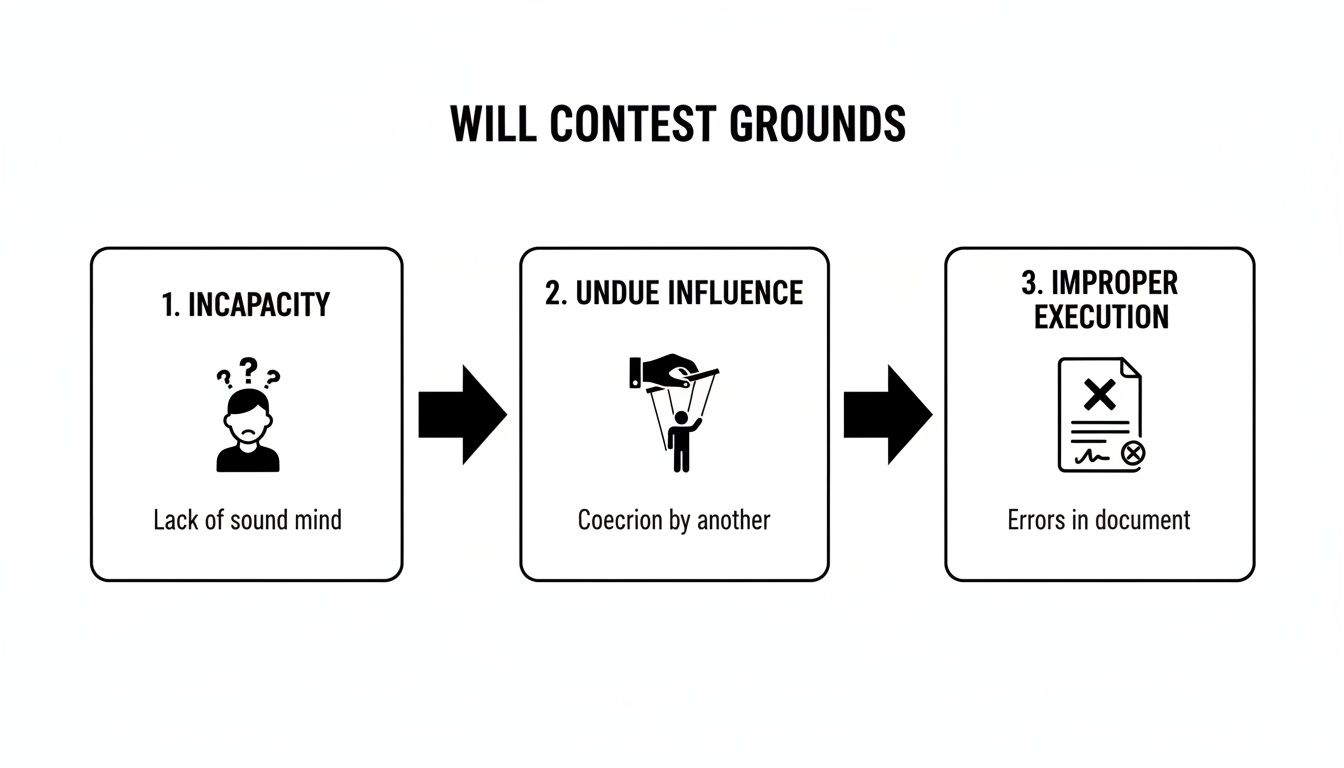
As you can see, these are the three main pillars of a will contest, and each one requires a different kind of proof.
Step 4: Exploring Settlement and Mediation
Believe it or not, most will contests never see the inside of a courtroom for a full-blown trial. Before things get to that point, both sides usually try to find common ground through negotiation or a formal process called mediation.
In mediation, a neutral third-party mediator sits down with everyone involved to help broker a deal. It's a chance to find a creative, mutually agreeable solution that avoids the cost, time, and emotional toll of a trial. A successful mediation can save everyone a world of stress.
Step 5: Preparing for Trial
If a settlement just isn't in the cards, your case will head to trial. Your attorney will meticulously prepare to present all the evidence, documents, and witness testimony you've gathered to a judge or jury. This is your day in court, where a final, binding decision on the will's validity will be made.
Takeaway
The will contest process is a structured, step-by-step legal procedure. Under Texas Estates Code §256.204, you generally have only two years from the date the will is officially accepted by the court to file your lawsuit. An experienced probate attorney ensures these strict deadlines are met so you can focus on building the strongest case possible. You can learn more in our detailed guide to the contesting a will process in Texas.
Gathering the Evidence to Prove Your Claim

Once you’ve established you have legitimate grounds to dispute a will, the real work begins. Now you have to prove it. In a Texas probate court, your suspicions or feelings, no matter how valid, won’t be enough. The legal standard can be high—often requiring strong evidence to overturn a will.
Building a case that meets this bar requires a strategic, almost detective-like approach to gathering evidence. This is where a seasoned probate attorney becomes your most critical ally.
What Kind of Evidence Do You Need?
The specific proof you need will depend entirely on why you’re challenging the will. You need to turn your gut feelings into a collection of hard, undeniable facts. An attorney will help you hunt down, organize, and present the documents and testimony needed to build a winning argument.
Here’s a look at the kind of evidence we typically look for based on the claim:
- For Lack of Capacity: The entire case hinges on the testator’s state of mind at the very moment they signed the will. We’d dig into comprehensive medical records looking for diagnoses like dementia or Alzheimer's, seek testimony from their doctors about cognitive decline, and gather statements from caregivers or family who saw their confusion firsthand.
- For Undue Influence: This is about proving a pattern of manipulation and control. We’d search for emails, text messages, or voicemails showing one person pressuring the testator. We’d also look at financial records for unusual money transfers to the influencer and track down friends who were slowly isolated from their loved one.
- For Forgery or Fraud: These claims often come down to technical proof. We might bring in a forensic handwriting expert who can spot a forged signature a mile away or find evidence that the witnesses who supposedly signed the will were out of the country on that date.
The evidence-gathering phase, legally known as 'discovery,' is where the truth finally gets a spotlight. It’s a meticulous investigation designed to transform your legitimate concerns into a powerful, fact-based legal argument. This is the foundation a successful challenge is built on.
When you hear the term “will contest,” your mind probably jumps to a bitter, drawn-out courtroom drama. But the truth is, that’s more Hollywood than Houston probate court. The vast majority of will disputes in Texas never actually make it to a full-blown trial.
The Texas legal system is built to encourage families to resolve their differences outside of the courthouse. It's a practical approach that saves everyone a tremendous amount of time, money, and emotional grief. These alternatives aren’t about surrender; they're about finding a smarter path to resolution so your family can start to heal.
For most grieving families, the real goal isn’t just to “win” a case—it’s to find peace. Two of the most powerful ways to get there are through mediation and a Family Settlement Agreement.
Finding Common Ground Through Mediation
Think of mediation as a confidential, structured conversation guided by a neutral professional. This third-party mediator isn’t a judge. They don’t pick sides or issue rulings. Their job is to help everyone communicate clearly, get to the root of the disagreement, and explore creative compromises that both sides can accept.
It’s an incredibly effective tool for settling disputes without the public spectacle and hostility of a trial.
Mediation isn't just a nice idea—it gets results. For example, recent dispute resolution data showed that mediation cases had an 85% settlement rate, with resolutions reached in an average of just 121 days. That’s a world away from the years a court case can take. You can read more about these trends over at jamsadr.com.
Here at the Law Office of Bryan Fagan, we guide families through this process all the time. Whether you're in Houston or dealing with an estate in San Antonio from out of state, we can help, even offering virtual consultations to make things easier.
Securing a Lasting Peace
When mediation is successful, the outcome is almost always a Family Settlement Agreement. This is a formal, legally binding contract that every interested party signs. It clearly spells out exactly how the estate’s property will be divided.
Once this agreement is filed with and approved by the probate court, it effectively replaces the will. It becomes the final say on who gets what.
This approach gives your family something a judge often can't: control. You can craft solutions tailored to your family's unique needs—something a courtroom verdict rarely allows for. More importantly, it helps preserve relationships and keeps sensitive family finances out of the public record, giving you a way to honor your loved one’s memory without destroying family bonds.
Frequently Asked Questions About Disputing a Will
When you’re thinking about challenging a will, your mind is probably racing with questions. It’s a stressful and confusing time, and it's normal to feel uncertain about where to even begin. Below, we’ve put together some straightforward answers to the most common questions we hear from Texas families who find themselves in this tough situation.
What if the Will Has a No-Contest Clause?
Many people are scared off by a “no-contest clause,” also known in legal circles as an in terrorem clause. The whole point of this clause is to discourage challenges by threatening that anyone who contests the will and loses gives up their inheritance entirely.
But here’s what you need to know: under the Texas Estates Code, this threat is not enforceable if you file your lawsuit in “good faith” and with “just cause.” In simple terms, if you have a legitimate, well-founded reason to believe the will is invalid, the court won't penalize you for bringing a challenge. An experienced probate attorney can review the facts of your case and tell you whether your challenge is likely to meet that critical standard.
How Much Does It Cost to Dispute a Will?
This is one of the biggest worries for most families, and the honest answer is: it depends. The cost of a will contest can vary dramatically based on how complicated the issues are and whether the other side is willing to settle early or insists on fighting it out in court.
To make sure everyone has access to justice, many probate litigation attorneys handle these cases on a contingency fee basis. This means you don’t pay any attorney's fees upfront. We only get paid if we successfully recover assets for you. We are always transparent about this structure and can walk you through all potential costs during a free, no-obligation consultation.
Can I Dispute a Will After Probate Has Started?
Yes, absolutely. In fact, that’s usually when a contest happens. In Texas, the clock starts ticking once the will is officially admitted to probate. From that date, you generally have up to two years to file a formal contest.
It’s completely normal for the process to begin after an executor has already started managing the estate’s affairs. But it’s critical to act fast. That two-year deadline is strict, and waiting too long could mean losing your legal rights for good.
If you’re facing probate in Texas, our team can help guide you through every step — from filing to final distribution. Schedule your free consultation today.