Amending a trust in Texas is the legal term for updating your existing trust documents to match new wishes or life circumstances. It’s most common with a revocable living trust, which is a flexible estate planning tool designed to allow you to make changes during your lifetime without having to start over from scratch. In plain English, it lets your estate plan evolve as your life does.
When to Consider Amending a Trust in Texas

Creating a trust is a foundational step toward protecting your family’s future, but it’s not a "set it and forget it" task. Think of your trust as a living document. It's meant to adapt and evolve right alongside your life. A trust drafted a decade ago likely doesn't fit your current family dynamics, financial picture, or personal goals anymore.
Regularly reviewing—and when needed, amending—your trust is how you keep it accurate and powerful. Ignoring an outdated trust can cause serious unintended consequences. We've seen it lead to confusion, frustration, and even painful family disputes after someone is gone. The purpose of a trust is to keep your plan current so your assets are distributed exactly as you intend and your loved ones are cared for based on your most recent wishes. It’s a true act of care for your family.
Key Life Events That Signal an Update Is Needed
Certain milestones are clear indicators that it’s time to review your estate plan. These aren't just suggestions; they are critical moments when your trust can become dangerously outdated if you don't take action.
Common triggers include:
- Changes in Marital Status: Getting married, going through a divorce, or losing a spouse will dramatically impact your estate plan and beneficiary choices.
- Family Growth: The birth or adoption of a child or grandchild means you have new loved ones to protect and include in your plan.
- Death of a Beneficiary or Trustee: If someone named in your trust passes away, you must update the document to name a successor or reallocate their intended share.
- Significant Financial Changes: A large inheritance, selling a business, or making a major new investment might change how you want your assets managed or distributed.
- Relocating to Another State: Different states have different laws. A move could require changes to ensure your Texas trust remains compliant and effective.
A Realistic Scenario: The Evolving Family Trust
Let’s look at a realistic example. Consider Mark and Susan, a Texas couple who set up a revocable living trust 15 years ago. Back then, their two children were teenagers. Their trust was simple: when they both passed away, everything would be split 50/50 between the kids.
Fast forward to today, and their lives look completely different. Their son is now a successful doctor with his own family. Their daughter became a special education teacher and married a carpenter. They also now have three young grandchildren. After a recent family chat, Mark and Susan realized their old trust just didn't reflect their current reality.
They knew amending the trust was the right move. Here’s the step-by-step process they followed with their attorney:
- Reviewed the Original Trust: They identified the provisions that no longer matched their wishes.
- Drafted an Amendment: They created a sub-trust to set aside specific funds for their grandchildren's college education.
- Adjusted Distributions: They updated the distribution plan, giving their daughter a slightly larger share to reflect her family's more modest financial situation.
- Updated Roles: They named their now-adult son as the successor trustee, since he has the financial know-how to manage the estate.
By making these thoughtful changes, Mark and Susan ensured their trust now aligns with their desire to support their entire family in a way that felt fair and practical. Their story is a perfect example of why you must treat your estate plan as a dynamic tool. The reasons for setting up a trust change over time, and your document has to change with them.
Trust Amendment vs. Restatement: Which Is Right for You?
When life changes, your trust needs to change with it. The good news is you don’t have to tear up your old plan and start from scratch. Texas law gives you two primary tools for updating a revocable living trust: a trust amendment and a trust restatement. Understanding the difference is key to choosing the right path for your family.
Here's a simple way to think about it: an amendment is like adding a sticky note or a new page to an existing book. It’s perfect for making small, targeted changes. A restatement, on the other hand, is like publishing a brand-new, updated edition of that book—it replaces all the old text while keeping the original title and publication date.
Understanding a Trust Amendment
A trust amendment is a separate legal document that modifies, adds to, or deletes a specific part of your original trust. It gets physically attached to your existing trust document and becomes part of the overall plan.
Amendments are ideal for simple, isolated changes. For example, you may need to:
- Change who you’ve named as your successor trustee.
- Update a beneficiary's legal name after they get married.
- Tweak a specific dollar amount you planned to leave to someone.
- Remove a beneficiary who has sadly passed away.
The main benefit is simplicity and lower cost. Because you're only addressing one or two items, the legal drafting is much more straightforward. The downside? If you make too many separate amendments over the years, your estate plan can become a confusing patchwork of documents. This can increase the risk of misinterpretation when your family needs clarity the most.
When a Full Restatement Is the Smarter Choice
A trust restatement is a complete rewrite of your trust. While it replaces every single provision of the original document with new language, it critically keeps the original trust's name and creation date. This is a huge benefit because it means you don't have to go through the headache of retitling assets that are already funded into the trust.
A restatement is hands-down the better option when you’re making substantial or numerous changes. This scenario often comes up when many years have passed since the trust was created or when a major life event—like a divorce, remarriage, or the birth of a child—has occurred.
You should consider a restatement if you want to:
- Completely overhaul how your assets are distributed (for example, changing from a simple 50/50 split to creating complex sub-trusts for your children).
- Add or remove multiple beneficiaries all at once.
- Update your trust to comply with significant changes in Texas or federal estate tax law, often found in the Texas Estates Code.
- Consolidate several previous amendments into one clean, clear document.
While a restatement is more involved and costs more than a simple amendment, it provides absolute clarity. Your entire estate plan is contained in one single, current document, which makes it infinitely easier for your successor trustee to understand and carry out your wishes.
Data from estate planning firms highlights this point. Among all trust modifications recorded between 2019–2023, about 62% were handled with standalone amendments for minor changes. In contrast, 27% were full restatements for more significant revisions. You can dive deeper into these kinds of insights by reading about global digital trust trends on pwc.com.
Choosing Your Method: Trust Amendment vs. Trust Restatement
Deciding which route to take depends entirely on the changes you need to make. Sometimes a small tweak is all that's needed, but other times, a fresh start is the best way to ensure your plan is clear, current, and effective.
Here’s a table to help you compare the two options at a glance:
| Consideration | Trust Amendment | Trust Restatement |
|---|---|---|
| Best For | Small, specific, and isolated changes. | Major overhauls or multiple changes. |
| Document | A short, separate document attached to the original trust. | A new, comprehensive document that replaces the old one. |
| Clarity | Can become confusing if multiple amendments are made over time. | Provides a single, clear, and up-to-date document. |
| Cost | Generally less expensive. | More expensive due to the comprehensive drafting required. |
| Funding | No need to retitle assets. | No need to retitle assets already in the trust. |
Ultimately, the goal is to have an estate plan that is easy to understand and execute. If an amendment makes things messy, a restatement is almost always the better long-term solution.
The Practical Process for Amending Your Texas Trust
You understand why you need to update your trust. Now for the important part: how to actually get it done. Amending a trust in Texas is a formal legal process, but it’s not something to be intimidated by. Following these deliberate steps ensures your changes are legally solid and reflect your exact intentions.
This isn't just about jotting down new wishes on a piece of paper. It’s about creating a binding legal instrument that your trustee is required to follow.
Step 1: Review Your Original Trust Document
Before you draft anything new, pull out your original trust agreement. This document is your rulebook. Almost every well-drafted trust includes a specific clause—usually titled something like “Amendment and Revocation”—that spells out the exact procedure you, the grantor (the person who created the trust), must follow to make changes.
Don't skip this step. That clause is legally binding. If it says amendments must be signed in front of two witnesses and a notary, then that’s exactly what you have to do. Trying to cut corners here is a recipe for disaster and could give a disgruntled heir a reason to challenge your amendment in court.
Step 2: Draft a Clear Amendment
Next is drafting the actual amendment. This is no place for casual notes or vague ideas. Your language needs to be precise and completely unambiguous to prevent anyone from misinterpreting your intentions later.
A solid trust amendment should always include these key pieces of information:
- Identification: Clearly state your name as the grantor, the official name of your trust, and the date it was originally created.
- Statement of Intent: Add a direct sentence declaring that you are amending the original trust agreement.
- The Specific Changes: This is the core of the amendment. Detail the exact article or section you are changing. For example, you might write, "Article IV, Section B, is hereby deleted in its entirety and replaced with the following…"
- Reaffirmation Clause: Finish with a statement confirming that all other parts of the original trust that aren't changed by this amendment remain in full force.
This structured approach leaves no room for doubt about what you changed and what you wanted to keep the same.
The flowchart below shows the difference between making a simple amendment and doing a full-blown restatement.
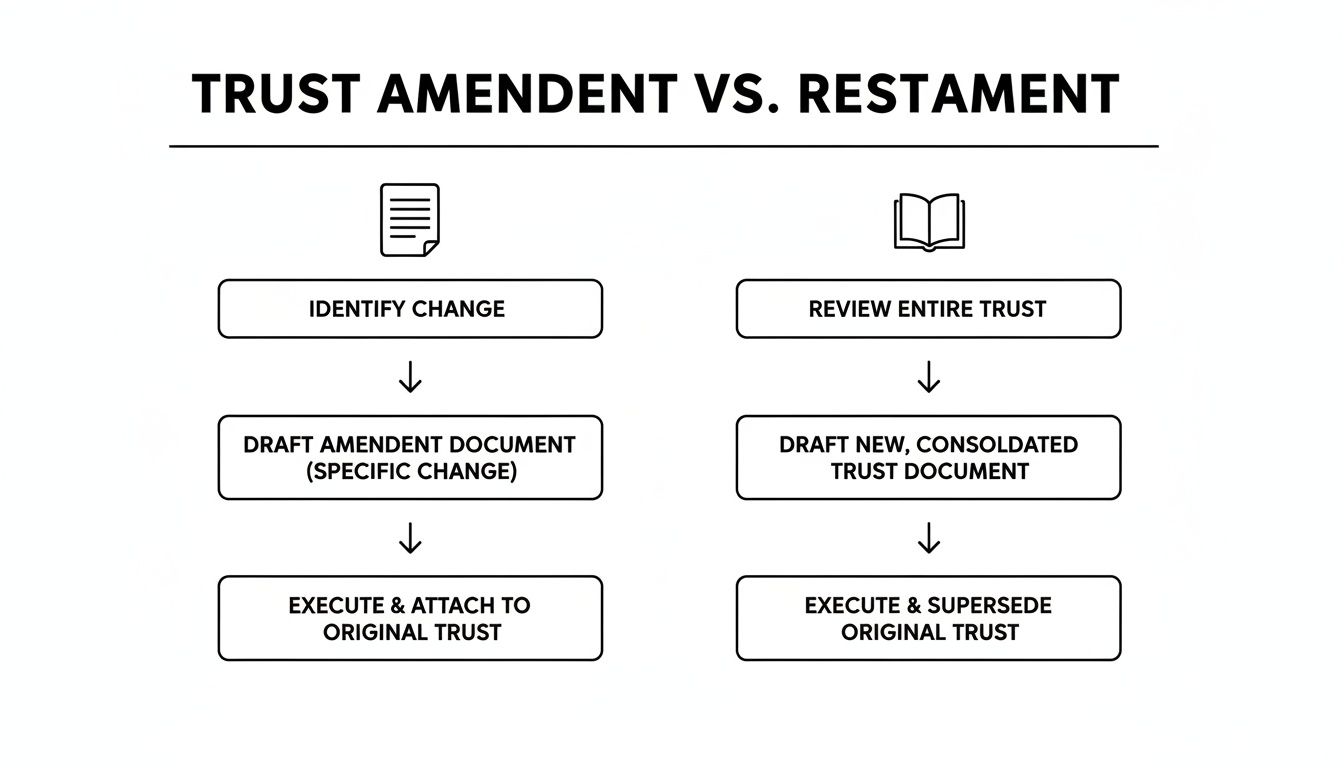
As you can see, an amendment is like a targeted add-on, while a restatement wipes the slate clean and replaces the whole document with a fresh, consolidated plan.
Step 3: Execute the Amendment with Texas Formalities
Once you’ve drafted the amendment, it’s time to make it legally binding. While the Texas Estates Code, particularly Title 2, provides a general framework, your original trust document is the ultimate authority on what’s required for execution.
In Texas, a revocable trust and any amendments to it should be executed with the same formalities as a will. This almost always means signing the document in front of a notary public. One of the most common—and costly—mistakes we see is people forgetting to get their signature properly notarized.
After you've signed and notarized the amendment, physically attach it to your original trust document. Don't just tuck it into the same folder; staple or clip it securely. You should also give a copy to your successor trustee. This final step is crucial for a smooth trust administration down the line, as it guarantees the person in charge of your estate has the most up-to-date instructions.
Why Funding Your Trust After an Amendment Is Crucial
You've successfully amended your trust. That's a huge milestone, but the work isn't quite done. There’s one more absolutely essential step that is the most commonly overlooked—often with heartbreaking consequences for the family left behind.
We need to talk about funding your trust.

In plain English, "funding" is the process of legally transferring ownership of your assets to your trust. Think of a trust as an empty box; it only protects what you put inside it. If you amend your trust to add a new vacation home or a recently inherited investment account, that change is only on paper until you formally update the legal titles of those assets.
Failing to fund the trust properly after an amendment can render your careful planning completely useless. An unfunded asset is an asset that will almost certainly have to go through the public, costly, and time-consuming Texas Probate Process you worked so hard to avoid.
The Critical Link Between Amending and Funding
Let’s play this out with a real-world scenario. Imagine you amend your trust to state that your new lake house should pass to your eldest daughter. A clear, legally sound amendment. However, the deed to the property still lists you as the individual owner, not the trust.
When you pass away, the trust document says one thing, but the legal property record—the deed—says another.
Because the deed was never changed, the lake house is not legally owned by the trust. This means your daughter won't be able to inherit it smoothly as you intended. Instead, the property becomes part of your probate estate, and your family will have to navigate the court system to resolve the ownership. This is exactly the situation the trust was designed to prevent.
A Practical Checklist for Funding New or Changed Assets
Properly funding your trust after making changes involves updating the legal ownership documents for each affected asset. The specific steps will vary depending on what you're moving into the trust.
Here's a straightforward guide for some of the most common assets Texas families include in their trusts:
- Real Estate: This requires preparing and filing a new deed that transfers the property from your name into the name of the trust. For example, the title would change from "Jane Smith" to "Jane Smith, Trustee of the Jane Smith Revocable Living Trust." You can learn more by reviewing our guide on how to change a deed on a house.
- Bank Accounts (Checking & Savings): You'll need to work directly with your bank to either retitle your existing accounts into the trust's name or open new accounts under the trust's name. They will likely ask for a copy of your Certificate of Trust.
- Investment and Brokerage Accounts: Similar to bank accounts, you must contact your financial institution to change the account registration from your individual name to the name of your trust. This usually involves completing specific paperwork provided by the brokerage firm.
- Business Interests: If you own an interest in a partnership or an LLC, you'll need to amend the company's operating or partnership agreement to reflect the trust as the owner of your share.
This process is detailed and requires careful attention, but it is the final, crucial step in making your amendment truly effective. Taking the time to properly fund your trust after every change ensures your estate plan will work exactly as you intended, providing a seamless transition for your loved ones during an already difficult time.
Common Mistakes to Avoid When Amending Your Trust
Amending your trust is a powerful way to keep your estate plan current, but even the smallest oversight can create huge problems for your family. The goal is to provide clarity and peace of mind, not leave behind a legal puzzle for a court to solve.
Let’s walk through the common pitfalls we see far too often. These mistakes are almost always unintentional, but they can lead to confusion, family disputes, and costly legal battles—the very things your trust was meant to prevent.
Ignoring Your Trust's Own Rules
One of the most frequent errors is forgetting to consult the original trust document itself. A well-drafted trust will have a specific section detailing the exact steps required to amend it. Think of it as your legally binding instruction manual.
If your trust states that amendments require two witnesses and a notary, then that is precisely what you must do. Trying to make changes with a simple signed letter or an informal note won’t cut it. A Texas court will almost certainly invalidate it. Following the prescribed method is non-negotiable.
Using Vague or Ambiguous Language
When you amend your trust, your words must be crystal clear. Vague phrases like "I want my children to share my property fairly" or "split my investments between my grandkids" can become the fuel for bitter family disagreements.
Your amendment must be specific and direct. Instead of ambiguity, use precise language that leaves no room for interpretation:
- "I direct my trustee to distribute the sum of $50,000 to my grandson, John D. Smith."
- "Article V, Section C is hereby amended to name my sister, Carol Johnson, as the first successor trustee."
- "My residential property located at 123 Oak Lane, Houston, Texas, shall be distributed to my daughter, Emily Davis."
This level of detail eliminates confusion and ensures your wishes are carried out exactly as you intend.
Forgetting to Sign and Notarize Properly
This mistake is so simple, yet so devastating. An unsigned or improperly witnessed amendment is just a piece of paper with no legal authority. In Texas, the formalities for amending a trust typically mirror those for executing a will, which means your signature must be acknowledged by a notary public.
A notary acts as an impartial witness, verifying your identity and confirming you signed the document willingly. Skipping this step gives a disgruntled heir a perfect reason to challenge the amendment, arguing it was fraudulent or created under duress.
A Scenario of Unintended Consequences
Consider this realistic scenario. A father in his later years wanted to change his trust. He had originally planned to leave his estate equally to his three children. But after his youngest son provided years of dedicated, around-the-clock caregiving, the father decided to leave him the family home outright.
Instead of creating a formal amendment, he simply wrote his wish on a sticky note and attached it to the trust document. After he passed away, the other two siblings discovered the note. Because it wasn't a legally valid amendment, the trustee had no choice but to ignore it and follow the original trust's terms, splitting everything three ways. The situation escalated into a painful and expensive probate litigation case that shattered the family's relationship.
This tragic outcome could have been easily avoided with a properly drafted and notarized amendment.
The preference for formal methods isn't just anecdotal. Court surveys estimate that 6%–10% of amended trusts face legal challenges, and these cases are 1.8 times more likely to succeed against informally altered trusts than those with notarized amendments. You can explore more data on why formal processes matter by reviewing insights on digital trust from pwc.com.
Navigating the complexities of amending a trust requires careful attention to detail. Partnering with a skilled attorney helps ensure your changes are not only clear but also legally unassailable.
Common Questions About Amending a Trust
When it comes to your family’s future, it’s only natural to have questions. Here are some clear, straightforward answers to the concerns we hear most often from Texas families looking to update their Wills & Trusts.
How Much Does It Cost to Amend a Trust in Texas?
The honest answer is: it depends. The cost to amend a trust hinges entirely on how complex your changes are.
For instance, a simple, one-page amendment to swap out a successor trustee will be far less expensive than a full-blown restatement that completely redesigns how your assets will be distributed.
While it’s easy to focus on the upfront cost, it’s better to think of it as an investment. Spending a little now to get the amendment drafted and executed correctly can save your family from the astronomical expense and emotional turmoil of probate litigation if a faulty document gets challenged down the road.
Can I Amend a Trust Without a Lawyer?
Legally speaking, you aren't required to hire an attorney to amend your trust, particularly for a very minor change. However, trying to do it yourself is like walking through a legal minefield. Trust and estate law is riddled with nuances.
Using the wrong turn of phrase, creating ambiguity, or failing to follow the specific signing and witnessing formalities required by Texas law (and your own trust document) can render the entire amendment invalid.
A DIY amendment might feel like a smart way to save a few dollars today, but it can backfire spectacularly, costing your family dearly in legal fees and heartache. We always recommend getting professional legal guidance to ensure your wishes are locked in tight, with no room for misinterpretation.
Do I Have to Tell My Beneficiaries I Changed My Trust?
As long as you are alive and have the mental capacity to make your own decisions, what you do with your revocable living trust is your business. You generally have no legal obligation to tell beneficiaries that you’ve amended the trust—whether you’ve added them, removed them, or changed their share. That privacy is one of the key benefits of a revocable trust.
However, sometimes a little transparency can go a long way toward keeping the peace. We often discuss the personal pros and cons of notifying loved ones during our consultations. The goal is to help you land on a decision that feels right for your specific family situation. After all, a good estate plan should protect relationships just as much as it protects assets. It can also impact future matters like a Guardianship if not handled with care.
Key Insight: Takeaway for Texas Families
Amending a trust isn’t just a legal task; it’s an act of love and foresight for your family. The most important takeaway is that your trust must evolve with your life. Regularly reviewing it (every 3-5 years) and formally updating it after major life events ensures your wishes remain clear and legally enforceable. Choosing between a simple amendment for minor tweaks and a full restatement for major changes provides clarity and prevents future family disputes. Always remember to follow the legal formalities required by Texas law and fund any new assets into the trust to make your changes effective. This diligence provides peace of mind, knowing you've done everything possible to protect your loved ones.
If you’re facing probate in Texas, our team can help guide you through every step — from filing to final distribution. Schedule your free consultation today.