When people hear the word “trust,” they often imagine a complex legal tool meant only for the ultra-wealthy. But that’s a common misconception. For Texas families, setting up a trust is really about one thing: gaining control over your assets and protecting your family’s future.
Think of a trust as a personal rulebook for your property. This rulebook ensures your wishes are followed precisely, helping your loved ones sidestep the public, expensive, and often painfully slow Texas probate process. It's a compassionate way to make things easier for your family during an already difficult time.
Why Set Up a Trust in Texas?
Many Texas families I work with wonder why they should bother with a trust, especially if they already have a will. It’s a great question. The simplest answer is that a trust offers a level of control and privacy that a will alone just can’t provide.
While a will is an essential document, it’s really just a set of instructions that only kicks in after your death. Before those instructions can be followed, the will must go through a court-supervised process called probate, as required by the Texas Estates Code. During probate, the will becomes a public record, and every step is subject to a judge’s approval.
A trust, on the other hand, is a private legal arrangement that can manage your assets both during your lifetime and after. When you place assets like your home, bank accounts, and investments into a trust, you’re not giving them away. You’re just ensuring they can be managed seamlessly by someone you choose—your trustee—for the benefit of your loved ones (the beneficiaries), often without any court involvement at all.
This proactive step can make a world of difference for your family during a period of grief.
Here are a few of the biggest reasons Texans choose to create a trust:
- Avoiding Probate Court: This is a huge one. Assets held in a trust bypass the public and often sluggish probate process, saving your family precious time, money, and stress.
- Maintaining Family Privacy: A trust is a private document. Unlike a will filed in court, the details of your estate—who gets what and how much—are not splashed across the public record for anyone to see.
- Protecting Your Beneficiaries: You can set specific conditions for how and when assets are distributed. This is perfect for protecting inheritances for young adults who might not be ready for a windfall, or for loved ones with special needs who rely on government benefits.
To make these benefits easier to see, I've put together a quick summary table.
Key Reasons for a Texas Trust at a Glance
This table breaks down the primary motivations for creating a trust, helping you quickly understand the value it can bring to your family's financial security.
| Primary Benefit | What It Means for Your Loved Ones |
|---|---|
| Probate Avoidance | Your family gets access to assets faster, without the delays and costs of court proceedings. |
| Privacy Protection | The details of your estate remain a private family matter, not a public record. |
| Beneficiary Protection | You can safeguard inheritances from creditors, divorce, or a beneficiary's own immaturity. |
| Incapacity Planning | If you become unable to manage your affairs, your chosen trustee can step in seamlessly without court intervention. |
| Control Over Distributions | You decide how and when your heirs receive their inheritance, ensuring it's used wisely. |
Ultimately, a trust is more than just a legal document; it’s a strategic plan that provides certainty, protection, and peace of mind for you and the people you care about most.
Navigating Around the Texas Probate Process
For many Texans, one of the biggest motivators for setting up a trust is simple: keeping their family out of probate court.
Probate is the formal, court-supervised process Texas law requires to settle an estate. It’s where a judge validates a will, makes sure all debts are paid, and legally transfers what's left to the people named as beneficiaries. While the system is designed to be orderly, it can quickly become a heavy burden for a grieving family.
The entire probate process, which is governed by Titles 2 & 3 of the Texas Estates Code, is a matter of public record. That means your family’s financial business—from the value of your assets to who gets what—is open for anyone to see. It’s also notoriously slow, often dragging on for months or even years while legal fees and court costs pile up.
Probate Delays Versus Trust Efficiency
Let's look at a realistic scenario. The Garcia family's mother passed away leaving only a will. Her children now have to hire a lawyer, file the will with the court, and get a judge’s permission for nearly every step. A small, unexpected claim from a creditor pops up, and just like that, the entire process is frozen for six months while it's investigated. Meanwhile, the family can't access funds needed to maintain their mother's home.
Now consider the Smith family. Their father had placed all his major assets into a living trust years ago. When he passed, his daughter, the successor trustee he’d chosen, was able to manage and distribute the assets right away according to his private instructions. No court approval needed. The whole affair was handled discreetly and efficiently, letting the family focus on what matters most, not on court dates.
This graphic really breaks down how a trust puts you in the driver's seat, helping you sidestep the courthouse and keep your family’s affairs private.
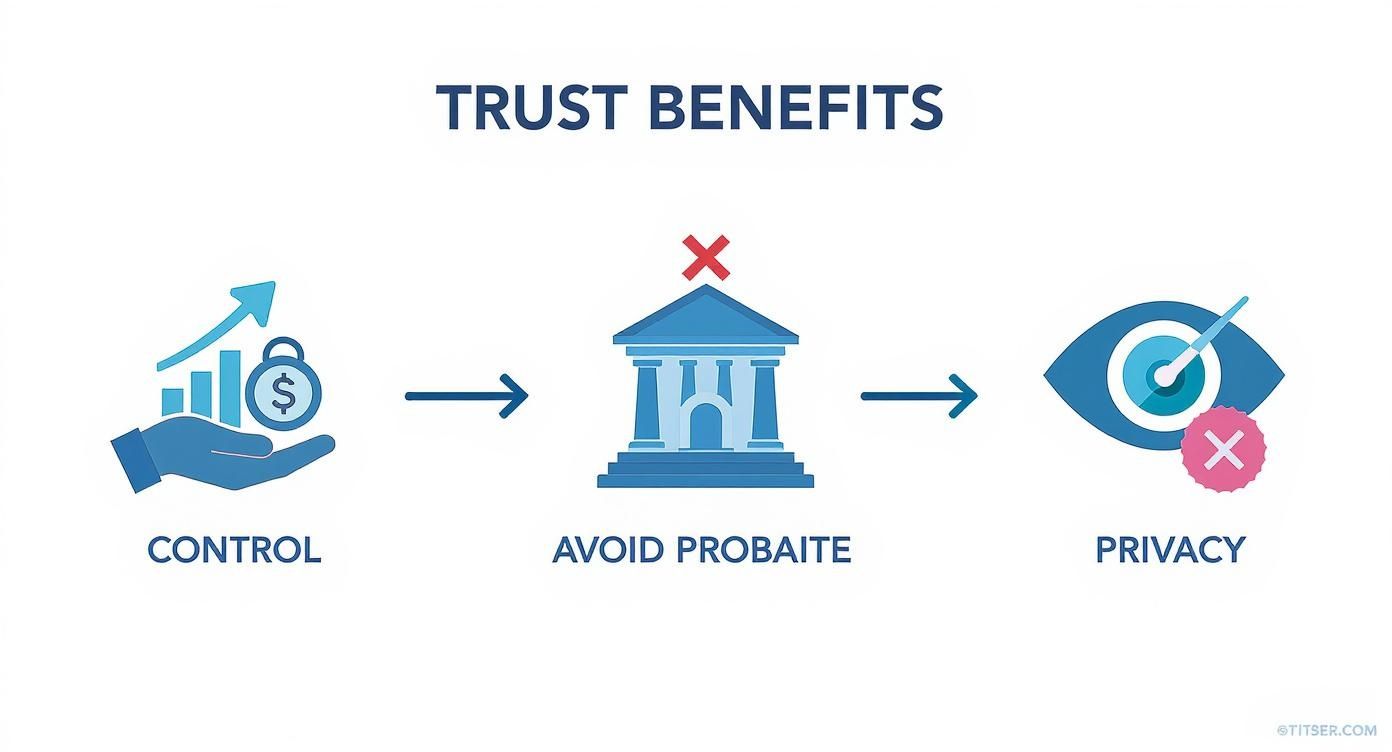
As you can see, a trust creates a clear, private path for settling your affairs on your own schedule.
Taking Control of Your Legacy
When you place your assets into a trust, you’re fundamentally changing who owns them. They are no longer part of your personal estate after you die. Instead, they belong to the trust itself, which is then managed privately by the trustee you handpicked. This is a core reason why setting up a trust is such an effective estate planning strategy.
Key Insight: A trust allows assets to pass directly to your beneficiaries based on your private instructions, completely sidestepping court interference. This ensures a faster, more private, and less expensive transition for your loved ones.
For a deeper look into the strategies for bypassing this court process, you can explore guides on how to avoid probate court. You can also discover more about how a Texas living trust can be your main tool to avoid the complexities of probate.
Protecting Your Assets for Future Generations

While avoiding probate is a huge benefit, one of the most powerful reasons families create a trust is to act as a shield for their assets—and just as importantly, for their beneficiaries. Think of a trust as a secure family vault. The assets you place inside are protected from outside threats, ensuring they are preserved for your loved ones exactly as you intended.
This protection can be a game-changer. Certain types of trusts, like an irrevocable trust, can safeguard assets from potential lawsuits, creditors, or even the financial fallout from a beneficiary's divorce. Once assets are moved into this kind of trust, they are no longer legally considered the beneficiary's personal property, putting them safely out of reach of these external claims.
Managing Inheritances with Care and Wisdom
Let's be honest: a sudden inheritance can sometimes be more of a burden than a blessing. This is especially true for a young adult, a relative with special needs, or anyone not prepared to manage a large sum of money. A trust gives you the control to manage how and when distributions are made.
This means you can make sure your legacy supports your loved ones constructively, not destructively. Common provisions I've seen clients use include:
- Staggered Distributions: Releasing funds at specific ages, like one-third at 25, one-third at 30, and the final third at 35. This gives them time to mature.
- Incentive-Based Payouts: Tying distributions to life achievements, like graduating from college, buying a first home, or maintaining a steady job.
- Lifetime Support: Providing for a loved one with special needs without jeopardizing their eligibility for vital government benefits like Medicaid or SSI.
This kind of thoughtful planning ensures your assets provide lasting security. For instance, you can learn more about using trusts to manage real estate in Texas to keep a family home protected for generations to come.
Key Insight: A trust allows you to build a protective barrier around your family’s inheritance, ensuring it is a source of support and opportunity, not a cause of stress or financial mismanagement.
Of course, trusts are just one piece of a comprehensive asset protection strategy. Many individuals also explore other legal instruments. As part of a broader financial plan, for example, it can be helpful to learn more about understanding prenuptial agreements.
Maintaining Your Family's Privacy and Dignity
When a family is grieving, the last thing they need is the public looking over their shoulder. Privacy becomes an invaluable gift, and a trust is one of the most powerful tools in Texas for ensuring your loved ones have it.
When a will goes through the Texas Probate Process, it doesn't just get a judge's stamp of approval—it becomes a public court record. Think about what that means. The value of your assets, the names of your beneficiaries, and the private details of who gets what are all laid bare for anyone to see. This exposure can attract nosy neighbors, opportunistic salespeople, and even predatory scammers.
A trust, on the other hand, operates in a completely different world. It’s a private document. The entire process of managing and distributing your assets happens behind closed doors, handled quietly by the trustee you chose. This shields your family from public scrutiny and allows them to manage your final wishes with the dignity they deserve.
Keeping Your Affairs Out of the Public Eye
The peace of mind that comes with privacy is hard to overstate. It lets your family focus on grieving and honoring your memory, not on fending off unwanted attention or defending their inheritance in a public forum. This isn't just about comfort; it's about responsible planning.
Recent findings, like those in PwC’s 2025 Global Digital Trust Insights survey, highlight a growing demand for robust and confidential processes in legacy planning. People want assurance that financial and family matters will be handled with integrity, reinforcing the value of a well-drafted trust. You can discover more about these trust insights to see how modern planning is evolving.
Key Insight: A will is public; a trust is private. By choosing a trust, you keep your family’s financial details off the public record, protecting them from outside interference during an already difficult and emotional time.
Ultimately, a trust ensures your legacy remains a private family matter. The Law Office of Bryan Fagan can help you explore Wills & Trusts to determine the right path for protecting your family’s privacy.
Providing for Loved Ones with Unique Needs

Trusts are far from one-size-fits-all legal documents. In fact, their greatest strength is their remarkable flexibility, which is the core reason why setting up a trust is often the most thoughtful and compassionate way to plan for your family's future. They can be perfectly shaped to fit your unique circumstances.
This is especially true when you’re planning for a loved one who will require specialized, lifelong care. In these situations, a well-crafted estate plan becomes an act of profound love, ensuring their protection and well-being long after you are gone.
Tailoring Protection with Special Purpose Trusts
For families with a disabled child or other relative, a Special Needs Trust is an absolutely essential tool. This type of trust allows you to set aside funds for your loved one's supplemental needs—things that truly enhance their quality of life, like education, recreation, or medical care that isn't covered by government aid.
Here’s the crucial part: the assets inside a Special Needs Trust are managed by a trustee and are not legally "owned" by the beneficiary. This specific structure is what protects their eligibility for vital government benefits like Medicaid and Supplemental Security Income (SSI), which have very strict asset limits. A direct inheritance could instantly disqualify them from the very programs they rely on for essential care.
Key Insight: A Special Needs Trust ensures your loved one can benefit from their inheritance without losing access to critical government assistance, providing a safety net that supports them for life.
Creating Stability in Complex Family Situations
Trusts also provide thoughtful solutions for other complex family dynamics. For beneficiaries who might struggle with managing a large sum of money, a Spendthrift Trust is a powerful tool. It allows a trustee to control distributions, protecting the inheritance from creditors or poor financial decisions.
In blended families, trusts are invaluable for ensuring fairness and clarity. You can structure a trust to provide for your current spouse for their lifetime, while guaranteeing that whatever is left will ultimately pass to your children from a previous relationship. This prevents misunderstandings and honors all your commitments.
Realistic Scenario: Imagine a parent of a child with special needs. They establish a Special Needs Trust and fund it with enough assets to cover future therapies and quality-of-life expenses. By doing this, they ensure their child will be cared for exactly according to their wishes, without disrupting the government benefits that cover daily living and medical needs. This provides true peace of mind.
Your Trust Is Your Family's Rulebook
When you're thinking about setting up a trust, it's easy to get lost in the legal jargon. But I always tell my clients to think of it in a much simpler way: a trust is your family's personal rulebook. It's the detailed plan you write yourself to protect your assets and provide for your loved ones with clarity and compassion. More than anything, it's a reflection of your values, designed to secure your family's future on your own terms.
A trust offers a level of control, protection, and peace of mind that a simple will often can't match. Throughout this guide, we've walked through its core benefits—from bypassing the public and costly Texas Probate Process to shielding assets from unforeseen challenges. It keeps your family’s affairs private and provides tailored solutions for loved ones who might have unique needs.
Takeaway: Creating a trust is one of the most powerful acts of love and responsibility you can undertake for your family. It replaces uncertainty with a clear, private plan, ensuring your legacy is a source of support and security—not a burden of legal complexities.
From establishing a Guardianship to navigating the turmoil of Probate Litigation, our goal is to offer compassionate, practical guidance. Planning your estate isn't just about documents; it's about making sure your final wishes are honored and safeguarding your family’s well-being for generations to come.
If you’re facing probate in Texas, our team can help guide you through every step — from filing to final distribution. Schedule your free consultation today.
Frequently Asked Questions About Texas Trusts
Navigating the world of estate planning can feel overwhelming, and it's natural to have questions. Here are some clear, straightforward answers to the concerns we hear most often from Texas families.
What Is the Main Difference Between a Will and a Trust?
The biggest distinction boils down to one word: probate. A will is essentially a set of instructions for what happens after you die, but it must go through the public probate court system to be validated and executed. It’s a public process, guided by a judge.
A trust, on the other hand, is a private legal entity you create to hold and manage your assets for your beneficiaries. Since the trust—not you—owns the assets, they can typically be distributed privately and without any court involvement. This saves your family precious time and keeps your financial affairs out of the public record.
For a deeper dive, you can explore the differences between a living trust and a will in Texas.
Is Setting Up a Trust Too Expensive for My Family?
It’s true that a trust has a higher upfront cost than a simple will, but it’s best to think of it as an investment in your family's future. That initial cost can save your loved ones a significant amount of money and stress down the road by completely avoiding probate fees, court costs, and potential legal fights.
The control, privacy, and peace of mind it provides are often priceless.
Will I Lose Control of My Assets in a Trust?
Absolutely not, especially with a revocable living trust. This is the most common type for families, and it’s designed to be completely flexible.
As the creator of the trust (also called the grantor), you keep full control. You can change the terms, add or remove assets, or even cancel the entire trust at any point while you're alive and well. It's your trust, and you make the rules.