When a loved one passes away without a will, settling their estate can feel uncertain and overwhelming, especially when you are grieving. For many Texas families, the biggest worry is securing the title to the family home or other real estate. This is precisely where an Affidavit of Heirship offers a beacon of clarity during a difficult time. At The Law Office of Bryan Fagan, we understand you are navigating a loss, and our goal is to provide a compassionate, straightforward path forward.
A Simpler Path Forward for Texas Families

Think of it as a formal, legally recognized family tree put down on paper. In plain English, this sworn document officially records who the deceased person's heirs are based on Texas intestacy laws—the state's rulebook for who inherits property when there's no will. It’s not filed in a probate court but directly in the real property records of the county where the property is located, creating a public record of ownership.
Why Is This Document So Important?
The main purpose of an Affidavit of Heirship is to create a clean chain of title from the person who passed away (the decedent) to their rightful heirs. This simple step is what allows the heirs to eventually sell the property, refinance a mortgage, or simply have their legal ownership recognized by banks and title companies.
This tool is especially valuable because many people pass away without an estate plan. An affidavit of heirship is a sworn statement used to identify the rightful heirs, allowing for the transfer of property ownership without the headache of a full probate. This becomes critical when no will exists or when a will wasn't probated within four years of death, as required by Texas Estates Code, Title 2, Subtitle E, Chapter 203.
Statistically, around 60% of Americans die intestate—without a will—making this document essential. In major Texas markets, probate can drag on for 12-18 months on average and cost 3-7% of the estate's value. You can find more general information about heirship affidavits on LegalZoom.com.
To give you a clearer picture, here’s a quick summary of what this document accomplishes.
Affidavit of Heirship at a Glance
| Characteristic | Explanation |
|---|---|
| Purpose | To identify the legal heirs of someone who died without a will. |
| Primary Use | Transferring title to real property (like a house or land). |
| Filing Location | Filed in the real property records of the county where the property is. |
| Legal Basis | Governed by Texas Estates Code, primarily sections 203.001-203.002. |
| Key Advantage | Avoids the time, cost, and complexity of formal probate court proceedings. |
| Requirement | Must be signed by two disinterested witnesses who knew the decedent. |
This table shows how the affidavit serves as a practical, efficient alternative to formal court proceedings when the circumstances are right.
How It Simplifies the Process
By using an Affidavit of Heirship, your family can sidestep the complexities of the formal Texas Probate Process. It essentially creates a public record that:
- Identifies the Heirs: It clearly lists all legal heirs, from a surviving spouse and children to other relatives, as dictated by state law.
- Establishes Ownership: Once filed, it serves as prima facie evidence of ownership that title companies and real estate agents can rely on.
- Avoids Court Proceedings: It bypasses the need for a court hearing to determine who the heirs are, saving time, reducing stress, and lowering legal costs.
At The Law Office of Bryan Fagan, we are here to demystify these procedures. We are committed to helping you and your family find the clearest, most reassuring path forward.
When Your Family Should Use an Affidavit of Heirship
Figuring out the right legal path after a loved one passes is one of the first, and most important, decisions you'll make. An Affidavit of Heirship isn't a solution for every situation, but for many Texas families, it offers the simplest and most dignified way forward. It’s designed for clear, straightforward circumstances where the time and expense of formal court proceedings just aren't necessary.
This document is a purpose-built tool. It works best when your family’s situation checks a few specific boxes. Knowing what they are can help you decide if this is the right choice, potentially saving you a world of time, money, and stress.
The Ideal Scenario for an Affidavit
Think of an Affidavit of Heirship as the perfect key for a very specific lock. It’s likely a strong option for settling your loved one's estate if you can say "yes" to these three conditions.
- Your Loved One Died Without a Will: The number one reason to use this affidavit is when someone dies intestate—meaning, without a legally valid will. In this case, the affidavit steps in to officially lay out who the heirs are according to Texas succession laws.
- The Main Asset Is Real Estate: This tool truly shines when its primary job is to transfer the title of real property, like the family home or a tract of land. While it identifies heirs for the entire estate, its real power is in clearing up the title to real estate so it can be sold or transferred.
- All Heirs Are on the Same Page: This is non-negotiable. Every single person who stands to inherit must be in complete agreement about what to do with the property. Any hint of a dispute makes the affidavit the wrong tool for the job and signals that a formal probate administration may be needed to settle things.
A Real-World Example
Imagine a father in Houston passes away suddenly without a will. His only significant asset is the family home he lived in for 40 years. He is survived by his three adult children, who are his only legal heirs under Texas law. The children are close and all agree they want to sell the house and divide the proceeds.
Instead of navigating a potentially long and expensive court process, they can use an Affidavit of Heirship. By working with an attorney to draft, sign, and file the document in Harris County, they create a clean chain of title. This gives a title company the confidence it needs to issue a policy, allowing them to sell the home and move forward without unnecessary legal drama and emotional strain during a difficult time.
When an Affidavit of Heirship Is Not the Best Option
Just as it's important to know when to use a tool, it's critical to recognize when it could create more challenges. An Affidavit of Heirship can cause more problems than it solves if the estate involves more than a simple transfer of real estate.
You’ll likely need an alternative route in these situations:
- There Are Significant Debts: If the estate owes money to creditors, an affidavit offers no formal way to notify them and handle payments. A formal administration is usually necessary to properly manage and settle those debts.
- The Estate Has Complex Assets: For estates holding bank accounts, stocks, or business interests, financial institutions almost always require Letters Testamentary or Letters of Administration. These can only be obtained through a court-supervised probate or other formal administration.
- Heirs Disagree or Can't Be Found: If one heir is missing, or if there's any conflict over who the heirs are or what should happen to the property, the court needs to step in. Only a judge can make a final, binding decision in a dispute, often through Probate Litigation.
In cases with very few assets and no real estate at all, you may want to look at other options. For a deep dive into another common probate alternative, check out our guide to the Small Estate Affidavit in Texas.
Takeaway
The Affidavit of Heirship is fundamentally a tool of agreement and simplicity. It's built for families who are united in their decisions and whose main goal is transferring real estate title without going to court. The moment conflict or financial complexity enters the picture, its effectiveness drops off sharply, and a more formal probate process may be necessary to protect the estate and the heirs.
Step-by-Step Guide: How to Complete the Affidavit of Heirship Process
When a loved one passes away, the legal steps that follow can feel like trying to navigate a maze in the dark. But the process for completing an Affidavit of Heirship doesn't have to be intimidating. We have laid out a clear, manageable roadmap to guide you through each stage, step by step, so you feel empowered and confident that everything is handled correctly.
The journey starts with gathering information and ends with an officially filed document that can clear the title to your loved one’s property.
This flowchart shows you the ideal scenario for using an Affidavit of Heirship: it’s the perfect tool when there's no will, the main asset is real estate, and all the heirs are on the same page.
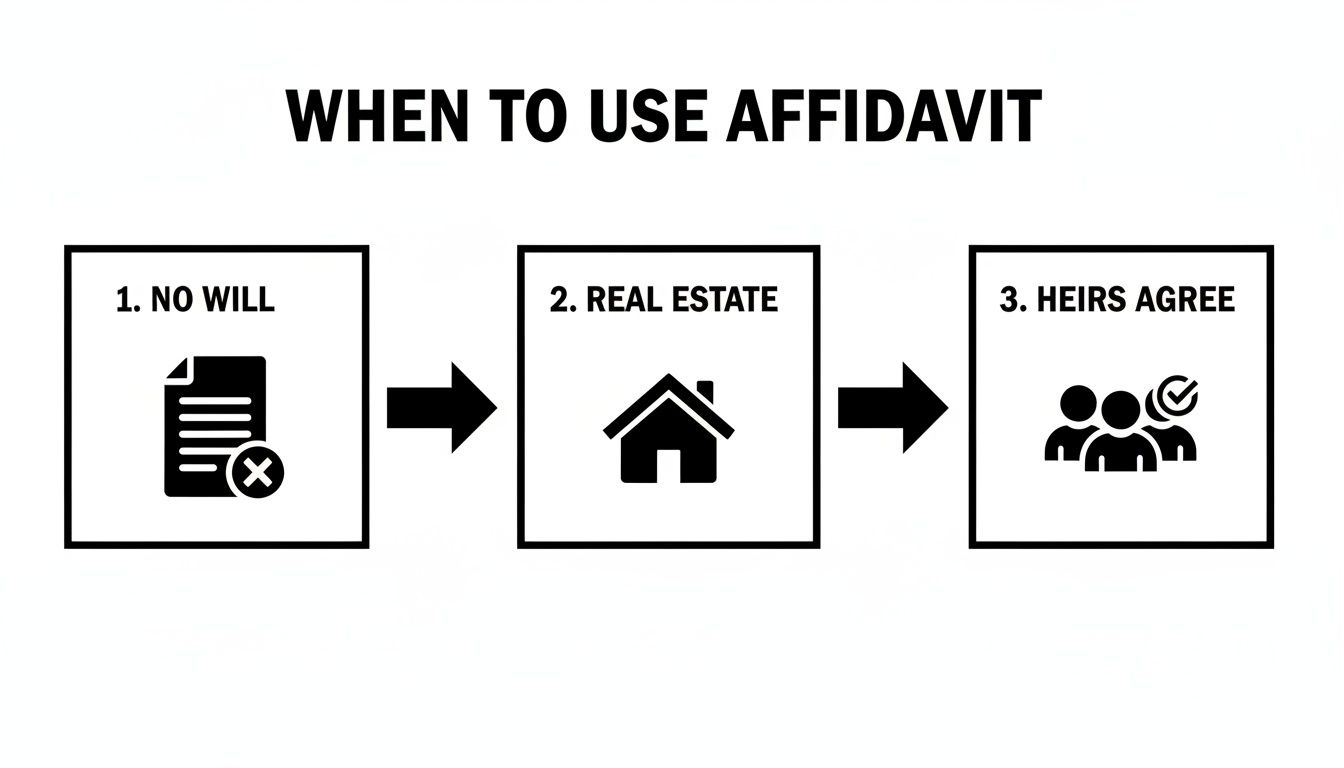
As you can see, the affidavit's real strength is its simplicity for straightforward, uncontested estates built around a piece of real property.
Step 1: Gather the Essential Information
The first—and most critical—step is to pull together all the details required by the Texas Estates Code. The accuracy of this information is the absolute foundation of a valid affidavit. An error here can cause a title company to reject the document down the road, creating unnecessary delays and stress.
You'll need to create a comprehensive file that includes:
- Decedent’s Information: Full legal name, their date and place of birth, and the exact date and place they passed away.
- Family History: A detailed rundown of their marital history, including dates of marriage and divorce, and the names of every spouse.
- Heir Identification: A complete list of all known heirs. This means children (both biological and adopted), parents, and siblings. For each heir, you’ll need their full name, date of birth, current address, and how they were related to the decedent.
- Property Details: The full legal description of the real property involved. You can find this on the property deed.
This stage requires care and attention to detail. You may need to sift through old family records, birth certificates, and marriage licenses to get every detail right.
Step 2: Find Two Disinterested Witnesses
Under Texas law, an Affidavit of Heirship has to be signed by two disinterested witnesses. This is a legal term for people who knew the decedent and their family history but will not inherit a single thing from the estate. Their job is to swear under oath that the family history laid out in the affidavit is true to the best of their knowledge.
A good disinterested witness should:
- Have known the decedent for a long time, often ten years or more.
- Not be a legal heir or have any financial stake in the estate.
- Be willing to sign the affidavit in front of a notary public.
Longtime friends, neighbors, or even colleagues of the person who passed away often make the best candidates. Their sworn statement adds a crucial layer of credibility and legal weight to the document. You can learn more about the critical role of witnesses and other proofs in Texas probate in our detailed guide.
Step 3: Draft and Execute the Affidavit
Once you have all your information and have lined up your witnesses, it's time to draft the affidavit itself. While you can find templates online, it is highly recommended to work with an attorney. This ensures the document meets every single statutory requirement and is tailored to your family’s unique situation.
The drafted affidavit will lay out all the facts you've collected in a clear, formal statement. Then, it's time to make it official:
- Review for Accuracy: Every single heir should read through the document to confirm all the details are correct.
- Signatures: All adult heirs and the two disinterested witnesses must sign the affidavit.
- Notarization: Every signature must be made in the presence of a notary public, who will then add their official seal. This is the step that makes the sworn statements legally binding.
For those looking to streamline the creation of legal forms, modern tools like legal document automation software can improve both efficiency and accuracy.
Step 4: File the Affidavit in the County Records
The final step is to make the Affidavit of Heirship part of the public record. This is what officially establishes the chain of title and tells the world that ownership has been transferred.
The completed, signed, and notarized affidavit must be filed with the county clerk in the county where the property is located. The clerk will record it in the official public real property records. Once it's filed, it serves as powerful evidence of heirship and can be used to transfer the property’s title.
Key Insight
Completing an Affidavit of Heirship is a meticulous process, but it is not an overly complicated one. Every step—from gathering information to filing the final document—is designed to create a legally sound record that honors your loved one's legacy and secures your family's inheritance with compassion and efficiency.
What Needs to Go Into a Valid Affidavit of Heirship

For an Affidavit of Heirship to work, accuracy isn't just a goal—it's everything. Think of this document as a legal map of your family's history. Every road and landmark must be perfectly placed. If even one detail is off, a title company will reject it, sending you right back to the starting line. This section is your checklist, covering every piece of information Texas law demands to get it right the first time.
The law requires this affidavit to be a complete and honest picture of the decedent's family, property, and history. Getting these details straight from the outset is the key to avoiding the frustrating and expensive delays that can trap an estate.
Decedent and Marital History
The affidavit has to start with a clear, detailed profile of the person who passed away (the decedent). This information is the foundation of the entire document.
You'll need to provide:
- Full Legal Name: Exactly as it appears on their legal documents.
- Complete Personal Details: Their date of birth and their last known address.
- Date and Place of Death: The specific date, county, and state where they died.
- Complete Marital History: This is a big one. You need the date of every marriage, the name of every spouse, and how each marriage ended (whether by death or divorce). Dates are absolutely critical here.
This detailed history is non-negotiable because it helps establish the primary heirs under Texas law, which always looks to the surviving spouse first.
A Definitive List of All Heirs
Next, the affidavit must create a comprehensive "family tree" identifying every single legal heir according to Texas's intestacy laws. This goes far beyond just listing the children.
The list has to include the following for each and every heir:
- Their full legal name and current address.
- Their relationship to the decedent (e.g., child, parent, sibling).
- Their date of birth.
- If an heir has also passed away, you must list their date of death and identify their own children, as those descendants may have a claim to a piece of the estate.
This is a strict requirement under the Texas Estates Code, Title 2, which lays out a specific order of inheritance. Missing even one potential heir can render the entire affidavit invalid.
The Critical Role of Disinterested Witnesses
Perhaps the most important part of a valid Affidavit of Heirship is the sworn statement from two disinterested witnesses. Their testimony is what gives the document its legal weight and credibility.
So, who qualifies as a "disinterested" witness? It has to be someone who:
- Has No Financial Stake: They can't be an heir or stand to gain a single penny from the estate. This ensures their testimony is completely impartial.
- Has Personal Knowledge: They must have known the decedent and their family personally, often for 10 years or more.
- Can Swear to the Facts: They must be willing to sign the affidavit in front of a notary public, taking an oath that the family history laid out in the document is true to their knowledge.
These witnesses essentially act as the community's stamp of approval on the family's story. Their signatures confirm that the list of heirs is correct and complete, giving a title company the confidence it needs to approve the transfer of property. Properly completed affidavits have a high acceptance rate, helping families bypass probate's typical 6-12 month delays that affect thousands of Texas estates every year. You can learn more about these legal requirements at PaulOwensLaw.com.
Gathering all this information with care can feel like a heavy lift, but it’s the only way to ensure a smooth process and protect your family's inheritance from future legal challenges.
Comparing Probate Alternatives in Texas
When you're grieving the loss of a loved one, the last thing you want is a complicated legal puzzle. Texas law offers a few different tools to settle an estate, and picking the right one can save your family a world of time, money, and stress. The Affidavit of Heirship is a fantastic option in the right circumstances, but it’s crucial to understand how it stacks up against the other methods, including formal probate, Wills & Trusts, and Guardianship proceedings.
Each path is designed for a specific situation—it all depends on the estate's size, the family's level of agreement, and the complexity of the assets involved. Knowing the difference is the first step to making a smart, efficient choice.
Affidavit of Heirship vs. Formal Probate
A formal probate is what most people think of when they hear the word "probate"—it's the traditional, court-supervised process for settling an estate. This is the most thorough and legally bulletproof option, making it the go-to for complicated situations. You'll almost certainly need formal probate if the estate has significant debts, a mix of assets like bank accounts and investments, or if there’s any hint of a disagreement among the heirs.
In stark contrast, an Affidavit of Heirship is built for simplicity. Its main job is to transfer title to real estate when there’s no will and everyone is on the same page. It completely sidesteps the courtroom, which makes it dramatically faster and cheaper.
Muniment of Title: A Unique Texas Option
Here in Texas, we have a unique process called a Muniment of Title. It’s a great alternative to full probate when someone leaves a valid will, but the estate has no debts (other than a mortgage or other loans secured by real estate). This special proceeding asks a court to legally recognize the will and the transfer of property to the people named in it. It's simpler and quicker than a full probate administration, but it does still require a trip to the courthouse.
The key difference is the will. An Affidavit of Heirship is only for situations where there is no will. A Muniment of Title, on the other hand, can only be used when a valid will exists. You can learn more about Muniment of Title in our comprehensive guide.
Small Estate Affidavit for Modest Estates
The Small Estate Affidavit (SEA) is another probate alternative, but it's designed specifically for very small estates. Under Texas law, an SEA is only an option if the person died without a will and their total assets (not counting their homestead) are worth $75,000 or less. Critically, it can't be used to transfer any real property other than the person's primary home, or homestead.
This makes the SEA far more limited than an Affidavit of Heirship, which has no strict value cap and is primarily used for transferring all types of real estate.
An Affidavit of Heirship is a perfect example of Texas's practical approach to intestate succession, especially when you compare it to the probate-heavy systems in other states. Avoiding formal probate in Texas can save heirs $3,000 to $10,000 per estate, on average. Better yet, 65% of filers report getting it done in under 30 days, a stark contrast to the 9-month median for probate in Harris County. Once the affidavit is filed, a 5-year waiting period gives it presumptive validity, protecting the title against late-arriving claims. This efficiency has been a lifesaver in booming markets like Austin, where these affidavits have helped thousands of families sell property without getting bogged down in court.
And as you navigate transferring property after a death, don't forget about the potential financial obligations that come with it. It’s always a good idea to have a clear picture of the estate's tax situation by understanding the nuances between death tax vs. estate tax.
Comparing Texas Estate Settlement Options
To make things clearer, let’s put these options side-by-side. Seeing the key differences in one place can help you quickly identify which path might be the best fit for your family's situation.
| Method | Best For | Typical Timeline | Relative Cost |
|---|---|---|---|
| Affidavit of Heirship | Simple estates with no will, where the main asset is real estate and all heirs agree. | 2-4 Weeks | Low |
| Formal Probate | Complex estates, estates with significant debts, or when heirs disagree. Required for most wills. | 6 Months – 2+ Years | High |
| Muniment of Title | Estates with a valid will but no unsecured debts (like credit cards or medical bills). | 2-3 Months | Moderate |
| Small Estate Affidavit | Very small estates (under $75,000, excluding homestead) with no will. Cannot transfer most real property. | 1-2 Months | Low |
Ultimately, the best choice depends entirely on your family’s unique circumstances.
Your family's situation—whether there’s a will, the types of assets, the amount of debt, and the level of agreement among heirs—is what will point you down the right path. An Affidavit of Heirship is often the perfect tool for an uncontested, intestate estate focused on real estate, while the other methods are better suited for more complex or contentious scenarios.
Key Insight: What Your Family Needs to Remember
Dealing with an estate is overwhelming, especially when you're also grieving. To make things a little clearer, we've boiled down the most critical points about using an Affidavit of Heirship in Texas. Think of this as your quick-glance guide to help you decide what to do next.
Here are the essential takeaways for your family:
- It’s a Tool for When There's No Will: An Affidavit of Heirship is designed to transfer title to property—almost always real estate—when the deceased did not leave a valid will. It cannot override the instructions in a will.
- Best for Simple Estates and United Families: This process works best when a house is the main asset and all heirs are in complete agreement. Any family disputes or complex assets are a red flag that you likely need a formal probate process.
- The Details Must Be Perfect: This is a sworn legal document. You are legally required to be completely accurate when listing all family members, marriages, divorces, and heirs. Any mistakes can invalidate the affidavit under the Texas Estates Code, Title 2.
- Independent Witnesses Are the Key: The entire affidavit hinges on the sworn statements of two witnesses who have zero financial interest in the estate. Their credibility is what gives the document its legal weight and allows it to function as intended.
Common Questions We Hear About Affidavits of Heirship
When you're dealing with the loss of a loved one, the legal process can feel overwhelming. It’s natural to have questions. At The Law Office of Bryan Fagan, we’ve found that direct, clear answers are the best way to bring comfort and confidence to families navigating this difficult time. Here are some of the most common practical concerns we hear about the Affidavit of Heirship in Texas.
Can We Use This Affidavit to Get Money from a Bank Account or Transfer a Car Title?
This is one of the first and most important questions families ask. The short answer is, probably not. In plain English, an Affidavit of Heirship is designed for one primary purpose: to transfer title to real estate, like the family home or a piece of land. Its real power is in creating a clean, recordable chain of title in the county property records.
When it comes to other types of assets, you'll likely hit a wall. Financial institutions like banks and credit unions, along with the Texas DMV, have their own strict internal rules. Most of them will not accept an Affidavit of Heirship to release funds or transfer a vehicle title. They almost always require official, court-issued documents like Letters Testamentary or Letters of Administration, which you can only get through a formal Texas Probate Process.
What Happens If a Long-Lost Relative Shows Up After We File?
Discovering an unknown heir after the affidavit is filed is a scenario that can turn a simple process into a stressful and legally tangled mess. This is one of the biggest risks of using this probate alternative, and it's exactly why getting the family history right from the very beginning is so critical.
Under Texas Estates Code § 203.001, a properly filed Affidavit of Heirship becomes prima facie evidence of heirship after it has been on record for five years. In plain English, this means that after five years, the law presumes the facts in the affidavit are correct. It becomes much, much harder for a newly discovered heir to challenge the title to the property.
But within that five-year window, an omitted heir could file a lawsuit to claim their share of the property. That can drag everyone into complex and expensive Probate Litigation. This five-year risk is a powerful reason to have an experienced attorney meticulously research and document your family’s history before anything is filed.
How Much Does an Affidavit of Heirship Actually Cost?
One of the biggest draws of an Affidavit of Heirship is its affordability when compared to full-blown probate. While the final cost depends on how complex the family tree is, the total expense is almost always just a fraction of what a court-supervised administration would run you.
Here’s a realistic look at what you can expect to pay for:
- Attorney's Fees: This is the main cost. It covers the lawyer's time and expertise to research the heirs, draft the document to meet all legal requirements, and guide your family through the signing and filing process.
- Filing Fees: The county clerk charges a fee to officially record the affidavit in the public records. This is usually a small, per-page charge.
- Notary Fees: Every signature on the affidavit has to be notarized, which comes with a small fee for each person signing.
Even when you add it all up, the total is significantly less than the thousands of dollars often required for formal probate, which includes court costs, higher attorney fees, and other administrative expenses. For the right family situation, the affidavit is an incredibly efficient and cost-effective solution.
If you’re facing probate in Texas, our team can help guide you through every step — from filing to final distribution. Schedule your free consultation today.