Skip to content
When you’re grappling with the loss of a loved one, the last thing you want to face is a mountain of dense legal jargon. That’s where the Texas Estates Code comes in. Think of it less as a stuffy rulebook and more as a practical roadmap, designed to bring order to a difficult time and ensure a person’s final wishes are honored with care and respect.
A Compassionate Guide for Texas Families
Navigating a family member's passing is emotionally draining, and the legal side of things can feel completely overwhelming. The Texas Estates Code was put together to provide a clear, step-by-step process for everything that comes next—from making sure a will is valid to seeing that assets get to the right people. Its primary goal is to head off confusion and family arguments by creating a predictable, fair framework.
This legal framework gives much-needed structure to what can otherwise be a chaotic period. It provides the official playbook for:
- Validating a Will: Confirming that a loved one's will is legally sound and enforceable.
- Appointing an Executor: Officially naming the person in charge of managing the estate.
- Paying Debts: Settling any outstanding bills or taxes the deceased person owed.
- Distributing Assets: Transferring property, money, and personal belongings to the correct heirs.
Why This Code Matters to You
If you were dealing with estates before 2014, you would have been working with the old Texas Probate Code. The state completely overhauled and reorganized those laws into the modern Texas Estates Code to make them more accessible for everyday families. This update, which went into effect on January 1, 2014, was a massive effort to simplify the legal language and streamline the entire process.
At its heart, the Code provides a clear path forward, making sure your loved one’s final wishes are respected and their legacy is protected. For executors, heirs, and families, understanding its basic purpose is the first step toward managing an estate with confidence. It’s about replacing legal anxiety with a clear understanding of the journey ahead, which is a core part of how we guide families.
You can read more about how to navigate probate court using the Estates Code in our detailed guide.
When you’re dealing with a loved one’s estate, cracking open the Texas Estates Code can feel like trying to read a phone book from cover to cover. It’s dense, intimidating, and filled with legal jargon. But here’s the good news: for most families, you only need to understand a handful of key sections to find your way.
Think of the code as a library. You don't need to read every book, just the ones relevant to your situation. For grieving families, those books are almost always found in Title 2 and Title 3. These two sections answer the most pressing questions that come up during an emotional time: who gets the property, and who takes care of those who can't care for themselves?
Title 2: Who Inherits When There Is No Will
One of the most stressful situations a family can face is when someone passes away without a will. In legal terms, this is called dying "intestate." Suddenly, there are no written instructions, and that void can quickly fill with confusion, disagreements, and anxiety.
This is where Title 2 of the Texas Estates Code provides a clear roadmap. It lays out the laws of intestate succession—the state’s default rules for dividing property among the closest surviving relatives. You can think of it as Texas's backup plan, designed to distribute assets the way the law assumes most people would have wanted.
For example, if a person dies without a will and leaves behind a spouse and children they had together, the spouse typically inherits all the community property. But things get more complicated with separate property, which is often split between the spouse and the children. Understanding these default rules is the first critical step in the Texas Probate Process.
Title 3: Protecting Vulnerable Loved Ones Through Guardianship
The Texas Estates Code isn't just about money and property. It also provides powerful protections for the most vulnerable members of our families. Title 3 is dedicated entirely to Guardianship, which is the legal process of appointing someone to make decisions for a minor child or an incapacitated adult.
At its core, this part of the code is about compassion. It ensures that people who can’t advocate for themselves have a trusted person legally empowered to act in their best interests.
- Guardianship of a Minor: This is crucial when a child's parents die without naming a guardian in their will. The court steps in to appoint someone to oversee the child’s well-being, education, and finances until they become an adult.
- Guardianship of an Incapacitated Adult: This applies when an adult can no longer manage their own personal or financial affairs due to an illness, like dementia, or a serious injury. A court-appointed guardian can then make medical decisions, pay bills, and protect them from harm.
Scenario: Imagine an elderly parent, Sarah, is struggling with dementia and can no longer live alone safely or manage her bank accounts. Her adult son, Mark, could petition the court under Title 3 to become her legal guardian. This would give Mark the legal authority to arrange for proper medical care and safeguard his mother's assets from fraud or mismanagement. It's a structured, compassionate way to ensure a loved one's safety and dignity.
While Title 2 handles inheritance and Title 3 handles care, they both underscore the Estates Code's main purpose: to bring order and protection to families during life's most difficult transitions. A solid plan using Wills & Trusts can often help you avoid these court-heavy processes altogether.
How to Navigate Common Texas Probate Procedures
When a loved one passes, the word "probate" can sound intimidating, like a single, rigid legal maze you're forced to navigate. But the reality in Texas is much more compassionate. The Texas Estates Code was written with real families in mind, providing several different routes to settle an estate.
Choosing the right path isn't just about following the law; it's about saving your family time, money, and emotional energy. Understanding these options is the first step toward turning an overwhelming task into a series of manageable steps.
This flowchart lays out the basic decision-making process for inheritance in Texas, starting with the most critical question: did the deceased leave a valid will?
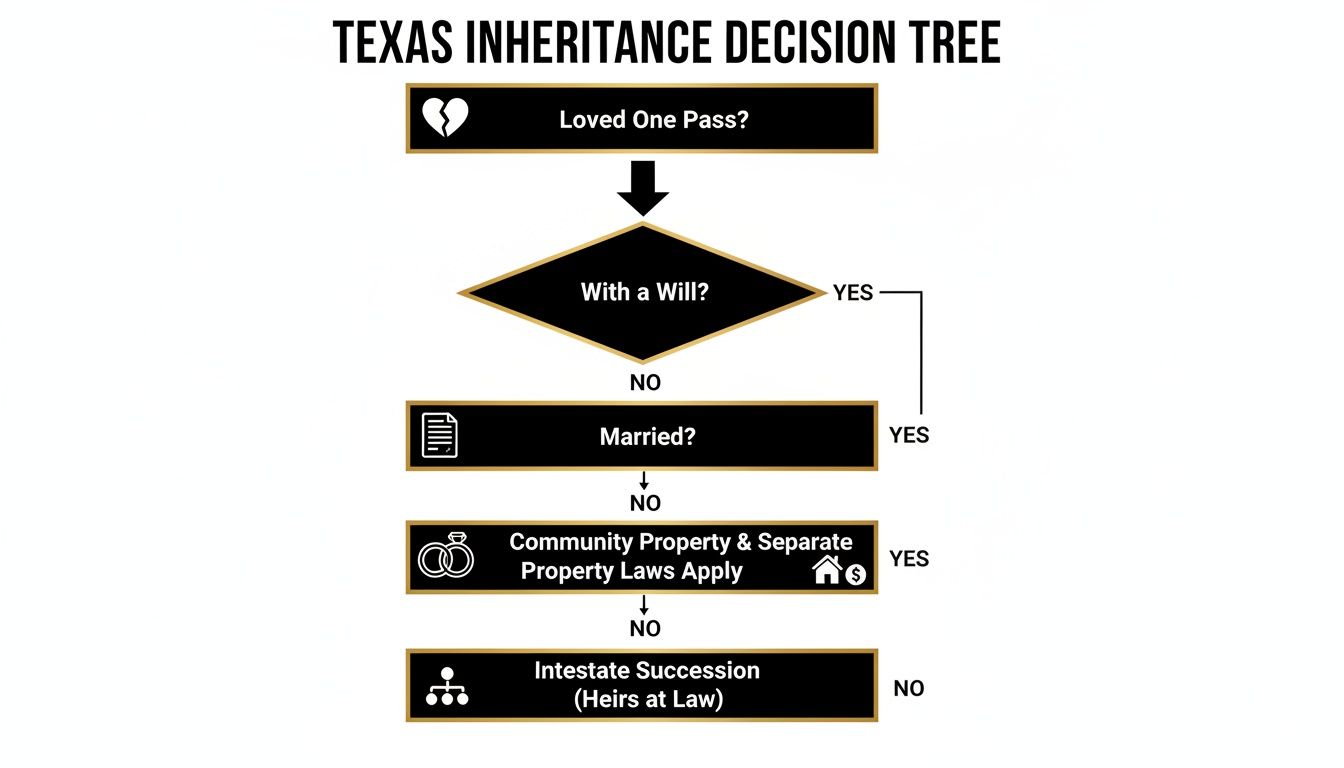
As you can see, a will acts as the roadmap. When one exists, it directs the entire process and provides clear instructions for everyone involved. If not, the state's intestacy laws take over.
Independent Administration: The Go-To for Most Texas Families
For the vast majority of Texas estates, Independent Administration is the most common and efficient path forward. Think of it as the "express lane" of probate. It allows the executor named in the will to manage the estate with minimal court supervision.
Once the court officially appoints the executor and they file an inventory of the estate's assets, they're free to pay debts and distribute property without running back to the judge for permission at every turn.
This streamlined approach is available when:
- The will specifically requests it.
- All beneficiaries agree to it, even if the will is silent on the matter.
Governed by Chapter 401 of the Texas Estates Code, this process is built on trust. It empowers the executor to act responsibly, saving the estate a small fortune in court costs and legal fees. It’s the preferred method when family harmony is strong and the will is straightforward.
Muniment of Title: A Shortcut When Only Property Needs Transferring
What happens if the estate is simple, with no debts to speak of, and the only real task is to transfer title to a house or a piece of land? In that case, a full-blown administration feels like overkill. That’s where the Muniment of Title process comes in.
Found in Chapter 257 of the Texas Estates Code, this procedure essentially asks the court to do one thing: officially recognize the will as a valid document for transferring assets. The court order itself acts as the new proof of ownership, like a deed.
No executor is appointed because no administration is needed. It’s a quick, clean, and far less expensive way to clear title when an estate's financial affairs are already in order.
Small Estate Affidavit: A Lifeline for Modest Estates
When a loved one dies without a will and leaves behind a very small estate, the cost of a formal probate can sometimes exceed the value of the assets themselves. The law recognizes this isn't fair, which is why it provides the Small Estate Affidavit (SEA).
Detailed in Chapter 205 of the Texas Estates Code, an SEA is a sworn statement filed with the court. It allows heirs to legally collect the deceased person's property without ever opening a formal probate case. It’s a powerful tool, but it comes with strict rules.
An SEA can only be used if the value of the estate's assets (not including the homestead and other exempt property) is $75,000 or less. The estate can't have any debts other than a mortgage, and the total assets must be worth more than the total liabilities.
This is a perfect example of how the Texas Estates Code offers practical, real-world solutions designed to protect families with limited means from unnecessary legal burdens.
Choosing the Right Texas Probate Path
| Procedure | Best For | Key Requirement | Court Involvement |
|---|---|---|---|
| Independent Administration | Most estates with a will and cooperative beneficiaries. | The will requests it, or all beneficiaries agree. | Minimal; after executor is appointed, most work is done outside of court. |
| Muniment of Title | Simple estates with no unsecured debts, primarily to transfer real estate. | A valid will and no need for an executor to pay debts. | Low; a single hearing to recognize the will as a valid transfer document. |
| Small Estate Affidavit | Very small estates (under $75,000) without a will. | Estate assets are less than $75,000, and assets exceed liabilities. | Very low; requires court approval of the affidavit but no formal hearing. |
| Dependent Administration | Contentious estates where beneficiaries are in conflict or there are complex debts. | Required when Independent Administration is not possible or desired. | High; the executor needs court approval for almost every action. |
Ultimately, each path is designed for a different scenario. An experienced attorney can help you make sense of these options and choose the one that aligns with your family's needs.
Choosing the right path forward is the most critical first step. An experienced probate attorney can help you evaluate your loved one's estate and determine the most efficient and compassionate route, whether it’s through the Texas Probate Process or another legal avenue like creating a Guardianship.
The Executor's Role: A Step-by-Step Guide

Being named the executor of a loved one’s will is more than just a legal title—it’s a profound act of trust. But it's a responsibility that often lands on your shoulders during a time of grief, making the path forward feel incredibly overwhelming.
Thankfully, the Texas Estates Code isn't just a dense legal text; it's a roadmap. It lays out a clear framework for your duties, giving you the structure needed to honor your loved one's wishes with confidence.
Step 1: Filing the Will and Applying for Probate
Your first official act as executor is to take the original will and file it with the appropriate county court, usually where your loved one lived. Along with the will, you must submit an application for probate. This formal request asks a judge to legally validate the will and officially appoint you as the executor. Once approved, the court issues Letters Testamentary—a legal document that proves you have the authority to act for the estate.
Step 2: Notifying Heirs and Creditors
With your Letters Testamentary in hand, your role shifts to communication. The Texas Estates Code is very specific here: you have 60 days from the day the will is probated to formally notify every beneficiary named in it. This isn't just a courtesy; it's a legal requirement. At the same time, you must publish a "Notice to Creditors" in a local newspaper. This public announcement gives anyone your loved one owed money to a set time to file a claim. It’s a crucial step that protects the estate from surprise claims later on.
Step 3: Gathering and Inventorying Estate Assets
This is often the most time-consuming part of the job. Your mission is to identify, locate, and secure everything your loved one owned. This requires meticulous organization of real estate, financial accounts, personal property, and insurance policies. Within 90 days of your appointment, you must file a detailed "Inventory, Appraisement, and List of Claims" with the court. This is a sworn document that lists all the estate's property and its estimated value. For a closer look at these tasks, our detailed guide on the many responsibilities of an executor of a will is a great resource.
Step 4: Paying Debts and Final Expenses
Once you have a clear picture of the estate's assets, your next job is to settle the final accounts. This means using the estate's funds to pay all legitimate debts and expenses. The Texas Estates Code sets out a specific pecking order for who gets paid first, typically starting with funeral costs, then administration costs, secured debts, and finally unsecured debts. It is absolutely vital that all valid claims are paid before a single dollar is distributed to the heirs.
Step 5: Distributing Assets and Closing the Estate
Finally, the most rewarding part of the journey. After every debt, tax, and expense has been paid, you can at last fulfill your loved one's wishes. You can start distributing the remaining assets to the beneficiaries exactly as the will instructs. This involves transferring car titles, writing checks from the estate account, and making sure each heir receives their rightful inheritance. By carefully following this process, you will have honored your loved one’s legacy with the care and diligence it deserved.
When Your Family Should Call a Probate Attorney
Trying to navigate the Texas Estates Code alone can feel like sailing a ship in a storm without a compass. While some estates are simple enough to handle, many situations hide legal traps that can quickly overwhelm a family already dealing with loss. Knowing the red flags is the key to protecting your loved one’s legacy and keeping the peace.
Deciding to call a probate attorney isn’t admitting defeat; it’s a smart, proactive step toward getting peace of mind. It turns a stressful, confusing ordeal into a clear, manageable plan, ensuring every move you make is legally sound and in the estate's best interest.
When a Will Is Contested or Unclear
One of the most painful scenarios is when a family member challenges the will's validity. This is what we call a will contest. It might happen if someone claims the deceased was pressured, wasn't mentally sound when they signed the will, or if there are hints of fraud. Likewise, a will might be written with vague language that leaves it open to interpretation, sparking disagreements among the heirs. When family members can't agree, a probate attorney is essential.
The Estate Has Significant or Complicated Debts
Settling an estate isn’t just about handing out assets—it’s also about paying off liabilities. If your loved one left behind significant debts like large credit card bills, business loans, or a hefty tax burden, the situation demands careful legal and financial handling. An attorney will make sure you notify creditors correctly, following the strict timelines laid out in the Texas Estates Code. Handling this process incorrectly can expose the executor to personal financial liability.
Finding Unknown Heirs or Beneficiaries
What if the will names a beneficiary you can't find? Or what if someone dies without a will, and you have to track down every legal heir according to Texas law? This process, known as an heirship determination, can get complicated fast. An attorney can get the court to appoint an "attorney ad litem"—an independent lawyer whose sole job is to conduct a thorough search for any missing or unknown heirs. Our guide on whether you need a probate lawyer digs deeper into these exact situations.
Navigating Complex Family Dynamics
Grief has a way of turning up the volume on old family tensions. Even in what seems like a simple estate, fights can break out over sentimental items, the sale of the family home, or how the executor is handling their duties. When communication falls apart, an attorney can step in as a neutral guide. Their involvement shifts the dynamic from an emotional battle to a practical, legal process, helping to preserve relationships that might otherwise be broken for good.
Key Takeaway: Your Roadmap to Managing an Estate in Texas
Losing a loved one is hard enough without the added weight of managing their final affairs. Think of the Texas Estates Code not as a legal obstacle course, but as a structured guide designed to bring clarity and order during an incredibly emotional time. Its entire purpose is to make sure your loved one’s wishes are honored with dignity.
The most powerful tool for ensuring a smooth process is a valid will. It acts as a direct instruction manual for your family, paving the way for simpler probate paths like Independent Administration and preventing the courts from having to make decisions on your behalf.
Here are the core principles to remember:
- Texas law is flexible. Not every estate needs a full-blown administration. Simpler options like a Muniment of Title or a Small Estate Affidavit exist to match the solution to the family's specific situation.
- Asking for help is a sign of strength. You aren't expected to be a legal expert overnight. If you face complex debts, a confusing will, or family conflict, bringing in a professional protects the estate and preserves family harmony. You can learn more about what to expect by understanding the Texas Probate Process.
- Planning ahead is an act of care. By setting up your own Wills & Trusts, you are lifting a tremendous emotional and administrative burden from the people you care about most.
The Texas Estates Code isn't a barrier; it's a roadmap. With a basic understanding of its structure, you can manage an estate with confidence and compassion.
Your Top Questions About the Texas Estates Code, Answered
When families start dealing with a loved one's estate, the same questions almost always come up. These are the practical, real-world concerns that keep people up at night. Let's clear the air and answer them in plain English so you can move forward with a bit more confidence.
What’s the Difference Between an Executor and an Administrator?
While these two roles sound almost identical, there’s one simple difference: was there a will? An executor is the person specifically named in a will to follow its instructions. Think of them as the hand-picked captain of the ship.
An administrator, on the other hand, is appointed by a probate court when someone dies without a will. The court steps in to choose a responsible person to manage the estate according to state law. Both have a strict duty to act in the best interests of the estate and its beneficiaries.
How Long Does Probate Really Take in Texas?
This is the million-dollar question, and the answer is… it depends entirely on how complex the estate is. For a straightforward estate using Independent Administration where everyone is on the same page, you could be looking at six to twelve months.
But that timeline can stretch out considerably if things get complicated. The process will almost certainly take longer if:
- Someone contests the will, sparking Probate Litigation.
- The estate involves complicated assets like a family business or has a mountain of debt.
- It's a struggle to track down all the heirs or beneficiaries.
Is It Possible to Avoid Probate in Texas?
Yes, absolutely. With some smart estate planning ahead of time, many people can structure their assets to bypass the probate process entirely. Tools like Wills & Trusts are designed to make this happen.
For instance, any asset you place inside a living trust is controlled by the trust, not your will. When you pass away, a successor trustee you've named simply distributes those assets according to the trust's rules—no court required. Other tools, like Transfer on Death Deeds (TODDs) for real estate and Payable on Death (POD) bank accounts, are also fantastic for transferring assets directly to your loved ones.
What Happens if Someone Dies with a Lot of Debt?
When a person passes away, their debts don't just vanish. The estate itself becomes responsible for paying them off before any money or property can be handed out to the heirs. The Texas Estates Code even lays out a specific priority list for which debts get paid first.
The executor or administrator has the job of using the estate's cash and assets to settle those claims. If the debts are greater than the value of the assets, the estate is considered "insolvent." In that unfortunate situation, the heirs likely won't receive anything. The good news? Heirs are almost never held personally responsible for paying the deceased's debts from their own pockets.
If you’re facing probate in Texas, our team can help guide you through every step — from filing to final distribution. Schedule your free consultation today.