When a loved one passes away without leaving a will, it's natural to feel overwhelmed and unsure of what to do next. The compassionate team at The Law Office of Bryan Fagan is here to reassure you: Texas law provides a clear path for handling the estate. This process is called intestate succession, and it acts as a default will, ensuring that your loved one's property is distributed to their legal heirs. We understand you're grieving, and our goal is to simplify this process for you.
What Happens When a Loved One Dies Without a Will in Texas
Losing a family member is hard enough without the added stress of legal confusion. One of the first questions we hear is, "What happens now?" Many people share a common fear: if there’s no will, the State of Texas will swoop in and take everything.
Let's put that myth to rest. That scenario is incredibly rare. Instead, the Texas Estates Code provides a structured roadmap for what to do when someone dies "intestate," which is simply the legal term for passing away without a valid will. Think of it as a pre-set plan the state created to protect families by directing assets to the closest living relatives.
This court-supervised process is known as probate without a will, or an intestate administration. It’s the official way the legal system identifies the rightful heirs, pays off any debts, and legally transfers ownership of the deceased person’s property. While it might sound complicated, the process is designed to be orderly and manageable, especially with compassionate legal guidance.
Understanding Intestate Succession
When someone dies intestate, the state's succession laws step in to decide who gets what. These rules, found in Titles 2 & 3 of the Texas Estates Code, don't consider verbal promises or what you think your loved one might have wanted. The distribution depends entirely on a fixed formula based on the deceased person's family structure at the time of death—were they married, single, did they have children, or were other relatives still living?
In an intestate probate, the court has a few primary goals:
- Legally identify the decedent's heirs. This isn't just a casual family discussion; it's a formal court proceeding called a Determination of Heirship.
- Appoint a personal representative. This person, known as an Administrator, is given the legal authority—called "Letters of Administration"—to manage the estate.
- Settle all valid debts and taxes. Before heirs get anything, the Administrator must use estate funds to pay off any legitimate obligations.
- Distribute the remaining assets. Once the bills are paid, the property is finally transferred to the legally confirmed heirs according to state law.
A Realistic Scenario: The Thompson Family
Imagine Sarah’s father, Mr. Thompson, passes away unexpectedly in Houston without a will. He owned a house, a car, and had a sizable bank account. Sarah and her brother are his only children, and they’re left confused about who is in charge and how they can even access his bank account to pay for funeral expenses.
This is a classic intestate situation. Sarah and her brother would need to open a probate case. Here's the step-by-step guidance:
- File an Application for Determination of Heirship: They would ask the court to formally declare them as their father's legal heirs.
- Request an Administrator: One of them could ask to be appointed as the Administrator of the estate.
- Receive Letters of Administration: Once appointed, the court would grant them "Letters of Administration," giving them the legal power to access the bank account, pay the bills, and eventually distribute their father's property according to Texas law.
This legal framework provides an orderly path forward, even when a will is missing.
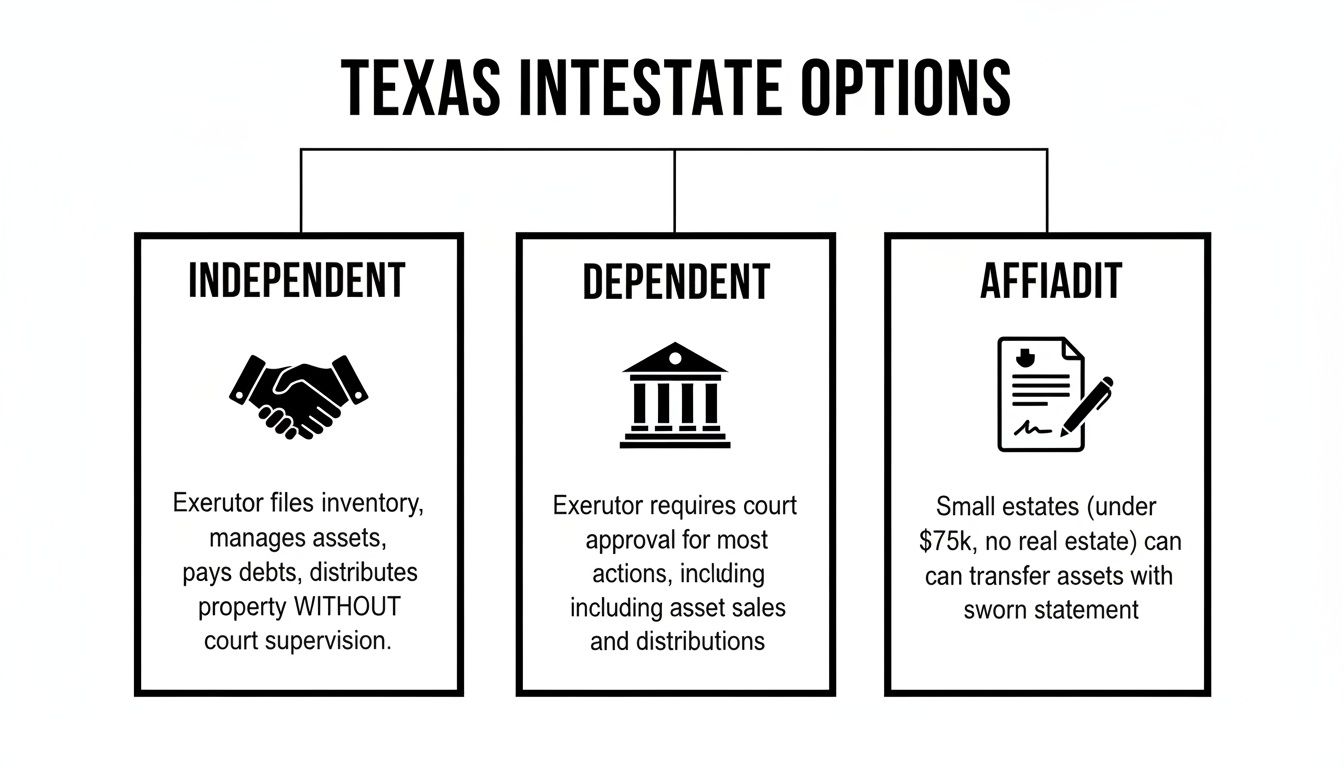
Texas Intestate Probate Options at a Glance
To help you understand the main legal pathways for handling an intestate estate in Texas, we've put together a quick comparison table. Each option is designed for a different scenario, from simple, low-value estates to more complex situations requiring court supervision.
| Probate Method | When It's Used | Key Requirement |
|---|---|---|
| Independent Administration | For estates where all heirs agree on an administrator and can act without constant court supervision. | Unanimous consent from all heirs. |
| Dependent Administration | When heirs disagree, there are complex debts, or court oversight is needed for protection. | Requires court approval for most actions (selling property, paying debts). |
| Small Estate Affidavit (SEA) | For estates valued at $75,000 or less (excluding the homestead), with no debts other than those secured by the homestead. | Strict asset and debt limits; cannot be used if the estate owns other real estate besides the homestead. |
| Affidavit of Heirship | To establish ownership of real property when traditional probate is not feasible or necessary, often for clearing title. | Not a formal court process. It's a recorded document used mainly for real estate title purposes. |
Choosing correctly from this list can save you significant time, money, and stress. An Independent Administration is usually the most efficient, but it requires everyone to cooperate. When that’s not possible, a Dependent Administration provides a more structured, court-monitored process, and for the smallest estates, an SEA can be a lifesaver.
Who Inherits Property Under Texas Law
When a loved one passes away without a will, the first question on everyone's mind is a simple but painful one: who gets what? In the absence of a will, you don't get to decide. The State of Texas does. The state provides a rigid, predetermined rulebook called the intestate succession laws, found in Title 2, Chapter 201 of the Texas Estates Code.
Think of these laws as the state’s default will for anyone who didn't leave one behind. It’s a system based entirely on family relationships, and it doesn't care about verbal promises, close friendships, or what you think the deceased would have wanted.
To figure out who inherits, the law first sorts all the deceased’s assets into two big buckets: community property and separate property.
- Community Property: In plain English, this is everything a couple acquired during their marriage, with a few exceptions like gifts or inheritances given to just one spouse.
- Separate Property: This includes any assets owned before the marriage, as well as any gifts or inheritances received by one spouse during the marriage.
How these assets are divided depends entirely on which family members are still living. Let's walk through the most common situations.
Distribution of Community Property
In Texas, the rules for community property seem straightforward at first, but they can get complicated quickly depending on the family tree.
If the deceased was married with no children, or if all their children were from their current marriage, the situation is simple. The surviving spouse inherits 100% of the community property.
But here’s where things get tricky, especially for blended families. If the deceased was married and had children from a prior relationship, the surviving spouse only keeps their 50% share of the community property. The deceased spouse's 50% is split equally among all of their children—including those from the other relationship.
This rule is a huge source of conflict and confusion. A surviving spouse often assumes they inherit everything, only to find out they now co-own their home with their stepchildren. You can explore these rules in more detail in our comprehensive guide on who inherits when there is no will.
Distribution of Separate Property
The rules for distributing separate property are even more complex. The outcome depends heavily on whether the deceased left behind a spouse, children, parents, or even siblings.
Here’s how it breaks down:
- Survived by a Spouse and Children: The surviving spouse gets one-third (1/3) of the separate personal property (like cash, stocks, and cars). For separate real estate, the spouse only gets a "life estate" in one-third (1/3) of it, meaning they can use the property during their lifetime. The children inherit the remaining two-thirds (2/3) of all separate property outright, plus the full ownership of the real estate after the surviving spouse passes away.
- Survived by a Spouse but No Children: The surviving spouse inherits 100% of the separate personal property. But for separate real estate, the spouse only gets one-half (1/2). The other half goes to the deceased’s living parents, or if they are not alive, to the deceased's siblings.
- Survived by Children but No Spouse: This one is easy. The children inherit 100% of all separate property, split equally among them.
A Real-World Example: David and Susan
Let's put this into a real-life context. Imagine David passes away in Texas without a will. He leaves behind his wife, Susan, their two children together, and one child from his first marriage.
- Their Home (Community Property): Susan already owns her 50% share. David’s 50% share doesn't automatically go to her. Instead, it’s divided equally among all three of his children. Susan now co-owns the family home with her two children and her stepchild.
- An Old Investment Account (David's Separate Property): Because David had children, Susan only receives 1/3 of the account's value. The remaining 2/3 is split equally among David's three children.
As you can see, the default rules can create messy and unintended consequences. Understanding how Texas law divides property is the critical first step in navigating the probate process and protecting your family’s interests.
Key Insight
Many grieving families are shocked to learn that a surviving spouse does not automatically inherit all of their deceased partner's separate property in Texas. The law gives children, parents, and siblings a potential claim, often against the family’s expectations. This underscores the importance of having professional guidance to clarify your rights.
Your Step-by-Step Guide to Intestate Administration
When your family is grieving, the last thing you want to think about is going to court. We understand. Handling an estate without a will—a process we call an intestate administration—isn’t a free-for-all. It’s a structured legal path designed to bring order and closure. We’ve broken this journey down into clear, manageable steps to demystify the process and show you exactly what to expect.

Step 1: Filing the Application to Determine Heirship
The very first official move is to ask the court to legally identify the deceased person’s heirs. This is done by filing a document called an Application to Determine Heirship. Think of it as the formal introduction of your family to the court. This crucial document, required by the Texas Estates Code, lays out a detailed family history—marriages, children, and other living relatives. This filing gets the ball rolling for a probate without a will in Texas and is your way of saying, "An estate needs to be settled, and we need the court to officially declare who the legal heirs are."
Step 2: The Role of the Attorney Ad Litem
Once the application is filed, the court takes an important step to ensure fairness. It appoints a neutral, third-party attorney known as an Attorney Ad Litem. This attorney has one very specific job: to represent the interests of any heirs who might be unknown or couldn't be located. The Attorney Ad Litem acts as a detective, independently verifying the family history you provided to ensure no rightful heir is accidentally left out. It’s a protective measure built right into Texas law.
Step 3: The Heirship Court Hearing
After the Attorney Ad Litem finishes their review and files a report, the court schedules a hearing. At this hearing, two disinterested witnesses must testify. These are people who knew the deceased person but have no financial stake in the estate—they won't inherit anything. They will swear under oath that the family history presented is accurate. Once the judge is satisfied, they will sign an Order Determining Heirship. This is the official court order that legally names the decedent's heirs and specifies the exact percentage of the estate each person is entitled to receive.
Step 4: Appointing an Administrator and Getting Authority
With the heirs now legally identified, the court can appoint someone to manage the estate. This person is called the Administrator. Often, one of the heirs will volunteer for the role, and if all other heirs agree, the court typically approves. The court then grants the Administrator a powerful document called Letters of Administration. This court-issued document is the legal proof you need to show banks, financial institutions, and others that you have the authority to access accounts, pay debts, and gather the assets of the deceased.
Finally, the Administrator must fulfill their duties, which include:
- Gathering all estate assets.
- Notifying creditors and paying valid debts.
- Filing an inventory of the estate with the court.
- Distributing the remaining property to the heirs as directed by the court's order.
It’s vital to act promptly. Texas probate law has strict deadlines, including a general four-year window from the date of death to start most probate proceedings. An experienced attorney can ensure you meet all deadlines and navigate this process with confidence.
Choosing the Right Path: Small Estate Affidavit vs. Full Administration
When a loved one dies without a will in Texas, many families imagine a long, expensive court battle. The good news? That’s not always the case. Texas law offers simpler, more affordable routes for certain estates, allowing you to settle a loved one's affairs without the time and cost of a full, court-supervised administration. Knowing which path your family can take is key to a faster, smoother resolution.

It really comes down to two main options: a simplified process using a Small Estate Affidavit (SEA) or a more formal court proceeding known as a full administration. The right choice hinges entirely on the size and complexity of your loved one's estate.
The Small Estate Affidavit: A Simpler Solution
For smaller, more straightforward estates, the Small Estate Affidavit, or SEA, is a game-changer. It’s a legal tool that allows heirs to collect and distribute assets without appointing an Administrator or enduring a lengthy court process. But to use it, the estate has to fit within strict guidelines set by the Texas Estates Code.
Here are the conditions an estate must meet to qualify for an SEA:
- Value Limit: The total value of the estate's assets—not counting the homestead and other exempt property—must be $75,000 or less.
- No Real Estate (Besides the Homestead): The person who died cannot have owned any other real property. The SEA can only transfer title to their primary residence (the homestead).
- Assets Must Exceed Debts: The estate’s total assets have to be worth more than its total debts (excluding mortgages on the homestead).
- No Will: The deceased must have passed away without leaving a valid will.
An Example of the SEA in Action
Let's imagine your mother passes away, and her only assets are a $20,000 bank account, a paid-off car worth $10,000, and her primary home. She didn't have any significant debts. Her non-homestead assets add up to just $30,000, well under the $75,000 threshold. Her heirs can use a Small Estate Affidavit to get the legal authority to close her bank account and transfer the title to her car and home—all without a formal administration.
You can learn more in our guide to the Texas Small Estate Affidavit form.
When Is a Full Administration Necessary?
A full administration becomes necessary when an estate is too large or too complicated for a Small Estate Affidavit. This court-supervised process is unavoidable if:
- The estate’s non-homestead assets are worth more than $75,000.
- The estate has significant debts, such as credit card bills or medical expenses.
- The deceased owned more than one piece of real estate.
- The heirs can't agree on how to handle things or who should be in charge.
In these situations, a formal Determination of Heirship and the appointment of an Administrator are required. While more involved, a full administration provides a clear legal framework to resolve complex issues and ensure everyone's rights are protected.
Key Insight
The $75,000 limit for a Small Estate Affidavit is a critical number, but what it doesn't include is just as important. The value of the primary home (homestead) and certain exempt personal property aren't counted, which means many more families qualify than they might first think. An attorney can help you determine if this simpler path is an option for you.
Navigating Common Hurdles in an Intestate Probate
While Texas law lays out a road map for estates without a will, real life rarely follows a map perfectly. For grieving families, these challenges can feel overwhelming, but knowing what to look out for can make all the difference.
Family Disagreements
One of the first hurdles families often face is deciding who should serve as the estate's Administrator. When siblings, a stepparent, or other relatives disagree, the process can grind to a halt. Without a court-appointed Administrator, no one has the legal authority to manage estate assets. This is a critical junction where a probate attorney can step in to mediate, help the family find common ground, or ask the court to decide who is best suited for the job, preventing a minor disagreement from turning into a major legal battle.
Locating All Legal Heirs
Another huge challenge in a probate without a will in Texas is tracking down every single legal heir. This isn't a suggestion; it's a strict legal command. The task gets incredibly complicated when the deceased had children from different relationships, a child who passed away leaving grandchildren behind, or simply lost contact with a branch of the family. The court takes this so seriously that it appoints an Attorney Ad Litem to independently search for any unknown or missing heirs, adding time and cost but ensuring fairness.
A Realistic Scenario: The Surprise Heir
Imagine a single man passes away, and his two known adult children start the probate process. The Attorney Ad Litem's investigation uncovers a third child from a brief relationship thirty years ago. That previously unknown heir has the exact same legal rights to the estate as the other two—a shocking revelation that completely changes how the assets will be divided and underscores the importance of this step.
Dealing with Complex Assets and Unexpected Debts
Finally, intestate estates are notorious for financial surprises. Perhaps your loved one left behind a small business without a succession plan. Intestacy laws might split ownership, but they don't provide a playbook for running the company. Likewise, it’s common for unexpected debts to emerge. The Administrator has a legal duty to notify creditors and use estate funds to settle all legitimate debts before any heir receives a single dollar.
These hurdles—family feuds, surprise heirs, and messy finances—are common, but they are not insurmountable. An experienced probate attorney anticipates these issues and develops strategies to manage them, keeping the process moving forward with compassion and professionalism.
A Final Word on Your Family's Next Steps
Losing a family member is hard enough without the added stress of a legal maze. When there’s no will to guide you, it's important to remember that in Texas, "no will" doesn't mean "no plan." The law has a default system in place, and understanding how it works is the first step toward finding your footing.
Key Takeaway
Texas intestate succession laws are designed to distribute property to legal heirs, not for the state to claim it. Your immediate priority is to get a court to legally determine who those heirs are. From there, the path becomes much clearer. For many families, settling an estate without a will doesn't have to be a long, drawn-out court battle. Simpler, more affordable options are often available, and moving quickly is the best way to protect assets and stay on the right side of legal deadlines.
This moment is also a good time to think about the future. For instance, recent federal changes have raised the estate and gift tax exemption to $13.99 million per person for 2025. These higher limits are set to expire after 2025 unless new laws are passed. You can explore these updates and what they mean for future estate planning strategies on jackrobinson.com.
The journey through probate without a will in Texas is not one you have to walk alone. Whether your family needs help with the Texas Probate Process, is facing complex Probate Litigation, or wants to plan ahead with Wills & Trusts, expert guidance provides clarity and peace of mind.
Let us help you find the clearest path forward.
Frequently Asked Questions
When a loved one passes away without a will, families are often left with a whirlwind of questions. We've compiled answers to the questions we hear most often from families navigating probate without a will in Texas.
How Long Does This Process Take in Texas?
For a straightforward, uncontested administration where every heir is on the same page, the process can often wrap up in about six to nine months. However, that timeline can stretch out quickly if heirs disagree, if the estate has complicated assets, or if a rightful heir is missing. The single biggest factor in keeping things moving is cooperation among all the heirs right from the start.
What Are the Typical Costs Involved?
The cost of an intestate probate can vary dramatically. You can generally plan for a few key expenses:
- Court Filing Fees: A few hundred dollars to open the case with the county.
- Attorney Ad Litem Fee: The estate pays for the court-appointed attorney's time to search for heirs.
- Administrator's Bond: An insurance policy to protect heirs from mismanagement.
- Legal Fees: The fees for the estate’s attorney to guide you through the court system.
Can We Avoid Probate If There Is No Will?
While it’s sometimes possible to sidestep a formal administration, most estates without a will need some kind of legal process. For very small estates, a Small Estate Affidavit might be a viable option. In other cases, an Affidavit of Heirship can sometimes be used to clear a property's title. However, these alternatives have strict rules. It's also important to remember that assets with a designated beneficiary, like life insurance or retirement accounts, pass directly to that person outside of probate.
What Happens If We Cannot Find an Heir?
The court takes this very seriously. The court-appointed Attorney Ad Litem is tasked with conducting a diligent search. If, after all that effort, the heir still can't be located, the court will issue an order detailing how to handle their share. In many cases, the funds are deposited into the court's registry, where the money is held, giving the lost heir more time to surface and claim what is rightfully theirs.
If you’re facing probate in Texas, our team can help guide you through every step — from filing to final distribution. Schedule your free consultation today.