Skip to content
When you’re dealing with the loss of a loved one, the last thing you want to face is a confusing legal maze. The probate of a will in Texas is simply the court-supervised process that confirms your loved one's will is valid. It’s what gives the person named as the executor the green light to legally manage the estate.
Think of it as the official step that turns the will's instructions into action, providing a clear path forward during a difficult time.
Understanding the Texas Probate Process

The word "probate" can sound intimidating, but in plain English, it’s a formal roadmap for winding up someone's affairs. Governed by the Texas Estates Code, the process brings legal oversight to what can be a chaotic and emotional time. It ensures debts are paid, assets are properly tracked, and property is transferred to the right people according to your loved one’s wishes.
For families in transition, probate provides much-needed clarity. It officially appoints the executor—the person the will names to be in charge—and grants them the legal standing to do their job. Without this court approval, banks, title companies, and other financial institutions simply won't recognize the executor's authority to act.
Key Roles in the Probate Journey
Every probate case involves a few key players. Understanding these roles can make the whole process feel less mysterious.
- The Decedent: This is the legal term for the person who has passed away.
- The Executor: Named in the will, this individual (or sometimes a bank) is responsible for everything from gathering assets and paying final bills to distributing property to the heirs.
- The Beneficiaries: These are the people, charities, or organizations named in the will to inherit assets.
- The Probate Court: This is the court that oversees the entire process, making sure everything is done according to Texas law.
A Realistic Scenario: The Garcia Family
Let's walk through a common situation. Maria's father, Mr. Garcia, passes away, leaving a will that names her as the executor. His estate is straightforward: a home in Houston, a savings account, and his prized classic car. Maria feels a deep sense of responsibility, but she’s grieving, overwhelmed, and unsure where to begin.
She’s wrestling with questions like:
- How do I get legal access to his bank account to pay for the funeral?
- What paperwork do I need to transfer the house title to me and my brother like the will says?
- What if there are debts I don't even know about?
This is exactly where the probate of a will in Texas provides answers. By filing an application with the court, Maria can be formally appointed as executor. This gives her the legal tools she needs to settle her father's estate with confidence and honor his wishes.
Key Takeaway: Probate isn't just a legal hurdle; it's a protective measure. It validates the will, empowers the executor, and creates a clear, public record of how the estate was settled, which can prevent family disputes down the road.
There isn't a one-size-fits-all approach to probate in Texas. The path you take—whether it's an independent administration, a dependent administration, or a muniment of title—depends entirely on your family's situation. Some paths offer more freedom, while others involve greater court supervision. For a deeper look at the historical side of these procedures, you can learn more about how Texas probate records are managed.
To figure out which route might be best for you, a side-by-side comparison can be incredibly helpful.
Choosing Your Probate Path in Texas
Here’s a straightforward comparison to help you identify which type of probate best fits your family’s circumstances.
| Probate Path | Ideal for Situations Where | Primary Characteristic |
|---|---|---|
| Independent Administration | The estate is straightforward and all beneficiaries are agreeable. | Minimal court supervision; the executor acts freely. |
| Dependent Administration | There are disputes among heirs or significant, complex debts. | The court must approve nearly every action the executor takes. |
| Muniment of Title | There are no debts (except a mortgage) and the main asset is a house. | A fast-track process that essentially turns the will into a deed. |
| Small Estate Affidavit | The estate's value is under $75,000 (excluding the homestead). | An affidavit is filed instead of a full probate process. |
Ultimately, this framework brings order to the process of settling an estate, ensuring everything is handled fairly and according to the law.
Taking the First Steps in the Probate Process
When you're named as the executor, knowing where to begin can feel like a huge weight being lifted. The initial steps are the most critical, as they set the stage for a smooth and orderly administration of your loved one's estate. The journey starts not in a courtroom, but with a single, essential document.
Your first priority is to locate the original, signed will. While you might have copies floating around, Texas courts have a strong preference for the original document with its authentic signature. It is possible to probate a copy, but it requires extra proof that the original wasn't intentionally destroyed, adding complexity and stress to the process.
The Four-Year Filing Deadline
Once you have the will, the clock starts ticking. This is a big one. The Texas Estates Code, Section 256.003, lays out a critical deadline: a will must generally be filed for probate within four years of the person's death. If you wait longer, you'll face significant legal hurdles that can make it nearly impossible to probate the will, forcing the estate to be handled as if no will existed at all.
This four-year rule is strict, and it's designed to ensure estates are settled in a timely manner. Procrastination here can unfortunately have serious consequences.
This infographic lays out the initial sequence of actions you'll need to take to get the ball rolling.
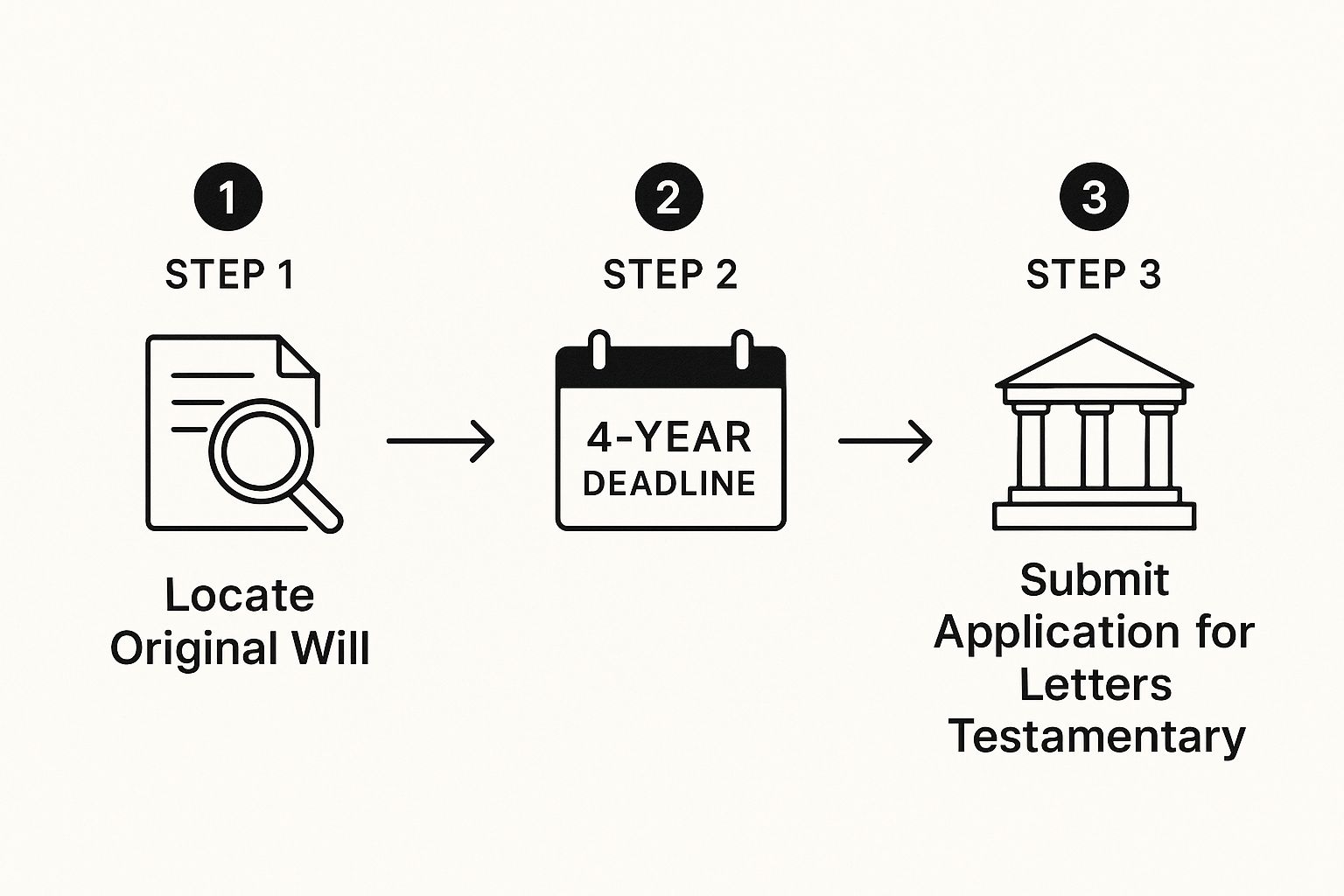
As you can see, these foundational steps build on each other, moving you from finding the will to formally kicking things off with the court system.
Filing the Application with the Court
With the original will in hand, the next move is to file an Application to Probate Will and for Issuance of Letters Testamentary with the correct county court. This is the formal legal document that officially opens the probate case.
It’s not just a form; it’s a detailed petition that includes:
- The decedent’s personal details and date of death.
- Facts confirming why you're filing in that specific county.
- Information about the will and you, the executor named within it.
- The names and addresses of all beneficiaries.
This application is your formal request to the court, asking it to legally recognize the will as valid and to officially appoint you as the executor.
Understanding Letters Testamentary
You probably noticed the phrase "Issuance of Letters Testamentary" in the application's title. This is simply the formal way of asking the court to grant you official authority to act on behalf of the estate.
Letters Testamentary is the legal document the court issues once the will is admitted to probate. Think of it as your official certificate—it's the proof you need to show banks and other institutions that you have the legal power to manage the estate’s assets.
Without Letters Testamentary, you’re stuck. You can't:
- Access the decedent's bank accounts.
- Sell estate property like a house or a car.
- Pay the estate’s final bills and debts.
- Distribute assets to the beneficiaries.
Once your application is filed, the county clerk will post a public notice at the courthouse. This is a required procedural step that starts a mandatory waiting period, usually about two weeks, before a hearing can be scheduled. This gives anyone who might want to contest the will a chance to step forward. For a detailed breakdown of the necessary paperwork, you can check out our guide on how to file a petition for probate in Texas.
Your Role as an Executor After the Court Hearing
The probate court hearing might sound intimidating, but it’s often more of a formality than a courtroom drama. If the will is uncontested, the proceeding is usually quick and straightforward. You’ll be sworn in and asked a few basic questions to confirm the information in your application—like verifying the decedent's identity and confirming the document you filed is, in fact, their last will.
Once the judge is satisfied, they’ll sign an order that officially admits the will to probate. This is the moment you are formally appointed as the executor of the estate. Soon after, the court clerk will issue your Letters Testamentary. This document is your official proof of authority to act on behalf of the estate. Your real work begins now.
Taking the Oath and Posting Bond
Before you receive your Letters Testamentary, you’ll need to take an oath of office. It’s a formal, sworn promise that you will faithfully perform your duties according to the will and Texas law.
The court might also require you to post a bond. Think of a bond as an insurance policy that protects the estate and its beneficiaries from any potential mismanagement on your part. Fortunately, many Texas wills contain a simple clause that waives this bond requirement for the named executor, which makes this step much easier.
Notifying Creditors of the Estate
One of your first and most critical legal duties is to let potential creditors know that your loved one has passed away. The Texas Estates Code, Section 308.051, requires you to publish a general “Notice to Creditors” in a local newspaper where the probate was filed.
This notice is a public announcement that starts a timer, giving anyone the estate might owe money a deadline to file their claim. You must get this published within one month of receiving your Letters Testamentary.
Key Insight: Publishing the Notice to Creditors is a non-negotiable step that protects the estate. It creates a clear cutoff for claims, preventing a surprise bill from appearing months or years later and derailing the final distribution to the heirs.
Beyond the public notice, you also have to notify certain creditors directly. Texas law mandates that you send a formal notice by certified mail to any secured creditors—like a mortgage lender or a car loan company—within two months of your appointment. This ensures they are officially in the loop and can take any necessary steps to protect their collateral.
Compiling the Estate Inventory
You have 90 days from your appointment to file a crucial document with the court: the "Inventory, Appraisement, and List of Claims." This is essentially a detailed financial snapshot of every asset the decedent owned when they died.
The inventory needs to be painstakingly accurate. You’ll list everything from the house and bank accounts to cars, jewelry, and furniture. Every item must be assigned its fair market value as of the date of death.
- Real Estate: This includes the home's value, which can be determined from a professional appraisal or the most recent county tax assessment.
- Financial Accounts: You'll need the exact balance for every bank account, retirement fund, and investment portfolio on the day your loved one passed.
- Personal Property: For high-value items like art, antiques, or a classic car, you’ll likely need a professional appraisal. For everyday household goods, a reasonable, good-faith estimate is usually acceptable.
Pulling this inventory together is a major undertaking and forms the bedrock of the entire probate of will in Texas. This document will guide how you pay off debts and, ultimately, how you distribute the remaining assets to the beneficiaries. As an executor, you may need to communicate formally with the court from time to time, so knowing the basics of writing a letter to a judge can be helpful. For a deeper look at all these duties, check out our guide on the executor's roadmap and duties under Texas probate law.
Managing Estate Assets and Settling Debts

Once you're appointed executor, you officially step into the role of a fiduciary. This is a legal term that means you have a duty to act in the best interest of the estate and its beneficiaries—a position of enormous trust. One of your first and most important jobs is to get the estate's finances organized and protected.
This almost always starts with a trip to the bank. Using your Letters Testamentary, you'll need to open a dedicated bank account in the name of the estate. All of the deceased's liquid assets—cash from their personal accounts, incoming checks, or any income the estate earns during probate—get deposited here. This account creates a clean, transparent paper trail for every dollar that comes in and goes out, which is absolutely essential for paying bills and for the final accounting you'll eventually provide to the beneficiaries.
Handling Debts and Creditor Claims
A core purpose of the probate of a will in Texas is making sure the deceased person's legitimate debts get paid. These obligations can be anything from a final electricity bill and credit card statements to outstanding medical expenses or a mortgage. As the executor, you'll use that new estate bank account to pay these valid claims.
But what if a bill looks suspicious? You aren't required to just pay every invoice that shows up. If a creditor submits a claim that you believe is wrong or invalid, you have the right to formally reject it. This shifts the burden onto the creditor to file a lawsuit to prove their claim is legitimate—a hurdle many won't bother with for smaller or poorly documented debts.
Key Insight: Your primary duty is to the estate and its beneficiaries. That means you need to carefully scrutinize every creditor claim and only pay those that are legally valid and presented correctly under the rules of the Texas Estates Code.
It's also critical to do your due diligence to protect the estate from fraud. This includes knowing how to spot fake bank statements or other doctored financial documents. This level of care ensures you're preserving as much value as possible for the heirs.
When Debts Outweigh Assets
One of the toughest situations an executor can face is discovering the estate is "insolvent"—a term for not having enough money to cover all its debts. When this happens, you can't just pay bills as they come in. The Texas Estates Code sets out a strict priority list for who gets paid first.
Generally, the payment order looks like this:
- Funeral expenses and costs of the last illness, up to a combined $15,000.
- Expenses of administering the estate, like court costs and your attorney's fees.
- Secured debts, like a mortgage on a house (but only up to the value of the house).
- Any outstanding child support obligations.
- State taxes owed by the deceased.
- Claims for the cost of confinement if the decedent was ever incarcerated.
- All other general unsecured claims, like credit card debt or personal loans.
This hierarchy ensures the most critical expenses are handled first. Unfortunately, in an insolvent estate, the beneficiaries may not receive anything. For a more detailed look, check out our article on managing and prioritizing estate debt repayment and tax obligations.
The Garcia Family Scenario Continued
Maria, serving as executor for her father's estate, gets a shocking medical bill for $25,000 from a specialist her father saw just once. The amount seems far too high, and the estate's funds are already tight.
Instead of just paying it, Maria's lawyer helps her send a formal request for a detailed, itemized statement. When they review it, they spot several billing code errors. They successfully dispute the charges, and the valid claim is reduced to just $9,000. By being diligent, Maria saved the estate $16,000, preserving that money for herself and her brother—exactly what a good executor is supposed to do.
Distributing Assets and Closing the Estate
Getting to the final stage of the probate of a will in Texas often brings an enormous sense of relief. You’ve navigated the courts, managed the assets, and paid the debts. Now, your last big responsibilities are to distribute the property to the beneficiaries and officially close the estate.
This is the moment when all your hard work pays off, and your loved one’s final wishes are finally brought to life.
The Final Accounting: Transparency is Non-Negotiable
Before a single piece of property changes hands, you must provide a final accounting to all beneficiaries. This isn’t just good practice; it's a fundamental part of your duty as an executor. This document is a clear, detailed report card of your management of the estate’s finances.
A proper final accounting should clearly lay out:
- Every asset that was brought into the estate.
- Any income the estate earned during administration (like bank interest or stock dividends).
- A list of all debts, bills, and administrative costs that were paid out.
- The final value of the assets left over for distribution.
This accounting gives everyone peace of mind. It proves you’ve handled everything by the book and are ready to make the final distributions correctly.
Transferring Property to the Heirs
Once the beneficiaries have reviewed and approved the accounting, you can start the process of actually transferring the assets. This step-by-step guidance is about the details, as each transfer must be legally sound to prevent future problems.
For example, if the will leaves a house to a daughter, you’ll need to sign a formal Executor’s Deed to transfer the title. For a car, it means signing the title over to the new owner. For bank accounts, it involves closing the estate's account and issuing checks to the beneficiaries.
Each type of asset has its own specific procedure. This is where mistakes can create headaches down the road, so precision is absolutely critical. A probate attorney can be invaluable here, ensuring every deed, title, and transfer document is drafted and filed correctly.
Key Insight: Always, always get a signed receipt from each beneficiary for every single asset they receive. This document, often called a "Receipt and Release," is your proof that you fulfilled your duty. It shields you from any future claim that a beneficiary never got their rightful inheritance.
Think of these receipts as your get-out-of-jail-free card. They provide a clean, documented end to your distribution duties.
Officially Closing the Estate
With all debts settled and every asset distributed, you’re ready for the final step: formally closing the estate with the court. If the estate was handled through an independent administration—which is the most common and efficient path in Texas—this part is refreshingly simple.
You can file a document known as an "Affidavit of Completion." It’s a sworn statement you sign that tells the court you’ve finished all your duties as executor. Filing this affidavit officially closes the estate and, just as importantly, releases you from your responsibilities.
This final filing is more than just paperwork. It's the official conclusion of your role and the entire probate process, finally allowing everyone to move on. This journey can be complicated, and our team is here to help with everything from Wills & Trusts to the nitty-gritty details of the Texas Probate Process.
Wrapping It Up: Key Insights for Texas Families and Executors
Navigating the probate of a will in Texas is a journey of responsibility, but you don’t have to walk it alone. When you're dealing with the loss of a loved one, the legal maze can feel overwhelming. Let’s boil it all down to what truly matters.
Key Takeaway: Early legal advice is your most powerful tool. Consulting a probate attorney at the very beginning can help you avoid common pitfalls, ensure compliance with the Texas Estates Code, and make the entire process smoother and less stressful for everyone involved.
Your Path Forward: Actionable Advice
Remember, the Texas probate system isn’t designed to be a trap. It's there to provide an orderly and fair process. Keeping these points in mind will help you feel more in control.
-
Communicate, Communicate, Communicate: Keep beneficiaries in the loop with regular updates. This simple act builds trust and can head off misunderstandings or even potential Probate Litigation. Family harmony is priceless, and transparency is the key to preserving it.
-
Become a Meticulous Record-Keeper: This part is non-negotiable. Every single transaction, from paying a small utility bill to selling a major asset like a house, must be documented. You'll need it all for the final accounting.
-
Don't Rush the Finish Line: When it's time to distribute the assets, do it right. Properly handing over property and getting signed receipts from every single beneficiary protects you from future claims and gives everyone the legal finality they need to move on.
This process is manageable with the right support. Whether it's establishing a Guardianship for a loved one or drafting solid Wills & Trusts to protect your own family's future, our focus is always on securing what matters most.
If you’re facing probate in Texas, our team can help guide you through every step—from that first filing to the final distribution. Schedule your free consultation today and let's get you started on the right foot.
Your Top Questions About Texas Probate, Answered
When families come to us for help, they often have a lot of the same questions. The Texas probate process can feel overwhelming, but a little bit of clarity goes a long way. Let's walk through some of the most common concerns we hear every day.
How Long Does The Probate Of A Will In Texas Typically Take?
This is the million-dollar question, and the honest answer is: it depends. For a straightforward, uncontested estate where everyone is on the same page, you might wrap everything up in as little as six months. That's usually enough time to get the will filed, have the court hearing, notify any creditors, and handle the final distributions.
But things can get complicated fast. If family members start fighting, if the assets are complex, or if creditors appear, the timeline can stretch out significantly. A dependent administration, where the court has to sign off on every little thing, can easily take a year or more to resolve.
Key Insight: The single biggest factor that speeds up or slows down probate is family harmony. When beneficiaries communicate and agree, the entire process moves smoothly. Disagreements are what cause delays and drive up costs.
What Happens If Someone Dies Without A Will In Texas?
When a person passes away without leaving a valid will, Texas law says they died "intestate." In these situations, the court has to step in, but the process isn't probate—it's a formal proceeding to determine who the legal heirs are.
The outcome isn't always what the person would have wanted. For example, many people assume their surviving spouse automatically inherits everything. But in Texas, if the deceased had children from a previous relationship, the community property doesn't all go to the spouse. The court must follow the strict formulas laid out in the Texas Estates Code to divide the property, which is often far more expensive and complicated than just probating a will.
Can I Probate A Will Without A Lawyer In Texas?
While you technically can represent yourself (known as "pro se") in some very simple probate matters, it is strongly discouraged. In fact, most probate courts in Texas will require you to hire an attorney.
Here's why: The executor doesn't just represent their own interests. They have a legal duty to the estate's beneficiaries and creditors. Navigating the deadlines, notices, and procedural rules in the Texas Estates Code is a minefield for non-lawyers. One small mistake can lead to massive delays or even make the executor personally liable for financial losses. Hiring an experienced probate attorney is an investment in doing things right the first time.
What Are The Average Costs Associated With Probating A Will?
The costs generally fall into a few key buckets. First, you'll have court filing fees, which are usually a few hundred dollars. Then, there are smaller costs, like publishing a notice to creditors in a local newspaper and paying the county clerk for official copies of the Letters Testamentary.
The biggest expense is typically the attorney's fees. For a simple, uncontested probate, many Texas attorneys will charge a flat fee. If the case is more complex or involves disputes, they will likely bill by the hour. The good news is that these fees are paid directly from the estate's assets, not from the executor’s personal bank account.
If you’re facing probate in Texas, our team can help guide you through every step — from filing to final distribution. Schedule your free consultation today.