Losing a family member is a profoundly difficult experience. When you discover they died without a will, a wave of confusion and anxiety can follow. What happens now? Who inherits their property? We understand the weight of these questions. Fortunately, you are not left to figure it out alone. The intestate succession process in Texas provides a legal roadmap for exactly this situation, ensuring assets are distributed fairly and lawfully.
This guide is designed to walk you through this process with clarity and compassion, helping you understand your rights and what to expect every step of the way.
What Happens When Someone Dies Without a Will in Texas

When a person passes away in Texas without a valid will, they are said to have died “intestate.” This legal term doesn't mean the state automatically swoops in and takes everything. It simply means the Texas Estates Code provides a default plan for who inherits the estate.
This legal roadmap is what lawyers call intestate succession. It’s a predictable, structured process designed to pass a person's property to their closest relatives in a very specific order. While it might not match your loved one’s unspoken wishes, it provides a clear and lawful way to settle their affairs. The court’s main job is to identify the legal heirs and ensure they receive their rightful share according to state law.
Key Terms You Need to Know
To navigate this process, you’ll hear a few legal terms. We believe in plain-English explanations, so let’s cut through the jargon.
- Heir: This is a person legally entitled to inherit property from someone who died without a will. Under Title 2, Chapter 201 of the Texas Estates Code, this usually means the surviving spouse, children, parents, or siblings.
- Community Property: Think of this as the "ours" bucket. It generally includes all property acquired by either spouse during the marriage, other than separate property. The house you bought together or a joint bank account are common examples.
- Separate Property: This is the "yours" or "mine" bucket. It includes assets owned by one spouse before the marriage. It also covers property one spouse received during the marriage as a gift or an inheritance specifically for them.
These distinctions are absolutely critical because Texas law divides community and separate property very differently among heirs. For example, how the family home purchased during the marriage is handled will be completely different from how an inheritance your late spouse received from their parents is treated.
A Quick Guide to Texas Intestacy Rules
To give you a clearer picture, here’s a table that breaks down how property is divided in some common scenarios. It’s a good starting point for understanding where different assets might go.
| If the Deceased Is Survived By | How Community Property Is Divided | How Separate Property Is Divided |
|---|---|---|
| Spouse, no children | Spouse inherits 100%. | Spouse inherits all personal property and 1/2 of the real estate. Parents inherit the other 1/2 of the real estate. |
| Spouse and children (all from that spouse) | Spouse inherits 100%. | Spouse inherits 1/3 of personal property. Children inherit the remaining 2/3 of personal property and 100% of the real estate. |
| Spouse and children (some from a prior relationship) | Spouse keeps their 1/2 share. Children inherit the deceased's 1/2 share. | Spouse inherits 1/3 of personal property. Children inherit the remaining 2/3 of personal property and 100% of the real estate. |
| Children, no spouse | Children inherit 100%, split equally. | Children inherit 100%, split equally. |
| Parents, no spouse or children | N/A (no community property) | Parents inherit 100%, split equally. |
| Siblings, no spouse, children, or parents | N/A (no community property) | Siblings inherit 100%, split equally. |
This table covers the most frequent family structures we see, but it’s not exhaustive. Every family is unique, and things can get more complex with half-siblings, deceased children who had their own kids, and other blended family situations.
We know this can feel overwhelming, but please remember that you are not alone in this. Thousands of Texas families go through the intestate succession process every year. It is a manageable journey, especially with the right guidance.
Understanding the basics is the first step toward gaining control and peace of mind during a difficult time. As you begin sorting through your loved one's affairs, it's helpful to know what the probate process without a will in Texas looks like from start to finish. This knowledge empowers you to make informed decisions and anticipate what lies ahead.
Key Takeaway
Dying without a will doesn't create a legal free-for-all. The Texas Estates Code provides a clear, though inflexible, set of rules. The key is understanding how those rules apply to your specific family, especially when it comes to separating community and separate property.
The Texas Order of Succession: Who Inherits What
When a loved one dies without a will, the first and most painful question is often: who gets what? The law has an answer, but it's not always the one families expect. Texas law provides a rigid, default playbook for this situation, known as the "order of succession."
This legal hierarchy, laid out in the Texas Estates Code, Title 2, Subtitle E, decides how an estate is split among surviving relatives. It removes all the guesswork, but it also removes your loved one's personal wishes. The entire system hinges on one critical distinction: was the asset community property or separate property? Understanding this difference is the absolute bedrock of the intestate succession process in Texas.
How Community Property Is Divided
Community property is basically everything a couple accumulates together during their marriage while living in Texas. Think of the house you bought together, the joint bank accounts, the cars.
In the simplest scenario—where the deceased is survived by a spouse and children they had together—the law is pretty straightforward. The surviving spouse inherits 100% of the community property. This makes sense, as the law views these assets as part of a single, shared partnership.
But blended families completely change the equation. If the deceased had children from a previous relationship, the division gets complicated fast.
- The surviving spouse keeps their own 50% share of the community property.
- The deceased's children (from all relationships) inherit the other 50% of the community property, which is then divided equally among them.
This rule is designed to make sure kids from outside the current marriage aren't accidentally cut out of their parent’s share of the marital estate.
How Separate Property Is Handled
Separate property is a whole different ballgame. This includes assets someone owned before the marriage or anything they received as a personal gift or inheritance during the marriage. Here, the rules become far more complex, and the outcome often surprises people.
For a married person with children, the surviving spouse absolutely does not get all the separate property. In fact, they get just one-third of the personal separate property outright. For real estate, they only get a life estate in one-third of it.
A life estate means the spouse can live in or use that portion of the property for their lifetime, but they can't sell it or leave it to someone else in their will. The kids inherit the other two-thirds of the personal property immediately, plus the full ownership of all separate real estate (though it’s still subject to the spouse's temporary life estate). You can review an official chart to see these specific divisions laid out.
A Blended Family Scenario in Houston
Let's put this into a real-world context. Imagine a Houston couple, Maria and David, married for 15 years. Maria has a son, Leo, from a previous relationship. David has no children. During their marriage, they bought a home together (community property). Years before they met, Maria inherited a stock portfolio from her grandmother (separate property).
If Maria dies without a will, here’s how Texas law would likely divide her estate:
- Community Property (The Home): David keeps his 50% interest. But Maria's 50% interest does not automatically go to David. It passes directly to her son, Leo. Suddenly, David and his stepson, Leo, co-own the house.
- Separate Property (The Stock Portfolio): David receives one-third of the stocks. Leo, Maria's son, inherits the remaining two-thirds.
This scenario shows how the intestate succession process in Texas can create challenging co-ownership situations and outcomes that Maria almost certainly never intended.
What if There Is No Spouse or Children?
When someone dies with no surviving spouse or kids, the law keeps looking outward to the next closest relatives. The order of succession moves on to parents and then to siblings.
- Survived by Parents Only: If both parents are alive, they inherit the entire estate, split equally (50/50).
- Survived by One Parent and Siblings: The living parent gets 50% of the estate. The other 50% is divided up among the deceased's siblings.
- Survived by Siblings Only: The siblings inherit the entire estate, divided equally among them.
This legal cascade is designed to keep property within the family, but the results can feel random. For those trying to make sense of these complex distributions, our firm provides a detailed Texas descent and distribution chart that helps visualize these rules. Getting a handle on this hierarchy is the first step in figuring out what comes next.
Key Takeaway
The distinction between community and separate property is crucial. A surviving spouse in a long-term marriage might assume they will receive everything, but under Texas intestacy law, the deceased's separate property is often shared with children, parents, or even siblings.
Choosing the Right Legal Path to Determine Heirship
So, you’ve mapped out the family tree and have a good idea of who stands to inherit under Texas law. That’s a huge first step. But just knowing who the heirs are isn't enough to get bank accounts released or property titles transferred. Now comes the part where you make it legally official.
This is where many families get stuck. The intestate succession process in Texas isn’t a single, one-size-fits-all path. It’s more like a fork in the road with several options, and picking the right one is arguably the most important decision you'll make. The choice you make here will dictate the time, cost, and stress involved in settling the estate.
It all boils down to the estate's size, what kind of assets are involved, and whether everyone in the family is on the same page. The flowchart below gives you a glimpse into just how complicated property division can get for a married person, which directly influences which legal tool you’ll need.
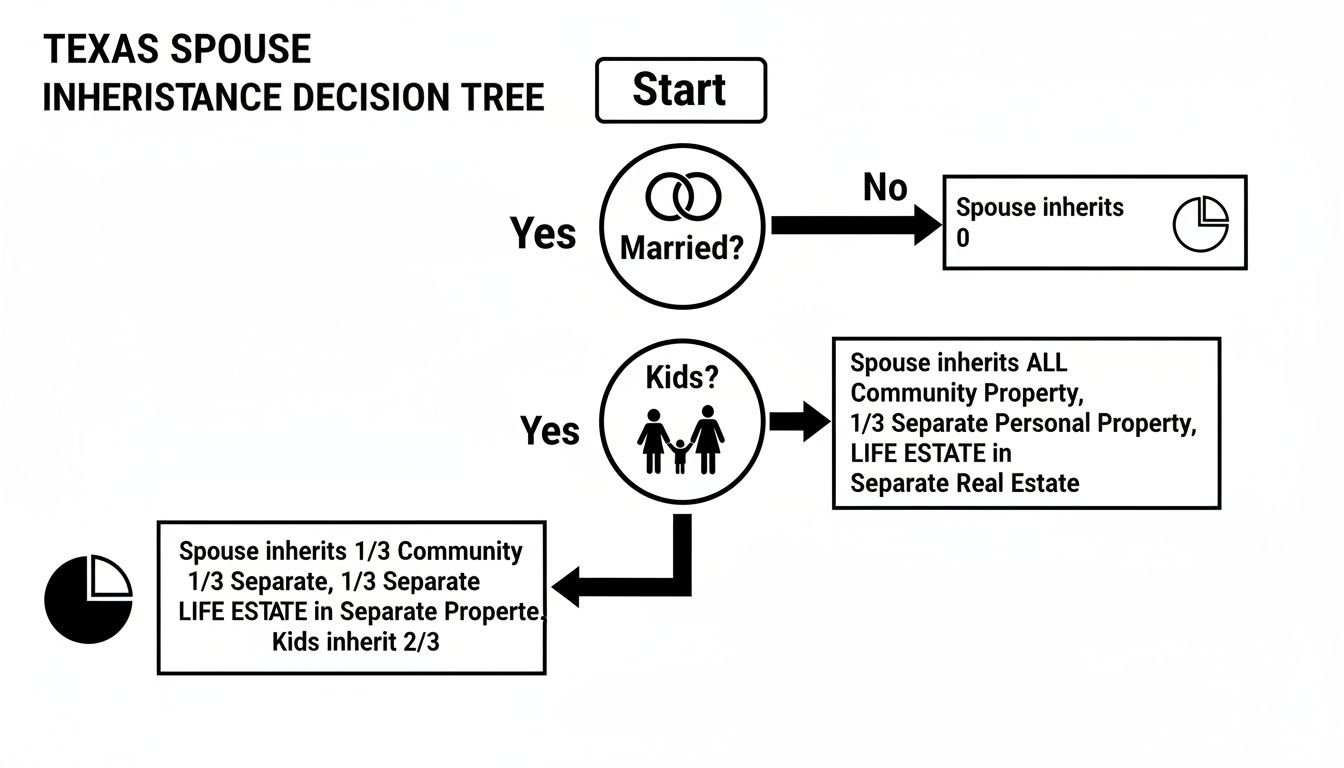
As you can see, even a seemingly simple family structure can lead to complex outcomes. This is exactly why a formal, legal determination of the heirs is so crucial.
The Small Estate Affidavit
For genuinely small and uncomplicated estates, the Small Estate Affidavit (SEA) is a true game-changer. It’s an option under Chapter 205 of the Texas Estates Code that lets heirs collect assets without having to go through a full, formal probate administration.
But there are strict rules. To qualify, the estate must meet every single one of these criteria:
- The total value of the assets (not counting the homestead and other exempt property) is $75,000 or less.
- The deceased passed away without a will.
- The only debts are those secured by the homestead (like a mortgage).
- The only real estate owned is the decedent's primary home (the homestead).
- Every single known heir is willing to sign the affidavit under oath.
Think of the SEA as a sworn statement filed with the court. It identifies all the heirs and what percentage of the estate they're entitled to. Once a judge signs off on it, that approved affidavit becomes your legal key to unlock bank accounts and transfer assets.
The Affidavit of Heirship
What happens when the main asset is a house, but the estate doesn't qualify for a Small Estate Affidavit? This is where the Affidavit of Heirship often comes into play. It’s not a court proceeding, but rather a document that acts as sworn evidence of who the heirs are.
Here’s how it works: you find two “disinterested witnesses”—people who knew the deceased and their family but have absolutely nothing to gain from the estate. They sign a detailed affidavit outlining the family history, marriages, children, and deaths. This document is then filed in the official property records of the county where the real estate is located.
It’s a common tool for clearing up title to a family home. But be warned: it's not a silver bullet. Some title companies get nervous and may refuse to accept it, which can throw a wrench in your plans to sell the property. We dive deeper into the pros and cons in our guide on the Affidavit of Heirship versus a formal probate.
Formal Heirship Determination and Administration
When an estate is larger, has significant debts, or the family dynamics are contentious, you have to go to court. A simple affidavit won't cut it. This usually involves one of two formal processes.
First is an Application to Determine Heirship. This is a lawsuit filed in probate court to get a definitive ruling on who the heirs are. The court will appoint an "attorney ad litem" to act as an independent investigator, tasked with finding and representing any unknown or missing heirs. After a formal hearing, the judge issues a Judgment Declaring Heirship, a court order that is the final word on who inherits and in what shares.
Sometimes, just knowing who the heirs are isn’t enough. If the estate has creditors that need to be paid or assets that must be sold, you’ll need a full Administration of the Estate. In this process, the court appoints an administrator to take charge of the estate's affairs. This person has the legal authority to pay debts, manage and sell property, and ultimately distribute what’s left to the heirs. It's the most thorough and legally sound option, but also the most expensive and time-consuming.
Key Takeaway
Don’t look for a "one-size-fits-all" answer when dealing with an intestate estate in Texas—it doesn’t exist. The right move depends entirely on the unique facts of your situation: the assets, the debts, and the people involved. Getting compassionate, expert advice on the front end can save you a mountain of time, money, and family drama on the back end.
Navigating the Intestate Administration Process

When simple affidavits won't cut it, and an estate needs formal court management, you’ll find yourself in what's known as an "administration." This is the most structured part of the intestate succession process in Texas. It brings the court directly into the picture to make sure every detail is handled correctly, from paying final bills to getting property into the hands of the rightful heirs.
The word "administration" can sound intimidating, but it’s really just the legal roadmap for settling your loved one's affairs. It’s designed to bring order and peace of mind to a situation that can feel anything but.
Step 1: Kicking Off the Administration and the Heirship Hearing
The whole thing starts by filing an Application for Letters of Administration and Determination of Heirship with the probate court. This one document serves two critical purposes: it asks the judge to officially declare who the legal heirs are, and it requests the appointment of an administrator to manage the estate.
Once that application is filed, the court sets a date for a hearing. This is a crucial step. At the hearing, your attorney will present evidence proving who is legally entitled to inherit. This often involves testimony from a couple of witnesses who knew the deceased and their family history.
The court also appoints what's called an "attorney ad litem." Think of this person as an independent investigator—a lawyer whose sole job is to track down any unknown or missing heirs and represent their interests. After reviewing all the evidence, if the judge is satisfied, they'll sign a Judgment Declaring Heirship. This court order is the final word, legally identifying every single heir and their precise share of the estate.
Step 2: The Estate Administrator's Role and Responsibilities
With the heirs officially determined, the court's next move is to appoint an administrator. If all the heirs can agree on one person for the job, the judge will almost always go with their choice. That person is then given Letters of Administration, the official document granting them the legal power to act for the estate.
Being an administrator comes with a fiduciary duty, which is a legal way of saying they must always act in the estate's best interest. It’s a job with a clear-cut list of responsibilities:
- Get a Bond: The administrator typically has to buy a probate bond. It’s basically an insurance policy protecting the heirs and any creditors from financial harm if the administrator mismanages things.
- Notify Creditors: Within one month of being appointed, the administrator must publish a notice in a local newspaper. This is the official signal for anyone owed money by the estate to come forward and make a claim.
- File an Inventory: The administrator has 90 days to file a detailed report called an "Inventory, Appraisement, and List of Claims." This document catalogues every asset in the estate and its fair market value.
- Settle Debts and Taxes: Using estate funds, the administrator pays off all valid debts, covers final expenses, and handles any required tax filings.
- Distribute the Assets: Once all the bills are paid, the administrator divides the remaining property among the heirs according to the percentages laid out in the Judgment Declaring Heirship.
Real-World Scenario: The Out-of-State Administrator
Let’s look at a common situation. Sarah, who lives in Colorado, gets the news that her unmarried brother, Mark, has passed away in Austin without a will. Mark’s only other living relatives are his elderly parents, who aren’t in a position to handle the legal process. His estate includes a house, a car, and a few bank accounts.
Sarah hires a Texas probate attorney who gets the ball rolling. At the heirship hearing, the judge officially declares Sarah’s parents as the sole heirs. With their written consent, the court appoints Sarah as the dependent administrator. Even though she’s in Colorado, she can manage the estate with her attorney’s help on the ground in Texas.
She works with a local realtor to appraise the Austin house for the inventory, uses estate funds to pay off Mark's credit card bills, and files his final tax return. After every task is done and the court approves her final accounting, she distributes the cash from the accounts equally to her parents and officially closes the estate.
When a person dies with no spouse or children, the law is very specific about who inherits what. The intestate succession process in Texas sets out exact splits for parents and siblings under Estates Code §201.001(c)-(e). For example, if both parents are alive, they each get 50% of the estate. If only one parent is alive and the decedent had siblings, that parent gets 50%, and the remaining 50% is split among the siblings. If there are no surviving parents, the siblings inherit everything. Our firm has been guiding Texas families through these complex rules for years, and you can discover more insights about these statutory rules and how they apply in different scenarios. This court-supervised administration ensures every step is handled by the book.
Key Takeaway
The administrator is the estate’s legal quarterback. Their job isn’t to make decisions based on emotion or family politics but to strictly follow the court's orders and the Texas Estates Code. This process creates accountability and protects everyone involved.
Avoiding Common Pitfalls and Family Disputes
Navigating an estate without a will is challenging enough on a legal level. When you layer in grief, complex family dynamics, and financial surprises, you have a recipe for serious conflict.
While the Texas Estates Code provides a roadmap for intestate succession, it’s the human element that often derails the process. Being aware of the common roadblocks can help you protect not only the estate's assets but, more importantly, family relationships during this emotional time.
One of the most common and frustrating issues is an uncooperative heir. It can be a single person who, out of grief, distrust, or simple stubbornness, refuses to sign necessary documents. This can bring everything to a screeching halt, especially when you’re trying to use simpler, consensus-based methods like an Affidavit of Heirship.
Identifying and Locating All Heirs
A huge hurdle in the intestate succession process in Texas is the absolute legal duty to track down and notify every single heir. In a small, close-knit family, this might be easy. But it can quickly become a genealogical detective story with blended families, long-lost relatives, or children from a previous relationship no one knew about.
The law doesn't care if an heir is hard to find or if the relationship was strained. You have a legal obligation to conduct a diligent search. This isn't a casual Google search, either. It often involves:
- Talking to the Elders: Interviewing older family members who might hold the key to the complete family tree.
- Digging into Public Records: Combing through marriage licenses, birth certificates, and old census data.
- Modern Online Sleuthing: Using social media and other online tools to try and locate relatives who have fallen out of touch.
For really tangled family trees—where heirs could be scattered across the country or even living abroad—you may need to hire a professional genealogist. These experts are skilled at tracing family lines and can produce the evidence the court requires to finalize who the legal heirs are. Make no mistake: failing to identify and notify even one heir can completely invalidate the probate proceeding, forcing you back to square one.
Handling Surprise Debts and Asset Disagreements
Another classic pitfall is discovering debts you never knew existed. You might believe the estate is in good financial shape, only to have a massive medical bill or an old personal loan pop up after the official notice to creditors is published. These claims have to be validated and paid from the estate’s funds before any heir gets a dime, which can drastically shrink the inheritance everyone was anticipating.
Disagreements over what things are worth are also a major source of tension. One heir might be convinced the family home is a goldmine, while another just wants to sell it quickly for whatever they can get. It’s often the items with sentimental value but little cash value that cause the biggest fights.
When these disagreements spiral, they can escalate into formal probate litigation, a court battle that pits family members against each other. It’s not just emotionally devastating; it's incredibly expensive and can drain a huge chunk of the very assets everyone is fighting over.
Your best defense is proactive communication and getting professional guidance early on. Of course, the best way to prevent these intestate headaches is through proper estate planning with wills and trusts. Understanding guardianship is also vital if a potential heir is unable to manage their own affairs.
Key Takeaway
Open and honest communication is the single most effective tool for preventing disputes. Keeping all heirs informed about every step—from asset valuation to debt settlement—builds trust and reduces the suspicion that can poison family relationships during an already stressful time.
If you’re facing probate in Texas, our team can help guide you through every step — from filing to final distribution. Schedule your free consultation today.
Frequently Asked Questions About Texas Intestacy
Even with a detailed guide to Texas intestacy, it’s natural for specific questions to pop up. Every family’s situation is unique, and the legal jargon can feel overwhelming. We get it.
Here are straight-to-the-point answers to some of the most common questions we hear from families trying to navigate this process without a will.
How Long Does Texas Intestacy Take?
There’s no one-size-fits-all answer, but the timeline really depends on the complexity of the estate and the probate path you take.
A simple, straightforward situation using a Small Estate Affidavit might be wrapped up in just a few months. On the other hand, a formal administration that requires a full heirship proceeding can easily stretch to a year or longer. This is especially true if there are arguments over property, challenges finding every legal heir, or significant debts that need to be settled.
What if an Heir Cannot Be Found?
This is a scenario where the court system really steps in to protect everyone. If a legal heir is missing or their whereabouts are unknown, the court requires a formal, diligent search. This isn't just a casual Google search; it’s a legal requirement.
The court will appoint an “attorney ad litem” whose sole job is to represent the interests of that missing or unknown heir. This attorney conducts their own independent investigation to try and locate the person.
If all that effort comes up empty, the heir’s share of the estate doesn’t just disappear. It’s typically paid into the court's registry or handed over to the state comptroller, where it’s held in case the heir ever surfaces to claim it.
Who Pays for the Debts of the Estate?
The estate itself is responsible for paying any valid debts the decedent left behind. Think of the estate as its own financial entity for a short time.
This means assets from the estate—cash from bank accounts, proceeds from selling property—must be used to pay off final medical bills, credit card balances, mortgages, and taxes. This has to happen before any property can be distributed to the heirs.
It's a critical point to understand: as an heir, you don’t personally inherit your loved one’s debts. But their estate must settle its accounts before you can receive your inheritance.
Can We Avoid Probate Court Entirely?
Sometimes, yes. But it’s rare for an entire estate to bypass the court system completely, especially without a will. Certain assets are designed to pass outside of probate. We call these "non-probate assets," and they include things like:
- Life insurance policies with named beneficiaries
- Retirement accounts, such as a 401(k) or IRA, with designated beneficiaries
- Bank accounts set up as "payable-on-death" (POD)
- Property held inside a living trust
However, for most other property—like a house, car, or personal belongings held only in the decedent's name—some form of court process is usually needed to legally transfer ownership. This could be a formal probate administration or a simpler alternative like an heirship proceeding. Modern resources, including AI legal software, can offer valuable context for understanding these complex legal distinctions.
Of course, the most effective way to sidestep these issues is with proactive estate planning, including comprehensive wills and trusts. It's also vital to understand concepts like guardianship if an heir is incapacitated. When conflicts do arise, a probate litigation attorney becomes essential for protecting your rights throughout the Texas probate process.
Key Takeaway
The court's primary duty in an heirship proceeding is to protect the rights of all heirs, even those who are absent. This built-in protection ensures the process is fair and legally sound, preventing future claims that could unravel the entire estate settlement.
If you’re facing probate in Texas, our team can help guide you through every step — from filing to final distribution. Schedule your free consultation today.