Gaining guardianship of a parent in Texas begins with a compassionate, yet legally precise, process. Before a court will grant this authority, you must prove that your parent is legally incapacitated—a term that means they can no longer care for themselves or manage their own finances. This is not a decision made lightly. It is a formal legal process that involves filing an application with the court, obtaining a detailed report from their doctor, and attending a hearing to demonstrate why this step is necessary to protect them. While it is a profound legal action, it is almost always taken out of love when a parent’s safety and well-being are at risk.
Knowing When Guardianship Is the Right Choice
Realizing a parent can no longer safely care for themselves is a painful and often slow process. The decision to pursue guardianship isn’t made lightly; it comes from a place of deep concern and love. But how do you know when it’s the right path? In Texas, the legal system boils it all down to one clear standard: incapacity.

Defining Incapacity in Plain English
According to the Texas Estates Code, Title 3, Chapter 1002, an adult is considered incapacitated if a physical or mental condition makes them substantially unable to provide their own food, clothing, or shelter. This also applies if they can’t manage their physical health or their own financial affairs. This isn’t about occasional forgetfulness; it’s about a consistent, clear inability to handle essential life tasks.
Instead of getting lost in legal jargon, think about these real-world indicators that might point to a need for help:
- Medical Mismanagement: Is your parent forgetting to take critical medications? Are they taking the wrong doses or unable to keep track of their doctor’s appointments?
- Financial Vulnerability: Have they fallen for financial scams? Are bills going unpaid, or are they making strange, impulsive financial decisions without grasping the consequences?
- Decline in Personal Care: Is their personal hygiene suffering? Has their home become unsafe or unsanitary in a way that’s out of character for them?
- Safety Risks: Are they getting lost while driving or walking? Have you found the stove left on? Are they having frequent falls they can’t manage on their own?
A Realistic Scenario: When Concern Turns to Action
Let’s imagine your mother, who has early-stage dementia, still lives alone. During a recent visit, you found a stack of unpaid electricity bills and a letter from a scammer congratulating her on winning a prize—all she has to do is send them her bank account details. When you bring it up, she gets confused and defensive, insisting everything is fine.
This situation is a classic sign of incapacity. Her cognitive decline is preventing her from managing her finances and protecting herself from being exploited. This isn’t about taking away her independence; it’s about recognizing that her condition now poses a direct threat to her well-being. Guardianship, in a case like this, becomes a protective shield.
Making this call is one of the hardest parts of the journey. It requires you to step into a new role—shifting from being the child to being the protector. While this guide will walk you through the entire process, including less restrictive alternatives like powers of attorney, recognizing these initial signs is the crucial first step. It validates your concerns and confirms that seeking legal help is a responsible, caring, and necessary action.
Exploring Alternatives Before Filing for Guardianship
Before you even think about filing for guardianship in Texas, you need to understand a core legal principle: courts demand that you exhaust all less restrictive options first. This isn’t just a legal formality. It’s about protecting your parent’s fundamental rights and preserving their dignity for as long as possible.
Guardianship is a profound step—it strips an individual of their right to make their own decisions. Because of this, a judge will not even consider it unless it’s truly the last resort. The good news is that many families find a combination of simpler, less intrusive tools can provide all the support their parent needs without ever stepping into a courtroom.

Powers of Attorney: The First Line of Defense
Powers of Attorney are the workhorses of estate planning for a reason. These legal documents let your parent (the “principal”) appoint a trusted person (the “agent”) to act on their behalf. The absolute crucial part? Your parent must have the mental capacity to sign these documents before they become incapacitated. Once capacity is lost, this option is off the table.
There are two main types you’ll encounter:
- Durable Power of Attorney: This gives an agent control over financial matters. Think paying bills, managing investments, selling a house, or talking to the bank. The word “durable” is key here—it means the document stays in effect even if your parent later becomes unable to make decisions.
- Medical Power of Attorney: This empowers a healthcare agent to make medical choices when your parent can’t. This person can speak with doctors, consent to surgery, and ensure your parent’s healthcare wishes are honored, preventing agonizing guesswork during a crisis.
It’s vital to grasp how these documents differ from a full guardianship. In some tough situations, a parent’s diminished capacity might be tied to substance abuse. Before pursuing guardianship, it’s worth exploring whether recovery is possible, as regaining independence is always the best outcome. Learning about the benefits of sobriety can offer valuable perspective.
Supported Decision-Making: A Collaborative Approach
A newer and even less intrusive tool in Texas is the Supported Decision-Making Agreement. This forward-thinking option allows an adult with a disability to select trusted “supporters”—like you or a close friend—to help them process information and make their own life decisions.
This is a fantastic choice for a parent who can still participate in decisions but might get overwhelmed by complex medical or financial details. Supporters can help gather information and talk through the pros and cons, but the parent keeps the final say. It’s a powerful way to offer help without taking away their autonomy.
Comparing Your Options
Choosing the right tool comes down to your parent’s specific needs and level of capacity. A Power of Attorney works beautifully for a parent who is mentally sharp but needs help with the logistics of life. Supported Decision-Making is perfect for someone with mild cognitive decline who just needs a trusted sounding board. Guardianship only enters the picture when a parent truly cannot make or communicate any responsible decisions for themselves.
To help clarify these choices, here’s a side-by-side look at how these legal tools stack up in Texas. This table breaks down the key differences in authority, scope, and court involvement.
Comparing Guardianship and Its Alternatives in Texas
| Feature | Full Guardianship | Durable Power of Attorney | Supported Decision-Making |
|---|---|---|---|
| Decision-Making Authority | Guardian makes all decisions, removing the parent’s rights. | Agent makes decisions on the parent’s behalf. | Parent retains final authority, with help from a supporter. |
| Court Involvement | High: Requires a court hearing, appointment, and ongoing supervision. | None: A private document that doesn’t require court approval. | None: A private agreement signed by the parent and supporter. |
| Activation | Effective upon court order after a finding of incapacity. | Effective immediately upon signing or upon incapacity, as specified. | Effective immediately upon signing by all parties. |
| Best For | A parent who is completely unable to make safe decisions. | A parent who is still mentally capable of appointing a trusted agent. | A parent who can still make decisions but needs help understanding options. |
Each of these paths offers a different level of support. Your job is to find the one that fits your parent’s situation while preserving as much of their independence as possible.
Navigating the Texas Guardianship Process: A Step-by-Step Guide
Once you’ve determined that guardianship is the only path left, it’s time to engage with the Texas court system. This part can feel overwhelming—it’s a world of unfamiliar legal terms, specific forms, and rigid procedures. Our goal is to pull back the curtain and give you a clear, step-by-step roadmap so you know exactly what to expect.
Think of this as a court-supervised journey designed to protect your parent. Every single step, from the first form you file to the final hearing, has a purpose. Understanding what’s coming can make a world of difference in managing the stress of it all.
Step 1: Filing the Application
The whole process officially begins the moment you file an Application for Appointment of Permanent Guardian with the court. This is almost always done in the probate court of the county where your parent lives. This document isn’t just paperwork; it’s your formal request to the judge, explaining why a guardian is needed and why you’re the right person for the job.
The Texas Estates Code, Chapter 1101, is very specific about what this application must include. You’ll need to provide:
- Your parent’s full name, date of birth, and current address.
- Your name, address, and relationship to your parent.
- A clear, detailed story of the facts that demonstrate your parent is incapacitated.
- The specific type of guardianship you’re requesting (Guardian of the Person, Guardian of the Estate, or both).
- A list of your parent’s known relatives.
Filing this application sets the legal wheels in motion. It’s the official starting gun for the series of events that will lead to your day in court.
Step 2: The Physician’s Certificate
You can’t just walk into court and say your parent needs help. You have to prove it with solid medical evidence. This is where the Certificate of Medical Examination (CME) comes in, and it is the single most critical piece of evidence in your entire case.
This isn’t just any doctor’s note. It must be completed by a licensed Texas physician who has examined your parent within the last 120 days. The Texas Estates Code requires the doctor to get specific, detailing the nature, degree, and severity of your parent’s condition. The CME will answer the very questions the judge needs to know:
- Can your parent make sound decisions about where they live?
- Are they capable of consenting to their own medical care?
- Can they still manage their finances responsibly?
A detailed, professional CME gives the court an objective look at your parent’s abilities, forming the legal bedrock for a finding of incapacity. Without a strong CME, your application will not succeed.
Step 3: The Attorney Ad Litem
Shortly after you file the application, the court will appoint an independent attorney to represent your parent’s best interests. This lawyer is called an attorney ad litem. It’s crucial to understand their role: their job is not to help you. Their one and only client is your parent.
The attorney ad litem will meet with your parent, explain what guardianship means in plain English, and go over their legal rights—including the right to contest the proceeding. They’ll also interview you, your siblings, doctors, and caregivers to get a full 360-degree view. Finally, they write a report for the judge outlining their findings and making a recommendation.
For a closer look at how judges weigh these factors, you might find our article on guardianship probate court decisions helpful.
Step 4: Notifying Relatives and Preparing for the Hearing
Texas law is clear: all “interested persons” have to be formally notified that a guardianship case has been filed. This means your parent’s spouse, all of their children (your brothers and sisters), and sometimes other close relatives. This isn’t just a courtesy; it’s a legal requirement that ensures transparency and gives family members a chance to show up in court to either support or contest the guardianship.
As your court date gets closer, you and your lawyer will be busy gathering all the evidence you’ll present to the judge. This includes:
- The completed Certificate of Medical Examination.
- Your own testimony about your parent’s recent behavior and needs.
- Statements or testimony from other relatives, friends, or caregivers who have witnessed the decline.
- Any financial records or other documents that show mismanagement or vulnerability to scams.
The hearing is your chance to tell the story. You’ll explain why you believe your parent needs a guardian and why you are the best person for that role. A nationwide study found that courts want to see clear medical proof of incapacity and evidence that no less restrictive options, like a power of attorney, will work. This high standard is there for a reason—to prevent abuse, especially since family members initiate over 50% of guardianship cases. You can learn more about these findings from the National Core Indicators project on guardianship.
Step 5: The Judge’s Ruling
After hearing from you, the attorney ad litem, and possibly your parent, the judge will review all the evidence and make a decision. If the judge finds by “clear and convincing evidence” that your parent is incapacitated and that appointing a guardian is in their best interest, they will sign an order making it official.
But you’re not done yet. You’ll still need to take an oath, post a bond (which is like an insurance policy protecting your parent’s assets), and file a detailed inventory of their estate. Only after you’ve completed these final steps will the court issue Letters of Guardianship—the official document that gives you the legal authority you need.
This journey is undeniably complex, but every part of it is structured to protect our most vulnerable loved ones with the dignity they deserve.
Understanding Your Duties as a Guardian
Once the judge signs the order and you’re officially appointed, your role flips from applicant to guardian. This isn’t just a new title; it’s a profound legal and ethical responsibility. You are now a fiduciary—a legal term that simply means you have a duty to act only in your parent’s best interest with every single decision you make.
This fiduciary duty is the absolute cornerstone of your new role. It means your own interests, financial needs, or even your convenience can’t factor into the choices you make for your parent, who the court now refers to as the ward. Every action, whether it’s paying a bill or approving a medical treatment, must be guided by one question: What is best for them?
The path to getting this appointment is a structured, court-supervised process designed to ensure the decision is made with the utmost care.
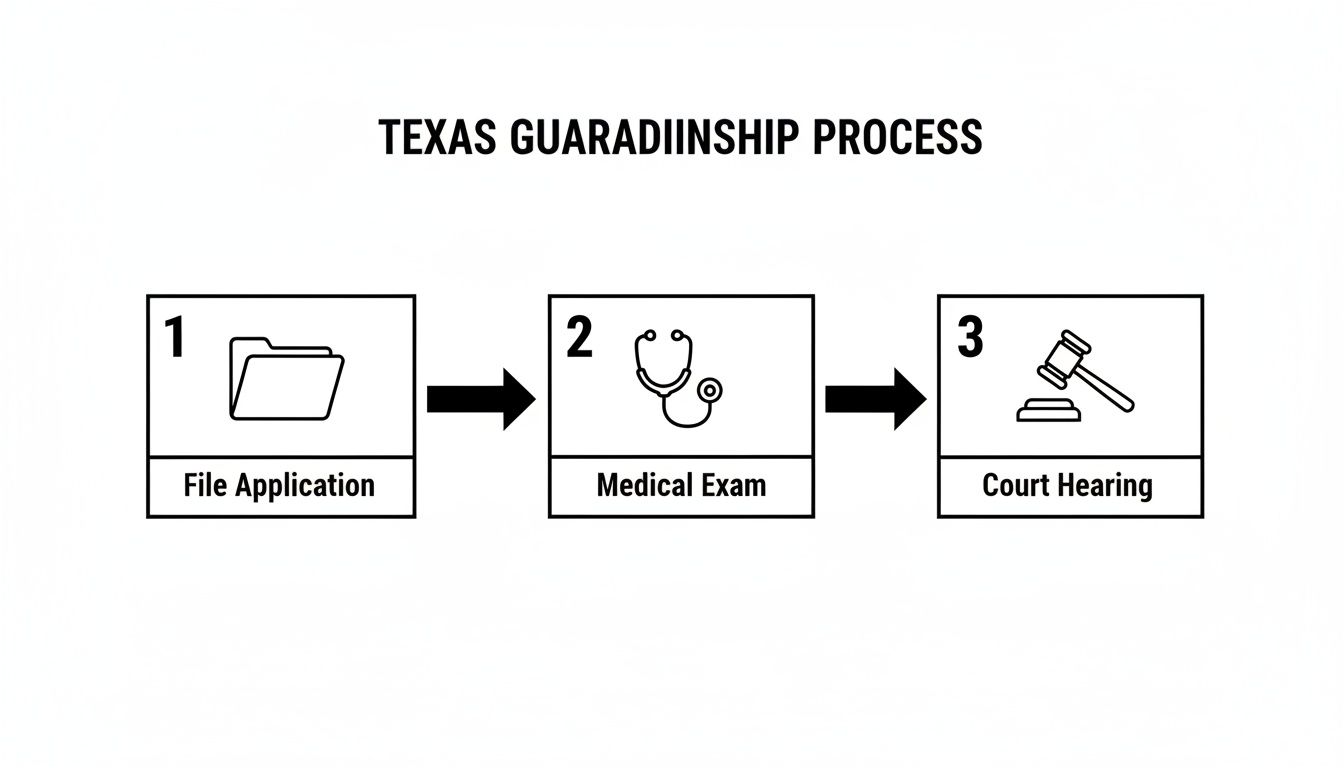
As you can see, it’s not a simple request but a formal journey through the legal system.
Managing Finances with Transparency
If you’re named the guardian of your parent’s estate, your financial duties are extensive and come under the strict watch of the court. The Texas Estates Code demands meticulous record-keeping to prevent any hint of mismanagement or exploitation. This isn’t just a good idea; it’s a legal command.
Your first big task is filing an Inventory, Appraisement, and Claim with the court, which is usually due within 30 days of your appointment. Think of this document as a complete financial snapshot of every single asset your parent owns.
From that point forward, your ongoing responsibilities will include:
- Setting up a dedicated bank account: Your parent’s money must be kept entirely separate from your own. This is non-negotiable.
- Paying all legitimate bills: You’ll manage everything from the mortgage and utilities to medical co-pays and insurance premiums, all paid from the dedicated guardianship account.
- Tracking every dollar: All income (like Social Security or a pension) and every single expense must be documented with receipts and clear explanations.
Making Personal and Healthcare Decisions
As a guardian of the person, you’re now responsible for your parent’s physical well-being. This means making critical decisions about their daily life and medical care, always with the goal of providing the safest, most supportive environment possible.
This role takes a deep sense of empathy and careful thought. You will be the one to:
- Decide where your parent lives, whether it’s at home with help, with you, or in an assisted living community.
- Consent to medical treatments, surgeries, and therapies on their behalf.
- Make sure their daily needs for nutrition, hygiene, and social engagement are met.
The court expects you to make choices that align with what your parent would have wanted if they were able. If they previously executed any Wills & Trusts or advance directives, those documents can offer priceless insight into their wishes.
The Annual Reporting Requirement
Your duties don’t just stop after you get everything set up. The court’s oversight is continuous. Under the Texas Estates Code, you are required to file annual reports that detail your parent’s condition and, if you’re managing their finances, a full accounting of their money.
The Annual Report on the Condition and Well-Being of the Ward is your update to the judge on your parent’s physical and mental health, their living arrangement, and any major changes from the past year.
The Annual Account is a detailed financial statement that must show:
- All income received.
- Every single expenditure made, with vouchers or receipts to back it all up.
- The assets that remain at the end of the year.
This reporting is what ensures accountability and protects your parent. Failing to file these reports on time can get you removed as guardian and even lead to legal penalties. It’s a powerful reminder that guardianship isn’t a permanent transfer of ownership—it’s a supervised position of trust and service. Families who end up arguing over these duties often find themselves in Probate Litigation, which just highlights how critical it is to follow the court’s rules to the letter.
Sidestepping the Common Pitfalls on the Guardianship Journey
Pursuing guardianship is as much about legal precision as it is about emotional endurance. There’s a reason the process is so detailed and demanding—it’s built to protect your parent. Looking back at the hundreds of families we’ve helped, a few key insights and common missteps always stand out. Getting these right can make all the difference.
One of the most frequent mistakes is waiting too long to act. Families hold off, hoping things might get better on their own. But that delay can leave a vulnerable parent exposed to financial scams, medical emergencies, or neglect. Taking action as soon as you see a consistent pattern of incapacity isn’t aggressive; it’s a protective and loving step.
Another major hurdle is underestimating the emotional toll this takes on everyone. This is a profound shift in your family’s dynamic. It’s completely normal to feel grief, stress, and even frustration. It’s just as important to brace for your parent’s potential resistance. They might feel like their independence is being stolen, which makes clear, compassionate communication non-negotiable, even when it’s incredibly difficult.
Failing to Get Siblings on the Same Page
Nothing poisons the well faster than a lack of communication among siblings. When one child starts the process without looping in the others, it almost always breeds suspicion and resentment. This is a primary trigger for messy and expensive Probate Litigation.
To head this off, call a family meeting as early as possible. Be transparent about your concerns, what you’ve observed, and the steps you’re thinking about taking. Presenting a united front doesn’t just strengthen your case in court—it helps preserve family relationships when they matter most.
Understanding the True Costs Involved
Many families are caught off guard by the financial reality of seeking guardianship. The expenses go far beyond what you pay your own attorney.
- Court Filing Fees: You’ll have initial costs just to file the paperwork, often running several hundred dollars.
- Attorney Ad Litem Fees: The court will appoint an independent attorney to represent your parent’s interests, and your family is responsible for paying their fees.
- Surety Bond: If you’re appointed guardian of the estate, the court will require you to buy a bond. Think of it as an insurance policy. The annual premium is based on the value of your parent’s assets.
All told, the total cost can easily range from $2,000 to $10,000 or more, especially if the case gets complicated. The good news? When there’s solid medical evidence, approval rates are quite high, around 70-80%. And courts overwhelmingly prefer to appoint family members, with children or a spouse being named in about 90% of U.S. cases. You can discover more global insights on family guardianship to see how this compares worldwide.
Navigating the full Texas Probate Process or creating essential documents like Wills & Trusts can feel just as daunting, but having the right support makes every step clearer.
Key Insight
The path to guardianship is a marathon, not a sprint. The Texas legal system prioritizes the dignity and rights of the individual, meaning you must first explore all less restrictive alternatives, such as Powers of Attorney or Supported Decision-Making agreements. Guardianship is a last resort, granted only with clear medical evidence of incapacity. Proactive planning, open family dialogue, and a clear-eyed view of the legal process and its costs can help you navigate this challenging journey with compassion and care.
Questions Texas Families Often Ask About Guardianship
Taking that first step toward guardianship for a parent brings up a flood of questions. It’s an emotional and legally complex road, so wanting clear, straightforward answers is completely understandable. We’ve gathered some of the most common concerns we hear from families across Texas to give you some practical insights.
How Long Does the Guardianship Process Take in Texas?
This is probably the number one question on everyone’s mind. While every case is different, a realistic timeline for a straightforward, uncontested guardianship is usually one to three months from the day you file the application.
That window gives the court time to appoint an attorney ad litem to represent your parent, allows that attorney to do their investigation, ensures all family members are properly notified, and gets the final hearing on the judge’s calendar.
Of course, if other family members object or if proving incapacity becomes complicated, the process can stretch out much longer. Having an experienced attorney file everything correctly from the start is the best way to keep things moving as efficiently as possible.
Can My Parent Object to the Guardianship?
Yes, they absolutely can. The Texas Estates Code is very clear on this: your parent has a fundamental right to show up at the hearing and tell the judge they object to the guardianship. They also have the right to hire their own lawyer—completely separate from the court-appointed one—to fight the case.
If your parent does object, the judge will listen carefully to their side of the story. Their wishes and feelings are a critical piece of the puzzle. The court will weigh their testimony against the medical evidence and other information you provide, but the final decision will always come down to what the judge believes is in your parent’s best interest.
What Is the Difference Between Guardian of the Person and Guardian of the Estate?
This is a crucial distinction, and it’s one of the first things a court will sort out. A judge can appoint one person to handle both roles or split the duties between two different people.
- Guardian of the Person: This person is in charge of your parent’s physical well-being. They make the big decisions about where your parent lives, what medical care they get, and making sure their day-to-day needs for safety and comfort are met.
- Guardian of the Estate: This person becomes the manager of your parent’s financial world. Their job is to handle everything from paying bills and managing investments to filing taxes and protecting their assets from scams or mismanagement.
A Texas court doesn’t have to grant an “all-or-nothing” guardianship. They can create a limited guardianship that is tailored to your parent’s specific challenges. For example, if your mom can still handle her daily life but is falling for financial scams, the court might only appoint a guardian of the estate, leaving her personal decisions in her own hands.
Getting these details right is at the heart of the Guardianship process. This entire legal framework, from the broader Texas Probate Process to specific tools like Wills & Trusts, is designed to protect vulnerable loved ones. Unfortunately, disagreements over these roles can sometimes lead to messy Probate Litigation, which is why getting clear legal advice from the start is so important.
Need Help Navigating a Texas Guardianship Case?
Making the decision to seek guardianship for a parent is never easy. It’s an emotionally heavy process wrapped in complex legal procedures, and it’s not something you should have to figure out on your own. Our team has walked alongside many families in your exact position, and we understand the immense weight of these situations.
We’re here to help you figure out if guardianship is the right path forward and to guide you through every single step of the Texas court process. If you need a trusted probate lawyer near you, we’re ready to protect your parent’s best interests while supporting your family through this challenging transition.
If you’re facing probate in Texas, our team can help guide you through every step — from filing to final distribution. Schedule your free consultation today.