If you need to cancel a Power of Attorney (POA), the first step is creating a formal written document called a Revocation of Power of Attorney. In Texas, simply telling your agent their authority is over isn’t enough to make it legally binding. To effectively cancel the POA, you must sign the revocation document, have it notarized, and then deliver copies to your former agent and any institutions—like banks or hospitals—that have the original POA on file. This formal process ensures everyone is officially notified that the agent’s authority has ended.
Understanding Your Right to Cancel a Power of Attorney
Deciding to cancel a Power of Attorney is a common and perfectly valid choice. Life changes, relationships shift, and the person you once trusted to act on your behalf may no longer be the right fit. This is a significant decision, and our goal is to walk you through the process with clarity and compassion, ensuring you feel empowered to do what’s best for your future.
A Power of Attorney is a serious legal document. As the “principal,” you grant an “agent” the authority to make critical decisions for you. Understanding what a Power of Attorney is provides helpful context, but the most important thing to remember is this: as long as you have the mental capacity to make your own decisions, you always have the right to revoke that authority.

Why You Might Need to Revoke a POA
Circumstances change, and your estate planning documents should change with them. We’ve worked with countless Texas families who needed to cancel a POA for very personal and practical reasons, such as:
- A change in relationship: You may have divorced your agent, or a close friendship may have soured.
- Loss of trust: Perhaps the agent acted irresponsibly or in a way that just didn’t sit right with you.
- Logistical issues: Your agent might have moved out of state, become ill, or is otherwise unable to handle the responsibilities anymore.
- A better choice: Sometimes, you simply have someone new in your life who is better suited for the role.
Whatever your reason, the decision is yours alone. The Texas Estates Code, Title 2, explicitly gives you the power to make this change, and doing it correctly is the key to protecting your interests.
What Revocation Means in Texas
In plain English, “revocation” means to officially cancel or take back the powers you granted. This isn’t a casual process. You can’t just tell your agent they are no longer needed or tear up your copy of the document. You have to follow specific legal steps to ensure the revocation is final and legally binding on everyone.
Key Insight: A Power of Attorney is a powerful tool that grants someone else control over your affairs. Revoking it is an equally powerful act that reclaims that control. The legal process is designed to be clear and definitive to prevent any confusion or unauthorized actions by a former agent.
Our firm handles these situations with care. For example, we helped a Houston-area senior who had appointed her son as her agent years ago. After their relationship soured, she wanted her daughter to take over instead. We helped her draft a formal Revocation of Power of Attorney, got it notarized, and ensured both her son and her bank received official, certified copies. This made the transition seamless and legally airtight, providing her with peace of mind and absolute clarity for everyone involved.
For a deeper dive into the fundamentals, our guides on Wills & Trusts offer more comprehensive information.
How to Formally Revoke a Power of Attorney in Texas
So, you’ve decided to cancel a Power of Attorney. That’s a big step, but making it official requires more than just a phone call or a difficult conversation. In Texas, your decision has to be put into a formal legal document. Skipping this step isn’t an option; it’s the only way to legally and effectively take back the authority you once gave away.
Think of it as the formal, legal end to your agent’s ability to act for you. To pull the plug, you need to create a document called a Revocation of Power of Attorney. This piece of paper is what officially cancels the old POA.
The Essential Elements of a Valid Revocation
For your revocation to be legally sound in Texas, the document needs to be crystal clear and contain specific details. Any ambiguity can create massive headaches down the road, so precision is your best friend here.
The document absolutely must include:
- Your full legal name as the principal.
- The full legal name of the agent whose power you are revoking.
- The execution date of the original Power of Attorney you are canceling.
- A clear, direct statement that you are revoking the POA.
This statement doesn’t need fancy legal jargon. In fact, simple and direct is far better. Something like this works perfectly: “I, Jane Smith, hereby revoke, withdraw, and terminate the Durable Power of Attorney dated June 1, 2018, which appointed my nephew, John Doe, as my agent.” There’s no room for anyone to misunderstand that.
Following Texas Legal Formalities
Here’s a critical point: under the Texas Estates Code, the rules for revoking a POA are the same as the rules for creating one. This is intentional. It ensures the act of taking back power is just as legally significant as the act of granting it in the first place.
Just like the original document, your Revocation of Power of Attorney must be signed and acknowledged before a notary public. The notary’s seal is the official proof that you are who you say you are and that you signed the document willingly. This step is non-negotiable. Without a proper notarization, the revocation isn’t legally effective in Texas, and institutions like banks or hospitals will likely refuse to honor it.
Key Insight: In Texas, the law follows what’s sometimes called the “equal dignity rule.” This means your revocation must have the same level of formality as the original POA. A powerful legal document can only be undone by an equally powerful and legally sound one.
A Realistic Scenario: Appointing a New Agent
Let’s look at a situation we see often with Texas families. A mother in Fort Worth originally named her eldest son, who lives in Austin, as her agent. As the years go by, she realizes her daughter, who lives just a few blocks away, is in a much better position to handle daily banking and urgent healthcare decisions.
She can’t just create a new POA naming her daughter and call it a day. She must first formally cancel the old one giving her son authority. She would draft a Revocation of Power of Attorney, sign it in front of a notary, and then make sure to deliver copies to her son, her bank, and her doctors. This clean, legal break prevents any confusion or conflict over who has the authority to act for her.
Putting It All Together: A Step-by-Step Guide
From a practical standpoint, revoking a POA correctly involves a few key actions to make sure it’s honored everywhere:
- Confirm Capacity: The principal must be mentally capable of understanding the decision to revoke.
- Draft the Revocation: Create a written Revocation of Power of Attorney document with all necessary details.
- Sign and Notarize: Sign the document in the presence of a notary public.
- Notify Everyone: Deliver a copy of the notarized revocation to the former agent and all institutions (banks, doctors, etc.) who have the original POA.
Finally, a bit of practical advice: do your best to collect and destroy any existing copies of the original POA. This helps prevent any accidental or even fraudulent use in the future. You can find more practical information on these general steps in this helpful guide from MetLife.
Properly drafting and executing the revocation is the foundational step in taking back control. It gets your wishes down on paper legally, clearing the path for you to appoint a new agent or simply manage your own affairs again.
Notifying Your Agent and Other Institutions
Creating the revocation document is a huge and necessary step, but it’s only half the battle. Think of it this way: a signed and notarized revocation that sits in your desk drawer is legally valid but practically useless. For the cancellation to actually work, you have to let everyone who needs to know, know. This communication is every bit as crucial as the document itself.
Your former agent and any third parties who have a copy of the old Power of Attorney—like your bank, doctor’s office, or financial advisor—must be officially informed of the change. Until they receive that notice, they are legally protected if they continue to follow instructions from your old agent. This can create serious, and entirely avoidable, problems for you and your family.
This visualization outlines the core legal steps to officially cancel a Power of Attorney.
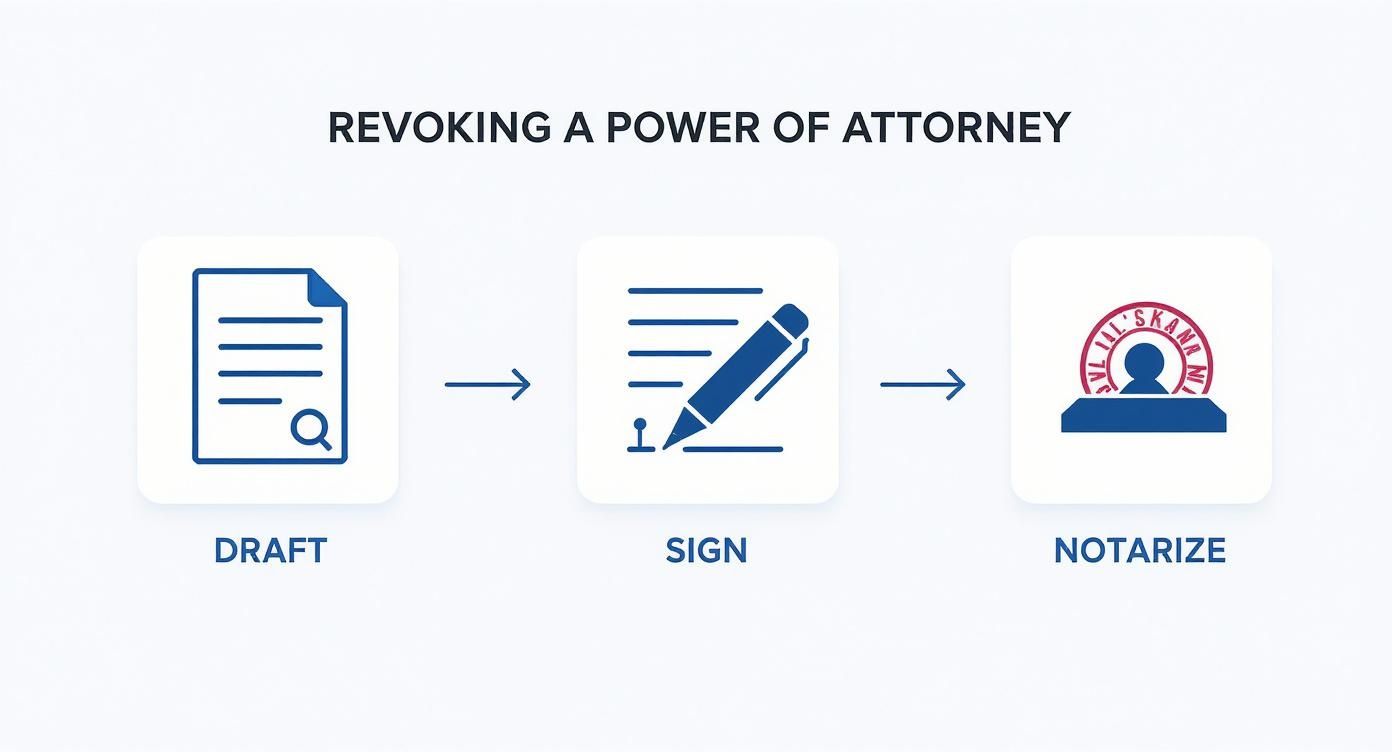
As the infographic shows, the process is a sequence of formal actions—drafting, signing, and notarizing—each building on the last to create a legally sound revocation.
The Right Way to Deliver the News
Simply calling or emailing your former agent isn’t going to cut it, legally speaking. You need a method that provides undeniable proof of delivery. This is where the old-school mail system becomes your best friend.
The most effective way to provide notice is by sending a copy of the notarized Revocation of Power of Attorney via certified mail with a return receipt requested. This service, offered by the U.S. Postal Service, creates a legal paper trail. The return receipt is a little green postcard that the recipient signs upon delivery, which is then mailed back to you.
That signed receipt is your golden ticket—it’s definitive proof that they received the notification and the exact date it happened. It removes all doubt and protects you from a former agent claiming they “never got the memo.”
Who Needs to Be on Your Notification List?
Your notification list should be thorough. Missing even one key institution can lead to chaos. Go back and think about every single place that has a copy of the old POA or where your agent has acted on your behalf.
Your list should include:
- The Former Agent: This is the absolute most important person to notify.
- Financial Institutions: This means all banks, credit unions, and brokerage firms where you have accounts.
- Healthcare Providers: Your primary doctor, specialists, and local hospital should all get a copy.
- Insurance Companies: Life, health, and auto insurance providers need to be updated.
- Government Agencies: If your agent dealt with the Social Security Administration or the IRS for you, they need to know.
- Attorneys and Accountants: Any professional who worked with your agent on your behalf must be informed.
Takeaway: Proper notification is a defensive measure. It protects you from unauthorized transactions and prevents the very complications that could later require navigating the Texas Probate Process or even costly Probate Litigation to fix.
A Realistic Scenario: Why Notice Matters
Let’s paint a picture. Imagine a father in San Antonio revokes a POA that named his son as agent, but he forgets to tell his bank. A week later, the son—totally unaware of the change and trying to help with a bill—goes to the bank and withdraws funds from his father’s account.
Because the bank was never notified, it acted in good faith and is legally in the clear. The father has little recourse against the bank. This entire stressful situation could have been prevented by sending one certified letter. By failing to complete this final step, you leave the door wide open for confusion and potential financial harm, undoing all the work you did to reclaim control. Proper notification closes that door for good.
Handling Revocations for Real Estate Transactions
If your original Power of Attorney gave your agent the power to buy, sell, or manage real estate, you have one more critical step to take. This isn’t optional. Real estate deals are public matters, and the document that handed over control of your property is part of that public record.
When a POA affecting real property is signed, it’s almost always filed with the county clerk where the property sits. This is called “recording,” and it’s what gives title companies, buyers, and lenders official notice that your agent can sign deeds for you. To properly undo that authority, you have to follow the exact same public process.

Why Recording Your Revocation Is So Important
Filing your notarized Revocation of Power of Attorney in the same county property records is the only way to officially wipe the agent’s authority off the public books. The Texas Estates Code requires this step, and it serves as a formal announcement that the old POA is dead. Until you do this, anyone checking the property records will assume the agent still has the power to act.
Forgetting to record the revocation creates a dangerous legal loophole. A dishonest—or even just an uninformed—former agent could potentially exploit it, causing a world of trouble.
A Realistic Scenario: The West Texas Ranch
We have seen this go wrong before. Imagine a family with a large ranch out in West Texas. An aging father gave his nephew a POA with sweeping powers, including the right to sell the land. That POA was properly recorded with the county clerk.
Years later, a family falling-out leads the father to revoke the POA. He signs the revocation document, has it notarized, and even mails a copy to his nephew. But he never files it with the county. A few months down the road, the nephew, deep in his own financial problems, uses the old POA—which is still on record and appears valid—to sell off a prime piece of the ranch.
Because the revocation was never recorded, the title company found nothing wrong. The sale looked legitimate, the buyer acted in good faith, and the deal closed. The family is now stuck in costly and heartbreaking litigation trying to claw back their property. This entire nightmare could have been avoided by taking that one final step.
Takeaway: When real estate is involved, the revocation must be a mirror image of the original filing. Think of it like a public notice board. You can’t just take down your personal copy of the flyer; you have to go back to the official board and post the cancellation notice for all to see.
To make sure a revocation is legally sound, it’s crucial to understand how documents are handled both before and after the fact.
Document Handling Before vs After Revocation
| Document Type | Action Required | Reasoning |
|---|---|---|
| Original Power of Attorney | Locate all copies, especially the original signed document. If you can, retrieve it from the former agent. | Prevents the old document from being mistakenly used. Possessing the original adds a layer of security. |
| New Revocation Document | Must be in writing, signed by you, and notarized. | Texas law requires this formality to make the revocation legally effective and verifiable. |
| Notice to Agent | Deliver a copy of the notarized revocation to the former agent. Use certified mail for proof of delivery. | This provides legal proof that the agent was officially informed their authority has been terminated. |
| Notice to Third Parties | Send a copy to all banks, financial institutions, and individuals who relied on the original POA. | Stops them from accepting the agent’s instructions and protects you from unauthorized transactions. |
| Recording the Revocation | File the notarized revocation with the county clerk in every county where you own real estate. | This is the only way to provide public notice and officially remove the agent’s authority over your property. |
Properly managing these documents ensures there are no loose ends that could cause legal or financial problems later on.
This process shares principles with other actions that affect property ownership. For anyone interested in the mechanics of updating property titles, our guide on how to change a deed on a house in Texas offers some valuable insights. Taking this final recording step ensures a clean break, protects your assets, and closes the door on future legal battles.
Navigating Complications Like Incapacity or Death
While canceling a power of attorney is often a direct process, life rarely sticks to a simple script. Complications can arise that make the situation feel overwhelming, especially when a loved one’s health is on the line. Understanding how to handle these tough scenarios with empathy and knowledge is key to protecting them and their assets.
The Challenge of Lost Capacity
The most heartbreaking complication occurs when the principal—the person who created the POA—loses the mental capacity to make their own decisions. If they can no longer understand what they are signing or the consequences of their actions, they legally cannot sign a revocation. This puts families in an incredibly difficult and painful position.
In these sensitive cases, the only path forward may be to seek a court-ordered Guardianship. This is a formal legal process where a judge appoints a guardian to make decisions for the incapacitated person, now called the “ward.” A guardianship is often the only way to remove an untrustworthy agent and shield the principal from neglect or financial harm.
When an Agent Becomes a Problem
Another serious issue arises when an agent refuses to accept the revocation notice. Even worse is when you suspect they are misusing their power for personal gain, like financial abuse. An agent who ignores a valid revocation and continues to act is breaching their duties, and that breach of trust almost always requires legal action.
These disputes can escalate quickly, often leading to Probate Litigation. This means taking the matter to court to enforce the revocation, recover any stolen assets, and hold the former agent legally accountable. It’s a stressful road, but sometimes it’s the only way to protect the principal’s financial security and well-being.
Takeaway: When a principal loses capacity, the power to revoke the POA is lost with it. At that point, the family’s options shift from a simple revocation to a court-involved process like guardianship to ensure their loved one is protected.
The Finality of Death
It’s also crucial to understand what happens when the principal passes away. A Power of Attorney, whether durable or not, automatically terminates the moment the principal dies. The agent’s authority is instantly and completely extinguished. They can no longer write checks, access bank accounts, or manage any property.
From that point on, the principal’s will and the Texas probate process take over. The person named as the executor in the will is the only one with the authority to step in and manage the estate—not the former agent. The agent from the POA has no further legal standing. For more on this, you can explore the relationship between a living will and power of attorney.
Interestingly, not all legal systems treat these documents the same way. While a Texas POA is revocable by a competent principal, some jurisdictions recognize an irrevocable power of attorney, which can’t be unilaterally canceled. This concept is used in places like Malaysia and other common law systems, often to protect an agent’s interests in a business transaction. You can discover more insights about these global legal differences here.
A Realistic Scenario: When Guardianship is Necessary
Let’s imagine an elderly mother in Dallas who named her son as her agent. As her dementia progresses, her daughter notices large, unexplained withdrawals from their mother’s bank accounts. The mother, tragically, is no longer mentally capable of understanding what a revocation is, let alone signing one to stop him.
The daughter, deeply concerned, now must petition the court for guardianship. Through that process, she can present evidence of her brother’s financial mismanagement and ask a judge to appoint her as guardian instead. Once appointed, she would have the legal authority to take control of her mother’s finances, put a stop to the abuse, and ensure her mother’s needs are finally met. It’s a difficult step, but a necessary one when capacity is gone and an agent can’t be trusted.
Wrapping It Up: Your Next Steps
When it comes to revoking a Power of Attorney in Texas, a few critical steps make all the difference. Remember, your decision isn’t legally binding until it’s put into a formal written document. Simply telling your former agent you’re canceling their authority just isn’t enough to protect you.
The revocation document has to be signed and notarized, just like the original POA was. From there, it’s on you to deliver a copy to your former agent and to every institution—like your bank, doctor’s office, or financial advisor—that has a copy of the old POA on file. This notification step is non-negotiable; it’s what closes the door on their ability to act for you.
Takeaway: If your Power of Attorney touched on real estate and was filed in the county land records, you must also file the revocation in those same public records. Failing to do this creates a dangerous loophole, leaving your property exposed to transactions you never authorized.
While you can certainly handle this process yourself, don’t hesitate to seek legal guidance, especially if you’re dealing with declining health or a difficult agent. This is also the perfect moment to take a fresh look at your entire estate plan, including your Wills & Trusts, to make sure all your documents are in sync and truly reflect your current wishes.
Got Questions? We’ve Got Answers.
When it comes to revoking a Power of Attorney in Texas, a lot of questions pop up. It’s a process filled with specific rules, and it’s easy to feel uncertain. Here are some straightforward answers to the questions we hear most often from families just like yours.
Can My New Agent Revoke The Old Power Of Attorney For Me?
This is a common misconception, but the answer is a firm no. Only you, the principal (the person who created the POA), can revoke it.
Think of it this way: you’re the one who hired the agent, so you’re the only one who can fire them. This power is personal and can’t be delegated to someone else, not even a newly appointed agent. As long as you have the mental capacity to understand your decision, the authority to revoke rests entirely with you.
What If I Cannot Find The Original POA Document?
Don’t worry, this happens more often than you’d think. While finding and destroying every copy of the old POA is ideal, it’s not a deal-breaker. You can absolutely still move forward with the revocation.
The most important step is creating a new, properly executed, and notarized revocation document. Once that’s done, your focus just shifts to communication. The real legal power comes from formally notifying your old agent and every single institution that might have the old POA on file. That notification is what legally severs their authority and protects you.
Does Divorce Automatically Cancel A POA For A Spouse In Texas?
Yes, it does. Under the Texas Estates Code, Title 2, a final divorce decree automatically terminates any Power of Attorney that names your now ex-spouse as your agent. The law handles this one for you.
A Word of Caution: Even though the law is on your side, it’s still a smart move to complete a formal written revocation. Why? Because it leaves no room for error or confusion. Sending a clear, written notice ensures banks, hospitals, and other institutions have definitive proof and update their records, preventing any accidental or unauthorized transactions down the road.
How Much Does A Lawyer Charge To Help Revoke A POA?
The cost really depends on how complicated your situation is. For a straightforward revocation where everyone is on the same page and cooperative, the legal fees are usually quite modest and predictable.
However, the cost can go up if there are complications. Things like a dispute with the current agent, questions about the principal’s mental capacity, or suspicions of financial wrongdoing make the process more involved. Many Texas law firms, including ours, offer a free consultation. It’s a chance for you to tell your story, understand your options, and get a clear picture of potential costs without any financial commitment.
If you’re facing probate in Texas, our team can help guide you through every step — from filing to final distribution. Schedule your free consultation today.