When a loved one passes, the language of estate law can feel overwhelming, full of terms that sound similar but mean vastly different things. Two of the most common are heir and beneficiary, and in Texas, the distinction is everything. We understand that navigating this process during a time of grief is incredibly challenging, and our goal is to provide clear, compassionate guidance for your family.
At its core, the difference is simple: a beneficiary is someone you intentionally name in a will, trust, or account to inherit your property. An heir, on the other hand, is a relative who inherits under Texas law only when there is no will. This single distinction shapes who has the right to receive your loved one's property and what legal path they must follow to claim it.
Understanding Heir and Beneficiary Roles in Texas Estate Law
Navigating the loss of a family member is difficult enough without the added stress of deciphering complex legal terms. In Texas, getting a firm grip on the roles of an heir versus a beneficiary is the first step toward managing an estate with confidence. The law defines these roles in completely different ways, and that definition has a direct impact on who inherits and what the process looks like.
A beneficiary is a person, a charity, or even a trust that the deceased person (the "decedent") specifically chose to receive an asset. Their rights are spelled out in a legal document the decedent created, such as:
- A Last Will and Testament
- A Revocable Living Trust
- A retirement account (like a 401(k) or IRA)
- A life insurance policy
On the flip side, an heir is someone legally entitled to inherit from a person who died without a will—a situation known as dying "intestate." When this happens, Texas law steps in with a predetermined road map for inheritance.
How Texas Law Defines an Heir
The Texas Estates Code, specifically Title 2, Chapter 201, lays out a clear hierarchy for who qualifies as an heir. This legal framework, called intestate succession, is built entirely on family relationships. The law essentially follows the decedent’s family tree to decide who gets what, ensuring property passes to the closest living relatives. This process is the state's way of preventing an estate from being abandoned unless no relatives can be found.
Here’s a simple breakdown of these fundamental differences.
| Feature | Heir | Beneficiary |
|---|---|---|
| Source of Rights | Texas Estates Code (Intestate Succession) | A legal document (Will, Trust, Account Designation) |
| How They Are Chosen | By state law, based on family relationship (spouse, child, parent) | Specifically named by the decedent |
| When the Role Applies | Primarily when there is no valid will | When a valid will, trust, or other legal instrument exists |
| Example | A person dies without a will, so their surviving spouse and children inherit the estate by law. | A person writes a will leaving their home to a lifelong friend and a car to their nephew. |
This foundational knowledge is crucial for anyone involved in the Texas Probate Process, whether you're stepping into the role of an executor, are a concerned family member, or have been named as a recipient in a will.
Comparing How Heirs and Beneficiaries Inherit
The biggest difference between an heir and a beneficiary comes down to one simple thing: choice. One person’s right to inherit is spelled out in a legal document, a deliberate decision made by the person who passed away. The other person’s right only exists because state law creates a default plan when no personal choice was recorded. Getting this distinction right is the first step for anyone trying to navigate the Texas probate system with a sense of clarity and peace of mind.
A beneficiary is hand-picked. Their claim comes directly from a will, a trust, or an account designation. On the other hand, an heir inherits by default. Their claim only materializes when there are no documents to follow, forcing the state to step in and distribute assets based on a generic family tree.
This decision tree gives you a clear visual of the two paths an estate can take.
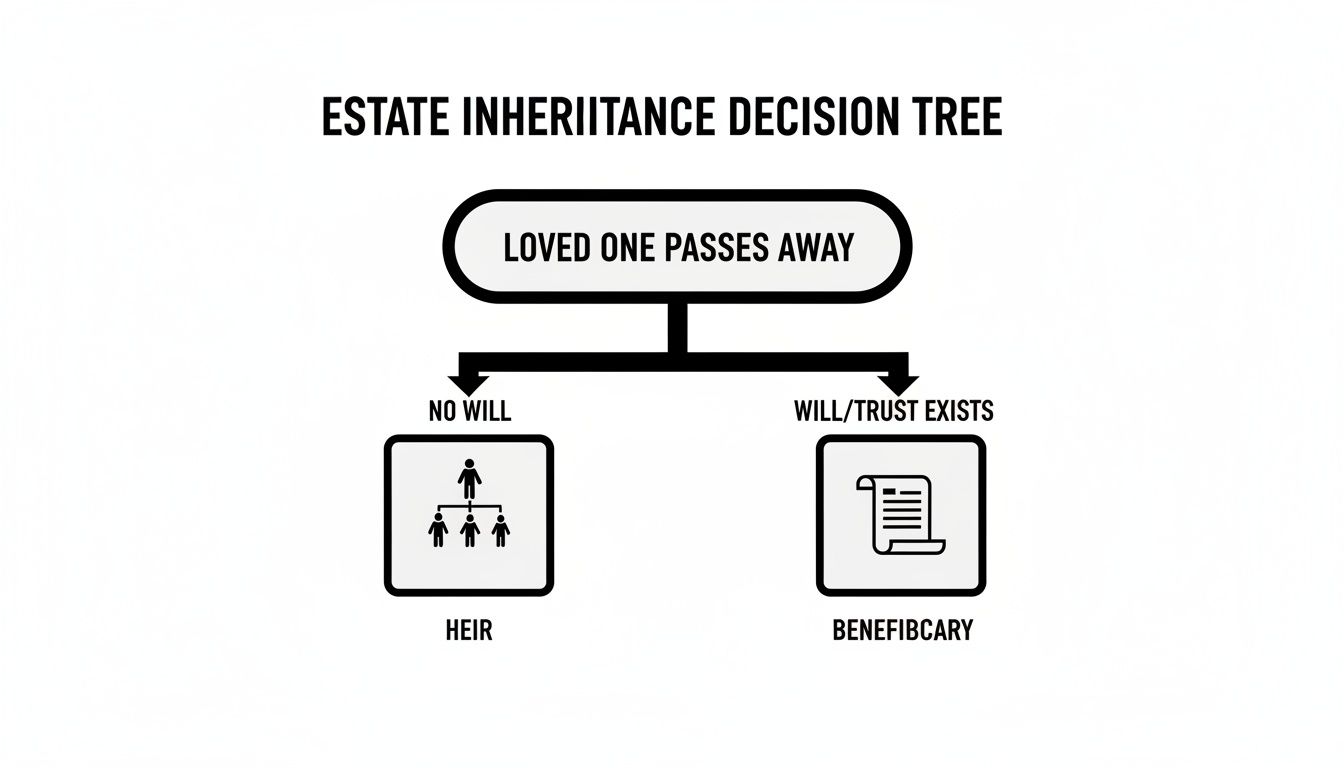
As you can see, the fork in the road is the existence of a will or trust. That single factor determines whether we’re talking about beneficiaries or potential heirs.
Source of Inheritance Rights
The root of the claim is what truly separates an heir from a beneficiary. A beneficiary's claim is born from the documented, explicit wishes of the decedent.
For a Beneficiary: Their right is granted by a legal instrument. This could be a will, a living trust, a life insurance policy, or a retirement account. The decedent made a conscious choice and put their name on a piece of paper.
For an Heir: Their claim comes from Texas law—specifically, the intestate succession statutes in the Texas Estates Code, Title 2. Their rights have nothing to do with the decedent's wishes and everything to do with their branch on the family tree.
Think of it this way: a beneficiary is a chosen successor, while an heir is a legally presumed one. This isn't just semantics; it dramatically changes how smoothly the inheritance process unfolds.
Certainty and the Probate Process
For a beneficiary, the path to inheritance is usually much clearer. Because their gift is spelled out in a legal document, there’s little room for debate about what they’re supposed to get, as long as the document is valid.
For an heir, the process is filled with uncertainty. Before they can inherit anything, they must go through a formal court proceeding, known as a determination of heirship. This requires proving their relationship to the decedent to a judge, a process that can be time-consuming, expensive, and sometimes, intensely contentious during an already emotional time.
Heir Vs Beneficiary Key Distinctions Under Texas Law
This chart offers a side-by-side look at how Texas law defines the roles, rights, and legal standing of heirs versus beneficiaries.
| Attribute | Heir | Beneficiary |
|---|---|---|
| Legal Basis | Texas Estates Code § 201 (Intestate Succession) | Last Will, Living Trust, or Account Designation |
| How Identified | By family relationship (spouse, child, parent, etc.) | Specifically named by the decedent in a document |
| Certainty of Inheritance | Must be legally proven in court; share is determined by statute | Clearly defined in the document, provided it's valid |
| Court Involvement | Often requires a formal Determination of Heirship proceeding | Inherits through the standard probate process for wills or outside of probate for trusts and accounts |
| Flexibility of Giver | None; the law dictates who inherits and how much | Complete flexibility; can choose anyone or any entity |
Understanding these distinctions isn't just an academic exercise. It has real-world consequences for families grieving a loss, shaping the timeline, cost, and emotional toll of settling a loved one's final affairs. For a deeper dive, check out our guide on inheritance and legal entitlements according to wills and intestacy laws.
When There’s No Will: Navigating Intestate Succession as an Heir
When a Texan passes away without a will, it’s called dying “intestate.” In these already difficult moments, the family is left without a clear roadmap for what comes next. This is where Texas law steps in to provide one through a rigid legal process called intestate succession. It's the only path forward for distributing an estate when there are heirs but no named beneficiaries.
The playbook for intestate succession is written in the Texas Estates Code, specifically Chapters 201 through 205. These statutes don’t attempt to guess what your loved one might have wanted. Instead, they apply a strict, formulaic approach based solely on family ties to decide who gets what. For heirs, understanding this process isn’t just helpful—it’s critical, as their rights are dictated entirely by these laws.
How Texas Law Divides Property Without a Will
The distribution of assets under intestate succession hinges entirely on who survives the decedent. The law has a clear hierarchy that prioritizes the closest relatives, but it can get messy in a hurry, especially with blended families. The state’s goal is to pass property to the next of kin in a predictable, though impersonal, way.
Here are a few common scenarios that play out in probate courts:
- Survived by a Spouse and Their Shared Children: The surviving spouse inherits all community property, plus one-third of the decedent's separate personal property and the right to use one-third of the separate real estate for life. The children inherit the remaining two-thirds of the separate property.
- Survived by a Spouse and Children from a Prior Relationship: This is where things get complicated. The surviving spouse keeps their half of the community property, but the decedent's half goes straight to their own children. The spouse still receives one-third of the separate personal property and a life estate in one-third of the separate real estate.
- Survived by Children, No Spouse: In this straightforward case, the children inherit the entire estate, split equally among them.
- Survived by a Spouse, but No Children or Parents: The surviving spouse inherits everything—all community and separate property.
For families trying to make sense of this, getting familiar with probate procedures in Texas when there's no will is the essential first step.
The Heirship Process: A Real-World Example
Let's walk through a realistic scenario. Imagine Mark, a Dallas man, passes away unexpectedly without a will. He leaves behind his second wife, Sarah, and two adult children from his first marriage, Emily and John. Mark's estate includes the home he shared with Sarah (community property), a stock portfolio he inherited from his parents (separate property), and a classic car he owned before they married (also separate property).
Because Mark died intestate, his children, Emily and John, are now his legal heirs right alongside his wife, Sarah. They can't just agree to divide the assets among themselves. Before anything can be distributed, they must legally establish who the heirs are through a court proceeding. Here's what that step-by-step process looks like:
- File an Application to Determine Heirship: An interested party (like Sarah or the children) must file a legal application with the probate court, asking a judge to officially declare who Mark's heirs are.
- Appoint an Attorney Ad Litem: The court will appoint an independent attorney to represent any "unknown" heirs. This attorney's job is to conduct a thorough investigation to verify the family tree and ensure no potential heir is overlooked.
- Hold a Court Hearing: A hearing is scheduled where evidence and testimony are presented to the judge. This typically involves at least two disinterested witnesses who can swear to the decedent's family history.
- Obtain a Judgment Declaring Heirship: If the judge is satisfied with the evidence, they will sign an official order that legally identifies the heirs and their respective shares of the estate according to Texas law.
Only after this judgment is issued can the property be legally distributed according to the strict formulas of intestate succession. This process can be emotionally draining and drag on for months, perfectly illustrating the stark difference between the straightforward path of a beneficiary and the legal hurdles an heir must overcome.
Fulfilling a Loved One's Wishes as a Beneficiary
Being named a beneficiary is a personal thing. It means someone you loved specifically chose you, by name, to receive a piece of their legacy. This isn't like being an heir, where your rights are determined by state law simply because no will exists. As a beneficiary, your rights are spelled out in black and white in the legal documents your loved one took the time to create—a will, a trust, or even a simple retirement account form.

This intentional choice creates a much clearer, more direct path to inheritance. Your job isn't to prove your relationship to a court; it's simply to receive the gift exactly as your loved one intended. The entire process is driven by their written instructions, which the estate’s executor or trustee is legally required to follow to the letter.
The Beneficiary's Journey Through the Estate Process
For most beneficiaries, the process kicks off with a formal notification. Once a will is admitted to probate, the executor—the person named in the will to manage the estate—is legally obligated to notify all named beneficiaries. This notice officially confirms your status and gives you the executor's contact information. From that point, the process typically unfolds in a few key steps:
- Executor Manages the Estate: The executor's first job is to round up all the estate’s assets, pay any final bills and taxes, and handle all the necessary court paperwork.
- Asset Protection and Inventory: While this is happening, the executor has a duty to safeguard all estate property. You have a right to be kept reasonably informed about how things are progressing.
- Final Distribution: After all debts are settled and the court approves the final accounting, the executor will distribute the remaining assets to you and the other beneficiaries, following the will's instructions precisely.
Understanding Probate vs. Non-Probate Assets
One of the most critical things for any beneficiary to grasp is the difference between probate and non-probate assets. This distinction dictates how—and how quickly—you'll receive your inheritance.
Probate assets are properties that were owned solely in the decedent's name. They have to go through the court-supervised probate process and are the assets governed by a will.
Non-probate assets, on the other hand, get to skip probate entirely. These assets have beneficiary designations built right in, so they transfer automatically upon death. Common examples include:
- Life insurance policies
- Retirement accounts like 401(k)s and IRAs
- Payable-on-death (POD) bank accounts
- Property held in a living trust
This direct-transfer mechanism makes non-probate assets a powerful tool for maintaining privacy and efficiency in estate planning. You can get a deeper understanding of these differences in our detailed guide on non-probate assets in Texas.
A Scenario Following a Will's Instructions
Let's imagine a woman named Susan from Houston passes away. Her will names three specific beneficiaries: her son, David, is to receive her house; her niece, Laura, gets her stock portfolio; and her favorite local animal shelter is gifted $25,000 in cash.
The executor of Susan's estate must follow these directions exactly. They can't decide David needs the cash more than the shelter or that Laura should receive a different asset instead of the stocks. The will is the final word. The executor's duty is to liquidate other assets if needed, pay Susan's final bills, and then make sure the house goes to David, the stocks go to Laura, and the cash goes to the charity.
This scenario shows the certainty that comes with being a named beneficiary. Of course, disputes can still happen—say, if an heir who was left out decides to challenge the will. In those situations, our firm's expertise in Probate Litigation becomes crucial. It’s also a powerful reminder that creating clear Wills & Trusts is the best way to ensure your own wishes are just as clear for the people you love.
Avoiding Common Estate Planning Pitfalls
Knowing the difference between an heir and a beneficiary isn't just a legal trivia question; it's the key to protecting your family from serious, often heartbreaking, legal and financial messes. When an estate plan is unclear—or worse, non-existent—good intentions can quickly dissolve into confusion, family fights, and a devastating loss of wealth.
Tackling these potential problems head-on is one of the most compassionate gifts you can give the people you love. These common pitfalls show exactly why the distinction between a chosen beneficiary and a default heir is so critical under Texas law.
The Problem of Heirs' Property
One of the most destructive consequences of dying without a will is the creation of "heirs' property." This legal nightmare happens when land is passed down through intestate succession to multiple heirs, weaving a tangled web of shared ownership. Each heir gets a fractional interest, but no single person holds a clear title.
This makes it nearly impossible to sell the property, get a mortgage on it, or even manage it effectively. This legal limbo can trap family land for generations, preventing it from ever being used to build wealth. It also makes the property a prime target for predatory developers, who can buy out one heir's tiny share and then force a court-ordered sale of the entire parcel. You can read more about these critical findings on heirs' property.
By using a will or a trust to name specific beneficiaries for your property, you ensure a clean transfer of title and completely sidestep the heirs' property trap.
When a Beneficiary Predeceases You
Here’s another common snag: what happens when a named beneficiary in your will or on an account dies before you do? The answer depends entirely on the specific language in your documents and Texas law. Many well-drafted wills include provisions for a contingent (or alternate) beneficiary to step in if the primary choice is no longer living.
But if no alternate is named, things can get messy. The asset might fall back into your general estate. From there, it could go to your residuary beneficiary (the person who gets "everything else"). In a worst-case scenario where the will has no residuary clause, it could be distributed according to intestate succession—meaning it goes to your legal heirs. This could easily send an asset to someone you never intended to receive it.
Will Contests and Family Disputes
The emotional and financial toll of a will contest can tear a family apart. These disputes often ignite when heirs who expected an inheritance are left out in favor of other beneficiaries. An heir might challenge the will's validity, raising claims like:
- Lack of Testamentary Capacity: Arguing the person who made the will wasn't of sound mind when they signed it.
- Undue Influence: Alleging that another person manipulated the decedent into changing their will for personal gain.
- Improper Execution: Claiming the will wasn't signed or witnessed according to the strict rules laid out in the Texas Estates Code, Title 3.
While a solid will drafted by an experienced attorney significantly lowers these risks, the potential for a fight highlights the need for clear communication. A major pitfall in any estate plan is the silence that often surrounds it. To help start these vital conversations, you might find it useful to explore these thoughtful questions to ask your aging parents.
These discussions can prevent future misunderstandings and align family expectations, which is also a crucial part of planning for potential Guardianship needs down the road. When it comes to estate planning, proactive communication is always the best defense.
Key Insights for Texas Estate Planning
When you dig into the difference between an heir vs beneficiary, it all comes down to one powerful concept: intention. If there's one lesson every Texas family should take to heart, it's that proactive estate planning is the only way to make sure your wishes are honored. Without it, your loved ones are left at the mercy of the rigid, impersonal process of intestate succession.
Think of it this way: being a beneficiary is an honor given by choice. It means someone you love took the time to create a legal document—like a will or a trust—and specifically named you to inherit from them. It's a deliberate act.
In stark contrast, being an heir is a default status assigned by Texas law. This happens when there's no will or trust, forcing a court to follow a strict family tree formula that often fails to reflect modern family structures or your actual relationships.
Your Path Forward
Ultimately, the choice is yours. You can let the state decide who your heirs are, or you can take control of your legacy and name your beneficiaries. Securing your family’s future starts with clear, legally sound documents that leave no room for doubt.
Key Takeaway
Don't leave your legacy to chance. A comprehensive estate plan, including well-drafted Wills & Trusts, transforms your loved ones from potential heirs facing a complex court battle into beneficiaries with a clear and direct path to their inheritance. This simple act of planning provides peace of mind and prevents needless conflict down the road.
Whether you're looking to create your first estate plan, are stuck in the middle of the Texas Probate Process, or need guidance on a Guardianship, our team is here to provide the clarity and compassion you deserve. We can also step in when disputes require skilled Probate Litigation.
If you’re facing probate in Texas, our team can help guide you through every step — from filing to final distribution. Schedule your free consultation today.
Common Questions About Heirs vs. Beneficiaries
When you're navigating Texas probate, the specific language matters. The terms ‘heir’ and ‘beneficiary’ can get confusing, but understanding how they apply in real life is crucial. Here are some of the most common situations families run into and what you need to know.
Can I Be Both an Heir and a Beneficiary?
Absolutely. In fact, it happens all the time. The two roles aren’t mutually exclusive; they just come from different legal starting points.
Let's imagine a mother in Austin drafts a will. She specifically names her only son as the beneficiary of her stock portfolio but completely forgets to mention her antique car collection. When she passes, her son is the clear beneficiary of the stocks, entitled to them under the will.
But what about the cars? Because the will didn't account for them, that part of her estate falls under intestate law. As her closest living relative, her son is also her legal heir. In this scenario, he wears two hats—he’s a beneficiary for the stocks and an heir for the cars.
What Happens If a Will Is Invalidated?
This is a scenario where the distinction becomes critical. If a Texas probate court declares a will invalid, it's as if the document never existed. The entire game changes.
Anyone named as a beneficiary in that voided will loses their legal claim to the assets they were supposed to receive. The court then pivots to the strict rules of intestate succession found in the Texas Estates Code. The estate’s assets are distributed to the decedent’s legal heirs, based purely on their family relationship. This is a common battleground in Probate Litigation when a will's validity is challenged.
Do Beneficiaries of Non-Probate Assets Go Through Probate?
No, and this is one of the most powerful tools in modern estate planning. Assets that have a designated beneficiary are often called non-probate or transfer-on-death assets, and they bypass the court system entirely.
Things like life insurance policies, 401(k)s, IRAs, and payable-on-death (POD) bank accounts pass directly to the person you named as the beneficiary. The process is private, fast, and avoids the costs and delays of the Texas Probate Process.
This direct transfer is exactly why keeping your beneficiary designations updated is a cornerstone of smart Wills & Trusts planning. It’s the surest way to get your assets exactly where you intend, without any unnecessary court interference.
If you’re facing probate in Texas, our team can help guide you through every step — from filing to final distribution. Schedule your free consultation today.