When you're named the executor of a will, you've been handed the profound responsibility of carrying out a loved one's final wishes. At its core, the job involves gathering their assets, settling their final debts and taxes, and making sure the remaining property gets to the people named in the will, all while playing by the rules of Texas law. We understand that this role often comes during a time of grief, and our goal is to provide clear, step-by-step guidance to help you navigate this process with confidence.
What Does An Executor Actually Do In Texas

Stepping into the role of an executor can feel like a heavy weight, especially when you’re already grieving. It's a position of immense trust, but it's important to remember you aren't expected to have all the answers from day one. In plain English, an executor is the person legally appointed to manage a deceased person's estate and see their final instructions through to the end.
This isn't just a checklist of tasks; it’s an act of honor and a final service to someone you cared about. Your duties are guided by both the will itself and the Texas Estates Code, which sets the legal framework for the entire process. While the official term is "executor," it helps to see yourself as the estate's temporary caretaker. You’re the one safeguarding assets, keeping family members in the loop, and ensuring everything is handled with integrity.
Your Primary Responsibilities
Your main job is to act in the best interest of the estate and its beneficiaries. This is a legal concept known as a "fiduciary duty," which simply means you have to be honest, diligent, and transparent from start to finish. This is a responsibility we take seriously, and we help executors uphold it every day.
When an executor deals with the deceased's personal property, this duty often extends beyond physical items. It's also critical to consider the secure disposal of digital assets like old hard drives to protect the estate from potential fraud or identity theft down the road.
To give you a clearer picture of what lies ahead, we've put together a quick overview of an executor's core responsibilities.
An Executor's Core Responsibilities At A Glance
This table breaks down the main duties you'll be handling throughout the probate process. It’s a roadmap to help you stay organized and on track.
| Duty Category | Key Actions Required |
|---|---|
| Initial Steps | Locate the original will, order death certificates, and notify beneficiaries and relevant agencies (like Social Security). |
| Legal Administration | File the will with the correct Texas probate court and get your official authority to act ("Letters Testamentary"). |
| Asset Management | Find, secure, and create a detailed inventory of all estate property, from bank accounts and real estate to personal belongings. |
| Financial Duties | Open a separate bank account for the estate, pay all legitimate debts and final taxes, and manage the estate's finances. |
| Distribution & Closing | Distribute the remaining assets to the beneficiaries as the will directs and then formally close the estate with the court. |
While these steps outline the general flow, every estate is unique. Some are simple and straightforward, while others can have unexpected twists and turns.
One quick note on terminology: the term "executor" is used for someone specifically named in a will. If there is no will, the court appoints an "administrator" to handle the estate. The duties are similar, but the legal path can differ.
Your First Critical Steps As An Executor
In the difficult days after a loved one passes, knowing where to start can bring a much-needed sense of direction. The first few moves you make are foundational to fulfilling your role, and they all center on one critical goal: preserving the estate. Under Title 2 of the Texas Estates Code, your job is to act prudently to protect the deceased’s assets, and these initial steps are your first chance to prove you're up to the task.
Your absolute first priority is to find the original, signed will. This isn't just a piece of paper; it's the cornerstone of the entire probate process, the final word on your loved one's wishes. Check safe deposit boxes, home offices, or with the attorney who drafted it. A copy is a good start, but the probate court needs the real deal to officially grant you authority.
Next, you’ll need to get multiple certified copies of the death certificate. Trust us on this one. You'll hand these out like business cards to banks, insurance companies, and government agencies. It's smart to order at least 10-12 copies right away from the funeral home or the Texas Bureau of Vital Statistics. Almost every institution will demand an original certified copy, not a photocopy.
Securing Property and Notifying Key Parties
With the essential documents in hand, your focus shifts to safeguarding the estate’s physical assets and getting the word out to important organizations. This isn't just about paperwork—it's about preventing theft, damage, and financial loss.
A huge part of an executor’s job is taking physical control of the estate’s property. This means you need to:
- Real Estate: Secure the deceased’s home immediately, especially if it's vacant. Change the locks. Make sure the utilities stay on to prevent problems like burst pipes in a winter freeze, and double-check that the homeowner's insurance is paid up.
- Vehicles: Find all cars, trucks, and other vehicles. Gather the keys and titles and make sure they're parked somewhere safe.
- Valuables: Collect any easily transportable items like jewelry, art, or important papers. Get them into a secure location, like a safe deposit box.
Realistic Scenario: Picture this: An executor in Dallas learns his mother has just passed away, leaving her house empty. His very first move is to drive over, have a locksmith change the locks, and put a few lights on a timer. It's a simple, proactive step, but it fulfills his core duty to secure the estate’s most valuable physical asset from day one.
At the same time, you need to start notifying key agencies and financial institutions. Make a list, grab a cup of coffee, and start making calls. Just know that you'll need to follow up by sending a death certificate to pretty much everyone.
Key parties to notify include:
- Social Security Administration: You need to stop benefit payments and ask about any potential survivor benefits for a spouse or minor children.
- Financial Institutions: Call all banks, credit unions, and brokerage firms. They need to freeze the accounts to prevent any unauthorized withdrawals.
- Life Insurance Companies: Start the claims process for any life insurance policies. The money from these typically goes directly to the named beneficiaries, not the estate.
- Employers: Reach out to the deceased’s last employer. Ask about final paychecks, 401(k) or pension plans, and any other employee death benefits.
- Credit Card Companies: Notify them to prevent fraudulent charges and to get a final statement of the outstanding balance.
Taking these first steps methodically lays a secure foundation for the more complex tasks to come. It shows you're meeting your legal obligations from the very beginning and will make the entire Texas probate process feel much more manageable.
How To Navigate The Texas Probate Court System
For a first-time executor, the legal side of things can feel like stepping into a foreign country. But the Texas probate court system isn't a confusing maze—it's actually a structured, predictable process. This is the stage where you officially "probate a will," which is just the formal court proceeding to validate the will and get you appointed as executor.
Your main goal here is to get your hands on a document called Letters Testamentary. Think of this as your official key to the estate. It's the court order that gives you the legal authority to act on behalf of the person who passed away, from accessing their bank accounts to selling their property.
This infographic lays out the foundational steps you'll take before you even set foot in the courthouse.
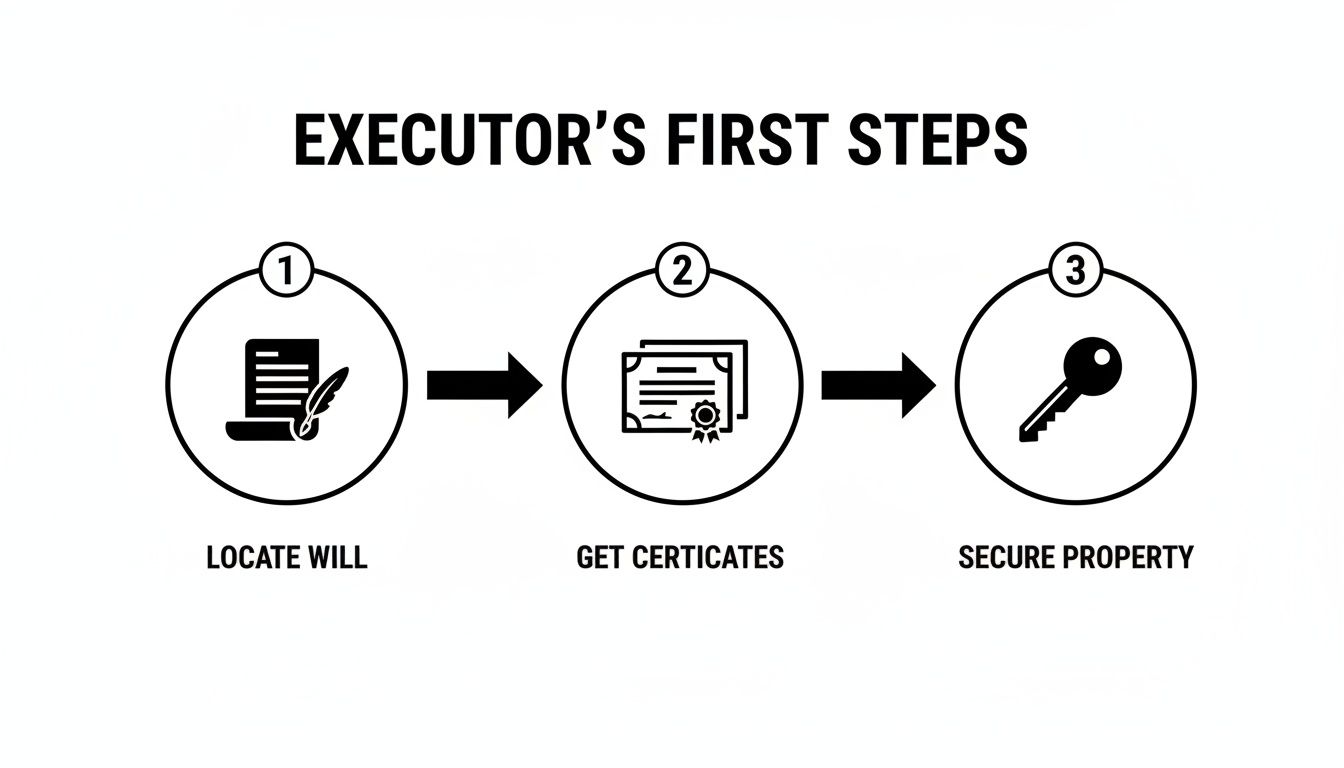
These initial actions—finding the will, ordering death certificates, and locking down the property—are the essential groundwork. You have to get this done before you can formally start the probate process.
Filing The Will And The First Hearing
To kick things off, you or your attorney will file an "Application to Probate Will and for Issuance of Letters Testamentary" with the probate court. This happens in the county where the deceased person lived. Along with this application, you'll submit the original will, which gets the legal ball rolling.
Once filed, there’s a mandatory waiting period. After that, a notice is posted publicly at the courthouse, a simple formality required by the Texas Estates Code.
Next up is the initial court hearing. This is usually a quick and straightforward affair. You'll appear before a judge, almost always with your attorney, to provide testimony confirming the details of the will and the death. The judge just wants to make sure the will is valid and that you’re qualified to serve as executor.
After the judge approves your application, you’ll take an oath of office. This is a sworn promise to faithfully do your job according to the law and the will. It’s at this moment that you are officially granted your Letters Testamentary and can legally get to work. Our firm has a detailed guide on how to get these crucial documents if you want to learn more about Letters Testamentary in Texas.
Independent vs. Dependent Administration
One of the most important things to understand about Texas probate is the type of administration you'll be handling. The wording in the will is everything here.
- Independent Administration: This is the most common and efficient path in Texas. If the will includes specific language—lawyers sometimes call them "magic words"—stating the executor can act without court supervision, you can handle most estate business without asking the judge for permission every time.
- Dependent Administration: If the will doesn't mention this, or if there's no will at all, you'll likely be in a dependent administration. This is a much more supervised process. You'll have to get court approval for many actions, like selling property or paying debts, which makes it far more time-consuming and expensive.
The difference is huge. An independent administration saves the estate a ton of time and money, and it shows how much trust the person who died had in you. But that freedom comes with a serious time commitment. It takes an average of 570 hours to fully settle an estate, and executor compensation can vary widely. This is why getting a handle on your duties and the legal framework from day one is so critical.
Managing The Estate's Finances, Debts, And Taxes

Once the court gives you the green light by issuing Letters Testamentary, your role pivots to the heart of the estate—its money. This is where your fiduciary duty gets real. You’re now responsible for every dollar, from rounding up assets and paying off legitimate debts to filing the final taxes. Every move you make must be in the estate's best interest.
This financial stewardship can feel like the most overwhelming part of the job. It’s not just you; a recent survey found that 47% of executors didn't even know they had to handle taxes, and 28% completely overlooked paying the deceased's debts. These aren't minor slip-ups; they can lead to serious legal trouble and personal liability, which is why a methodical, step-by-step approach is your best friend.
Gathering And Managing Estate Assets
Your first major financial task is to get all the estate's assets under your control. This isn't just about making a list. It’s about actively managing and protecting the estate's wealth until it can be distributed.
One of the first things you absolutely must do is open a new bank account in the name of the estate. Get this done as soon as you have your Letters Testamentary. This account will be the estate's financial command center, and it keeps the estate's money completely separate from your own—a non-negotiable legal requirement.
Next, you'll create a detailed inventory of everything the person owned. This is a formal document, often required by the court, that should include:
- Bank Accounts: Every checking, savings, and money market account.
- Real Estate: The primary home and any other properties. You'll likely need a formal appraisal to pin down their fair market value.
- Investments: All stocks, bonds, and mutual funds.
- Personal Property: Cars, jewelry, art, furniture, and other valuables.
- Life Insurance Policies: Only if the estate is the beneficiary, rather than a specific person.
This inventory gives everyone a clear, official snapshot of the estate's total value, which is critical for correctly handling debts and taxes down the road.
Addressing Debts And Notifying Creditors
One of your most critical duties as an executor is settling the deceased's final debts. Texas law has a specific process for this, and following it to the letter is the only way to protect yourself from getting stuck with the bills.
The Texas Estates Code (specifically Title 2, Subtitle H) requires you to formally notify potential creditors. The standard way to do this is by publishing a notice in a local newspaper. This notice gives anyone owed money by the deceased a set amount of time to come forward and make a formal claim.
This isn't a suggestion; it’s a hard-and-fast rule that protects both you and the estate. Our firm has a comprehensive guide to handling debts and taxes in probate that walks you through these steps in greater detail.
A Practical Example Of Creditor Priority
Let’s say an estate has $100,000 in cash, a valid $20,000 credit card bill, and two heirs. The executor, wanting to help the grieving family, quickly pays $50,000 to each heir before the creditor notice period ends.
A month later, the credit card company presents its valid claim. The estate account is empty. In this scenario, the executor is now on the hook personally for that $20,000 bill. This is exactly why the legal order of payments is not something you can ignore.
Handling Final Tax Obligations
Your final major financial duty involves taxes. This responsibility usually breaks down into two main parts: filing the deceased's final personal income tax return (Form 1040) and figuring out if the estate itself owes any taxes.
You’ll need to file a final income tax return that covers the period from January 1st up to the date of death. On top of that, if the estate earns its own income after death—say, from stock dividends or rent from a property—you may also need to file an estate income tax return (Form 1041).
As part of this, you’ll need to get a handle on any potential inheritance tax obligations. While Texas doesn’t have a state-level inheritance tax, federal rules can still apply. You can get a better sense of this by understanding inheritance tax and its requirements.
Throughout this entire process, meticulous record-keeping is your greatest asset. Save every receipt, every bank statement, and every invoice. This paper trail is your proof that you’ve handled your financial duties honestly, transparently, and with the utmost care.
Handling Common Executor Challenges And Disputes
Even with the clearest will and the best of intentions, serving as an executor is rarely a smooth ride. After a loved one passes, emotions run high, and old family tensions can surface in unexpected ways. Knowing what roadblocks might be ahead is a huge part of doing your job well and protecting both the estate and family harmony.
One of the most common flashpoints is the distribution of personal property. It’s often not about the money. Items with deep sentimental value—like old family photos or a grandfather's watch—can become the center of heated disputes, no matter what they’re worth.
Another major hurdle pops up when an estate’s debts seem to be larger than its assets. This is what’s known as an insolvent estate, and it puts you in a tricky legal position where you have to pay creditors in a specific, legally mandated order. Get it wrong, and you could find yourself personally on the hook.
Navigating Disagreements Among Beneficiaries
When it comes to preventing—or resolving—disputes, your best tool is open and frequent communication. Beneficiaries who are kept in the loop are far less likely to get suspicious or assume the worst. But even with perfect communication, tempers can flare.
Let’s walk through a classic scenario: Two siblings inherit their father's house. The out-of-state sibling wants to sell it right away and get their share of the cash. But the other sibling, who has lived in the home for years, wants to keep it in the family—they just can't afford to buy out their brother’s half.
This is the kind of stalemate that can tear a family apart. Rather than letting resentment build, a savvy executor, working with a probate litigation attorney, can step in and propose real solutions.
- Mediation: A neutral third party can help the siblings find some common ground and hash out options they hadn’t considered on their own.
- Buyout Agreement: An attorney could structure a payment plan, allowing one sibling to buy out the other over an extended period.
- Legal Guidance: If they just can’t agree, the attorney can lay out the legal process for forcing a sale of the property. Often, just understanding that reality is enough to motivate everyone to find a compromise.
By actively steering the ship toward a resolution, you're not just moving the process along; you're fulfilling your core duty to act in the best interest of all beneficiaries.
The Serious Risk of Breaching Your Fiduciary Duty
As an executor, you’re held to what’s called a fiduciary duty. This is the highest standard of care recognized by the law. In plain English, it means you must act with absolute honesty and loyalty, always putting the estate's interests ahead of your own. Betraying that trust is a breach of fiduciary duty, and the consequences are severe.
This isn't some dusty legal theory—it’s a real and growing risk. Recent data reveals a startling 21% spike in lawsuits against executors, mostly for breaches like mismanaging estate funds or distributing assets improperly. You can learn more about the findings on executor lawsuits, a trend that highlights just how carefully you need to navigate Texas probate law.
The only way to avoid these landmines is through meticulous record-keeping and total transparency. Every single financial move you make has to be defensible and backed up by documentation. When you’re facing a tough or contentious decision, getting professional legal advice isn’t a sign of weakness—it's the smartest thing you can do to protect yourself from personal liability and honor the trust that was placed in you.
Tying Up Loose Ends: Finalizing The Estate
You’ve navigated the debts, paid the taxes, and managed the assets. Now you’re at the finish line. Reaching the end of the probate process is a huge milestone, but your final duties are just as critical as your first. This last stage is all about carefully and formally wrapping up your responsibilities, making sure every last detail aligns with the will and Texas law.
The first step in closing the doors on the estate is preparing a final accounting. Think of this as the estate's final financial report card. It’s a detailed breakdown showing all the money and property that came into the estate and every single dollar that went out—from paying off that last credit card bill to covering your own administrative fees. Transparency here is non-negotiable.
Distributing Assets and Closing the Estate
Once all debts, taxes, and expenses are settled, you can finally do what everyone has been waiting for: distribute the remaining assets to the beneficiaries exactly as the will instructs. It’s a smart move to have each beneficiary sign a receipt or release form confirming they’ve received their inheritance. This simple piece of paper can be your best friend, protecting you from future claims or misunderstandings down the road.
With all the assets distributed and receipts in hand, you can take the final step of formally closing the estate with the court. This means filing the last bits of paperwork to be officially discharged from your duties. This isn't just a formality; it's the legal finish line that officially ends your responsibilities—and your potential liabilities.
Key Takeaway
Serving as an executor is a marathon, not a sprint. It’s a journey of responsibility, trust, and painstaking attention to detail. We’ve covered a lot of ground in this guide on executor of a will duties, but it all boils down to a few core principles.
Your success as an executor stands on three pillars: meticulous record-keeping, open communication with beneficiaries, and knowing when to call in a professional. Master these, and you’ll not only protect yourself from personal liability but also honor the incredible trust placed in you.
Here’s a final checklist to keep these crucial lessons front and center:
- Keep Flawless Records: Document every transaction, every decision, and every phone call. This paper trail is your best defense if anyone ever questions your actions.
- Communicate, Communicate, Communicate: Keep beneficiaries in the loop about your progress, especially if there are delays. An informed heir is far less likely to become an angry one.
- Follow the Law, Not Your Heart: Stick to the will's instructions and the Texas Estates Code like glue. This is especially true when paying debts before you distribute a single dollar to the beneficiaries.
- Ask For Help: You’re not expected to be an expert in Wills and Trusts or navigate the maze of probate law alone. Hiring an attorney isn't a sign of weakness; it's a mark of a prudent and responsible executor.
Honoring a loved one's final wishes is a profound responsibility. By approaching the role with care, diligence, and the right support, you can navigate the process with confidence and integrity.
A Few Common Questions About Executor Duties in Texas
Stepping into the executor role for the first time naturally brings up a lot of questions. As you navigate the process, you'll run into specific situations that aren't always clear. Below are some straightforward, plain-English answers to the most common concerns we hear from Texas families.
How Long Does an Executor Have to Settle an Estate in Texas?
While there isn't a single, hard-and-fast deadline that applies to every estate, most are fully settled within 9 to 18 months in Texas. The final timeline really depends on how complex the estate is. Things like the types of assets involved, disputes popping up among beneficiaries, or dealing with creditors can definitely stretch out the process.
Your main legal obligation here is to act diligently and avoid any unreasonable delays. If beneficiaries start to feel like things are dragging on without a good reason, they have every right to petition the court for an update. In more serious cases of delay, they can even ask for you to be removed as executor.
Does an Executor Get Paid for Their Services in Texas?
Yes, absolutely. Executors are entitled to be compensated for their time, effort, and responsibility. The Texas Estates Code allows for a "reasonable" fee, and it's important to know this is paid from the estate's assets, not out of your own pocket.
If the will itself outlines a specific payment amount or a certain way to calculate the fee, those instructions are typically the final word. But if the will is silent on compensation, Texas law kicks in with a default commission structure. This is usually 5% of the funds that move in and out of the estate. This fee is considered a standard administrative expense and has to be approved by the probate court.
What Happens if an Executor Fails to Follow the Will?
An executor has what's called a fiduciary duty to follow the instructions in the will to the letter. This is the highest standard of care recognized by the law, and failing to uphold it is a massive breach of trust. It's not a suggestion; it's a legal command.
If an executor messes up—say, by mismanaging funds, giving property to the wrong person, or acting in their own self-interest—they can be held personally liable for any financial losses the estate takes as a result. Beneficiaries can sue to have the executor removed, force them to repay the estate for damages, and demand they give up any commission they were paid. This is one of the biggest reasons why getting professional guidance from a Guardianship and probate attorney is so critical.
Do I Need a Lawyer to Be an Executor in Texas?
While Texas law doesn't technically force you to hire one, it is highly, highly recommended that every executor work with a probate attorney. The process is a minefield of complex legal filings, strict deadlines, and procedural rules that are incredibly easy for a non-lawyer to miss. Making a mistake here could expose you to personal liability.
An attorney represents you—the executor—and makes sure all your duties are handled correctly and legally. Better yet, their fees are considered a normal administrative expense and are paid directly from the estate's assets. This gives you crucial protection without it costing you anything personally.
If you’re facing probate in Texas, our team can help guide you through every step — from filing to final distribution. Schedule your free consultation today.