Thinking about the future can feel overwhelming, but taking control of your healthcare decisions is one of the most empowering steps you can take. A durable power of attorney for health care, known in Texas simply as a medical power of attorney, is a legal tool that lets you choose a trusted person—your "agent"—to make medical decisions for you if you become unable to speak for yourself.
This is not just about planning for a worst-case scenario. It is about ensuring your voice is heard and relieving your loved ones of an immense burden during a time of crisis. It is an act of love and foresight for the Texas families you cherish.
What a Medical Power of Attorney Means for You

Think of a durable power of attorney for health care as more than just a piece of paper. It's a direct expression of your autonomy and a profound gift to your loved ones. It gives someone you trust the authority to act as your healthcare agent if a doctor determines you cannot make or communicate your own medical choices. This could happen after a sudden accident, during a serious illness, or with a progressive condition.
This legal tool is your proactive solution to an uncertain future. Without it, your family might be left in an impossible position, forced to guess your wishes or petition a court for the authority to make decisions. That kind of scenario can lead to stress, family conflict, and heartbreaking delays in care during an already emotional time.
Why This Document Is Essential for Every Texan
Creating a medical power of attorney is a fundamental part of responsible estate planning. It provides clarity and legal authority, removing any ambiguity when it matters most. Under the Texas Health and Safety Code, specifically Title 2, Chapter 166, this document allows your chosen agent to step in and advocate for your best interests.
Here’s why it’s so critical:
- It Maintains Your Control. This document ensures that decisions about your medical treatment align with your personal values and wishes, even when you can't voice them yourself.
- It Reduces Your Family's Burden. It relieves your family from the heavy weight of making agonizing decisions without clear guidance, preventing potential disagreements and guilt.
- It Avoids Court Intervention. A valid medical power of attorney helps prevent the need for a court-appointed guardianship, which can be a public, expensive, and lengthy process.
- It Provides Peace of Mind. Knowing you have a plan in place offers comfort to both you and your family, assuring everyone that your health is in trusted hands.
For families navigating complex health challenges, such as understanding Alzheimer's disease, the need for a designated decision-maker becomes crystal clear. These situations highlight just how vital this planning can be.
This document is distinct from other legal instruments, and you can learn more about those differences in our comprehensive guide on what is a power of attorney. Ultimately, establishing a medical power of attorney is an act of foresight and care. It protects your right to self-determination and provides a clear, legally recognized roadmap for your medical journey.
Choosing Your Healthcare Agent with Confidence
Picking the person who will make medical decisions for you is probably the single most important choice you'll make when creating your durable power of attorney for health care. This individual, your healthcare agent, holds a profound responsibility. They become your voice, your advocate, and your decision-maker when you are at your most vulnerable.
The role of a healthcare agent is so much more than just signing forms. It's about deeply understanding your values, respecting your wishes, and having the strength to see them through, even under immense pressure. This is a role built on trust, clear communication, and unwavering advocacy.
What Your Healthcare Agent Can Do
Under the Texas Health and Safety Code, once a doctor certifies that you're unable to make your own healthcare decisions, your agent is given significant authority. Their primary duty is to make decisions that align with what they know you would want. If your wishes aren't known, they must act in your best interest.
Key powers of a healthcare agent include:
- Consenting to Medical Care: They can agree to or refuse any medical treatment, procedure, or service on your behalf.
- Choosing Healthcare Providers: Your agent can select or discharge your doctors, specialists, and other medical professionals.
- Accessing Medical Records: They have the right to review your medical information to make informed choices, a power that is often reinforced by a separate HIPAA release.
- Making End-of-Life Decisions: If you have expressed your wishes about life-sustaining treatment, your agent is empowered to carry them out.
It’s critical to understand that their power isn't absolute. An agent is legally bound to act in good faith and follow the instructions you've laid out in your durable power of attorney and in your personal conversations. They can't act in their own self-interest or make decisions that go against your clearly stated preferences.
Qualities of an Ideal Agent
The best person for this role isn't always the most obvious choice. It demands a unique blend of compassion and strength. Think less about who lives closest or who is the oldest, and more about who has the right character to handle this immense responsibility.
Look for someone who is:
- Trustworthy: You must have complete confidence that this person will honor your wishes above all else.
- Level-Headed: They should be able to stay calm and think clearly during a stressful, emotional medical crisis.
- A Strong Advocate: Your agent must be assertive enough to ask tough questions and ensure your medical team is following your care plan.
- Willing and Available: The person must agree to take on this role and be reasonably available to talk with doctors when needed.
A Realistic Scenario: Putting a Plan into Action
Imagine Sarah, a 45-year-old single mother, is in a serious car accident and lies unconscious in the ICU. She has a durable power of attorney for health care naming her brother, David, as her agent. The doctors recommend an aggressive, high-risk surgery that Sarah had previously told David she would never want due to its low success rate and painful recovery.
Because Sarah and David had this crucial conversation, David is able to confidently refuse the surgery on her behalf. He advocates for an alternative, less invasive treatment plan that aligns with her values about quality of life. Without this document and their prior discussions, Sarah’s family might have been paralyzed by indecision or conflict, potentially agreeing to a procedure she never would have wanted. David's role as a well-chosen agent ensures her voice is heard, even when she cannot speak.
Choosing your agent is an act of profound trust. By selecting a confident advocate and communicating your wishes clearly, you give them the tools they need to protect you—and give yourself priceless peace of mind.
Understanding Your Advance Planning Options
Navigating the world of estate planning can often feel like learning a new language. You’ll hear terms like “living will,” “guardianship,” and “power of attorney” thrown around, sometimes interchangeably. But in Texas, these are distinct legal tools, each with a very different job to do.
Understanding how they work together is the key to building a plan that truly protects you while empowering your family to act on your behalf. A durable power of attorney for health care is the cornerstone of your medical planning, but it's just one piece of a much larger puzzle. Let's clear up its role by comparing it to other important documents and legal processes you might encounter.
Differentiating Key Texas Documents
It’s incredibly easy to get these documents mixed up, but their functions are quite specific. Think of them as specialized tools in a toolkit—you wouldn't use a hammer to turn a screw. Each one is designed for a particular job.
Durable Power of Attorney for Health Care: This is your primary document for ongoing medical decisions. It covers a huge range of situations, from routine procedures and choosing doctors to more significant interventions, giving your agent broad authority to act for you.
Directive to Physicians (Texas's "Living Will"): This document is much narrower. It only addresses your wishes for end-of-life care, specifically about life-sustaining treatments if you have a terminal or irreversible condition.
A living will answers the question, "Do I want to be kept on life support?" In contrast, a medical power of attorney answers the question, "Who will make all my medical decisions if I can't?" You can learn more about how living wills and powers of attorney complement each other in a Texas estate plan.
This infographic highlights what really matters when you're choosing an agent: trust, a level head, and the guts to advocate for you.
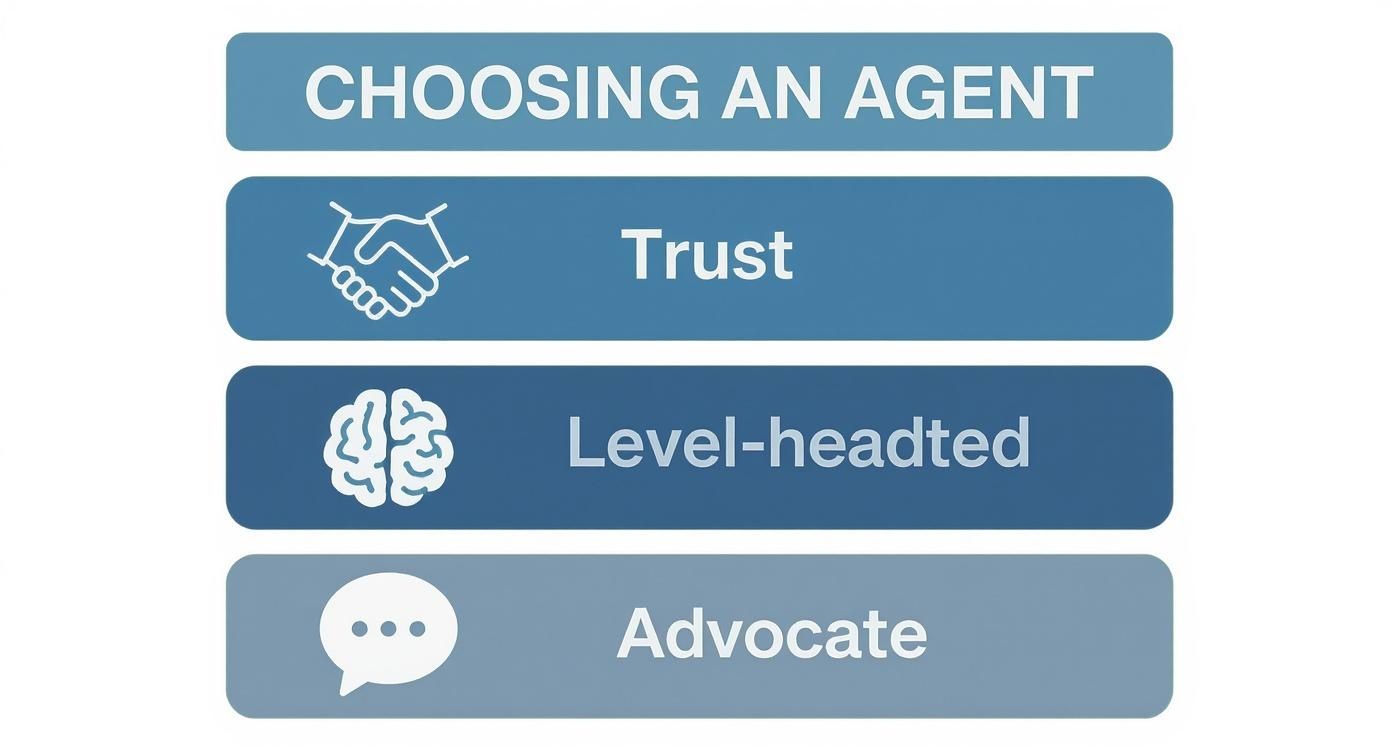
These traits are the bedrock of an effective agent relationship, ensuring your chosen representative can confidently and compassionately carry out your wishes when it matters most.
Proactive Planning vs. Court-Ordered Guardianship
There’s another critical distinction to make: the difference between planning ahead with a durable power of attorney and what happens if you don't. Should you become incapacitated without a designated healthcare agent, your loved ones may have no choice but to seek a court-ordered Guardianship.
A guardianship is a legal process where a judge appoints someone to make decisions for an incapacitated person, who is then called the "ward." While it serves an important function, it is almost always a last resort. The guardianship process can be:
- Public: Court proceedings and records are generally open to the public, sacrificing your family's privacy at a vulnerable time.
- Costly: The process involves court costs, attorney's fees, and sometimes ongoing reporting requirements that add up quickly.
- Time-Consuming: It can take weeks or even months to get a guardian appointed, potentially delaying critical medical decisions.
- Stressful: The court process adds a heavy layer of emotional and financial strain on your family during an already difficult situation.
Texas Advance Planning Documents at a Glance
This table breaks down the core purpose of each document or process so you can see exactly how they differ and when they come into play.
| Document / Process | Who Makes the Decision? | When Does It Apply? | Key Purpose |
|---|---|---|---|
| Medical Power of Attorney | Your chosen Agent | When you are unable to make your own medical decisions | To appoint a trusted person to make a broad range of healthcare decisions for you. |
| Directive to Physicians (Living Will) | You, in advance | Only when you have a terminal or irreversible condition | To state your specific wishes about life-sustaining treatment at the end of life. |
| Court-Appointed Guardianship | A Guardian chosen by a judge | After a court declares you legally incapacitated | To have a court appoint a decision-maker when no other planning is in place. |
By creating a durable power of attorney for health care, you make your own choice about who will speak for you. You empower someone you know and trust, completely avoiding the uncertainty, cost, and stress of a court proceeding. This simple act of foresight is one of the most compassionate things you can do for your family.
Step-by-Step Guide to Creating a Valid Texas Medical Power of Attorney

Putting your wishes into a legally binding document is an empowering step, but it only works if you do it correctly. Creating a durable power of attorney for health care in Texas isn’t overly complicated, but it demands close attention to the specific rules laid out in the Texas Health and Safety Code. Following these steps ensures your document is ironclad and that your agent’s authority will be respected when it matters most.
Think of these requirements not as legal hurdles, but as safeguards. They exist to protect you from fraud or coercion, verifying that the document truly reflects your intentions. The process involves more than just filling out a form; it’s about formally and legally declaring your choice of a healthcare advocate.
Step 1: Formal Signing and Witnessing Requirements
For a medical power of attorney to be valid in Texas, you have two options: sign it in the presence of two qualified witnesses, or have it notarized by a notary public. Most legal professionals, including our team at the Law Office of Bryan Fagan, strongly recommend doing both. Having your document witnessed and notarized creates the strongest possible legal foundation.
The signing has to happen while you are of sound mind and acting of your own free will. This is the moment you formally execute your wishes, so it's critical that anyone present can attest to your capacity to make these decisions.
Step 2: Selecting Qualified Witnesses
The state of Texas is very particular about who can witness your signature. These rules are designed to prevent conflicts of interest and ensure the witnesses are completely impartial. A person cannot serve as a witness if they are:
- Your Designated Agent: The person you are appointing to make decisions for you cannot also witness the document that gives them that power.
- Your Healthcare Provider: This includes your doctor or any employee of a facility where you are receiving care.
- Your Spouse or Heir: Anyone who has a claim to your estate or is a direct family member who stands to inherit is disqualified.
- An Employee of Your Agent: If your agent works for a company, like a professional fiduciary, none of their employees can serve as witnesses.
Essentially, a witness must be a neutral third party who has no financial or personal stake in your healthcare decisions or your estate.
Step 3: Including a HIPAA Release
Here’s something many people overlook. While your medical power of attorney grants your agent decision-making authority, it doesn't automatically give them access to your protected health information. Federal privacy laws under HIPAA (the Health Insurance Portability and Accountability Act) prevent doctors from sharing your medical records without explicit, written permission.
This is why a separate HIPAA release form is an essential companion to your power of attorney. This document explicitly authorizes your doctors, hospitals, and other providers to share your medical information with your agent. Without it, your agent would be trying to make informed decisions in the dark, unable to review your charts, speak to your doctors, or understand your prognosis.
Fortunately, people are waking up to the need for advance planning. A national poll found that nearly 46% of older adults have completed at least one advance care planning document. This shows a growing recognition of the need to prepare for future health events, and you can read the full research about these advance planning trends.
Creating a valid Texas medical power of attorney, complete with proper witnesses and a HIPAA release, provides a clear, legally sound plan. It’s the practical step that turns your thoughtful decisions into actionable instructions for your family and medical team.
Updating or Revoking Your Healthcare Directive
A durable power of attorney for health care isn't a document you create once and then file away forever. Think of it as a living part of your overall life plan—one that needs to adapt and evolve right along with you. Life is anything but static, and making sure your healthcare directive accurately reflects your current wishes is the key to maintaining control over your own medical decisions.
Taking the time to review this document is a powerful act of foresight. While national data shows that about 36.7% of U.S. adults have some form of advance directive, the real power of these documents comes from keeping them current. You can discover more insights about advance directive completion rates to see the trends for yourself. A directive that's years out of date can cause just as much confusion and conflict as having no directive at all.
When to Review Your Healthcare Directive
Certain life events should be an automatic trigger to pull out your power of attorney and give it a fresh look. These are moments that can dramatically shift your relationships, your priorities, and even the suitability of the agent you originally chose.
It’s always a good idea to reassess your choices if you experience:
- A Change in Marital Status: Getting married or divorced will almost certainly change who you’d trust with life-or-death decisions. A divorce, in particular, may legally revoke an ex-spouse's appointment as your agent in Texas, but it's always smarter to formally create a new document to remove all doubt.
- The Death of Your Agent: If your primary or even your alternate agent passes away, your document is suddenly without a designated decision-maker. This is a critical time to appoint someone new.
- A Shift in Relationships: Life happens. A major falling-out with your current agent or growing closer to another family member might mean your initial choice is no longer the best fit for you.
- A Change in Your Agent’s Health: If your agent’s own health takes a turn or they move across the country, their ability to be there for you and serve effectively could be seriously compromised.
- A New Medical Diagnosis: Receiving a significant diagnosis can completely change your perspective on medical treatments and end-of-life care, prompting you to update the specific instructions you’ve laid out.
The Formal Process for Revocation in Texas
Simply telling your old agent, "Hey, you're not my agent anymore," isn't enough. To legally revoke a durable power of attorney for health care in Texas, you have to take formal steps to make your intentions crystal clear and legally binding. Any ambiguity can lead to a nightmare scenario where a new agent and an old one are fighting over who’s in charge, leaving your doctors caught in the middle.
The safest and most effective way to update your wishes is to execute a completely new durable power of attorney. This new document must be signed, witnessed, and notarized according to Texas law, just like the original one was. It's also absolutely crucial to give copies of the new document to your new agent, your new alternate agent, and all of your healthcare providers, instructing them to remove any and all outdated versions from your medical files. For a deeper dive into this topic, check out our article on how to cancel a power of attorney.
The Power of Communicating Your Wishes

Signing a durable power of attorney for health care is the critical first legal step, but the real work starts with a conversation. Think of the document as a tool; its true power is only unlocked when your agent and family understand the why behind your choices. Open communication is the bridge that connects the legal text on the page to your personal values and beliefs.
Having this conversation is one of the most compassionate gifts you can give your loved ones. It transforms your agent from a simple decision-maker into a true advocate, armed with the confidence that they are honoring your voice. Without this dialogue, they are left to guess, which can create immense stress, guilt, and conflict during an already agonizing time.
Starting the Conversation
Bringing up end-of-life wishes can feel daunting, but it helps to frame it as an act of love and care. Explain that your goal is to lift this heavy burden from their shoulders, not to place one on them. Choose a quiet, private time where no one feels rushed, and let your agent know you want to discuss something important to ensure they're prepared.
Here are a few key topics to get the ball rolling:
- Your Definition of a Good Life: What makes life meaningful for you? Is it being able to communicate with family? Being free from constant pain? Simply being present?
- Your Thoughts on Specific Treatments: Talk honestly about your feelings on things like feeding tubes, ventilators, or resuscitation if your heart were to stop.
- Your Hopes and Fears: Be open about what you’re afraid of—like being in pain or losing your independence—and what you hope for, such as passing away peacefully at home surrounded by family.
Studies have even put a number on it, showing that a simple educational pamphlet could increase completion rates from a mere 0.4% to 18.5%. The takeaway is clear: talking about it works.
Storing and Sharing Your Document
Once signed and notarized, your durable power of attorney for health care needs to be accessible. It does no good locked away in a safe deposit box no one can get to. Make sure you give copies to your primary agent, your alternate agent, and your primary care physician.
When you share these documents with medical providers, it’s also smart to be aware of HIPAA-compliant faxing practices for healthcare documents to protect your privacy and security. By taking these final steps, you ensure your wishes are not just written down, but are ready to be followed when they matter most.
Takeaway: Empowering Your Family Through Planning
Working through the details of a durable power of attorney for health care is one of the most powerful and loving things you can do for your family. This isn't just another legal document; it's your voice, captured on paper, ready to speak for you when you can't. It is the core of a smart Texas estate plan, giving you the final say on your medical destiny and lifting a heavy burden from your family during a crisis.
We've covered a lot of ground, but the goal has always been simple: to show you that this is about preserving your autonomy and protecting the people you love from having to make impossible decisions in the dark.
Key Insights for Texas Families
A solid plan comes down to a few key actions. Keep these steps front and center as you move forward:
- Choose Your Champion Wisely: Your agent is your advocate. You need someone you trust implicitly—someone who is level-headed, clear-thinking, and strong enough to stand up for your wishes, even when things get tough.
- Get the Texas Formalities Right: A document that isn't legally sound is just a piece of paper. You must follow Texas law to the letter, including the specific witnessing or notarization rules laid out in the Texas Health and Safety Code. This makes it ironclad.
- Talk, Then Talk Some More: The document provides the legal instructions, but your conversations provide the human context. Sit down with your agent and your family. Talk about your values, your fears, and what a "good life" means to you.
A durable power of attorney for health care isn't just for the elderly or the sick. It's for every single adult. Accidents happen. Unexpected illnesses don't discriminate by age. This document is the only surefire way to guarantee your chosen person can legally step in and make medical decisions on your behalf.
While this guide gives you a solid framework, no two families are the same. Your life, your relationships, and your specific wishes demand a plan that’s built for you, not for a textbook example. Whether you're navigating the Texas Probate Process, setting up a Guardianship, or creating foundational Wills & Trusts, getting personalized legal guidance is the smartest investment you can make. And if disagreements pop up, knowing your rights in Probate Litigation can make all the difference.
It's time to take that next step.
If you’re facing probate in Texas, our team can help guide you through every step — from filing to final distribution. Schedule your free consultation today.