When a loved one passes away, one of the first questions we hear from Texas families is, "Do all wills go to probate?" The answer, thankfully, is no. We understand this is a difficult time, and our goal is to provide clear, compassionate guidance. A will is a critical roadmap for your loved one’s wishes, but some assets have their own built-in instructions that let them bypass the courthouse entirely.
Understanding Probate and Your Loved One's Will
Probate is the formal court process used to confirm a will is valid, pay off any lingering debts, and legally hand over property to the people named as beneficiaries. In plain English, it's the official system for making sure a will is carried out correctly under a judge's supervision. Many people assume that having a will automatically kicks off this process, but that's a common myth.
In Texas, whether a will needs to go through probate hinges entirely on what kind of assets your loved one owned.
Think of it this way: a will only controls assets that were titled solely in the deceased person's name, with no beneficiary named on the account. These are called probate assets.
On the other hand, many assets are set up to transfer automatically at death, completely outside of the will's instructions and the court's supervision. These are known as non-probate assets.
The Key Difference: Probate vs. Non-Probate Assets
The distinction between these two asset types is the single most important factor in figuring out if you need to head to the probate court. This isn't just a Texas quirk; it's a fundamental principle of how estates are settled everywhere.
Many estates are actually small enough to sidestep formal court proceedings, especially when assets are structured to transfer directly. In fact, national data shows that estates falling under certain value thresholds (which vary by state) often qualify for much simpler processes. You can discover more insights about estate settlement trends on Ibisworld, but the bottom line is that a huge number of estates are settled without ever seeing the inside of a probate courtroom.
This simple decision tree helps visualize the core question: do the assets listed in the will actually require probate?
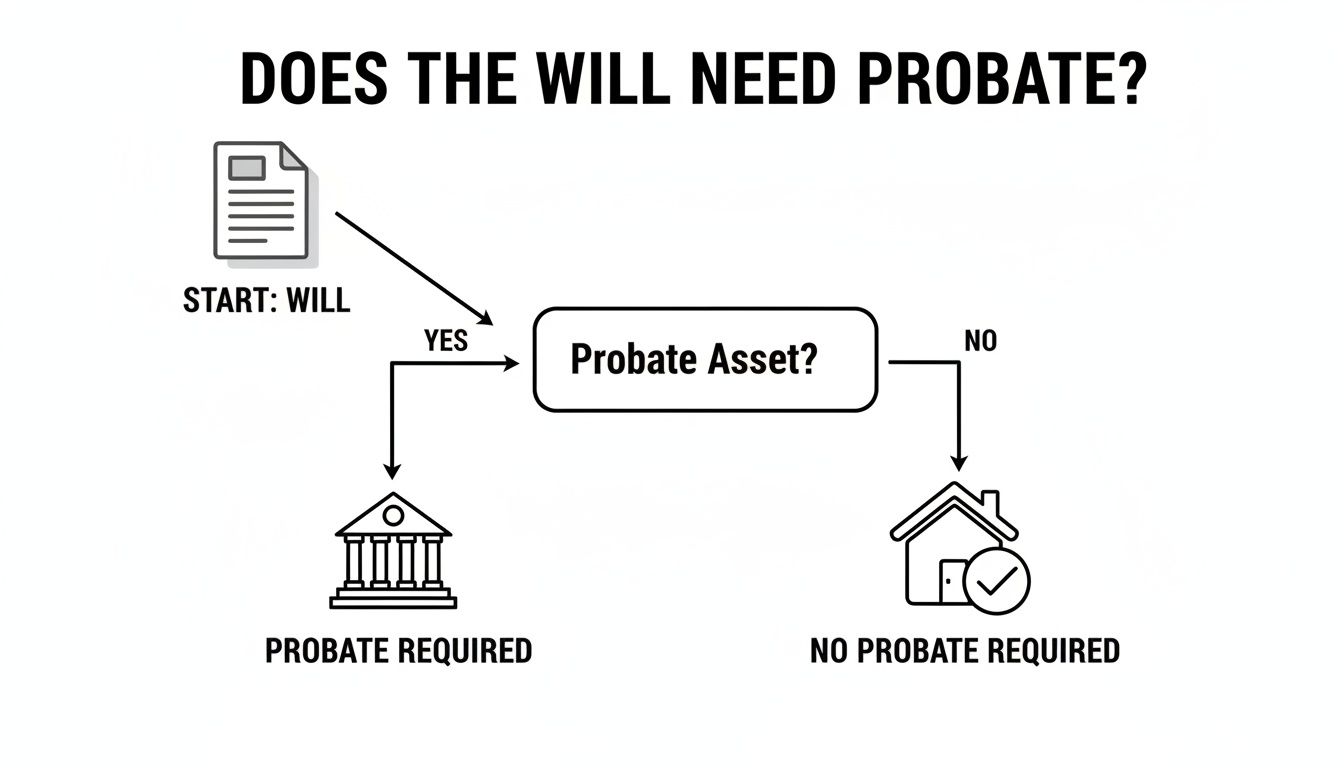
The big takeaway here is that the type of asset, not just the existence of a will, dictates the path forward. Knowing this difference is the first step in understanding what to expect as you begin to settle your loved one's affairs.
Probate vs Non-Probate Assets at a Glance
To make this crystal clear, here’s a quick breakdown of common assets and whether they typically have to go through the Texas probate system.
| Asset Type | Usually Requires Probate? | How It Transfers |
|---|---|---|
| Real Estate (Sole Ownership) | Yes | The will directs who inherits the property. |
| Bank Accounts (Sole Ownership) | Yes | The will names the beneficiary of the funds. |
| Personal Property (cars, jewelry) | Yes | Distributed according to the will's instructions. |
| Life Insurance Policies | No | Proceeds go directly to the named beneficiary. |
| Retirement Accounts (401k, IRA) | No | Funds transfer directly to the designated beneficiary. |
| Joint Bank Accounts | No | The surviving owner automatically gets the funds. |
| Assets in a Living Trust | No | The trust document controls the distribution. |
| Payable-on-Death (POD) Accounts | No | The named beneficiary claims the funds from the bank. |
This table should help you start sorting through your loved one's estate. If you see that most or all of their assets fall into the "No" column, there's a good chance you can avoid the time and expense of a formal probate process.
When Texas Law Requires a Will to Be Probated
It’s a common misconception that every will in Texas has to go through the probate process. The reality is, the need for probate isn’t about the will itself; it’s about the type of property your loved one owned. Texas law only steps in when assets are legally "stuck" in the deceased's name, making it impossible to transfer them to the rightful heirs without a court's help.

This usually happens when an estate includes probate assets—property titled solely in the deceased’s name with no co-owner and no designated beneficiary. Think of a house, a car, or a bank account owned by just one person. Without a surviving co-owner or a beneficiary designation to automatically pass the torch, there's no legal way to hand over that title.
That’s where the Texas Estates Code (specifically Title 2) comes in. It provides the probate process as the official solution. It's the court's method for formally recognizing the will, appointing an executor, and giving that person the authority to pay any final bills and transfer the assets.
A Realistic Scenario: The Stuck House Title
Imagine a family in Houston whose father just passed away. His will is crystal clear: he leaves his home to his three adult children. They assume they can just take over ownership, but they hit a brick wall when they try to sell the house.
The title company points out that the deed is only in their father's name. Because there's no living owner on the title, the children have no legal power to sign the closing documents. The house is, for all intents and purposes, legally frozen.
In this situation, the father's will has to be submitted to a Texas probate court. The court will then follow these steps:
- Step 1: Validate the Will: Confirming it meets all legal requirements to be considered official.
- Step 2: Appoint an Executor: Officially giving one of the children (or another named person) the power to act on behalf of the estate.
- Step 3: Issue Letters Testamentary: This is the golden ticket—the legal document that proves the executor's authority to the title company, banks, and anyone else who needs it.
Only with these steps completed can the executor legally transfer the home's title to the children, just as their father wanted. The process makes sure any of the father's final debts are settled and that the transfer of ownership is clean and legally binding, protecting everyone involved.
Why Probate Isn't Always Necessary
The idea that every will must face a judge is just a myth. In reality, a huge number of estates sidestep formal probate entirely. National statistics show that of the roughly 2.8 million deaths in the U.S. each year, only about 35-50% end up in a formal probate filing. The rest are settled using simpler methods because the assets were held in trusts, had named beneficiaries, or were owned jointly with someone else. You can get a better sense of how these choices play out by reviewing these insights on wills and estate planning.
Key Takeaway: Probate is a tool, not a punishment. The Texas Estates Code requires it only when necessary to unfreeze assets and provide a clear, legal path for transferring property from the deceased to their rightful heirs according to the will. Without it, assets titled solely in the deceased's name would be in legal limbo forever.
Understanding this core purpose helps take the fear out of the process. It's really a protective measure, designed to make sure a loved one’s final wishes are seen through to the very end.
How Families Can Avoid Probate Even with a Will
Even when a loved one leaves behind a will, your family isn't always destined for a long, drawn-out Texas Probate Process. Think of the will as the main road map for the estate, but certain assets have their own built-in GPS that lets them travel directly to the right person, bypassing the courthouse traffic altogether. With strategic estate planning using tools like Wills & Trusts, this smoother, faster transfer of property is more common than you might think.
This approach has become the go-to for families looking for simpler ways to handle an estate. It's a surprising fact, but a recent report shows that 55% of American adults don't have any estate plan at all. For those who do plan, many are wisely using these "titling tricks" to make things easier on their loved ones. It's estimated that a whopping 60-70% of estates manage to avoid probate entirely through smart tools like joint ownership and beneficiary designations on life insurance and retirement accounts. This leaves only a small fraction of deaths that actually trigger a formal court process. You can learn more about these estate planning trends and statistics to see just how important understanding these tools has become.
Using Beneficiary Designations as a Direct Delivery System
The single most powerful way to keep an asset out of probate is by using a beneficiary designation. This simple legal tool essentially pre-addresses an asset, making sure it gets delivered directly to your chosen person without ever stopping at the probate "post office."
Think about a life insurance policy or a 401(k) account. When you filled out the original paperwork, you named a primary beneficiary. Upon your death, that person simply contacts the financial institution, provides a death certificate, and receives the funds. No court order needed. The will doesn't even come into play for these types of assets.
Common assets that use this direct-delivery method include:
- Life Insurance Policies: The death benefit is paid straight to the person named in the policy.
- Retirement Accounts: This covers everything from 401(k)s and IRAs to other pension plans.
- Payable-on-Death (POD) Bank Accounts: You can add a POD designation to your checking and savings accounts, making the transfer to a loved one incredibly simple.
- Transfer-on-Death (TOD) Accounts: This works the same way but applies to investment and brokerage accounts.
How Property Ownership Can Bypass Probate
Another key strategy is all about how property is legally titled. In Texas, owning property jointly with another person can create an automatic transfer upon death, a concept known as the right of survivorship.
The most common setup for this is Joint Tenancy with Right of Survivorship. When two or more people own property this way—whether it's a house, a car, or a joint bank account—the surviving owner automatically absorbs the deceased owner's share. The property title is updated with just a death certificate, not a court order. It's that simple.
Key Takeaway: A will only directs the distribution of assets that it actually controls. Assets with beneficiary designations or a right of survivorship have their own set of instructions that legally override whatever the will says, making them powerful tools for avoiding probate.
Exploring the differences between probate and non-probate assets is crucial for any family trying to simplify the estate settlement process. We provide a detailed guide on figuring out which of your loved one's assets are considered non-probate assets in our comprehensive article. Properly setting up these designations and ownership structures ahead of time is the most compassionate and effective way to ensure your family can focus on healing, not on lengthy court procedures.
Navigating Small Estates in Texas
For many Texas families, the thought of a formal, drawn-out probate process is overwhelming. This is especially true when the estate is modest. Thankfully, Texas law gets it—not every estate needs the full court-supervised treatment. There are several practical, simplified options designed specifically to help families with smaller estates save time, cut costs, and reduce emotional strain.
These alternatives are powerful tools meant to make transferring property much more efficient when the circumstances are right. The trick is knowing which one actually fits your family’s situation.
Using a Small Estate Affidavit
One of the most common probate alternatives is the Small Estate Affidavit (SEA). Think of it as a sworn legal shortcut. This document can be used to collect and distribute the assets of someone who died without a will, completely sidestepping the need for a formal probate court proceeding. It’s an incredibly efficient solution for transferring things like a bank account or a car title.
But not everyone qualifies. To use an SEA in Texas, the estate has to meet a few strict criteria under the Texas Estates Code, Chapter 205:
- The total value of the estate's assets (not counting the homestead and other exempt property) can't be more than $75,000.
- The person must have died without a will (intestate).
- The estate’s assets have to be worth more than its total debts.
- All the heirs must be on the same page about how the property will be divided.
If you can check all those boxes, the heirs can file the affidavit with the court. Once a judge approves it, that document legally authorizes banks and other institutions to release the assets. We take a deeper dive into the specific requirements and when it’s necessary to consider the small estate probate process in Texas in another guide.
Probating a Will as a Muniment of Title
Another unique and efficient Texas procedure is probating a will as a Muniment of Title. This isn't your typical probate administration. It’s a streamlined process that basically asks the court to recognize the will as a valid legal document that transfers ownership of property. It's fast and effective.
Key Insight: Think of a Muniment of Title as having the court officially stamp the will, turning it into the new deed for a property. It proves the transfer of ownership without ever needing to appoint an executor or go through the full administration process.
This option is only on the table if a couple of conditions are met, as outlined in Texas Estates Code, Chapter 257:
- There is a valid will.
- The estate has no unpaid debts, other than any loans secured by real estate (like a mortgage).
This process is a lifesaver when the main goal is just to transfer title to a house and there aren't any other complex issues to sort out. It’s a perfect example of how Texas law provides practical solutions, proving that not all wills have to go through probate in the traditional sense.
Key Insights for Executors and Grieving Families
Losing a loved one is one of life's most difficult experiences, and the legal responsibilities that follow can feel like a heavy weight. The goal here is to give you a clear, actionable game plan. It’s about empowering you to honor your loved one’s wishes with confidence, not confusion.
Your Immediate Action Plan
As the executor, your first job is to start gathering the important paperwork. Here is a simple, step-by-step guide to get started:
- Locate the Will: Find the original copy of your loved one's last will and testament.
- Order Death Certificates: A critical early step is understanding the Texas death certificate, as you'll need certified copies for almost everything.
- Create an Asset Inventory: Create a complete list of everything your loved one owned. This isn't just a simple list; you need to figure out how each asset is legally titled.
- Check for Beneficiaries: This is crucial. You have to check every single account for a beneficiary designation. A named beneficiary on a life insurance policy, an IRA, or a 401(k) legally overrides whatever the will says about that specific asset. This is one of the biggest reasons a will might not need to go through probate at all.
Understanding Your Role and Responsibilities
Even if you discover that a formal probate isn't necessary, your job isn't over. You'll still have to take steps to legally transfer property, settle final bills, and close down accounts. It’s essential to understand the full scope of your duties from the start.
For a comprehensive look at what this role entails, we’ve put together a detailed guide on an executor of a will's responsibilities. Honoring your loved one’s legacy begins with knowing exactly what's ahead of you, and we're here to provide that clarity.
Key Takeaway
A will is a set of instructions for the court if probate is needed. It’s the roadmap for distributing probate assets, but it has zero power over non-probate assets that are already set up to pass directly to a beneficiary. Understanding this distinction is the first step to a smoother process.
When to Get Professional Legal Guidance
While many Texas estates can be settled with simplified procedures, some situations are just too complex or messy to handle alone. Knowing when to call in an experienced professional can prevent costly mistakes, keep family tensions from boiling over, and make sure your loved one’s legacy is honored without needless drama.
Think of a probate attorney as a seasoned guide for a treacherous hike. You might not need one for a simple walk in the park, but their expertise becomes indispensable when the trail gets rocky, the map is confusing, and a storm is brewing on the horizon.
Red Flags That Signal It's Time for Help
You should seriously consider getting legal guidance if you run into any of these common probate roadblocks:
- Family Disputes: Disagreements among heirs or beneficiaries can escalate in a heartbeat, spiraling into formal Probate Litigation. A good attorney can step in to mediate, protect the estate’s assets, and keep things from getting personal.
- Questions About the Will: If anyone starts questioning the will's validity—maybe suggesting it was signed under duress or when the person wasn’t mentally sound—legal intervention isn't just a good idea; it's necessary.
- Complex Assets: Estates that include a family business, multiple real estate holdings, or complicated investments need careful management. One wrong move can tank their value, and an attorney knows how to handle the transfer properly.
- Guardianship Concerns: If the will names a guardian for minor children, the court process for Guardianship needs to be handled with extreme care.
- The Executor Lives Out-of-State: Trying to manage a Texas probate from another state adds layers of logistical headaches. A local attorney can handle the court filings, navigate procedural quirks, and be your boots on the ground.
Trying to navigate these issues on your own can be completely overwhelming, especially when you're also grieving. Bringing in legal counsel provides peace of mind, ensuring every step is handled correctly according to Texas law. This isn't about adding another burden; it's about protecting your family and the estate.
Key Insight
Hiring a probate attorney isn't a sign of failure—it's a protective measure. It ensures that complex situations are managed correctly, safeguarding the estate's assets and preserving family harmony during an already difficult time.
Common Questions We Hear About Texas Probate
When a family starts navigating the probate process, a lot of questions come up. It's a confusing time, and getting clear answers is the first step toward finding your footing. Here are a few of the most common questions we get asked, with straightforward, plain-English answers to help you know what to expect.
How Long Do I Have to Probate a Will in Texas?
This is one of the most critical questions, and the answer is all about timing. In Texas, you generally have four years from the date of a person's death to file their will for probate. This isn't just a suggestion—it's a hard deadline set by the Texas Estates Code, Section 256.003.
What if more than four years have already passed? It gets a lot tougher. You'd have to convince the court that you weren't "in default," meaning you had a very good, non-negligent reason for the delay. This exception is rarely granted, so acting within that four-year window is absolutely key.
What Happens If We Just Don't Probate the Will?
Skipping probate might seem like an easy way to avoid legal hassles, but it almost always creates bigger problems down the road. Without the court's official stamp of approval, any assets titled only in the deceased's name are effectively frozen in time.
This means:
- Real estate can't be sold or have its title legally transferred to the heirs. It's stuck.
- Bank accounts that don't have a payable-on-death beneficiary will remain locked.
- Vehicles, stocks, and other titled property can't be legally signed over to a new owner.
Think of it this way: a will is just a set of instructions on paper. Probate is the legal process that gives those instructions the force of law. Forgoing this step means your family can't legally access or manage the very assets your loved one wanted them to have.
Key Takeaway
Failing to probate a will doesn't make assets disappear; it just puts them in legal limbo. The property remains titled in the deceased's name indefinitely, creating a tangled mess for future generations to sort out.
Can I Be the Executor If I Live Outside of Texas?
Yes, absolutely. Living out of state doesn't disqualify you from serving as an executor in Texas. However, the law has a practical rule in place to make sure everything runs smoothly from a legal standpoint.
An out-of-state executor must appoint a resident agent. This is simply a person who lives in Texas and agrees to be the official point of contact for any legal notices or lawsuits filed on behalf of the estate. It’s a common-sense requirement in the Texas Estates Code to ensure the court system always has someone local to serve papers to. It's a routine and manageable step, so don't let your location stop you from fulfilling your duty.
If you’re facing probate in Texas, our team can help guide you through every step — from filing to final distribution. Schedule your free consultation today.