The core difference between a Power of Attorney (POA) and a Durable Power of Attorney (DPOA) comes down to one critical moment: incapacity. A standard POA becomes legally invalid the moment you can no longer make decisions for yourself, while a Durable POA remains in full effect. This single distinction is one of the most vital in Texas estate planning, and it determines whether your chosen agent can help you in a crisis or if their hands are legally tied.
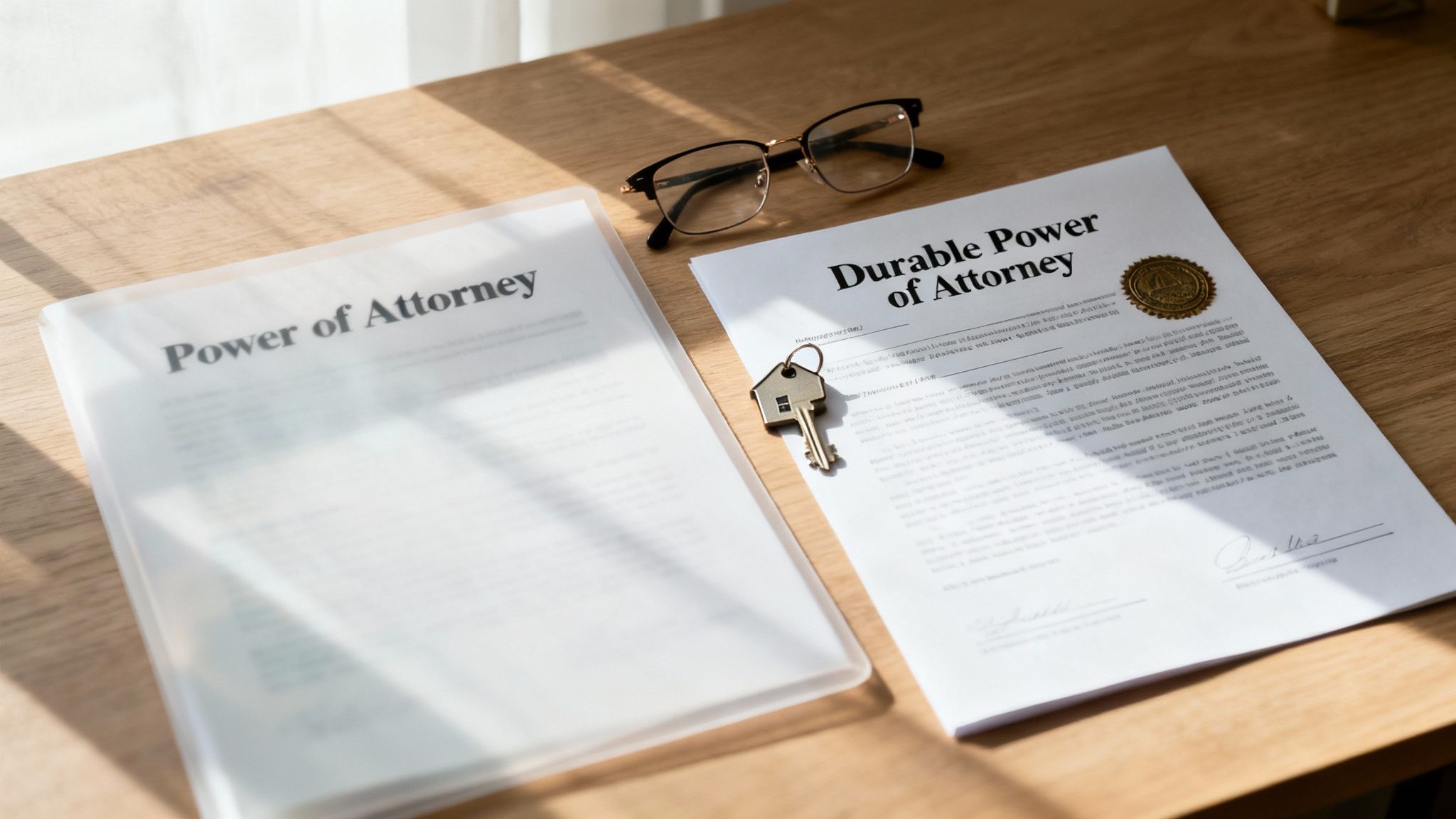
Understanding The Foundation Of A Power Of Attorney
A Power of Attorney is a legal document that lets you grant someone you trust—your "agent" or "attorney-in-fact"—the authority to manage your financial and legal affairs. In simple terms, it's a powerful tool that lets your agent do things like pay your bills, manage bank accounts, sell property, or handle tax matters on your behalf. Think of it as giving someone permission to step into your shoes and act for you.
For Texas families, creating a POA is often a first step in getting their affairs in order. But here’s where a common and dangerous misconception comes in: many people assume any POA will protect them in a medical emergency. The reality is that a standard, or "general," Power of Attorney has a fatal flaw defined by Texas law.
Without specific "durable" language, its authority evaporates precisely when you and your family need it most—at the point of incapacity. This can happen from a sudden accident, a serious illness like a stroke, or a progressive condition like dementia.
Comparing General And Durable POAs
The entire game changes with the "durable" provision. A Durable Power of Attorney includes specific wording, as required by the Texas Estates Code, Title 2, Subtitle P, that explicitly states the agent's authority continues despite your subsequent incapacity. This simple but powerful clause transforms the document from a tool of convenience into a foundational safeguard for your future.
To put it plainly, understanding this difference isn't just a legal formality. It’s about ensuring your wishes are honored and your family is protected from unnecessary stress, expense, and a potential court battle during an already difficult time.
Here's a quick breakdown to highlight the fundamental differences between a General Power of Attorney and a Durable Power of Attorney under Texas law.
General POA vs Durable POA A Quick Comparison
| Feature | General Power of Attorney (POA) | Durable Power of Attorney (DPOA) |
|---|---|---|
| Authority Before Incapacity | Your agent can act on your behalf. | Your agent can act on your behalf. |
| Authority After Incapacity | Becomes invalid. The agent loses all authority to act for you. | Remains valid. The agent's authority continues without interruption. |
| Primary Purpose | To delegate tasks for convenience while you are fully capable. | To ensure continuous management of your affairs if you become unable to do so. |
| Court Intervention | If you become incapacitated, your family may need to seek a court-ordered Guardianship. | Helps avoid the costly and time-consuming guardianship process. |
| Legal Requirement in Texas | The default POA in Texas is not durable unless specified. | Must contain specific language stating it is not affected by the principal's incapacity. |
If you’d like to explore the basics further, you can get additional details in our guide explaining what is a Power of Attorney. The next section will dig into exactly how incapacitation legally affects these critical documents.
How Incapacity Affects Your Power of Attorney
To truly grasp the difference between a standard POA and a durable one, it’s important to understand what incapacity means in a legal sense. In Texas, this isn't just a medical diagnosis; it's a legal determination that a person can no longer make or communicate responsible decisions for themselves.
This can happen for many reasons—a sudden accident, a stroke, a coma, or a progressive illness like dementia or Alzheimer's. And that exact moment of incapacity is where a standard Power of Attorney hits a wall, leaving a significant gap in your estate plan.
The Breaking Point for a Standard POA
Think of a standard, non-durable Power of Attorney as a tool of convenience. It’s perfect for letting an agent manage your affairs while you're healthy and able to oversee things. But the instant you become legally incapacitated, Texas law dictates that the agent’s authority is gone. It simply vanishes.
The logic is straightforward: an agent’s power comes directly from you, the principal. If you lose the ability to make decisions, you can no longer legally grant that power to someone else. This leaves families in a difficult position, often at the worst possible moment.
A Realistic Texas Scenario: What Happens When a POA Fails
Let’s walk through a realistic scenario to illustrate this. Imagine your elderly father, Mark, set up a standard Power of Attorney years ago, naming you as his agent. He believed he had taken the right step to protect his finances and make things easier for you.
Then one day, Mark suffers a major stroke and can no longer communicate or manage his affairs. You go to his bank with the Power of Attorney, ready to start paying for his medical bills from his account. However, the bank manager informs you that because your father is now incapacitated, the document is legally void.
Suddenly, you have no authority. You cannot:
- Pay his mortgage or utility bills from his accounts.
- Access his money for critical medical needs.
- Manage his investments or sell property to pay for long-term care.
- File his taxes or handle other financial tasks.
Your family is thrown into a crisis. The very tool you thought was a safety net has disappeared, and your only option is to begin a costly and public court process to get the authority you need. This is the stark reality of why the difference between a standard POA and a durable one is so critical.
Key Insight: A standard Power of Attorney works only when you are well. A Durable Power of Attorney works when you are not, providing a seamless bridge of authority that protects your family from the legal and financial chaos of a sudden incapacity.
This gap in planning is unfortunately common. In fact, a recent Paragon Bank study found that a staggering 72% of individuals over 65 do not have any Power of Attorney arrangements in place at all. This statistic highlights a widespread vulnerability, especially when families don't realize that a standard POA offers no protection against incapacity. You can find more details in the study about power of attorney preparations among seniors.
The Urgent Need for Court Intervention
When a standard POA becomes invalid due to incapacity, the family’s only remaining option is to petition a court for a guardianship. This is a formal, often lengthy legal proceeding where a judge appoints someone to manage the incapacitated person's affairs under strict court supervision.
While sometimes necessary, a guardianship is emotionally draining and financially expensive. It involves hiring attorneys, attending court hearings, and filing continuous reports. It also means a judge—not your loved one—will have the final say on who manages their life and finances. This is exactly the difficult situation a durable power of attorney is designed to prevent. You can learn more about the significant differences between guardianship and power of attorney in our detailed guide.
Securing Your Future with a Durable Provision
While a standard Power of Attorney is useful, it’s the Durable Power of Attorney (DPOA) that offers real security. Think of it as the definitive tool for incapacity planning—it’s specifically engineered to remain valid through the exact crisis it was created to solve.
The key is in the "durability" language. As required by the Texas Estates Code, Title 2, Subtitle P, a DPOA must include specific wording that ensures your agent's authority continues even if you become incapacitated. This simple but powerful clause provides an uninterrupted line of authority for your agent, giving your family both practical control and profound peace of mind.
This single provision is what keeps your family out of court, saving them the stress, cost, and public exposure of a Guardianship proceeding. Our firm can help you navigate the Texas Probate Process with confidence.
Immediate vs. Springing Durable Powers of Attorney
In Texas, DPOAs typically come in two forms, each designed for different family dynamics and comfort levels. The main difference between these types is when they become effective.
- Immediate DPOA: This document is effective the moment you sign it. Your agent can legally act on your behalf right away, even while you’re fully capable of managing your own affairs.
- Springing DPOA: This document only "springs" into effect after a specific event—your incapacitation. The document itself will define how incapacity is proven, which usually requires a written certification from one or more physicians.
Choosing between them is a personal decision that requires a careful look at your circumstances and the level of trust you have in your agent.
Key Insight: An Immediate DPOA gives your agent maximum flexibility to step in and help with finances at any time. A Springing DPOA acts as a safeguard, ensuring your agent's power is only triggered when it’s medically necessary.
Which Type of DPOA Is Right for You?
There’s no one-size-fits-all answer here. The right choice depends entirely on your situation and what you want to achieve. A few real-world scenarios can help clarify which path might be better for you.
An Immediate DPOA makes sense for people who want their agent to be able to help them right away. For example, if you travel frequently or have mobility issues that make banking difficult, an immediate DPOA lets a trusted agent pay bills or manage accounts for you without needing a doctor’s note. It signals a very high level of trust.
On the other hand, a Springing DPOA is a great fit for anyone who wants to maintain sole control over their affairs for as long as possible. This option often provides more comfort because it creates a clear boundary—your agent’s authority only begins after a medical professional confirms you can no longer make decisions for yourself.
The infographic below shows the critical failure point of a standard POA, driving home why the durable provision is so essential.
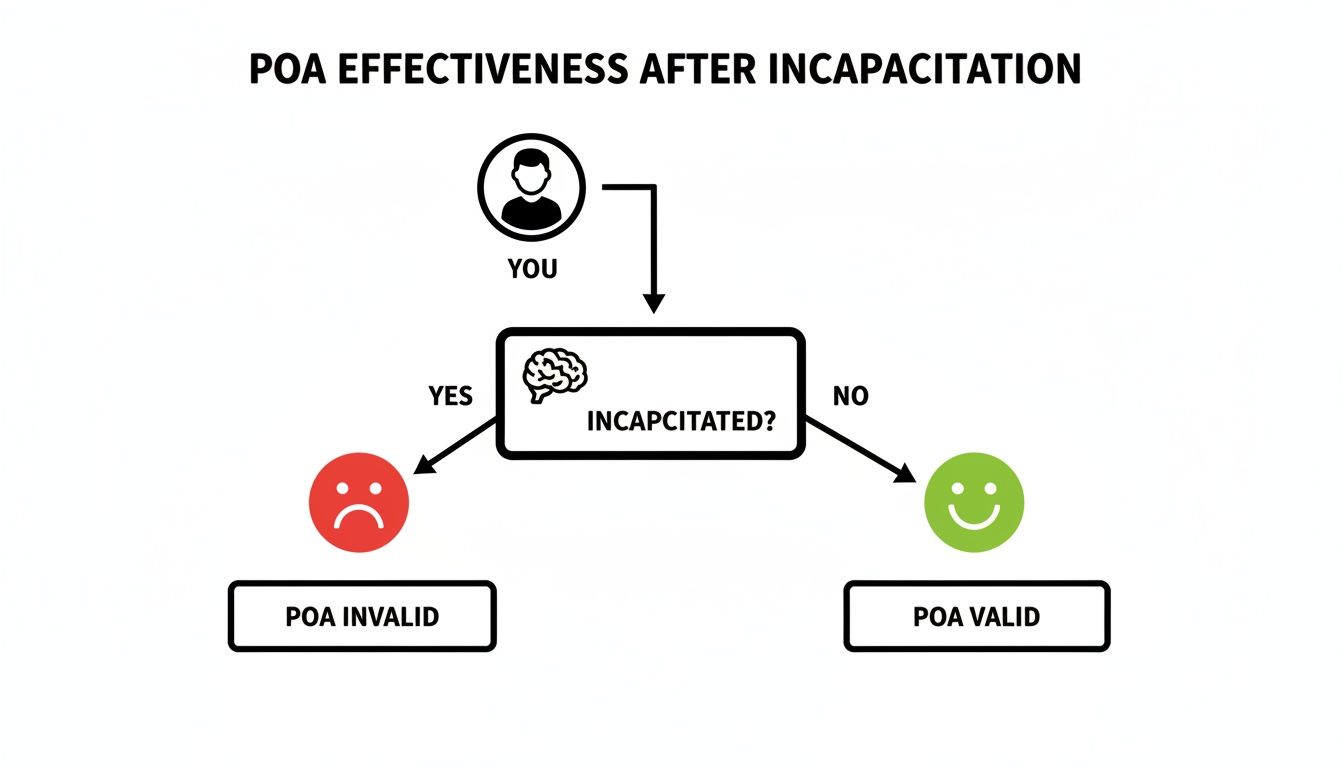
As you can see, a standard POA becomes useless at the very moment it’s needed most. This is exactly why planning for incapacity with a durable document is so important.
Integrating a DPOA into Your Complete Estate Plan
A Durable Power of Attorney shouldn't stand alone. It’s a crucial piece of a comprehensive estate plan that works alongside documents like Wills & Trusts and other advance directives.
For example, a Durable Power of Attorney for Health Care is another key document that lets an agent make medical decisions for you. You can learn more about how a Durable Power of Attorney for Health Care works in Texas and why it's just as important as your financial DPOA.
By building a complete plan, you ensure both your financial and personal well-being are protected. Your wishes will be respected, and your family will have a clear roadmap to follow during what will already be an emotional and difficult time.
Distinguishing Financial and Medical Powers of Attorney
It's a common point of confusion for Texas families, and an understandable one: the term "Power of Attorney" isn't a single, catch-all document. To truly protect yourself and your loved ones, you need to understand the distinct roles of a financial power of attorney and a medical power of attorney. They cover separate, equally vital areas of your life.

A Durable Power of Attorney for Financial Matters is the tool that empowers your chosen agent to manage your property and assets. Think of it as your financial shield. This is the document that lets them step in to pay your bills, manage bank accounts, handle real estate transactions, or even file your taxes if you're unable to do so yourself. It keeps your economic life running smoothly.
On the other hand, a Medical Power of Attorney (also known in Texas as a Durable Power of Attorney for Health Care) authorizes your agent to make healthcare decisions for you. When you can't speak for yourself, this person becomes your voice, communicating with doctors, consenting to treatments, and ensuring your medical wishes are honored.
Separate Roles for Complete Protection
The best way to think of these two documents is as a team, each with a very specific job. One protects your financial health, and the other protects your physical health. You can absolutely name the same person as your agent in both documents, or you might choose different people based on their unique strengths. Perhaps one child is adept with finances, while another is a compassionate advocate in a medical crisis.
The key takeaway is that you need both to create a complete safety net. A financial agent has no authority to make medical decisions, and a medical agent cannot access your bank accounts to pay for the very care they just approved.
A Real-World Scenario Where Both Agents Must Coordinate
Imagine your mother, Linda, has a serious fall and is hospitalized. She was wise enough to appoint her son, David, as her financial agent and her daughter, Sarah, as her medical agent.
- Step 1: Sarah's Role (Medical Agent): She is immediately on the phone with doctors, reviewing Linda's advance directive (living will) and consenting to a necessary surgery. In all matters of healthcare, Sarah is Linda's voice.
- Step 2: David's Role (Financial Agent): At the same time, David is accessing Linda's bank account to pay the hospital deposit. He later arranges payments to the rehabilitation facility Sarah chose and ensures Linda's mortgage and utility bills are paid while she recovers.
In this situation, David and Sarah must work in concert. Sarah makes the life-altering medical choices, and David provides the financial means to make them happen. Without both of these documents in place, the family would face significant logistical and legal hurdles during an already overwhelming time.
Key Insight: Having both a financial and medical durable power of attorney ensures that every aspect of your well-being is covered. It prevents gaps in authority that can lead to devastating delays in care or financial turmoil.
Despite how crucial they are, many Americans haven't taken these planning steps. A sobering analysis of 150 studies found that only 36.7% of adults have advance directives, which often include medical powers of attorney. This low adoption rate underscores the critical difference between a regular POA and a durable one; a non-durable document would become useless in a medical crisis, forcing families into a lengthy and expensive Guardianship process. You can learn more from the research on healthcare POA adoption rates.
Creating these documents is a fundamental part of the Texas estate planning process. They work hand-in-hand with your Wills & Trusts to make sure your wishes are followed, both during your life and after.
The High Cost of Not Having a Durable POA in Texas
Many Texas families see a Durable Power of Attorney as just another piece of estate planning paperwork. Its real value, however, isn't in what it does, but in the devastating financial and emotional ordeal it prevents. When a loved one becomes incapacitated without a DPOA, the alternative isn't simple. It’s a court-supervised process called Guardianship.

This isn’t just an inconvenience—it's incredibly expensive, stressful, and time-consuming. Understanding the true cost of guardianship frames the DPOA not as an expense, but as one of the most powerful tools you can have to protect your family’s future.
When Guardianship Becomes Necessary
Under the Texas Estates Code, Title 3, guardianship is the only option when someone can no longer manage their own affairs due to incapacity and they don't have a Durable Power of Attorney. Without a DPOA, no one has the automatic legal authority to access their bank accounts, pay their medical bills, or make financial decisions for them.
To get that authority, a family member has to petition the court, kicking off a formal legal proceeding. The process is designed to be rigorous to protect the incapacitated person (the "Ward"), but its safeguards come at a steep price.
The court must be convinced that the person is truly incapacitated and that the proposed guardian is a suitable choice. This almost always involves a step-by-step process:
- Filing a formal application with the court.
- Hiring an attorney to represent the person seeking guardianship.
- The court appointing an independent attorney (an "attorney ad litem") to represent the proposed Ward.
- Obtaining a physician’s certificate to confirm the incapacity.
- A court-ordered investigation into the proposed guardian's background.
Every single one of these steps comes with legal fees, court costs, and a significant time commitment.
The Financial Drain of Court Intervention
The financial consequences of a guardianship proceeding can be staggering, quickly eating away at the very estate you’ve spent a lifetime building. When incapacity strikes without a durable POA, the resulting guardianship can easily cost $20,000-$50,000 in legal fees and take 6-12 months just to get started. This highlights the critical difference: a standard POA dies when you become mentally incapacitated, while a durable POA lives on, letting your agent manage finances, pay bills, or sell property without missing a beat. You can find more details about the costs of forgoing a durable POA at agingcare.com.
These costs aren't a one-time hit. Once a guardian is appointed, they are under constant court supervision. They must post a bond, file a detailed inventory of the Ward’s assets, and submit annual accountings for court approval. Each filing often requires more legal help, creating a continuous drain on the estate for as long as the guardianship lasts.
Key Insight: A Durable Power of Attorney is a private agreement that costs a few hundred dollars to create. A guardianship is a public court proceeding that can cost tens of thousands over its lifetime. The DPOA is proactive protection; guardianship is a costly, reactive cure.
The Emotional Toll on Texas Families
Beyond the money, the emotional burden of guardianship is immense. The entire process is public, turning a private family matter into a court record for anyone to see. It can become adversarial, especially if family members disagree on who should be guardian, potentially sparking painful Probate Litigation.
The delays built into the court system mean urgent financial matters and critical care decisions are put on hold. Bills can go unpaid and assets can lose value while everyone waits for the court's permission to act. That feeling of helplessness, piled on top of the stress of court appearances and legal fights, takes a heavy toll during an already difficult time.
Proactive planning with a Durable Power of Attorney lets you sidestep this entire ordeal. By naming a trusted agent in advance, you keep control within your family, shield your assets from being bled dry by court costs, and spare your loved ones from a painful legal process. While our firm helps families navigate Guardianship proceedings, our real goal is to help you avoid them altogether through thoughtful estate planning.
Key Takeaway: Your POA Must Be Durable for True Protection
We've walked through the critical difference between a POA and a durable POA, and the conclusion is simple and absolute. For a Power of Attorney to be a reliable part of your Texas estate plan, it must be durable. Relying on a standard POA is like having an umbrella that dissolves in the rain—it fails you the moment you need it most.
A standard, non-durable POA becomes legally worthless the second you are incapacitated, leaving your family powerless to act on your behalf. In stark contrast, a durable POA is specifically built to survive incapacity, ensuring your chosen agent can step in and manage your affairs without a hitch. This single feature prevents the need for a costly and emotionally draining court-ordered Guardianship, protecting both your assets and your family's peace of mind.
An Act of Care for Your Loved Ones
Creating this document is far more than a legal formality; it’s a profound act of care. You’re giving your loved ones a clear roadmap and the legal authority to honor your wishes, preventing the chaos and confusion that erupts when there's no plan. Well-drafted documents are also your first line of defense against family disputes that can spiral into Probate Litigation.
To make sure your POA offers real protection, it's vital to know what to look for in the fine print. Learning how to review a legal document is a great first step to understanding what makes these instruments legally sound.
Takeaway: The single most important feature of a Power of Attorney is the durable provision. It transforms the document from a simple convenience into a powerful shield that protects your legacy and your family’s peace of mind during a crisis.
If you’re facing probate in Texas, our team can help guide you through every step—from filing to final distribution. Schedule your free consultation today.
Answering Your Top Questions About Texas POAs
When it comes to Powers of Attorney, the details can feel a bit tangled, but getting clear answers is the first step toward feeling secure. Here are some of the most common questions Texas families bring to the table when planning for what lies ahead.
How Do I Make My Power of Attorney Durable in Texas?
To give a Power of Attorney its "durable" status in Texas, the document must include very specific legal language. The Texas Estates Code is crystal clear on this: the document has to explicitly say that your agent’s authority continues even if you later become disabled or incapacitated.
Just signing a generic POA form won’t cut it. To be legally sound, the document needs to be drafted correctly, signed by you (the principal), and properly acknowledged before a notary public. This is exactly why getting professional legal help is so important—it ensures your POA will actually work when your family needs it most.
Can I Appoint More Than One Agent on My Durable POA?
Yes, Texas law gives you the flexibility to name more than one agent. You have a couple of ways to structure this, and each comes with its own real-world pros and cons for your family:
- Co-Agents: You can name two or more people to act at the same time. The key is to specify whether they must act jointly (meaning they all have to agree) or if they can act severally (letting each person act on their own).
- Successor Agents: A more common approach is to name a primary agent and then list one or more backups. The successor only gets to step in if the primary agent is unable or unwilling to serve.
Choosing the right setup really depends on your family dynamics. Joint co-agents can create a nice system of checks and balances, but it can also lead to gridlock if they can't agree on a decision. Naming successors is often cleaner, ensuring someone is always ready to step up without creating a gap in authority.
When Is the Best Time to Create a Durable POA?
The only time you can create a durable POA is right now, while you have a sound mind and the legal capacity to make your own decisions. Think of it as a proactive planning tool, not a reactive fix for a crisis.
Key Insight: A Durable Power of Attorney cannot be created after you have lost capacity. It is an essential safeguard you put in place today to protect your tomorrow, ensuring your wishes are honored and your affairs are managed by the person you trust.
Waiting until there’s an emergency is simply too late. By acting today, you hand your family a clear, legally binding roadmap, saving them the emotional and financial toll of a court-supervised Guardianship.
If you’re facing probate in Texas, our team can help guide you through every step — from filing to final distribution. Schedule your free consultation today.