When you transfer property in Texas, you're doing more than just signing a piece of paper. You're passing on a piece of your life—whether it's selling a home you’ve cherished, settling a loved one's estate, or gifting land to the next generation. This transfer is finalized with a legal document called a deed, but not all deeds are created equal. The specific type you choose carries serious legal weight, defining the promises you make about the property's history and ownership.
We understand that dealing with property transfers often comes during emotional times. Choosing the right deed is the first, most crucial step in ensuring the transfer is smooth, legally sound, and free of future headaches for your family. This guide is designed to provide clear, compassionate guidance to help you make informed decisions.
Understanding Your Options for Deeding Property in Texas
For many Texas families, the goal is straightforward: pass property to a child, settle an estate, or finalize a sale. But the path to get there can feel like navigating a legal minefield. A deed is the official instrument that moves ownership from one person (the grantor) to another (the grantee), and each type offers a different level of protection.
Picking the wrong one can lead to unexpected title problems, legal disputes, and financial strain down the road. It’s essential to understand what you’re promising before you sign, especially when you are grieving or managing a complex estate.
The Most Common Types of Texas Deeds
In Texas, your choice of deed comes down to your specific situation. Are you completing a standard sale, handling an estate as an executor, or gifting property to a relative you trust completely? Here are the main options you’ll encounter, explained in plain English.
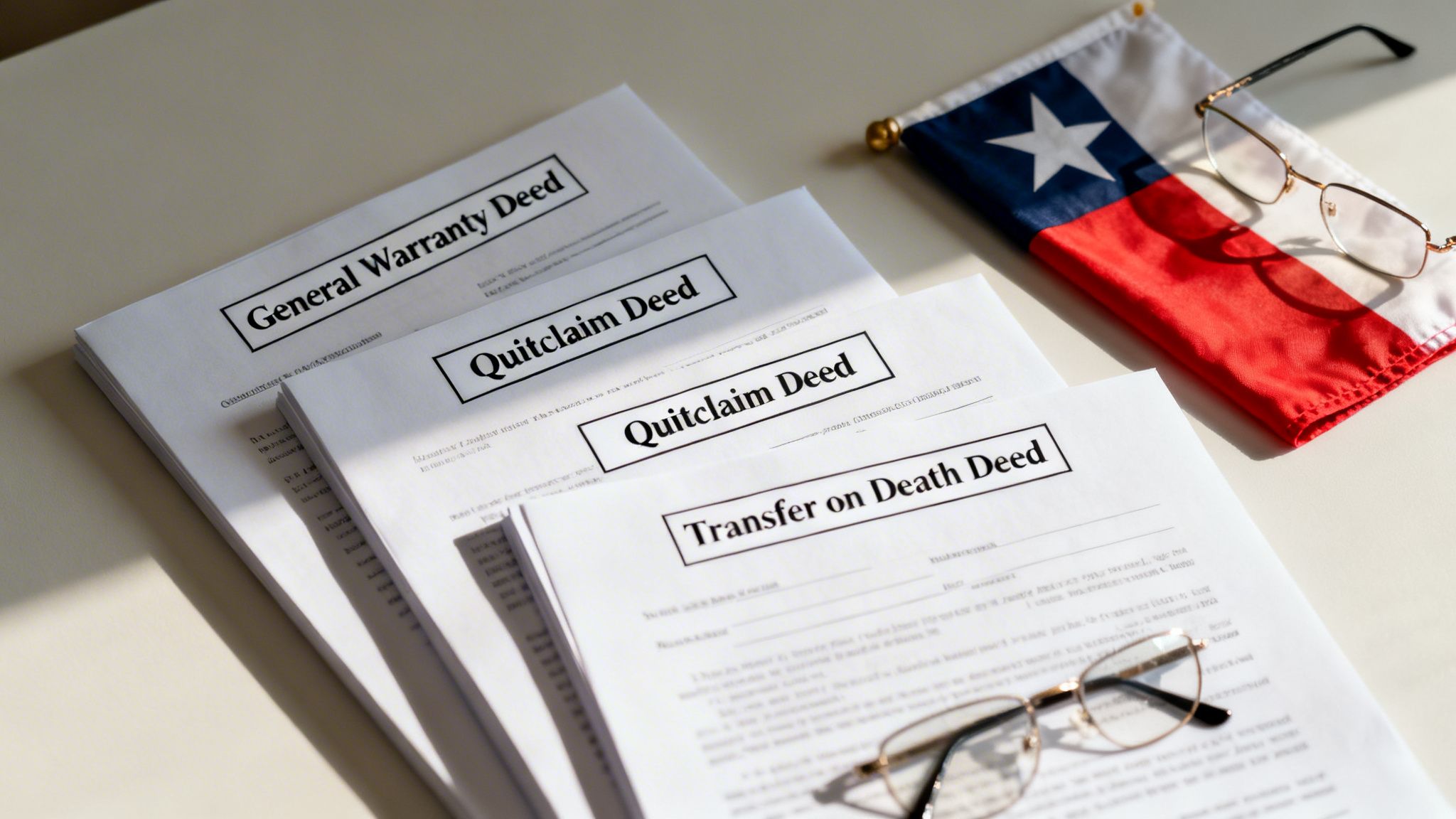
- General Warranty Deed: This is the gold standard and offers the highest level of protection to the new owner. As the grantor, you’re guaranteeing the title is clean and free of defects throughout the property's entire history—not just during your ownership. This is the standard for almost all traditional real estate sales because it gives the buyer maximum confidence.
- Special Warranty Deed: This deed offers a more limited promise. Here, you only guarantee that you haven't done anything to create a title problem during your period of ownership. You’re not making any promises about what might have happened before you came along. These are common in commercial deals or when an executor transfers property from an estate, as they can’t vouch for the property's distant past. This is consistent with an executor’s duties under the Texas Estates Code.
- Deed Without Warranty: This is often misunderstood and sometimes called a "quitclaim" in other states. In Texas, a Deed Without Warranty transfers whatever interest you have—if any—with absolutely no guarantees. It's like saying, "I'm giving you whatever piece of this property I own, but I'm not promising I own anything at all." These are best used to clear up title issues or for transfers between family members where trust is high.
- Transfer on Death Deed (TODD): A powerful estate planning tool authorized under Chapter 114 of the Texas Estates Code, a TODD lets you name a beneficiary who will automatically receive the property when you die, completely bypassing the Texas probate process. You keep full control of the property during your life and can change or revoke the TODD anytime.
Quick Guide to Texas Property Deeds
Use this table to quickly compare the most common deeds in Texas and understand which might be right for your situation.
| Deed Type | Level of Protection | Common Use Case | Key Takeaway |
|---|---|---|---|
| General Warranty Deed | Highest | Traditional home sales to a third party. | The grantor promises a clear title for the property's entire history. |
| Special Warranty Deed | Limited | Commercial transactions; sales from an estate or trust. | The grantor only promises a clear title during their ownership period. |
| Deed Without Warranty | None | Gifting property to family; clearing up title clouds. | The grantor transfers their interest without making any promises or guarantees. |
| Transfer on Death Deed | N/A (Estate Planning) | Passing property to a beneficiary outside of probate. | Allows automatic transfer upon death while the owner retains full control during life. |
Ultimately, the words used in the deed—like "warrant and defend" versus "quitclaim"—create binding legal obligations. Always match the deed to the nature of the transaction. You can learn more about the common types of Texas property deeds and their implications in our detailed guide.
Key Insight
Choosing the right deed is a critical act of due diligence. A General Warranty Deed offers maximum protection for a buyer in a sale. A Special Warranty Deed is often appropriate for executors who can only vouch for the title during the estate’s administration. For simple family gifts, a Deed Without Warranty may suffice. And for proactive estate planning, a Transfer on Death Deed can be a powerful tool to avoid probate.
The Anatomy of a Legally Sound Texas Deed
A simple mistake on a property deed can unleash a world of legal trouble years down the line. While different types of deeds offer varying levels of protection, every single one must contain specific, non-negotiable elements to be legally valid under the Texas Property Code. Think of it like a recipe—miss one ingredient, and the whole dish is ruined.
Getting the deed right from the very beginning is about more than just checking boxes; it's about securing peace of mind and protecting your family’s most valuable assets. Whether you're gifting a house to your kids or transferring land from an estate, every word matters.
Step 1: Clearly Identifying the Parties (Grantor and Grantee)
First things first, a deed must clearly name who is giving the property and who is receiving it.
- The Grantor: This is the person or entity currently on title and transferring the property. Their name must be spelled exactly as it appears on the current deed or title record. No nicknames, no shortcuts.
- The Grantee: This is the person or entity who will become the new owner. Use their full legal name to eliminate any confusion about who now holds the title.
Even a seemingly minor error, like using "Bill" instead of "William" or misspelling a last name, can create a “cloud on the title.” This is a legal red flag that complicates future sales and can cause major headaches during estate settlement.
Step 2: Stating the Consideration and Granting Clause
For a deed to actually transfer property, it needs two critical pieces of language: the "consideration" and the "granting clause."
Consideration is the legal term for what the Grantor receives in exchange for the property. In a typical sale, this is the purchase price. But for family transfers or estate planning, you'll often see phrases like "for ten dollars and other good and valuable consideration" or simply "for love and affection." This nominal language satisfies the legal requirement without putting sensitive financial details into a public record.
The granting clause contains the magic words that do the heavy lifting, such as "grant, sell, and convey." The exact phrasing is crucial because it ties directly to the type of deed being used and the level of warranty—or promises—being made.
Step 3: Providing an Accurate Legal Description (Not the Street Address)
This is, without a doubt, one of the most common and disastrous mistakes we see. A street address is for delivering mail and finding your way with GPS. It is not a legal definition of a property’s boundaries.
Every valid Texas deed must include a precise legal description.
You can usually pull this word-for-word from a previous deed, a formal property survey, or the county's official property records. It will look something like this: "Lot 5, Block B, of the Shady Acres Subdivision, an addition to the City of Houston, Harris County, Texas, according to the map or plat thereof recorded in Volume 123, Page 45 of the Map Records of Harris County, Texas."
Step 4: Accounting for Community Property and Homestead Rights
Because Texas is a community property state, another layer of complexity gets added to any property transfer. Generally, any property acquired during a marriage is considered owned by both spouses.
Even more importantly, if the property is the couple’s primary residence—their homestead—Texas law requires both spouses to sign the deed to sell or transfer it. This is true even if the house is technically one spouse's separate property (owned before the marriage or received as a gift or inheritance).
Failing to get both signatures on a deed for a homestead property renders the transfer completely void. This is a powerful protection built into Texas law, designed to prevent one spouse from selling the family home out from under the other.
Realistic Scenario: The Flawed Description
I once worked with a family where a father, Robert, wanted to give a piece of his rural land to his daughter, Emily. He wrote up a deed himself, stating he was giving her "the five acres at the back of my property." They both signed it in front of a notary and dutifully filed it with the county.
Years later, after Robert passed away, his estate entered the Texas probate process. That's when the trouble started. Emily’s brother challenged the deed, arguing that "the five acres at the back" was hopelessly vague. Which five acres? Where did they start and end? The court had no choice but to agree. The deed was declared unenforceable, and the land fell back into Robert's estate to be split among all his heirs—the exact opposite of what he had intended. This situation could have been entirely avoided with a proper legal description.
How to Prepare and Execute Your Property Deed
You’ve picked the right deed and understand the core elements required by Texas law. Now comes the critical part: turning that plan into a legally sound document. This is where your intentions get locked into ink and paper, creating a formal transfer of ownership. Getting the preparation, signing, and notarization right is non-negotiable if you want the deed to hold up.
A common question we hear is whether a fill-in-the-blank deed from an office supply store or website is good enough. For the absolute simplest transfers—say, a parent gifting a paid-off property to their only child—it might work. But these one-size-fits-all forms are often a recipe for disaster in more complex family situations, especially when estate planning or the Texas Probate Process is involved.
When You Need an Attorney to Draft the Deed
There are several scenarios where a boilerplate form just won't cut it, and you absolutely need an attorney to draft a custom deed. For example, if you're transferring property to several people with unequal ownership stakes, reserving a life estate, leaving property to a minor who needs a Guardianship or trust, or if the property has any existing liens or mortgages.
An experienced real estate or probate attorney can craft language that precisely matches your goals, shields you from unintended liability, and helps head off future family fights or even messy Probate Litigation. Spending a little on professional guidance now is far cheaper than trying to fix a botched deed down the road. Our team specializes in helping families with Wills & Trusts and all aspects of property transfer.
The Signing and Notarization Procedure
Under Texas law, the grantor—the person giving the property away—is the one who must sign the deed. And this isn't something you can do casually. The signing has to happen in the presence of a notary public.
It’s crucial to understand the notary's role here. They aren't there to give legal advice or double-check the deed's contents for accuracy.
A notary’s job is strictly to:
- Verify the identity of the signer.
- Witness the actual signature.
- Complete the "acknowledgment" section with their official seal and signature to certify the signing was done properly.
This formal step is called "execution," and it’s what makes the deed authentic. The grantee, the person receiving the property, does not have to sign the deed for it to be valid in Texas.
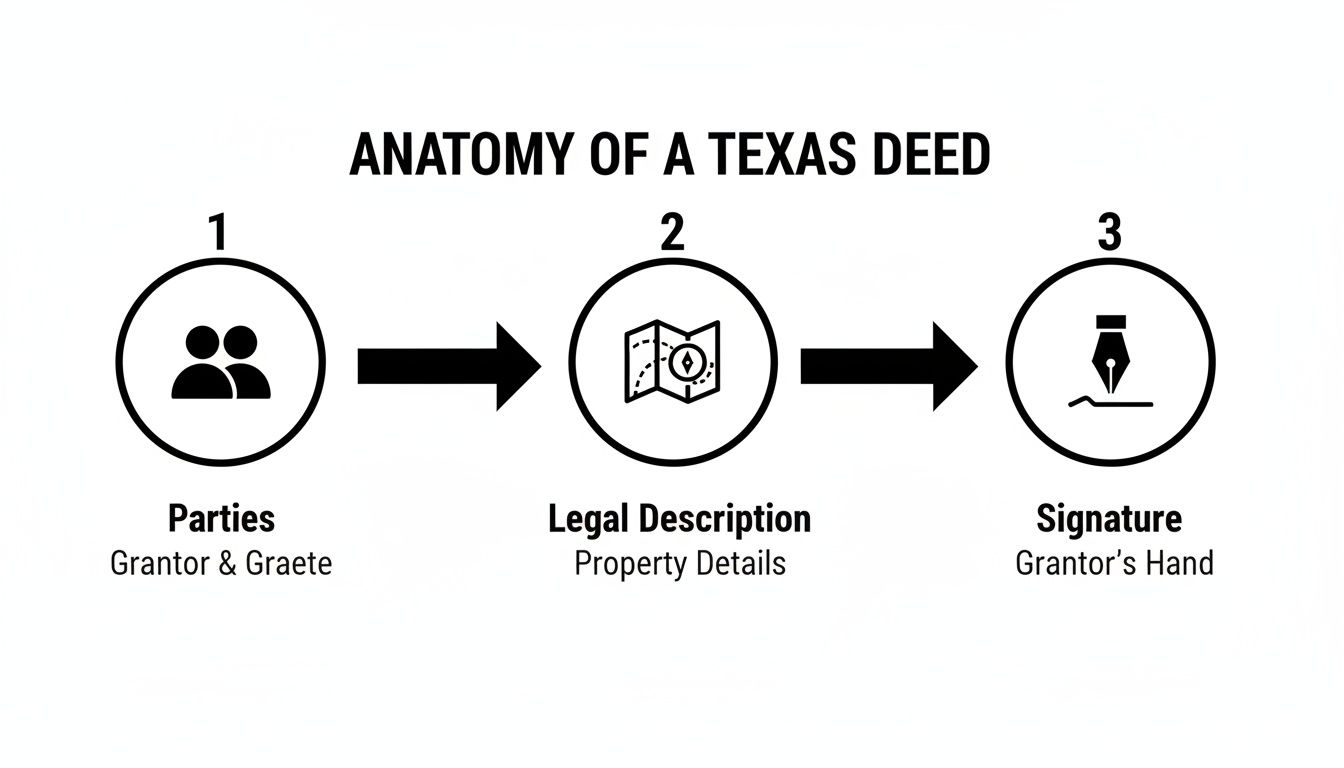
As you can see, identifying the parties, defining the property, and executing the signature are the three pillars that hold up a valid Texas deed.
Realistic Scenario: The Lake House Transfer
Let’s look at a real-life example we handled for the Henderson family. Mark and Susan, the parents, wanted to give their beloved lake house to their two adult children, Jessica and Ben, while they were still living. They came to our office for guidance.
Here's the step-by-step process we followed:
- Consultation: We discussed their goals. They wanted an equal transfer to both children and understood they could no longer make decisions about the property once deeded.
- Deed Selection: We recommended a Deed Without Warranty because it was a gift between trusted family members, and the parents did not need to provide a full warranty.
- Drafting: Our team drafted a custom deed that:
- Named Mark and Susan Henderson as grantors.
- Named Jessica Henderson and Ben Henderson as grantees, "as tenants in common," to legally establish their 50% individual shares.
- Included the complete, official legal description from their original purchase deed.
- Stated the consideration as "for love and affection."
- Execution: The family met at a bank with a notary. Mark and Susan presented their IDs, signed the deed in the notary's presence, and the notary completed the acknowledgment. Mark then handed the original, signed deed to his children. At that moment, the transfer was legally complete, bringing the family peace of mind.
Recording Your Deed to Protect Your Ownership

You’ve got a perfectly drafted deed, signed and notarized, sitting in your hands. At this moment, the transfer is legally valid between the grantor (the seller or giver) and the grantee (the new owner). But to protect that new owner from the claims of everyone else in the world, one final, non-negotiable step remains: recording the deed.
Failing to record a deed is like buying a car and leaving the title in the glove box instead of registering it with the state. Sure, you have the keys and the car, but your ownership isn't officially recognized or protected against outside claims. Recording your deed is what makes the transfer public record, permanent, and legally binding against third parties.
Why Recording a Deed Is So Important
Recording is simply the act of filing your executed deed with the county clerk's office in the county where the property is located. This single action accomplishes several critical goals that we’ve seen save families from immense legal headaches down the road.
- It Puts the World on Notice. Once recorded, your deed becomes part of the public record. This is crucial because it prevents the previous owner from fraudulently trying to sell or mortgage the same property to someone else.
- It Cements the "Chain of Title." The county clerk maintains a chronological history of a property's ownership. A recorded deed firmly places the new owner in this chain, providing a clear and traceable line of ownership for any future sale, refinance, or probate matter.
- It Shields the New Owner's Rights. An unrecorded deed is dangerously vulnerable. If a creditor of the previous owner places a lien on the property, they could have a stronger claim than the new owner if the deed isn't officially on file.
For an executor managing an estate, a recorded deed serves as undeniable proof that an asset was properly distributed according to a will or court order, fulfilling a key duty in the Texas Probate Process.
The Step-by-Step Process of Filing Your Deed
Filing a deed is a straightforward process, but it requires careful attention to the specific county's rules. You absolutely must file the deed in the county where the property physically sits. If a property happens to straddle two counties, it must be recorded in both.
Here’s the general breakdown of what to expect:
- Find the Right Office: A quick search for "[County Name] County Clerk Real Property Records" will usually give you the correct address, hours, and contact information.
- Submit the Original Deed: You must present the original, signed, and notarized deed. Copies are not accepted.
- Pay the Filing Fee: Each county sets its own fee schedule. It's typically a base fee for the first page and a smaller fee for each additional page. You can almost always find this information on the clerk’s website.
- Receive the Recorded Document: The clerk’s office will stamp the deed with a recording date and a unique document or instrument number. They will scan it into their system and then mail the original back to you or the designated recipient. This can take a few weeks.
This official recording cements the ownership transfer into the state's historical and legal records. Tracing these Texas property deeds can even unveil fascinating settlement patterns. The Texas General Land Office archives, for instance, contain records from Stephen F. Austin's original 1821 colony, showcasing the deep historical roots of Texas land ownership.
Key Insight
Recording a deed isn't just administrative paperwork; it's the ultimate act of protecting ownership. It transforms a private agreement into a public fact, providing a legal shield against future disputes and securing the property's title for generations to come. Whether part of an estate plan involving Wills & Trusts or a transfer related to a Guardianship, this final step is essential to prevent potential Probate Litigation.
If you’re facing probate in Texas, our team can help guide you through every step — from filing to final distribution. Schedule your free consultation today.
Avoiding Common Pitfalls and Tax Surprises
Transferring a property deed in Texas feels like the final step, but it’s often just the beginning of a new set of financial realities. We’ve seen countless families focus so intently on the legal paperwork that they completely miss the financial landmines waiting for them.
With a bit of foresight, you can sidestep these costly surprises and make sure the transfer is a true gift, not a burden.
Let's start with the most common oversight: the "gift" that comes with a tax bill. While deeding property to a family member for free or a steep discount is a wonderful act of generosity, the IRS sees it as a taxable event. If the property's value is more than the annual federal gift tax exclusion, you’ll likely need to file a gift tax return.
The Property Tax Shock
Beyond federal taxes, the most immediate financial hit for the new owner often comes from local property taxes. This is a detail that trips up so many families, leading to a much higher annual tax bill than they ever anticipated.
When ownership changes, the county appraisal district reassesses the property’s value. More importantly, valuable tax breaks like the homestead exemption or the over-65/senior exemption don't just tag along with the deed. They belong to the previous owner and vanish upon transfer.
The new owner has to qualify and apply for these exemptions all over again. If they don’t, or if they simply don't qualify, their property tax bill can skyrocket. Losing a homestead exemption alone can add thousands of dollars to the annual tax burden.
You can read more in our detailed article on the connection between Texas property deeds and property taxes.
Mortgages and Liens: Debts That Don't Disappear
Another major pitfall is assuming the property's debts transfer with the title. Handing over a deed for a property with a mortgage doesn't automatically make the new owner responsible for the loan. The original owner—the grantor—is almost always still on the hook for that debt.
Even worse, most mortgages have a "due-on-sale" clause. This gives the lender the right to call the entire loan due the moment the property is transferred. While banks might not always enforce this for family transfers, it’s a massive risk you’re taking.
Liens are another complication. An unresolved issue, like a tax lien, can cloud the title and halt the transfer completely. Understanding the process for removing tax liens is a critical step in clearing the way for a clean transfer.
Protecting Your Eligibility for Government Benefits
For seniors and their families, a poorly timed property transfer can be devastating to their eligibility for benefits like Medicaid. Texas Medicaid has a strict five-year "look-back" period to scrutinize any assets transferred for less than their fair market value.
If you deed your home to a child for free within that five-year window, Medicaid will likely view it as an attempt to artificially lower your assets to qualify for aid. This can trigger a penalty period, leaving you ineligible for benefits for months or even years—often right when you need long-term care the most. Careful planning, sometimes using tools from our Wills & Trusts services, is absolutely essential to avoid this outcome.
Key Insight
A property transfer has significant financial ripple effects. Before deeding a property, always consider gift tax implications, the loss of property tax exemptions, the risk of a "due-on-sale" clause in a mortgage, and the potential impact on Medicaid eligibility. Proactive planning can prevent a generous gift from becoming an unintended financial burden on your loved ones.
Frequently Asked Questions About Texas Property Deeds
When it comes to handling property, especially in the context of estate planning or settling a loved one's affairs, a lot of questions come up. The world of Texas property deeds can feel overwhelming, but a little bit of knowledge goes a long way. We've gathered some of the most common questions our firm hears from Texas families to give you the clarity you need to make the right choices.
Is It Risky to Use a DIY Deed Form?
Using a generic, fill-in-the-blank deed from an office supply store or an online template is one of the biggest—and most common—mistakes we see. It might feel like a cheap and easy solution, but these forms are a minefield of potential errors. They rarely account for the nuances of Texas law, like community property rights, homestead protections, or the specific legal language required for different deed warranties.
A single mistake can be catastrophic. A flawed legal description, an improper vesting clause, or a failure to mention mineral rights could invalidate the entire deed. Fixing that botched deed almost always involves expensive legal work, and in some cases, it can spiral into full-blown Probate Litigation. The cost to correct the error will be far greater than what you would have spent to have an attorney draft it correctly from the start.
How Does a Mortgage Affect a Property Transfer?
This is a huge point of confusion. Deeding a property with a mortgage does not automatically transfer the loan to the new owner. The original borrower—the grantor—almost always remains on the hook for the payments.
Even more critical is the “due-on-sale” clause found in most mortgage agreements. This gives the lender the power to demand the entire remaining loan balance be paid in full the moment you transfer the property. While lenders might not always enforce this for transfers between close family members, it’s a massive risk. You could put both yourself and your loved one in a serious financial bind overnight. Always talk to the lender before deeding property that has a mortgage.
Property Transfer Now vs. Through a Will or Trust
Deciding whether to transfer property during your lifetime or leave it as part of your estate is a major decision, and there’s no one-size-fits-all answer. The right path depends entirely on your family, your finances, and your long-term goals.
Transferring Now (Lifetime Gift): Deeding property while you're alive gives the new owner immediate control. But it's not without consequences. This can trigger immediate gift tax issues and exposes the property to the new owner's potential problems, like creditors or a divorce. It can also create a tax headache for them down the road by affecting the property's tax basis, leading to higher capital gains taxes if they sell.
Transferring After Death (Will or Trust): Passing property through a Will or Trust lets you keep full control for your entire life. Your beneficiaries also get a major tax advantage: a "stepped-up" tax basis, where the property's value is adjusted to its fair market value at your death, wiping out potential capital gains. The trade-off is that a will has to go through the Texas Probate Process, and a trust can be more complex and costly to set up.
A Transfer on Death Deed (TODD) is a popular middle-ground option, letting the property pass directly to a beneficiary and bypass probate, but with the simplicity of a standard deed.
Can I Just Add My Child’s Name to My Deed?
This is another seemingly simple move that is loaded with risk. Adding your child's name to your deed effectively creates a form of joint ownership and makes them a legal owner right now.
Once their name is on that deed, you’ve just given away a portion of your property. That means your home is now vulnerable to their financial troubles. If they get divorced, are sued, or file for bankruptcy, your property is on the line. You also lose sole control—you can’t sell or refinance without their signature. It can even lead to a Guardianship proceeding if your child becomes incapacitated and unable to sign documents.
If you’re facing probate in Texas, our team can help guide you through every step — from filing to final distribution. Schedule your free consultation today.