Losing a loved one is hard enough; navigating the legal system shouldn't add to your family's burden. One of the first, and most critical, decisions you'll face is where to file the probate case. In legal terms, this is called "venue," and getting it right from the start is essential for a smooth process.
Choosing the correct venue for a probate case in Texas isn't just a suggestion—it's a mandatory requirement under the Texas Estates Code. Filing in the wrong county can derail the entire process, leading to major delays, higher legal fees, and a mountain of unnecessary stress for your family.
This guide is here to cut through the legal jargon and break down the rules in plain English, helping you pinpoint the right county for your probate matter with confidence and peace of mind.
Why The Right County Matters for Texas Probate
When you're grieving, the last thing you need is a legal misstep forcing you to start over. The concept of "venue" simply means the specific county where the case must be filed. In Texas probate, this isn't a matter of convenience; it’s a strict rule set by law to ensure a fair and orderly process.
The Legal Foundation of Probate Venue
The Texas Estates Code (specifically Title 2, Subtitle C, Chapter 33) lays out a clear hierarchy for where an estate administration must begin. The law is designed to be predictable, creating a clear pecking order for determining which county has the legal authority to handle the case.
As you'll see, the primary rule almost always points to the county where the deceased person was domiciled—their true, fixed, and permanent home.
The decision tree below helps visualize the exact questions a Texas court will ask to figure out the proper venue for a probate case.
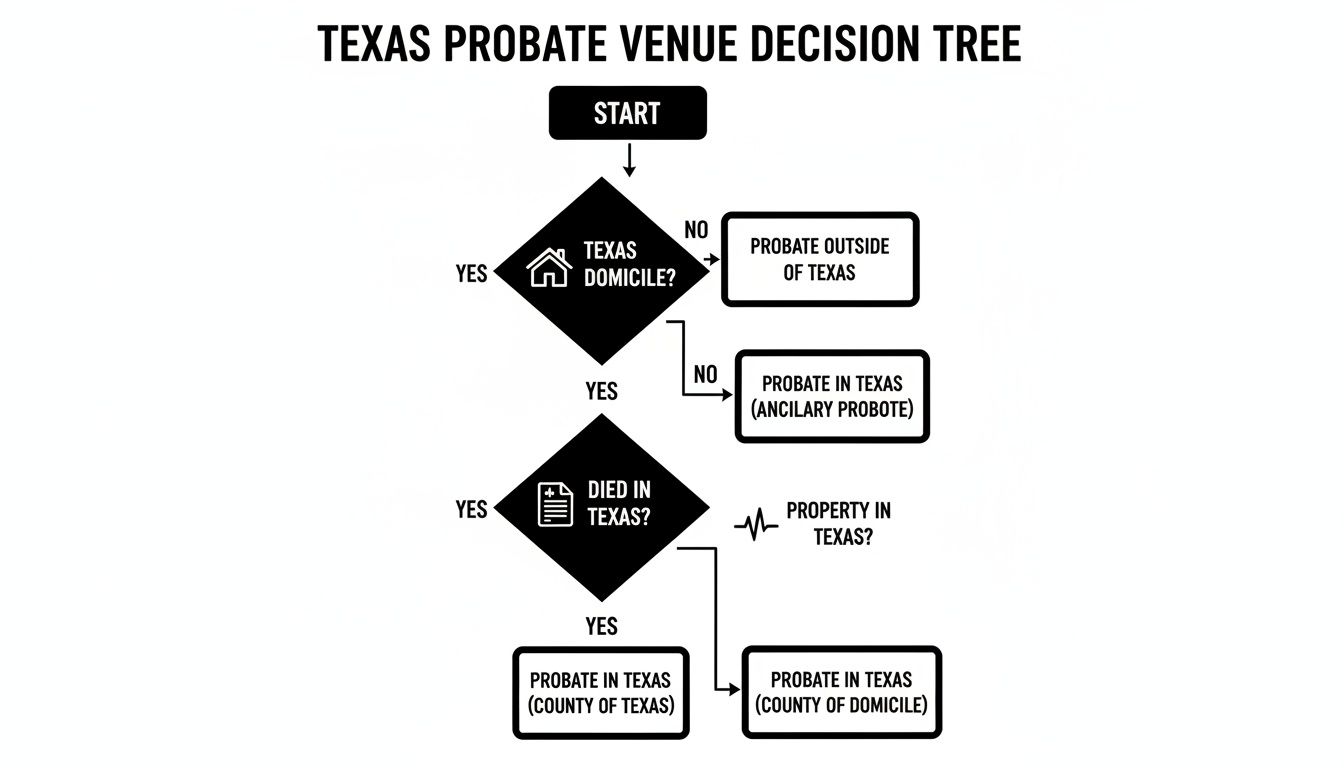
As the flowchart shows, the decedent's domicile is the first and most important factor. Only when the person didn't have a domicile in Texas do the place of death and location of property come into play.
To make this even clearer, here's a quick summary of the priority order the court follows.
Texas Probate Venue Hierarchy at a Glance
| Priority | Rule | Applies When… |
|---|---|---|
| 1st | County of Domicile | The decedent had a fixed and permanent home in a Texas county at the time of death. This is the most common and primary rule. |
| 2nd | County of Death | The decedent did not have a Texas domicile but died in a Texas county and owned property here. |
| 3rd | County of Principal Assets | The decedent died outside of Texas and had no Texas domicile, but owned property in a specific Texas county. The case is filed where the main assets are. |
| 4th | County Where Applicant Resides | This is rare. It applies if a non-resident decedent died outside of Texas with no property here, but an heir (the applicant) lives in Texas. |
This table shows just how much weight the law gives to the decedent's true home. Everything else is a fallback.
Consequences of Filing in the Wrong County
So, what happens if you get it wrong and file in the wrong county? The case won't just get moved automatically. Instead, another heir, a creditor, or any other interested party can challenge it. If they succeed, the court could dismiss your case entirely.
This means you’d be forced to start the whole process from scratch in the correct county.
A simple mistake like this can lead to:
- Wasted Time: Weeks or even months can be lost, delaying the distribution of assets to grieving family members.
- Increased Costs: You could end up paying court filing fees and legal expenses twice for the same estate.
- Added Stress: Starting over piles a significant emotional and administrative burden on the family at the worst possible time.
Understanding which Texas courts deal with probate matters is the first step, but identifying the correct county is what sets the stage for success. By correctly determining the venue from day one, you ensure the probate process starts on solid legal ground and paves the way for a smoother, more efficient administration of your loved one’s estate.
The Primary Rule: Domicile in Texas
When you're starting the probate process in Texas, the very first question you need to answer is, "Where do we file?" The entire legal journey hinges on getting this right, and in Texas, the answer almost always comes down to a single, critical concept: domicile.
This isn't just about where your loved one had a house or an apartment. Domicile is a legal term for a person's true, fixed, and permanent home—the place they always intended to return to, no matter where they were temporarily staying.

A person can have several residences, but they only have one domicile. The Texas Estates Code Section 33.001 is crystal clear on this. The county where the decedent was domiciled at the time of their death is the proper venue for the probate case. This rule trumps everything else, including where they passed away or where they owned a second home.
Proving Domicile: What Courts Look For
So, how do you prove something as personal as "intent"? It's not about what someone said over dinner one night; it's about the paper trail and the actions they took during their life. Judges look at the "totality of the evidence" to piece together the story.
Here is a realistic scenario: a retired couple spends half the year enjoying the warmth of their South Padre Island condo but returns to their lifelong home in a Dallas suburb for the other six months. They kept their Dallas County voter registration, their driver's licenses list their Dallas address, and their main bank accounts are there.
Despite spending a huge amount of time on the coast, their actions consistently point back to Dallas as their permanent home base. In a probate case, Dallas County is the correct venue. The court will look for hard, objective evidence like:
- Where the person was registered to vote
- The address on their driver’s license or state ID card
- The address used for filing federal income tax returns
- Any declarations of homestead filed for property tax breaks
- Statements made in other legal documents, like their will or a trust
Takeaway: Domicile is about intent backed by action. It’s the place a person treated as their permanent home, proven by their legal, financial, and personal ties. A temporary or seasonal residence, even one used for years, doesn't automatically change a person’s domicile.
The Domicile Rule in Practice
This focus on domicile isn't arbitrary. It ensures the estate is handled in the community where the person had their deepest roots. It’s also where most of the evidence, witnesses, and other interested parties are likely to be found. This legal principle creates a predictable starting point for every probate case, cutting down on arguments over which court has authority.
Even if you, the person applying for probate, live in another state, the decedent's Texas domicile is what matters. Correctly identifying it is the first and most important step. For more on this, you can learn about whether a probate applicant must be a resident of Texas in our detailed guide.
Getting the venue right from the start prevents your case from being challenged or dismissed, which would mean wasting time and money to start all over again in the correct county. Understanding the power of the domicile rule gives you the confidence to begin the probate journey on solid legal ground.
Where to File When There Is No Texas Domicile
Figuring out the right county for a probate case can get tricky when your loved one didn't have a permanent home, or domicile, in Texas. It’s a common source of confusion for families, but thankfully, the Texas Estates Code lays out a surprisingly logical roadmap for these exact situations.
Think of it as a clear set of backup rules. The law establishes a priority list, so you only move to the next option if the one before it doesn’t apply. This prevents chaos and gives families a predictable path forward, even when an estate spans multiple states.
What if They Died in Texas?
Let's start with the first possibility. Your loved one wasn't a Texas resident, but they passed away while physically inside the state. When this happens, Texas law gives you a choice between two equally valid counties to file the probate case.
Under Texas Estates Code Section 33.001(b), the application for probate can be filed in either:
- The county where the decedent's principal property was located at the time of their death.
- The county where they actually died.
This flexibility is designed to be practical. Imagine a resident of Oklahoma who owns a beloved vacation home in Galveston County. They travel to Austin for a business trip and tragically pass away there. Their family could properly file for probate in either Galveston County, where the main Texas asset is, or Travis County, where the death occurred.
This choice allows the family to pick the courthouse that makes the most sense for them, whether that's closer to the property they need to manage or more convenient for handling other administrative tasks.
Key Insight: When a non-resident dies in Texas, the law gives you a choice. You can file for probate where their main Texas property is or where they died. This flexibility is designed to make a difficult process a bit more manageable for grieving families.
What if They Died Outside of Texas?
The rules shift slightly if the person wasn't a Texas resident and also died outside of the state. If they still owned property here, the answer is straightforward: the case belongs in the Texas county where their principal assets are located. No other option is available.
To help you navigate these choices, here’s a quick comparison of your options when the deceased was not a Texas resident.
Comparing Venue Options When No Texas Domicile Exists
| Situation | Primary Venue Option | Secondary Venue Option |
|---|---|---|
| Died in Texas with property here | County where principal property is located | County where the person died |
| Died outside of Texas with property here | County where principal property is located | N/A |
| Died outside of Texas with no property here | County where the nearest of kin resides | N/A |
This table highlights the clear, prioritized system the law provides. The goal is to always find a logical connection to a specific Texas county.
But what about a truly rare scenario? What if the person had no Texas domicile, died out-of-state, and owned no property here at all? The law has a final backstop for this, too. Venue is proper in the Texas county where the decedent’s nearest of kin resides. This ensures there's always a legitimate place to handle the estate's affairs within the state.
If you're dealing with an estate that involves real estate or other assets located in another state, you might also need to look into a separate process. You can learn more in our guide to ancillary probate in Texas. Getting the venue for a probate case in Texas right from the start is critical for any out-of-state family, as it prevents costly delays and jurisdictional headaches down the road.
Special Circumstances and Contesting Venue
Getting the venue right is the foundation of a smooth probate process. But what happens when things aren’t so simple? Sometimes family disagreements or convenience lead someone to file in the wrong county, turning a straightforward process into a legal battleground.
Even the so-called “simple” probate alternatives have to follow the same rules. A Muniment of Title, which is a great tool for transferring property when there are no debts, or a Small Estate Affidavit for estates under $75,000, must still be filed where the decedent was domiciled. Filing these in the wrong court completely wipes out their time and cost-saving advantages, pulling you right back into the legal mess you were trying to avoid.

But what happens when you know a case was filed in the wrong county—either by mistake or on purpose? You can’t just let it slide. You have to take formal legal action.
Challenging the Venue for a Probate Case in Texas
If an heir or another interested party files a probate application in the wrong county, you have to take formal legal action. You can’t simply call the clerk and ask them to move it. The correct procedure is to file a Motion to Transfer Venue.
This is a formal legal document filed with the court where the case was incorrectly opened, asking the judge to transfer the entire case to the court where it correctly belongs.
Under Texas law, you generally have two main grounds for demanding a transfer:
- Wrong County: This is the most common reason by far. You’re arguing that the county chosen for the filing is not the decedent’s true domicile or otherwise proper under the Texas Estates Code.
- Inability to Get a Fair Trial: This is rare and much harder to prove. In highly contentious cases, you might argue that local prejudice or the overwhelming influence of the other party makes it impossible to get an impartial hearing in that county.
The key here is that the burden of proof is on you—the person filing the motion. You need to present clear and convincing evidence to the judge that the case needs to be moved.
A Real-World Scenario: Contesting Venue
Let’s look at a situation we have seen play out before. A father lived his entire adult life in Collin County. He voted there, paid property taxes there, and all his friends and neighbors were there. After he passed away, his son, who lives down in Harris County, decided to file for probate in Houston for his own convenience.
The father’s daughter, who still lives in Collin County, immediately knew this was wrong. Her father’s life was in Collin County, not Houston.
To fix this, the daughter had to hire an attorney to file a Motion to Transfer Venue in the Harris County probate court. Her lawyer presented evidence like her father’s driver’s license, voter registration card, property tax statements, and even affidavits from neighbors—all proving that Collin County was his one and only home.
The judge agreed and transferred the case, but not before the family spent valuable time and thousands of dollars on a legal fight that should have never happened.
Takeaway: Challenging venue is a necessary tool, but it's a reactive one. This is why getting the venue for a probate case in Texas right from the start is so critical. A mistake, whether accidental or intentional, creates delays, jacks up legal fees, and often deepens family conflict during an already painful time.
It’s also crucial to understand that every court system is different. Harris County, for instance, has five incredibly busy statutory probate courts, each with its own local rules and procedures. Texas Estates Code Section 33.002 specifies that once a probate matter is pending in one of these statutory courts, that court has exclusive venue for any related lawsuits. Getting it wrong at the beginning can lock you into a court system that’s less convenient and potentially less favorable for your case.
Where Do We Go From Here? Your Next Steps
Figuring out where to file a probate case can feel like a puzzle, but by now, you should have a solid framework for finding the right Texas county. Getting the venue correct isn't just about convenience; it's a non-negotiable legal requirement that sets the stage for the entire estate administration.
Starting in the right courthouse from day one is the single best way to avoid expensive detours, unnecessary legal bills, and the kind of stress no family needs after a loss. This isn't just procedural—it's foundational.
Key Takeaway: If you remember nothing else, remember this: domicile is king. The law is built around the simple idea that a person's final affairs should be handled in the place they called home. Get this wrong, and you're looking at frustrating and costly delays.
A Practical Checklist for Pinning Down Venue
To move forward with confidence, you need to do a little homework. Arming yourself with the right documents will make it easy to apply the rules we've discussed and prove you're filing in the correct place.
Here’s a simple checklist to guide your information gathering:
Step 1: Round Up the Essential Paperwork:
- The Original Death Certificate: This is the non-negotiable starting point for any probate case.
- The Decedent’s Will: If there is a will, it might contain a declaration of their intended residence.
- Property Deeds and Titles: Gather deeds for any real estate they owned, especially property in Texas.
Step 2: Hunt for Proof of Domicile:
- Address History: Where did they actually live? Make a note of their primary residence and any other properties.
- Driver’s License & Voter Registration: These are powerful, official declarations of a person's legal home.
- Tax Returns: The address listed on a federal income tax return is compelling evidence of domicile.
Step 3: Consult with a Probate Attorney:
- Once you have this information, an experienced attorney can confirm the correct venue and guide you through the filing process.
Once you have this information in hand, you can confidently walk through the venue rules we’ve covered. This organized approach is critical whether you're navigating the full Texas Probate Process, establishing a Guardianship, or untangling complex Wills & Trusts. Being prepared is also your strongest defense against potential Probate Litigation.
Frequently Asked Questions About Texas Probate Venue
Even when you think you understand the rules for probate venue, real life always throws a curveball. The black-and-white text of the law can feel a world away from the messy reality of settling a loved one's affairs. Here are some plain-English answers to the questions we hear most often from families trying to find their footing.
What If My Parent Lived in a Nursing Home in a Different County?
This question comes up all the time, and it’s a great one. It’s natural to assume that if your mom spent her final years in a nursing home in Travis County, that’s where you should file for probate. But in the eyes of the law, that’s almost always incorrect.
The key legal concept here is domicile, which is all about intent. If your mother moved into that Travis County facility for care but always considered her house in Williamson County her true home, then Williamson County remains her domicile. The nursing home is just a temporary residence for medical reasons.
A court will look for proof of her intent. Did she keep her homestead exemption, voter registration, or driver’s license in Williamson County? If so, that’s where the probate belongs.
Can Our Family Agree to File for Probate in a More Convenient County?
It’s a perfectly logical question. If all the heirs live in the Houston area, why on earth would you want to handle probate in Fort Worth, where Dad lived? It would save everyone a ton of travel time and expense to just file it in Harris County.
Unfortunately, Texas law doesn’t work that way. The rules for choosing the venue for a probate case in Texas are a statutory mandate—a command from the legislature, not a suggestion. It’s not a matter of convenience or family agreement.
Filing in the wrong county just because it’s easier is a recipe for disaster. The case can be challenged, dismissed, and you’ll have to start all over again. That mistake will end up costing far more time and money than a few trips to Fort Worth ever would have.
Key Insight: Venue is dictated by law, not by family agreement. The Texas Estates Code sets strict rules to ensure fairness and legal order. Attempting to choose a more convenient county can backfire, leading to significant delays and legal costs.
My Parent Owned Property in Multiple Texas Counties—Where Do I File?
This is another common scenario that trips people up. Let’s say your father was domiciled in Dallas County. He also owned the family ranch in Llano County and a small rental property in Tarrant County. It feels confusing, but the answer is surprisingly simple.
You follow the number one rule: domicile. The probate case must be filed in Dallas County, where he had his permanent home.
The location of his other properties only comes into play if he did not have a domicile in Texas. If your father had lived in Oklahoma but owned those same three Texas properties, then you would file in the county where his "principal assets" were located. But because he was a Texas resident domiciled in Dallas, the other properties are irrelevant for picking the right courthouse.
Getting this right from the very beginning is critical. It all starts with domicile. Nail that down, and you’ll ensure the probate process starts on solid legal ground and avoids a costly do-over.
If you’re facing probate in Texas, our team can help guide you through every step — from filing to final distribution. Schedule your free consultation today.