Planning for the future is one of the most significant acts of love you can undertake for your family. When the topic of trusts and wills comes up, it's easy to feel overwhelmed by the legal terms. But at their core, these are simply powerful tools designed to protect your loved ones and ensure your wishes are honored, providing clarity and comfort during a difficult time.
Think of it this way: a will acts as an instruction manual for the court after you're gone, while a trust can manage your assets during your life and beyond, often avoiding court involvement entirely. This guide is here to offer plain-English explanations and step-by-step guidance to help you make the best choice for your Texas family.
Starting the Conversation About Your Legacy

Embarking on estate planning can feel like a monumental task, which may explain why so many families put it off. In fact, a recent comprehensive report found that while 83% of U.S. adults believe having an estate plan is important, a staggering 55% have no documents in place at all.
This gap often stems from common misconceptions about complexity and cost. You can discover more insights about these estate planning trends and how they affect families. At its heart, though, the goal is simple: create a clear plan that preserves family harmony and provides security during an emotional time. Thinking about these documents not as legal burdens but as acts of care can shift the entire perspective.
The Blueprint and the Safety Box Analogy
To get a better handle on these concepts, let's use a simple analogy:
A Last Will and Testament is your blueprint. It provides detailed instructions for a builder—in this case, the Texas probate court—on how to construct your legacy after you pass away. It spells out who gets what, names a guardian for your minor children, and appoints an executor to oversee the process. However, the construction (probate) must happen publicly through the court system.
A Living Trust is like a private safety deposit box. During your lifetime, you place your valuable assets (your home, bank accounts, investments) into this box. You still hold the key and can manage everything inside just as you did before. When you pass away, the person you've chosen as your successor trustee simply uses their key to distribute the contents according to your private instructions, completely bypassing the public court process.
This fundamental difference—public court supervision versus private administration—is often the deciding factor for Texas families choosing between the two. Both are essential tools for a comprehensive plan, which can also include a [Guardianship] designation.
Quick Comparison: Wills vs. Trusts at a Glance
To see these differences side-by-side, here’s a high-level summary of how a will and a trust stack up in Texas.
| Feature | Last Will and Testament | Living Trust |
|---|---|---|
| Primary Function | To provide instructions for the probate court on asset distribution after death. | To hold and manage assets during your lifetime and distribute them after death. |
| Court Involvement | Typically requires going through the public probate process. | Generally avoids probate for all assets properly funded into the trust. |
| Effective Date | Only becomes effective upon your death. | Becomes effective as soon as it is signed and funded. |
| Privacy | Becomes a public record once filed with the probate court. | Remains a private document, not filed with the court. |
While this table gives you a quick snapshot, the best choice for you depends entirely on your specific family situation, your assets, and your long-term goals.
How a Last Will and Testament Really Works in Texas
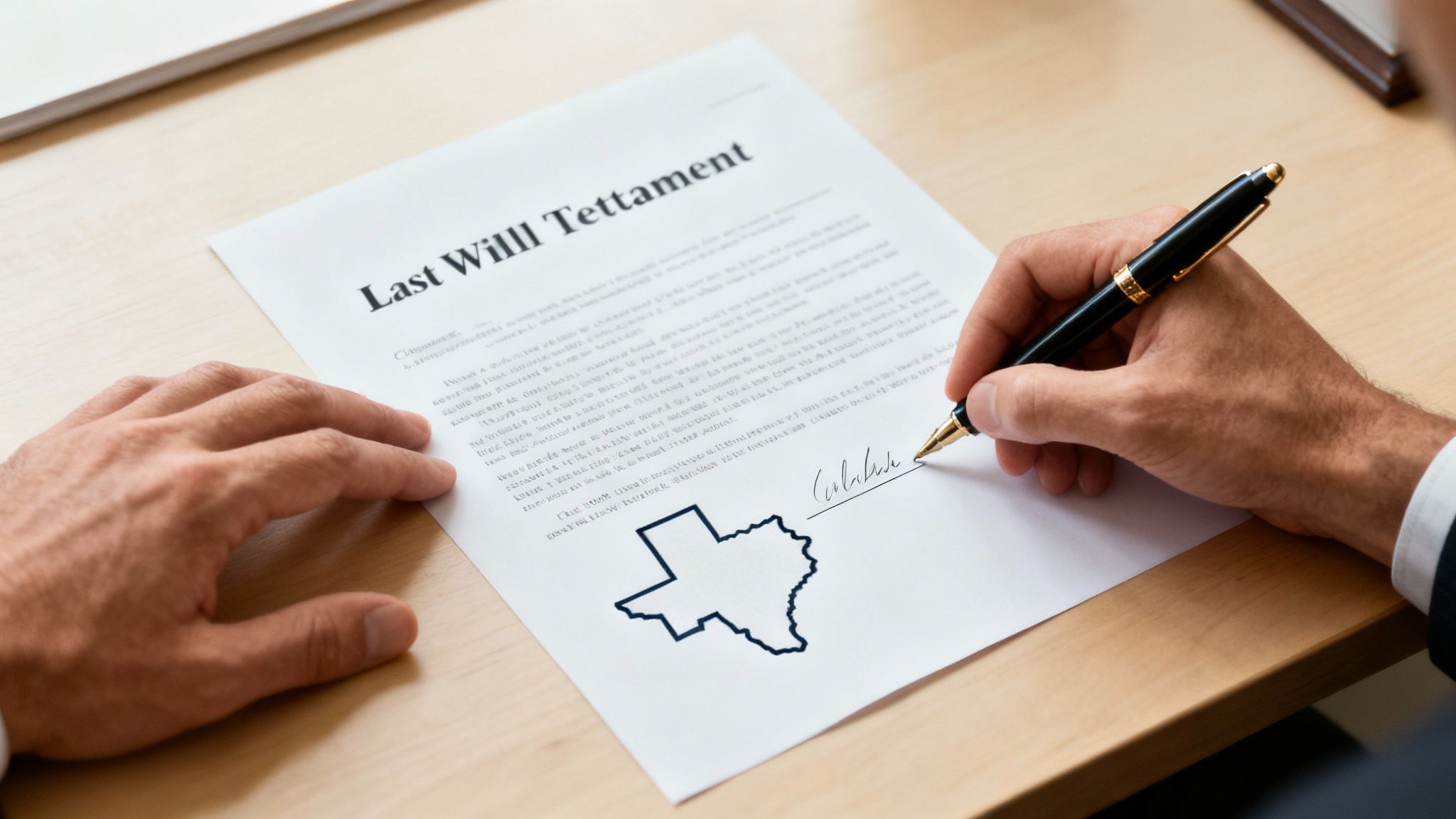
Many people get nervous when they hear the word "will," picturing a complex legal document full of traps. But in reality, a Last Will and Testament is much simpler than that. Think of it as your personal instruction book for the probate court. It’s a formal document that clearly communicates your final wishes after you’re gone, making sure your legacy is handled exactly the way you want.
What happens without one? Texas state law steps in and decides who inherits your property. That process, known as intestacy, almost never aligns with a person's actual desires. A will puts you firmly back in control, letting you direct your assets, protect your family, and provide clear guidance during an incredibly emotional time.
The Three Core Functions of a Texas Will
At its heart, a Texas will accomplishes three critical jobs. Each one is a pillar of a well-thought-out estate plan, giving security and clarity to the loved ones you leave behind. Understanding these roles helps demystify the entire process.
Designating Your Beneficiaries: This is the part everyone knows about. Your will precisely names who should receive your property—from your home and vehicles to your bank accounts and sentimental heirlooms. This level of detail prevents family arguments and ensures your assets go to the people and causes you care about most.
Appointing an Executor: Your executor is the person or institution you trust to carry out your will’s instructions. This individual is responsible for rounding up your assets, paying off any outstanding debts, and then distributing whatever is left to your beneficiaries. Choosing a responsible and trustworthy executor is one of the most vital decisions you'll make.
Naming a Guardian for Minor Children: For parents with young children, this is arguably the most important job a will can do. It allows you to formally name a guardian to care for your children if the unthinkable happens. Without this designation, the court will make this life-altering decision for you, likely without knowing your family dynamics or who you would have trusted.
Making Your Will Legally Binding in Texas
For a will to hold up in court, it can't just be a simple note. It has to meet specific legal standards. The Texas Estates Code, specifically Title 2, Subtitle C, outlines these requirements to prevent fraud and ensure the document truly reflects your intentions.
A valid Texas will must be in writing, signed by you (the testator), and attested to by two credible witnesses who are at least 14 years old. These witnesses must sign the will in your presence.
Failing to meet these technical requirements can give someone grounds to challenge your will in [Probate Litigation], or even have it thrown out by the court. This is why working with an experienced attorney is so important; they make sure every legal box is checked. To learn more, you can read our detailed guide on the importance of wills in Texas estate planning.
A Real-World Example: The Garcia Family's Story
Let's look at a realistic scenario. Mr. and Mrs. Garcia have two young children and a modest home. They created a simple will that named Mrs. Garcia's sister as the guardian for their children, ensuring they would be raised by a loving family member who shares their values.
Their will also appointed their most financially responsible cousin as the executor. It clearly stated that their home should be sold and the proceeds, along with their savings, be placed into a trust to fund the children's education and future.
By taking these steps, the Garcias created a clear, legally sound plan that protects their children’s future and heads off potential family disagreements over guardianship or money. Their will serves as a final act of love and protection.
Understanding the Protective Power of a Trust
When most people hear the word "trust," they picture vast family fortunes and sprawling estates. But for modern Texas families, that couldn't be further from the truth. Trusts are flexible, powerful, and surprisingly common tools for protecting your assets and your loved ones, offering a level of control and privacy that a Last Will and Testament simply can't match.
Think of a trust as a financial safety deposit box with a detailed rulebook that you write yourself. During your lifetime, you place your most important assets—your house, bank accounts, investments—inside this protective box. You still hold the key, meaning you can manage, use, and even sell these assets just as you did before.
The magic happens after you’re gone. Instead of sending your family to court, the person you named as your successor trustee simply uses their key to open the box and distribute the contents according to your private instructions.
Revocable vs. Irrevocable Trusts
In Texas, trusts generally come in two primary flavors, and understanding the difference is crucial for any estate plan.
Revocable Living Trust: This is the workhorse of modern estate planning. It’s flexible—you can change it, add or remove assets, or even cancel it entirely at any time while you are capable. It offers no creditor protection during your life but is primarily designed to keep your family out of probate court.
Irrevocable Trust: This one is a bit more permanent. Once you create this type of trust and place assets inside, you generally cannot change or revoke it. In exchange for giving up that control, an irrevocable trust can offer significant benefits, like protecting assets from creditors or helping with Medicaid planning.
For most families focused on streamlining things for their heirs, the revocable living trust is the go-to instrument. It provides the perfect balance of control during your lifetime and efficiency after your death. You can learn much more about why to set up a trust in our detailed guide.
The Greatest Benefit: Avoiding Probate
The single most significant advantage of a properly funded living trust is its ability to bypass the Texas probate process entirely. A will is essentially a ticket to probate court; a trust is designed to keep your family out of it.
By avoiding probate, a trust ensures your estate administration remains a private family matter, not a public record. This process saves your loved ones considerable time, reduces legal costs, and removes a major source of stress during an already difficult period of grieving.
While a will becomes a public document for anyone to read once it's filed, the terms of your trust remain confidential. This privacy is invaluable for families who prefer to keep their financial affairs and final wishes out of the public eye.
More Than Just Avoiding Court
Beyond privacy, a trust gives you unmatched control over your legacy. A will typically distributes assets outright to your beneficiaries. But what if you want to provide for a loved one with special needs without jeopardizing their government benefits? Or what if you want to ensure your children receive their inheritance in stages—say, at ages 25, 30, and 35—instead of all at once?
A trust allows you to build these specific conditions right into the document. You can set up guidelines for how the money should be used—for education, a down payment on a home, or starting a business—ensuring your assets support your beneficiaries exactly the way you intended, long after you are gone.
Interestingly, estate planning practices vary widely across the country. Data shows that 17% of residents in the Western U.S. have a trust, the highest rate in the nation. It also reveals that men are slightly more likely to have trusts than women (15% vs. 9%), highlighting different approaches to financial planning. You can explore the full report on these demographic breakdowns in estate planning. This shows that choosing between [Wills & Trusts] is a personal decision influenced by many factors.
Navigating the Texas Probate Process
The real, practical difference between a will and a trust snaps into sharp focus the moment a family has to settle an estate. With a will, you’re looking at a formal, court-supervised journey called probate. But with a properly funded living trust, the path is entirely different—it’s a private and often much faster way to get assets into the hands of your loved ones.
For many grieving families, the probate process feels like an unexpected and heavy burden. It’s a public affair, which means the will and a full inventory of the estate’s assets become public records for anyone to see. This can add a layer of stress during an already emotional time, turning a private family matter into a public proceeding.
The Probate Journey with a Will
When an estate is guided by a will, it has to travel through the Texas probate courts to be legally settled. While every family's situation is unique, the journey generally follows a predictable set of steps laid out in the Texas Estates Code, Title 2. This court oversight is there for a reason: to make sure the will is valid and that the executor follows its instructions to the letter.
Here’s a simplified, step-by-step look at what families can generally expect from the [Texas Probate Process]:
- Filing the Will: The process kicks off when the person named as executor files an application to probate the will in the correct county court.
- Validating the Will: The court holds a hearing to legally recognize the will as the deceased's true final testament, confirming it meets all of Texas's legal requirements.
- Appointing the Executor: The court officially appoints the executor and grants them a document called "Letters Testamentary." This is the golden ticket that gives the executor the legal authority to act for the estate.
- Notifying Creditors: The executor is required to publish a notice to any potential creditors, giving them a specific window of time to file claims against the estate.
- Inventorying Assets & Paying Debts: The executor’s next job is to gather all the estate’s assets, create a detailed inventory for the court, and use estate funds to pay off any valid debts, taxes, and final expenses.
- Distributing the Estate: Only after all those obligations are met can the executor finally distribute the remaining assets to the beneficiaries named in the will.
The Trust Alternative: A Private Path Forward
In stark contrast, any assets held inside a properly funded living trust completely sidestep this court-supervised ordeal. Because the trust—a separate legal entity—already owns the assets, there’s nothing for the probate court to administer. The successor trustee you appointed simply steps in and manages or distributes the assets according to the private instructions you left behind in the trust document. No court, no public record, no fuss.
This is where the core benefits of a trust really shine: privacy, control, and avoiding the public court system altogether.
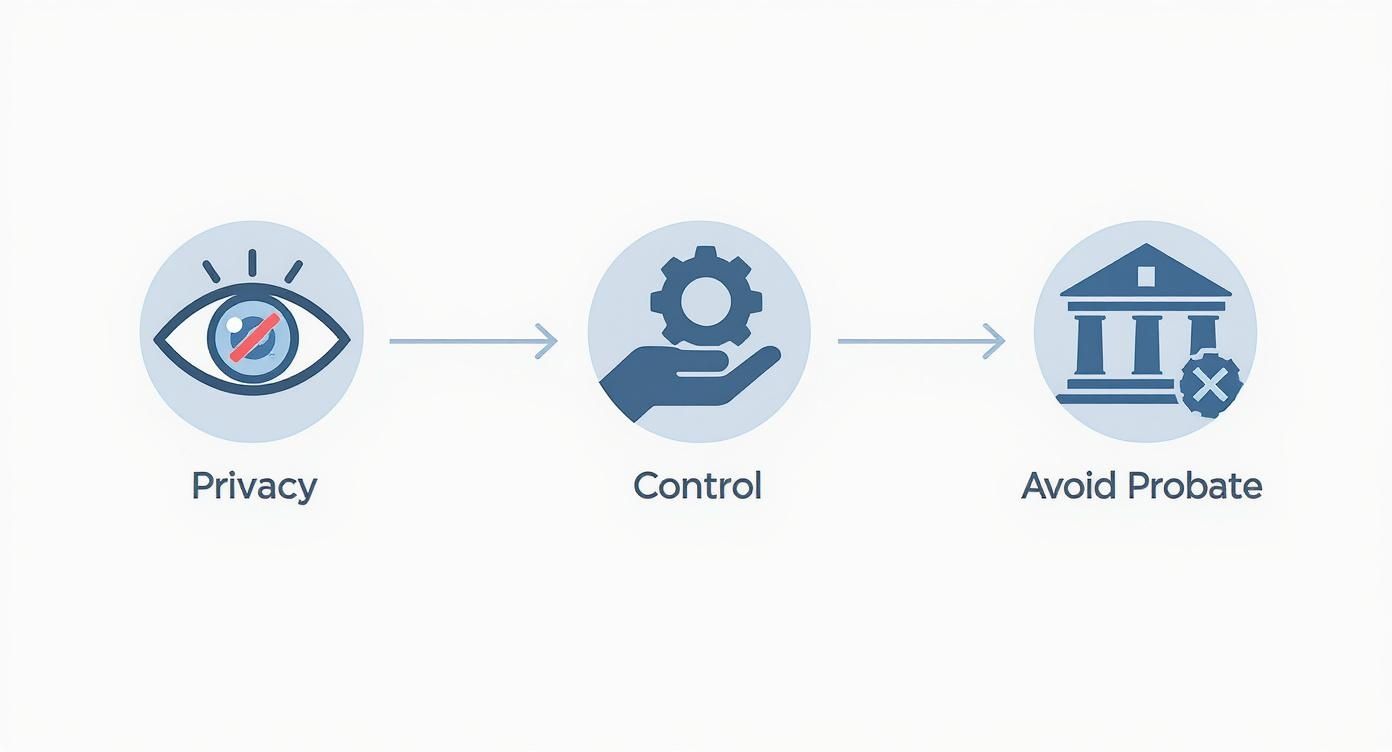
As you can see, the key advantages are all about maintaining privacy, keeping control over how and when assets are distributed, and completely avoiding the probate process.
Asset Distribution: Wills vs. Living Trusts in Texas
This table shows what happens to an asset after you pass away, depending on whether it's governed by a will or held in a funded living trust. The difference in process, timing, and privacy is significant.
| Stage | Path with a Will | Path with a Funded Living Trust |
|---|---|---|
| Initial Action | Executor files the will with the probate court. Public notice is required. | Successor Trustee takes control according to the private trust document. No court filing needed. |
| Asset Control | Executor gains control only after court appointment ("Letters Testamentary"). This can take weeks or months. | Successor Trustee has immediate control of trust assets upon your incapacity or death. |
| Creditor Claims | A formal, court-monitored process for notifying and paying creditors is mandatory. | Trustee is responsible for paying valid debts, but it's a private administrative process. |
| Distribution Timeline | Assets cannot be distributed until the probate process is complete, often taking 9 to 18 months or longer. | Assets can often be distributed in a matter of weeks, depending on the complexity of the trust. |
| Privacy | The will, asset inventory, and beneficiary list become public record. | The entire process is private. The trust document and assets are not filed with any court. |
The takeaway is clear: a will directs assets through a public, court-driven system, while a trust allows for a private, streamlined administration managed by someone you chose.
This distinction is often the most compelling reason Texas families choose a trust-based plan. You can explore a deeper comparison of the probate process versus using a living trust in Texas to see which approach better aligns with your family’s goals. For families who put a premium on efficiency, privacy, and reducing stress on their heirs, the benefits of avoiding probate are immense.
Choosing the Right Estate Plan for Your Family
Deciding between a will and a trust isn’t about picking the “best” option—it’s about finding the right fit for your family, your assets, and your goals. There's no one-size-fits-all answer. The most effective estate plan is the one that mirrors your life and gives you real peace of mind.
To figure out what you need, it helps to toss aside a few common myths. The biggest one? That trusts are only for the super-wealthy. The truth is, a trust can be a practical tool for any Texas family looking to own real estate, provide for a blended family, or simply keep their affairs out of the public eye.
Questions to Guide Your Decision
The first step is to think through your priorities. Your answers to these questions will start to paint a clear picture of whether a will-based or trust-based plan makes more sense for you.
- Is avoiding the Texas probate process a major priority? If you want to spare your family the time, expense, and public nature of court proceedings, a living trust is almost always the stronger choice.
- Do you own real estate? Placing property like your home into a trust is one of the cleanest ways to ensure it passes to your heirs without getting tangled up in probate.
- Do you have minor children or beneficiaries who may need long-term financial oversight? A trust is perfect for this. It lets you set specific rules for how and when assets are distributed, protecting their inheritance until they’re mature enough to handle it.
- Is privacy important to you? Once a will is probated, it becomes a public record for anyone to see. A trust, on the other hand, remains a private family document.
- Are you part of a blended family? Trusts are invaluable for making sure assets are distributed fairly between a current spouse and children from a previous relationship, which can prevent a world of conflict down the road.
If you answered "yes" to one or more of these, it's a strong signal that a living trust could offer you significant benefits that a simple will just can't match.
Common Scenarios and Solutions
Let's look at how these choices play out in the real world for different Texas families.
Scenario 1: The Young Couple
A newly married couple in their late 20s with no kids and few assets will likely find a simple will does the job perfectly. Their main goals are straightforward: name each other as beneficiaries and, crucially, appoint guardians for any future children. A will handles these essential tasks efficiently.
Scenario 2: The Established Homeowner
Picture a single woman in her 50s who owns her home outright and has a respectable investment portfolio. Her goal is to leave everything to her niece while making the process as painless as possible. By creating a living trust and transferring her home and investments into it, she ensures her niece can take control of the assets immediately after she passes, bypassing the entire probate process.
Beyond wills and trusts, a solid estate plan often pulls in other financial tools to protect your loved ones. For instance, federal employees should understand their options for things like federal employee life insurance, as it can be a critical piece of the puzzle in securing their family’s future.
Your Next Steps to Secure Your Family's Future
Taking that first step toward an estate plan is easily the most important move you can make for your family's long-term security. This isn't just about legal documents; it's about putting a plan in place that brings you peace of mind, prevents family conflict, and ensures your loved ones are cared for exactly the way you want.
The process doesn't have to feel intimidating. It’s really just a straightforward act of love and responsibility. Now that you have a solid grasp of the core concepts, you're in a great position to think about what your family truly needs.
Evolving Family Needs and Modern Planning
Families today look a lot different than they did a generation ago, which makes personalized legal advice more critical than ever. Technology and shifting cultural values are also shaping how people think about estate planning.
A recent survey revealed that about one in four Millennials and Gen Zers now prefer naming trusted friends or professionals as executors or trustees over family members. This reflects a new way of thinking about responsibility and trust. You can read the full report about evolving estate planning notions here.
This trend just goes to show how important it is to have a plan that reflects your unique relationships and modern realities. An experienced attorney can help you navigate these nuances, whether you’re planning for a blended family, protecting an heir with special needs, or just want to make sure your legacy is handled by the right person.
Key Takeaway
Creating an estate plan isn't just about distributing your assets. It's about protecting relationships and providing clarity for the people you love most. A will is the foundational document for naming guardians, while a trust is the ideal tool for avoiding probate and maintaining privacy. A skilled attorney is your best partner to ensure your documents are legally sound under the Texas Estates Code, Titles 2 & 3, and that your plan actually works when it's needed most. The proactive planning you do today is a priceless gift to your family tomorrow.
Answering Your Top Questions About Texas Wills and Trusts
Stepping into the world of estate planning naturally brings up a lot of questions. Getting clear, straightforward answers is the best way to feel confident about the choices you make for your family. Here are some of the most common concerns we hear from Texans just like you.
What Happens If I Die Without a Will or Trust in Texas?
If you pass away without an estate plan, you don't get a say in who gets your property. Instead, Texas law steps in through a rigid, one-size-fits-all process called intestacy. The rules are laid out in the Texas Estates Code, Title 2, Subtitle E, and they dictate exactly who inherits your assets, completely ignoring your personal relationships or wishes.
For example, your assets could be split between your spouse and children in a way you never would have wanted. This scenario has, in some cases, even forced the sale of a family home just to divide the property according to the law's formula. Intestacy often creates unintended nightmares, adding legal bills and emotional heartbreak to an already difficult time. The only way to ensure you decide what happens is to create a plan.
How Much Does a Will or Trust Cost?
The cost really depends on how complex your family and financial situations are. A simple will is almost always less expensive upfront than setting up a comprehensive living trust. But it's a mistake to view this as just another expense—it's an investment in your family's future.
A well-drafted estate plan can save your loved ones thousands, or even tens of thousands, of dollars in legal fees, court costs, and taxes down the road. Think of it as a proactive step to shield your family’s financial future from far greater expenses and headaches later on.
Can I Write My Own Will in Texas?
Yes, Texas law allows you to write your own will. If it's done entirely in your own handwriting, it's known as a holographic will. But going the DIY route is loaded with risk. To be considered valid by a court, your will has to follow the requirements of the Texas Estates Code to the letter.
A single mistake, like having your witnesses sign incorrectly or using ambiguous language, can invalidate the entire document. For anything beyond the most basic of estates, getting professional guidance is the only way to be sure your will is legally sound, actually accomplishes your goals, and won't be torn apart by a court challenge.
Do I Need a Will If I Have a Living Trust?
Even if you have a living trust as the centerpiece of your plan, you still need a special kind of will called a pour-over will. Think of it as the ultimate safety net. Its entire job is to "catch" any assets you might have forgotten to transfer into your trust, or assets you acquired right before your death.
Without a pour-over will, those overlooked assets are stuck outside the trust and have to go through the public, time-consuming probate process. This special will ensures those last few assets are neatly "poured over" into your trust, allowing them to be managed and distributed privately, just as you intended.
If you’re facing probate in Texas, our team can help guide you through every step — from filing to final distribution. Schedule your free consultation today.