When a loved one passes, the last thing your family needs is to juggle legal matters in an inconvenient courthouse. A transfer of a probate case in Texas is simply the formal process of moving a case from one county to another. This usually happens because it was filed in the wrong place by mistake or because a different location is more practical for everyone involved.
Losing someone is a profound experience, and navigating the legal system can feel overwhelming. We want to reassure you that this is a common and manageable procedure, designed to make a difficult process more efficient and less stressful for your family.
Understanding When to Transfer a Probate Case in Texas
Dealing with a loss is hard enough without the extra stress of a legal case being managed in an inconvenient or legally incorrect county. The Texas Estates Code provides a clear path for families to move a probate case when needed, ensuring the process is fair and makes practical sense for everyone.
There are two primary reasons a court will agree to transfer a probate case: it was filed in the wrong county to begin with, or moving it is simply in the best interest of the estate. Understanding these grounds is the first step toward getting your family’s probate matter handled in the right place.
Incorrect Venue: The Legal Starting Point
In plain English, "venue" is the legally correct county for a case to be heard. For probate, Texas law is very specific about where an estate should be administered.
Under Texas Estates Code § 33.001, the primary rule is that probate should take place in the county where the person who died (the "decedent") had their permanent home or "domicile." If they didn't have a fixed residence in Texas, other rules apply, such as filing where their main property was located or where they passed away.
Honest mistakes happen. An executor, especially one from out of state, might file the probate application in the county where their loved one was in a hospital, not realizing their legal residence was two counties over. If a court determines it doesn't have the proper venue, it can order the case transferred.
The Best Interest of the Estate
What if the case was filed in the correct county, but it's just not practical? The law provides flexibility, allowing a transfer when it serves the "best interest of the estate." This isn't about a legal error; it's about common sense and efficiency.
Here is a realistic scenario we often see:
A woman passes away in Travis County, her legal residence, so the probate is correctly filed in Austin. However, her only child and the executor of her will lives in Houston. All her significant assets—her home and her bank accounts—are also in Harris County. For the executor, traveling back and forth to Austin for hearings and to manage the property would be a significant drain on time and money.
In a situation like this, the executor could file a motion to transfer the case to Harris County for the convenience of everyone involved and to ensure the efficient administration of the estate.
The court’s goal is to prevent unnecessary hardship and expense. They'll look at factors like:
- Where are the estate's major assets, like real estate, located?
- Where does the executor or administrator live?
- Where do most of the heirs or beneficiaries live?
- What is most convenient for any potential witnesses or creditors?
To make this process smoother, Texas has specific procedures to ensure cases move between courts efficiently while protecting everyone's rights. It's also worth remembering that local court rules can vary. A transfer could impact how your case proceeds, which is why it's good to know how probate laws differ across Texas counties.
Grounds for Transferring a Texas Probate Case
This table provides a quick reference to the legal reasons you can request a transfer, as laid out in the Texas Estates Code.
| Reason for Transfer | Governing Statute | Common Scenario |
|---|---|---|
| Incorrect Venue | Texas Estates Code § 33.001 | The probate application was mistakenly filed in a county where the decedent did not legally reside. |
| Best Interest of the Estate | Texas Estates Code § 33.102 | The executor, heirs, and primary assets are all located in a different county, making administration there more practical and cost-effective. |
| Two or More Courts with Venue | Texas Estates Code § 33.002 | The decedent owned property in multiple counties, giving more than one court proper venue. The transfer consolidates the case in the most convenient location. |
Understanding these grounds is the first step, but the key is presenting a clear and compelling argument to the court that a transfer is not only justified but necessary.
Filing the Motion to Transfer Venue
So you've realized the probate case is in the wrong county. It's a common situation, but fixing it requires a formal, strategic step: filing a Motion to Transfer Venue. This isn't just about filling out a form; it's about presenting a clear legal argument to the judge, explaining precisely why the case needs to move.
Think of the motion as your official request to the court. It lays out the facts, cites the correct laws, and explains why administering the estate in a different Texas county is necessary for fairness and efficiency. Handled correctly, it’s a standard part of the process. Handled poorly, it can cause delays and frustration.
Drafting the Motion to Transfer
When your attorney drafts the motion, it needs to hit several key points. It must clearly state the legal grounds for the transfer, pointing to the specific sections of the Texas Estates Code that apply. The document will name the current court (the "transferor court") and the new, proposed court (the "transferee court").
The heart of the motion is the argument. It needs to lay out the facts that justify the move. If the transfer is for the estate's best interest, the motion must detail exactly why. This could mean highlighting things like:
- Where the executor actually lives and works.
- The location of the estate's main assets, especially real estate.
- The county where most of the beneficiaries or heirs reside.
- Evidence that handling the estate in the new county will be more practical and cost-effective.
This visual breaks down the two main reasons a court will consider a transfer.
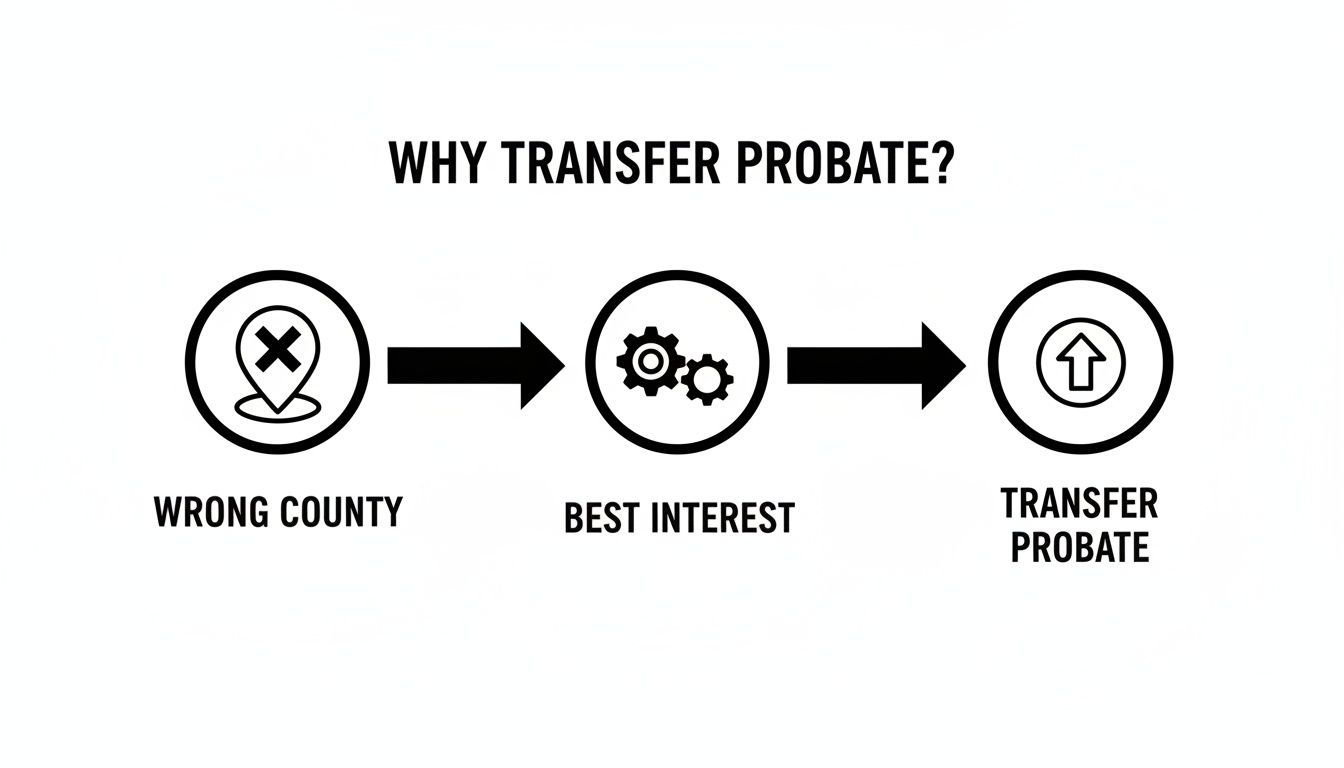
As you can see, the reason for the transfer can be as simple as correcting a filing error or as strategic as making the whole process smoother for everyone involved.
Timelines and Serving Notice
Here’s where timing and notice are crucial. Under Texas Estates Code § 33.103, a motion to transfer can be filed anytime before the court enters a final order closing the estate. However, it's wise to act the moment you realize there's a venue problem. Waiting only leads to wasted time and money.
Once the motion is filed, your work isn't done. You are legally required to notify all "interested parties" that you've requested a transfer. This is called serving notice, and it’s a critical step.
Interested parties usually include any heirs named in the will, known creditors, and anyone else with a financial stake in the estate. Giving them notice ensures everyone is informed and has a fair chance to respond. It shows the court you're acting with transparency and in good faith. You can find more details about picking the right county from the start in our guide on venue for a Texas probate case.
Key Insight: A well-drafted Motion to Transfer Venue does more than list facts; it tells a story. It paints a clear picture for the judge of why moving the case serves justice and makes practical sense, making it much easier for the court to approve the request.
What Happens After a Transfer Is Approved
Receiving the judge’s order approving your motion is a huge relief. But it also raises the question: what now? Knowing what comes next in the transfer of a probate case in Texas helps manage expectations and makes the process feel less daunting. The good news is that the procedure is designed to be straightforward, ensuring the estate administration continues without a hitch.

The transfer isn't instant. It involves a clear, administrative hand-off from the original court to the new one, all governed by the Texas Estates Code to keep things orderly.
The Administrative Handoff Between Courts
Once the judge signs the transfer order, the clerk of the original court—the "transferor court"—begins their work. Their main job is to prepare the entire case file for its journey to the new courthouse.
This isn’t just about sending a few recent documents. The clerk must assemble a complete, certified copy of the entire case history, including:
- The original probate application and the will itself.
- Every motion, order, and pleading that has been filed.
- A full index of all documents in the case.
- A cost bill showing any fees paid or still due.
This comprehensive package ensures the new court, or "transferee court," has a perfect record. You don't have to re-file anything or start over. The system is built for a smooth transition, not a frustrating reset.
What the Transfer Means for Estate Administration
Once the case file arrives in the new county, the local clerk dockets it, officially putting it on the new court's calendar. From that moment, the new court has full and exclusive jurisdiction over the estate.
All future hearings, filings, and communications will now happen in this new location. This is exactly why you filed the motion in the first place—to move the case to a more logical and convenient venue. The impact is immediate, saving you from unnecessary travel and logistical headaches.
For example, if the case involves ongoing issues like Probate Litigation, having it in a courthouse that’s convenient for you, your attorney, and any key witnesses is a massive advantage. This is especially true in busy urban areas. For instance, recent data showed that Harris County Probate Court No. 1 had an impressive case clearance rate of 128.8% over a twelve-month period, meaning it resolved nearly 29% more cases than were filed. Moving to an efficient court can make a real difference in how fast your case progresses. You can dig into Harris County's probate court performance here.
Does the Executor’s Authority Change?
One of the most common worries we hear from executors is whether a transfer will affect their legal authority. The answer is a firm and reassuring "no."
Your appointment as executor or administrator remains 100% valid. The document that grants you that power—your Letters Testamentary or Letters of Administration—remains in full effect. You do not need to be re-appointed or go through the qualification process again.
Your duties, responsibilities, and legal standing to act for the estate continue without interruption. The transfer simply changes the courthouse, not your role.
Navigating Contested Transfers and Special Cases
Not every probate transfer is a simple matter of filing paperwork. While many are straightforward and unopposed, things can get complicated, especially when family members don’t see eye to eye or the estate has unusual complexities. Let's walk through some of these situations, from contested transfers to the strategic reasons for moving a case between different types of Texas courts.

Knowing what to expect can help you prepare for these challenges and make smart decisions that protect the estate and honor your loved one's wishes.
When a Transfer Becomes a Disagreement
Just because one person files a Motion to Transfer Venue doesn’t mean everyone else will agree. Any interested party—an heir, a beneficiary named in the will, or even a creditor—has the legal right to object to the proposed move.
This is where a simple administrative step can turn into a contested hearing.
In court, both sides get to make their case. The person who filed the motion will present evidence showing why the transfer is legally required or in the best interest of the estate. The person objecting will argue the opposite, explaining why the case should stay put.
Ultimately, the judge makes the call based on one primary consideration: what is most fair, just, and efficient for administering the entire estate? The personal convenience of a single heir rarely outweighs the collective good of everyone involved.
County Court vs. Statutory Probate Court: Why It Matters
Texas has a two-tiered system for probate cases. In many rural counties, cases are heard in a County Court at Law. The judges in these courts are legal generalists, handling everything from family law to criminal matters.
However, Texas’s larger metropolitan areas have specialized Statutory Probate Courts. This is a different league entirely.
Judges in these courts deal exclusively with probate, guardianships, and complex estate disputes. Their deep expertise can be a game-changer, especially when dealing with a high-value estate, a family conflict, or serious litigation.
Here’s a look at the key differences:
County Court vs. Statutory Probate Court
| Feature | County Court at Law | Statutory Probate Court |
|---|---|---|
| Judge's Focus | Handles a wide range of legal matters (family, civil, criminal). | Exclusively handles probate, estate, and guardianship cases. |
| Experience Level | General legal knowledge. | Deep, specialized expertise in the Texas Estates Code. |
| Best Suited For | Simple, uncontested estates. | Complex, high-asset, or contested estates and litigation. |
| Availability | Found in most Texas counties. | Primarily in large urban counties (e.g., Harris, Dallas, Tarrant, Travis). |
Knowing this, a transfer might involve more than just moving counties; it could be a strategic move from a generalist court to a specialist one. If you anticipate a dispute over a will, getting the case in front of a judge who lives and breathes this area of law can make all the difference.
The Hurdles for Out-of-State Executors
Serving as an executor from another state adds a layer of complexity to an already demanding job. Managing a Texas estate from hundreds of miles away is not just inconvenient; it’s expensive. Flying in for court hearings and overseeing property can be a logistical and financial burden.
For these executors, transferring venue can be a lifeline. If the probate was opened in a county far from the estate’s main assets or from the executor’s Texas-based attorney, a transfer can bring everything to a central, manageable location.
This is especially true when real estate is involved. For example, if there are properties scattered across different regions, knowing how to probate real estate across multiple Texas counties is critical. It might make the most sense to move the entire case to the county where the most valuable property is located.
By transferring the case, an out-of-state executor can manage their duties more efficiently, saving the estate significant time and money.
Takeaway
A probate transfer is a practical move, not a punishment. The entire point is to align the legal proceedings with the realities of the estate—where the executor lives, where the assets are, and where administration can happen most efficiently. This helps make things easier for the executor and allows your family to move forward with greater clarity and peace of mind.
Final Thoughts from Our Probate Attorneys
Losing a loved one is hard enough. Dealing with the Texas probate system on top of that can feel overwhelming. When you learn the case may need to be moved to a different county, it’s easy to feel lost.
We want to emphasize that a transfer of a probate case in Texas isn't another roadblock for your family. It's a course correction—a legal tool designed to get the estate administration on the most logical and efficient track. It's about ensuring the case is handled in a place that makes sense for everyone involved.
The Real Goal: A Smoother Path to Closure
A probate transfer isn't about winning an obscure legal battle. It's about getting the case to the right courthouse so your family can find closure without unnecessary delays or expenses.
Perhaps the will was filed in a rural county where your parents retired, but all their property and business interests are in Houston. Or maybe there was a simple mistake during filing. In either scenario, the goal is a smoother, more streamlined process. An experienced probate attorney can spot these venue issues early and guide you through the motion to transfer, helping you avoid procedural slip-ups that cost families time and money. Our firm can help you manage every step of the Texas Probate Process, ensuring things are done right from the start.
Don't Mistake Court Closure for Case Closed
It's also critical to understand what comes after probate. Far too many people believe that once the judge closes the case, their work is done. This is a common and costly misunderstanding.
For example, just because the probate court is finished with an estate doesn't mean an heir automatically owns the house. The executor must still file a new deed with the county clerk to officially transfer the title. If that final step is missed, the property legally remains in the estate’s name, creating massive headaches years later. You can learn more in our guide on what to do after a Texas probate case is closed.
This highlights why you need guidance that covers the entire journey. Our experience covers all facets of estate administration, from drafting Wills & Trusts to handling complex Guardianship proceedings when necessary. We believe that with the right direction, Texas families can face these legal steps with confidence and peace.
If you’re facing probate in Texas, our team can help guide you through every step — from filing to final distribution. Schedule your free consultation today.
Common Questions About Transferring a Probate Case
When you're already juggling the stress of settling a loved one's estate, the last thing you want is another legal complication. It’s natural to feel a wave of new questions when the topic of transferring the probate case comes up. Let's provide straightforward answers to the most common concerns we hear from families.
How Long Does It Take to Transfer a Probate Case?
While there’s no exact timeline, you can generally expect the process to take anywhere from four to eight weeks. This clock starts when your attorney files the Motion to Transfer and ends when the new court officially has the case.
Here’s a step-by-step breakdown of what to expect:
- Filing the Motion: Your attorney drafts and files the official request with the current court.
- Notifying Everyone: The law requires a notice period, usually two to three weeks, to give all interested parties (heirs, creditors, etc.) a chance to respond.
- Getting the Judge’s Approval: If no one objects, the judge may sign the transfer order without a formal hearing. If contested, a hearing will be scheduled, which could add a few weeks.
- Moving the Files: Once the order is signed, the Texas Estates Code gives the court clerk 30 days to prepare and send a certified copy of the entire case file to the new county.
Can I Object to a Motion to Transfer?
Absolutely. Any interested party in the estate has the right to file a formal objection. This will trigger a contested hearing where a judge will listen to both sides. The person requesting the transfer must prove why it's legally required or in the estate's best interest. As the objector, you would present evidence showing why the case should stay put.
Solid grounds for an objection could include:
- Proving that the original county is the correct legal venue.
- Showing that a move would create an unreasonable hardship for most heirs.
- Demonstrating that the estate’s most important assets are located in the current county.
The judge will decide based on the law and facts, focusing on what's most fair and efficient for the estate as a whole.
What Are the Costs Involved?
Concerns about money are completely understandable. Expenses for transferring a probate case fall into two main buckets: court fees and attorney fees.
- Court Fees: You'll have filing fees for the motion, fees for the clerk to certify and transfer the file, and a filing fee at the new court. These typically amount to a few hundred dollars.
- Attorney Fees: Your lawyer will bill for their time spent drafting the motion, providing notice, and attending any hearings.
It helps to think of this as a strategic investment. Spending a little now to get the case to a more convenient location can save the estate significant time and money in travel, lost work, and logistical headaches down the road.
Does Transferring a Case Delay the Overall Probate Timeline?
This is a huge worry for many families, but the answer is usually no. While the transfer itself takes a few weeks, it doesn’t reset the probate clock. The new court picks up right where the old one left off.
In fact, in many situations, transferring the case can actually speed up the overall probate process. Once administration moves to the county where the executor lives or where the main property is located, everything gets easier. Appraising property, attending hearings, and meeting with lawyers becomes far more efficient, allowing the executor to do their job effectively and helping the family reach closure sooner.
If you’re facing probate in Texas, our team can help guide you through every step — from filing to final distribution. Schedule your free consultation today.