When a loved one passes away in Texas without a will, the law provides a clear roadmap for inheritance called the Texas Descent and Distribution Chart. This legal framework, found in the Texas Estates Code, is designed to bring predictability to a difficult situation by spelling out exactly who is entitled to receive property. Navigating this process while grieving can be overwhelming, but understanding how it works can provide much-needed clarity for you and your family.
Your Guide to Texas Intestate Succession
Losing a family member is hard enough without the added stress of legal uncertainty. When someone dies “intestate,” it simply means they passed away without a valid will. It’s a common misconception that the State of Texas gets to keep the property in these situations. Instead, a set of default rules kicks in to divide the estate among surviving relatives, and that’s where the Texas Descent and Distribution Chart becomes essential.
Think of this chart as the official guide used by probate courts to identify the legal heirs and calculate their shares of an estate. This process is called intestate succession. Understanding its basic principles can offer reassurance as you begin to navigate the Texas Probate Process.
The Two Pillars of Texas Inheritance
Before using the chart, you must understand the two types of property recognized under Texas law. How an asset is classified is the single most important factor in determining who inherits it.
- Community Property: This includes almost everything acquired by either spouse during the marriage. Think of it as the property you and your spouse built together—the family home, shared bank accounts, or vehicles bought while married.
- Separate Property: This category covers assets owned by one spouse before the marriage. It also includes property one spouse received on their own during the marriage, such as a direct gift or an inheritance. A family ranch passed down through generations, for example, is almost always separate property.
This distinction is crucial because the chart applies completely different rules for distributing community and separate property. Land ownership in Texas can be particularly complex, as a detailed report on Texas land distribution trends shows. Untangling heirship for real estate often requires careful legal guidance.
Ultimately, the goal of these laws, found in the Texas Estates Code, Title 2, Subtitle E, Chapter 201, is to reflect what the average person would likely want. But these are default rules—a backup plan. They may not match what your loved one actually intended. The only way to ensure your wishes are followed is with proper estate planning, like creating legally sound Wills & Trusts. Without a will, the court must follow the chart exactly as written.
Understanding Community vs. Separate Property In Texas
To make sense of the Texas descent and distribution chart, you first have to grasp how Texas law categorizes a married person’s property. This distinction is the most important factor in figuring out who inherits what when someone dies without a will. The entire system pivots on one question: is the asset community property or separate property? We understand these concepts can seem complicated, especially while you’re grieving, and our goal is to provide clear, compassionate explanations to help you through it.

Defining Community Property
In Texas, community property is the default for married couples. It’s generally defined as all assets that either spouse acquired during their marriage. It doesn’t matter whose name is on the title or whose paycheck bought it. If it was obtained between the wedding day and the day the marriage ended, Texas law presumes it belongs to the marital community.
Common examples of community property include:
- The family home purchased during the marriage.
- Wages, salaries, and bonuses earned by either spouse.
- Vehicles, furniture, and other personal items bought with marital funds.
- Contributions made to retirement accounts during the marriage.
Defining Separate Property
In contrast, separate property belongs exclusively to one spouse. This category is much more specific and only includes assets that fall into one of three buckets:
- Property owned by one spouse before the marriage.
- Property acquired by one spouse during the marriage as a gift.
- Property acquired by one spouse during the marriage through an inheritance.
A classic example of separate property is a vintage car that one spouse inherited from a grandparent. Even if they received it while married, it remains their separate asset because it was an inheritance. Properly identifying each type of property is the necessary first step before applying the rules of the Texas descent and distribution chart. This classification, outlined in the Texas Estates Code, sets the stage for the entire inheritance process.
Navigating The Official Texas Descent And Distribution Chart
When you’re grieving a loss, the last thing you want is to decipher a complicated legal document. The official Texas Descent and Distribution Chart is the state’s roadmap for who inherits property when someone dies without a will. Our goal is to make it as straightforward as possible for you and your family.
Think of the chart as a clear guide for Texas intestacy law. It’s logically organized based on one simple question: who survived the person who passed away? Was it a spouse? Children? Parents or siblings? By finding the scenario that mirrors your family’s situation, you can see exactly how the law requires the estate to be divided.
A Practical Tool For Your Family
Each section of the chart lays out the specific inheritance rules for both community property and separate property. These aren’t just suggestions; they are the mandatory instructions found in the Texas Estates Code, Chapter 201, that a probate court must follow. To help you see how these rules play out in the real world, the table below breaks down the most common family structures and shows precisely who is entitled to what portion of the estate.
For instance, the rules for a surviving spouse can be surprisingly different depending on the family makeup. If the deceased spouse has children who are also the children of the surviving spouse, the law is simple: the surviving spouse inherits 100% of the community property. But the rules change dramatically for blended families.
Detailed Texas Intestate Distribution Rules
This table acts as a quick reference guide, translating dense legal language into a practical tool. During a court proceeding called a Determination of Heirship, a judge will use these exact rules to issue orders distributing the estate’s assets. For a more in-depth look at specific scenarios, check out our guide on who inherits in Texas when there is no will. Understanding these rules is the first step toward gaining clarity during a difficult time.
| Scenario (Decedent’s Survivors) | Community Property Distribution | Separate Property Distribution (Real Estate) | Separate Property Distribution (Personal Items) |
|---|---|---|---|
| Spouse, No Children | Spouse inherits all community property. | Spouse inherits 1/2. Parents (or siblings if no parents) inherit 1/2. | Spouse inherits all personal property. |
| Spouse & Their Shared Children | Spouse inherits all community property. | Spouse gets a life estate in 1/3. Children inherit the remaining 2/3 outright. | Spouse inherits 1/3. Children inherit 2/3. |
| Spouse & Children (from another relationship) | Spouse keeps their 1/2 share. Children inherit the decedent’s 1/2 share. | Spouse gets a life estate in 1/3. Children inherit the remaining 2/3 outright. | Spouse inherits 1/3. Children inherit 2/3. |
| Children, No Spouse | Not applicable (no community property). | Children inherit everything equally. | Children inherit everything equally. |
| Parents, No Spouse or Children | Not applicable. | Parents inherit everything equally. | Parents inherit everything equally. |
| Siblings, No Spouse, Children, or Parents | Not applicable. | Siblings inherit everything equally. | Siblings inherit everything equally. |
Common Inheritance Scenarios Explained
Legal charts provide the rules, but real-life examples make them easier to understand. To help you see the Texas descent and distribution chart in action, we’ll walk through the most common situations families face when a loved one dies without a will. Applying these rules can feel abstract, so our goal is to show you exactly how they work in practice.
The following flowchart offers a simplified way to visualize the inheritance hierarchy in Texas. It shows at a glance how the law prioritizes a surviving spouse, children, and parents.
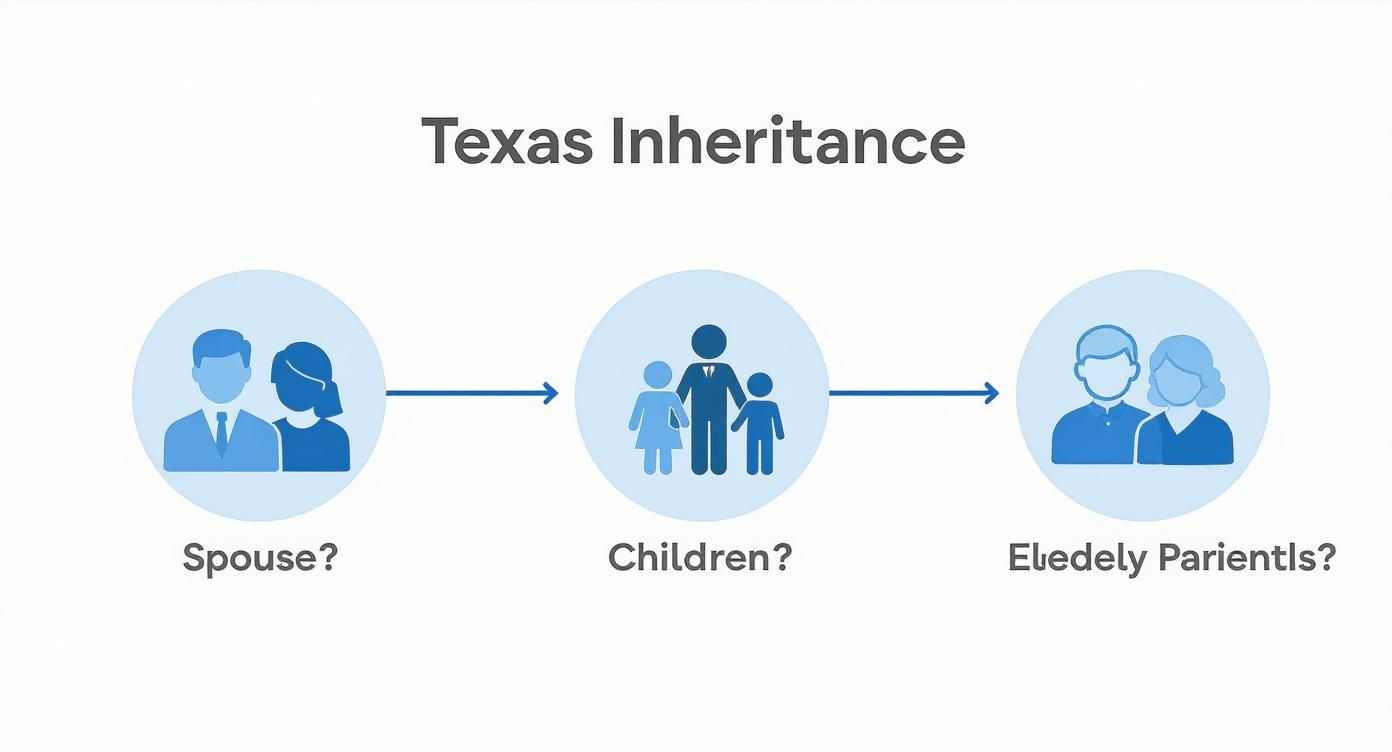
As you can see, the presence of a spouse and children are the first and most critical factors in determining who gets what under Texas law. Let’s explore how this plays out.
Scenario 1: Spouse and Their Shared Children Survive
This is the most straightforward and common scenario. If a person dies and is survived by a spouse and the children they had together, the law keeps things simple.
- Community Property: The surviving spouse inherits 100% of the community property. The law presumes the surviving spouse will continue to provide for their shared children, so everything the couple acquired together stays with the spouse.
- Separate Property: This is handled differently. The surviving spouse receives one-third of the personal property outright, plus a life estate in one-third of the real estate (meaning they can use it during their lifetime). The children inherit the remaining two-thirds of all separate property immediately.
Scenario 2: Spouse and Children from Another Relationship Survive (A Blended Family)
Here’s where Texas inheritance law gets more complex and where many blended families are caught by surprise. The distribution rules change dramatically to protect the inheritance rights of children from a prior relationship.
- Realistic Scenario: David passes away without a will. He is survived by his wife, Maria, and two children from his first marriage. Together, David and Maria owned a home and a joint savings account (community property). David also owned a classic car he inherited from his father (separate property).
- How the property is divided: Maria keeps her 50% share of the home and savings account. However, David’s 50% share of that community property goes directly to his children from the other relationship. Maria does not inherit David’s half of the community assets. For the separate property (the car), Maria receives one-third, and David’s children inherit the remaining two-thirds. This rule, found in the Texas Estates Code, Section 201.003, is one of the biggest surprises for blended families.
This careful division of property, especially real estate, has deep roots. Early Texas land distribution was designed to keep land within family bloodlines, a legacy that still shapes our property laws. You can explore more about the historic Texas land grant system to see how far back these concepts go.
Scenario 3: Children Survive, but No Spouse
If someone passes away without a spouse but leaves behind children, the rules are very simple. The children inherit the entire estate—both separate and community property—in equal shares. The law makes no distinction among the children; they all receive an identical portion of their parent’s estate.
Exceptions And Special Circumstances In Texas Inheritance Law
Inheritance in Texas isn’t always as simple as identifying a spouse and children. Families are complex, and the Texas Estates Code has specific rules for situations that don’t fit the typical mold. These exceptions are critical for ensuring property is distributed fairly and legally. Understanding them can help prevent confusion and conflict during an already difficult time.
Adopted Children And Inheritance Rights
In the eyes of Texas law, adoption creates a complete, legally binding parent-child relationship. An adopted child has the exact same inheritance rights as a biological child. They inherit from their adoptive parents—and their adoptive parents’ families—just as if they were born into the family. Once an adoption is finalized, the legal ties to the biological parents are severed for inheritance purposes.
Stepchildren And Half-Siblings
This is where many families get tripped up. Under Texas intestacy laws, stepchildren do not have any automatic right to inherit from a stepparent. Unless a stepparent legally adopts their stepchild or names them in a will, they are not considered a legal heir.
When it comes to siblings, the law distinguishes between “whole blood” and “half blood.” A half-sibling (who shares only one parent) is entitled to inherit. However, they only receive half as much as a full-blood sibling. This is often called the “half-blood rule” and is laid out in Texas Estates Code § 201.057.
What If An Heir Dies First? (The Right of Representation)
If a direct descendant, like one of your children, dies before you do, their share of your estate doesn’t disappear. Instead, it passes down to their children. This legal principle is known as the right of representation. Your grandchildren essentially step into their deceased parent’s shoes to inherit the share their parent would have received.
This can get especially complicated with land distribution—a major issue as Texas’s population grows and rural land is developed. You can read more about Texas’s changing demographics and land use to understand this trend.
If an heir is a minor, the court will almost certainly require a Guardianship to be established to manage their inheritance. When these kinds of exceptions lead to family disagreements, our experience in Probate Litigation can help families find a resolution.
How The Chart Guides The Texas Probate Process
The Texas descent and distribution chart isn’t just a legal document; it’s the official roadmap probate courts follow when someone dies without a will. Every decision a judge makes about who gets what is grounded in that chart. It directly shapes the court proceedings needed to identify heirs and legally transfer property. Here is a step-by-step look at what you can expect.
Step 1: Initiating a Determination of Heirship
For most intestate estates, the court process begins with a Determination of Heirship. Think of this as a formal legal proceeding with one purpose: for a judge to officially declare the decedent’s rightful heirs according to Texas law.
Step 2: The Role of the Attorney Ad Litem
During an heirship proceeding, the court appoints an independent attorney known as an attorney ad litem. This person’s job is to act as a neutral investigator, conducting a thorough search to find all potential heirs and ensure no one is left out. It’s a crucial step that protects the integrity of the process.
Step 3: The Court Order
Once the investigation is complete and the judge is satisfied that all heirs have been identified, the court issues a formal order. This document lists the heirs by name and specifies the exact percentage of the estate each person is legally entitled to inherit. This court order is the legal key that unlocks the estate, giving banks and title companies the authority they need to transfer assets to the newly declared heirs.
Are There Simpler Alternatives? The Small Estate Affidavit
Yes, but only in very specific situations. For small estates with minimal assets and no debts (other than a mortgage), Texas law provides a simpler, less expensive path. An heirship can sometimes be avoided by using a Small Estate Affidavit to transfer property.
However, this option is strictly limited to estates that meet all of the following criteria:
- The person died without a will.
- The value of the estate (excluding the homestead) is $75,000 or less.
- The estate’s assets are worth more than its known debts.
Understanding how the chart connects to these real-world legal procedures can turn a confusing situation into a manageable one. For a more detailed breakdown, our firm has an in-depth guide to initiating an intestate probate in Texas that walks you through each step.
Key Takeaway
Navigating Texas inheritance law without a will can feel overwhelming, but the process becomes much less intimidating once you understand a few core principles. The single most important takeaway is this: a valid will is the only way to ensure you decide who inherits your property. Without one, the Texas descent and distribution chart makes the decision for you, and those default rules may not align with your wishes. Remember that the distinction between community and separate property is the starting point for every intestate case, and blended families often face the most complex scenarios. While the chart shows what happens, the probate process is how it happens. Creating a clear estate plan with Wills & Trusts is the best way to protect your loved ones and provide peace of mind.
Common Questions About Texas Inheritance
When you lose a loved one, the legal questions can feel overwhelming. Families often have urgent concerns about what comes next. Here, we provide clear, direct answers to some of the most common questions we hear about the Texas descent and distribution chart and intestate succession.
Do Unmarried Partners Have Inheritance Rights?
No. Under Texas intestacy laws, an unmarried partner has no automatic inheritance rights. The law only recognizes a legally married spouse as an heir. If you want to leave property to your partner, you absolutely must name them in a valid will.
Who Is Responsible for the Decedent’s Debts?
The estate itself is responsible for paying the decedent’s debts, not the heirs personally. Assets from the estate are used to pay creditors before any property is distributed to heirs according to the inheritance chart. You won’t inherit someone’s debt, but the debt can reduce or eliminate the assets you would have inherited.
What Happens If an Heir Cannot Be Found?
This happens more often than you might think. If a potential heir can’t be located, the probate court will appoint an attorney ad litem. This is a neutral attorney whose job is to conduct a diligent, thorough search for the missing heir. Their role is to ensure that person’s rights are protected throughout the heirship proceeding. A Determination of Heirship is a formal court process designed to bring legal certainty to a complex situation. The process typically takes several months because it involves notifying all potential heirs and giving the court-appointed attorney enough time to conduct their investigation properly.
Understanding these details can provide reassurance during a difficult time. Each step in the probate process is designed to ensure a fair and lawful distribution of your loved one’s estate according to Texas law.
If you’re facing probate in Texas, our team can help guide you through every step — from filing to final distribution. Schedule your free consultation today.