When planning for your family's future in Texas, you'll encounter two key estate planning tools: the testamentary trust and the living trust. The primary difference between them boils down to two critical factors: timing and the court process known as probate.
A testamentary trust is created within your will. Think of it as a set of instructions that only activates after you’ve passed away and your will has gone through the court-supervised probate process. In contrast, a living trust is established and funded while you're alive, with a primary goal of allowing your assets to bypass the probate court system altogether. Making an informed choice between the two is a profound act of care for your loved ones.
Understanding Your Core Estate Planning Choices

Navigating estate planning can feel overwhelming, especially when you are grieving or simply trying to do right by your family. The terms "testamentary trust" and "living trust" are central to these discussions. While both are legal tools for managing and distributing your assets, they operate in fundamentally different ways under Texas law.
A living trust—also known as an inter vivos trust in legal terms—is a dynamic tool you create during your lifetime. You transfer ownership of your assets, like your home, bank accounts, and investments, into the trust. It’s this crucial step of "funding" the trust that allows those assets to completely bypass the often public and lengthy Texas Probate Process.
A testamentary trust, however, is a provision written directly into your Last Will and Testament. It has no power or legal existence while you are alive. Only after you pass away, and only after a Texas court validates your will through probate, does this trust come into being to hold and manage assets for your beneficiaries.
Key Differences at a Glance
Let's put their core features side-by-side to make it clearer. Understanding these distinctions is the first step toward choosing the path that best aligns with your family’s needs for privacy, control, and efficiency.
| Feature | Testamentary Trust | Living Trust |
|---|---|---|
| When It's Created | Specified within a will; only becomes active after death and probate. | Created and funded by you during your lifetime; active immediately. |
| Probate Process | Must go through the Texas probate court process just to be established. | Assets properly funded into the trust avoid the probate process. |
| Privacy | Becomes part of the public record because it's filed with the probated will. | Remains a private document, keeping your family's affairs confidential. |
| Initial Cost | Generally a lower initial cost, as it’s part of your will preparation. | Higher upfront costs for drafting the trust and retitling assets. |
Ultimately, choosing between these two involves weighing the upfront work and cost of a living trust against the court-supervised, post-death nature of a testamentary trust. Many Texans find the benefits of setting up a trust, like avoiding probate and maintaining family privacy, to be well worth the effort.
How Each Trust Is Created and Funded in Texas

The real difference between a testamentary trust and a living trust lies in when and how they are activated. One is a hands-on project you complete now, while the other is a set of instructions left for your executor to handle later. This distinction is critical—it shapes your responsibilities today and what your family will experience tomorrow.
The Proactive Process of a Living Trust
A living trust is created and activated while you’re alive. It starts with drafting a formal trust agreement that outlines your wishes, names a trustee (usually yourself at first), and lists your beneficiaries. But signing the document is not enough. The most important step is funding the trust.
Funding is the process of legally transferring ownership of your assets into the trust's name. This is an active, detailed process that requires careful attention. You're not just signing a paper; you're actively reorganizing how your property is legally held.
Here’s what that looks like in practice for a Texas family:
- Real Estate: You’ll prepare and file a new deed for your home and any other properties, changing the owner from "John and Jane Doe" to "The John and Jane Doe Living Trust."
- Bank Accounts: Your checking and savings accounts must be formally retitled in the trust’s name.
- Investments: Your brokerage accounts, stocks, and bonds have to be officially transferred over to the trust.
This upfront work is precisely why a living trust can bypass probate. When you pass away, the trust already owns the assets, not you personally. This means there's nothing for the probate court to oversee, which is one of the most powerful revocable living trust benefits.
The Posthumous Creation of a Testamentary Trust
A testamentary trust remains dormant during your lifetime. It’s not a separate legal entity but rather a set of instructions written into your Last Will and Testament. It has no legal existence until two things happen: you pass away, and your will is validated by a Texas probate court.
Under the Texas Estates Code, Title 2, your will serves as the blueprint. Only after a judge confirms the will is valid can the trust officially be created. From there, your executor takes on the task of transferring the assets named in your will out of your estate and into this brand-new trust. The entire process hinges on the probate system. While you are alive, the assets remain in your personal name. It’s only after your death, and under a court’s supervision, that your executor moves them into the trust. While some people explore modern resources like AI tools for drafting wills to understand document structure, proper legal guidance is essential.
The Critical Impact on the Texas Probate Process
For most families, the word "probate" can bring to mind stress, delays, and unexpected expenses. When you’re weighing a testamentary trust vs a living trust, one of the most significant differences is how each one interacts with the Texas probate courts. This choice directly impacts your family’s privacy, timeline, and costs after you’re gone.
A properly funded living trust is designed with one powerful goal: keeping your assets out of the courthouse. Because the trust—not you—legally owns the assets, there is nothing for the probate court to administer. This allows for a private and often much faster transfer of wealth to your beneficiaries, handled directly by your successor trustee according to your instructions.
A testamentary trust, on the other hand, is fundamentally tied to the probate process. Since it’s created inside your will, the will must be validated by a Texas court before the trust can even exist. This means your estate must go through the entire probate journey just to activate the trust you planned.
Probate Journey Versus Private Administration
The path your assets take depends entirely on which trust you choose. A living trust paves the way for a confidential, out-of-court administration. A testamentary trust requires court supervision from the start, making the process public and subject to rigid legal formalities.
Because a testamentary trust only becomes effective after your death during probate, it can easily add months—or even more than a year—to the process. A living trust allows for immediate management and distribution of assets. This public exposure can also lay bare sensitive family and financial details for anyone to see. For families who value efficiency and privacy during an already difficult time, exploring strategies for how to avoid probate in Texas is often a top priority.
A Clear Comparison of Key Differences
To understand the impact on your family, let's put these two paths side-by-side. The differences in privacy, cost, and time are significant. The table below breaks down how each trust type affects the probate process in Texas.
Probate and Privacy Comparison: Testamentary vs. Living Trust
| Feature | Testamentary Trust (Via Will) | Living Trust (Funded During Life) |
|---|---|---|
| Probate Requirement | Mandatory. The will must be probated in a Texas court to create the trust. | Avoided. Assets properly titled in the trust's name bypass probate entirely. |
| Public Record | Public. The will, including the trust's terms and asset descriptions, becomes a public court document. | Private. The trust document and its contents remain completely confidential. |
| Timeline for Access | Delayed. Beneficiaries must wait for the entire probate process to conclude before the trust is funded. | Immediate. The successor trustee can manage and distribute assets as soon as needed, without delay. |
| Potential for Disputes | Higher. The public nature of probate can invite will contests from creditors or disgruntled heirs. | Lower. Private administration significantly reduces the opportunity for public challenges. |
| Legal & Court Fees | Typically higher. Costs include court filing fees, mandatory notices, and attorney fees for probate. | Typically lower. Post-death administration costs are generally far less than a formal probate. |
Ultimately, while a testamentary trust can be a useful tool, it forces your estate—and your family—through the public court system. A living trust empowers your family to handle your affairs privately, compassionately, and on their own timeline, honoring your wishes without unnecessary court intervention.
Control, Flexibility, and Cost: A Realistic Look
When you're deciding between a testamentary trust and a living trust, it comes down to two personal factors: control and cost. This is about your freedom to adapt to life's changes and understanding the true financial impact on your family—both today and down the road.
A revocable living trust gives you the most hands-on control. Because you create it while you're alive, you are typically your own trustee. This puts you in the driver's seat. You can switch beneficiaries, move assets in or out, or even dissolve the trust if your life changes.
A testamentary trust is part of your will. You can change its terms by updating your will, but the moment you pass away, those instructions are locked in. The trust becomes irrevocable, and its rules are set in stone. This rigidity can create problems if your family's needs change in unexpected ways years later.
How Much Flexibility Do You Really Have?
Life is unpredictable, which is why flexibility is so important. A revocable living trust is designed to change with you. The power to modify your trust is a critical part of maintaining control, and understanding the process of amending an existing legal document is valuable. This adaptability keeps your estate plan aligned with your current wishes.
A testamentary trust cannot offer that kind of post-death agility. For example, you set up a trust in your will for a grandchild with payouts at ages 21 and 25. Years after you're gone, that grandchild develops a serious addiction. Your trustee's hands are tied. They cannot adjust the distribution schedule to protect the inheritance. The terms are frozen—a significant limitation.
Upfront Costs vs. Long-Term Expenses
You have to look at the total financial picture. A living trust has higher upfront costs. You're paying for a detailed trust agreement and the process of retitling assets. But that initial investment often saves your family money in the long run. By avoiding probate, a living trust lets your heirs sidestep court costs and attorney’s fees that can drain an estate's value.
A testamentary trust is cheaper on day one, as it's just another provision in your will. However, this early savings is often misleading because the trust can only be activated through probate. Your estate is guaranteed to incur all typical probate costs:
- Court Filing Fees: Required to open a probate case in Texas.
- Attorney's Fees: To guide your executor through the court-supervised process.
- Executor Compensation: Your executor is legally entitled to payment.
- Notice to Creditors: The cost of publishing legal notices.
These post-death expenses can easily add up to more than the initial cost of a living trust, placing a heavier financial burden on the very people you wanted to protect.
Our firm can walk you through every aspect of creating Wills & Trusts that are built around your family’s unique needs and goals.
Texas Scenarios: When to Choose Each Trust
Deciding between a testamentary trust and a living trust isn’t about which one is universally “better”—it’s about which one is better for you. Your family's circumstances, assets, and goals will steer the decision. Let's walk through a few realistic scenarios Texas families often face.
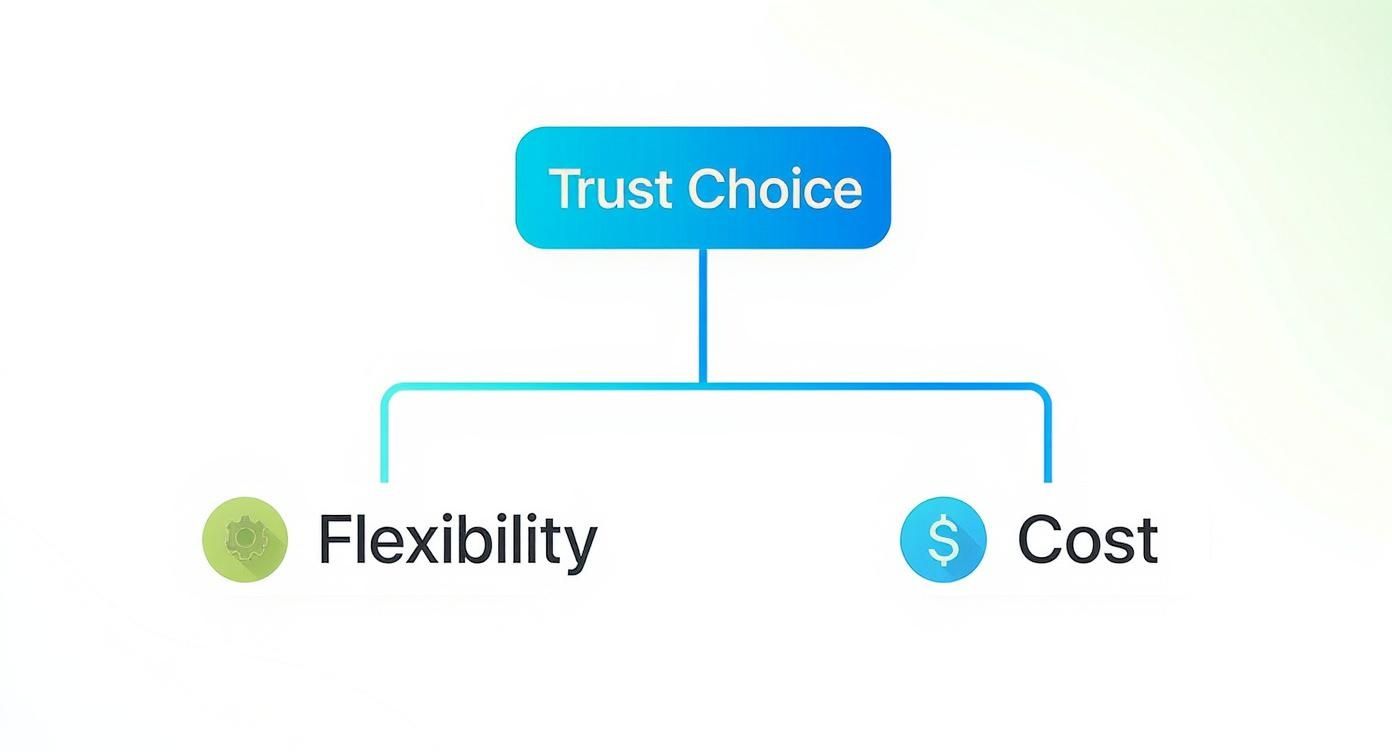
As the graphic shows, your primary goal—whether it's immediate savings or lifetime control and privacy—is the key factor in determining which trust is right for you.
Scenario 1: Young Parents with Minor Children
The Situation: Sarah and Tom, a couple in their early thirties with two young children, own a home and have some savings. Their main goals are to name a guardian for their kids and ensure their inheritance is managed responsibly.
The Solution: A testamentary trust created within their wills is often a practical choice.
- Why it works: It's a cost-effective way to achieve their primary objectives. They can appoint a trustee to manage funds for their children's health and education, staggering the inheritance at ages 25 and 30 to prevent a young adult from receiving a large sum at once.
- The tradeoff: Their assets are not complex. For them, the probate process required to activate the trust is a reasonable trade-off for the lower upfront cost and simplicity.
Scenario 2: Retirees with Complex Assets
The Situation: David and Mary are retired and own a home in Houston, a vacation condo in Florida, and a diverse investment portfolio. They want to avoid the costs of probate, especially with property in two states, and ensure a seamless transition of finances if one becomes incapacitated.
The Solution: A revocable living trust is the clear winner.
- Why it works: By transferring their Texas home, Florida condo, and investments into the living trust, they completely bypass probate in both states. This saves their heirs from the expense of two separate probate proceedings (ancillary probate).
- Incapacity Planning: The trust also plans for incapacity. If David or Mary can no longer manage their finances, their chosen successor trustee can step in immediately without needing court permission.
Scenario 3: Business Owners Focused on Privacy
The Situation: Jessica owns a successful family manufacturing business in Texas. Her priority is ensuring the business continues running without interruption after her death. She also wants to keep the company's value and succession plan out of the public record.
The Solution: A living trust is essential for Jessica.
- Why it works: By placing her business shares into a living trust, she ensures the successor trustee can take control immediately upon her death or incapacity. This prevents a leadership vacuum that could harm the company.
- Privacy is key: A will becomes a public document once probated. This would expose sensitive business details to competitors and the public. A living trust keeps this information entirely private, avoiding unwanted scrutiny and potential probate litigation.
These scenarios show that the right choice depends on your specific life stage, assets, and priorities. Speaking with an experienced attorney can help you build a plan that serves your family’s best interests.
Your Key Takeaways and Final Considerations
Choosing between a testamentary trust vs. a living trust in Texas comes down to a fundamental trade-off: pay now or pay later. A living trust requires more work and investment upfront but offers your family probate avoidance, privacy, and immediate control. A testamentary trust is simpler to include in your will, but it forces your estate into the public, lengthy, and potentially costly probate process. The "best" choice is deeply personal.
Final Questions to Guide Your Decision
Before meeting with an attorney, consider these questions:
- Privacy: How important is it that your family’s financial details remain private?
- Complexity: Do you own property in other states or have complex assets that could complicate probate?
- Incapacity: Are you concerned about who will manage your finances if you become unable to do so?
- Cost: Would you rather invest more now to save your family stress later, or is keeping initial costs low the priority?
Key Insight
A living trust is only as effective as its funding. An unfunded living trust is like an empty vault—the structure exists, but it holds nothing and offers no protection from probate. Diligent funding is the most critical step.
Estate planning is not just a legal task; it's a final act of care for your family. Making an informed choice now, with professional guidance, ensures your wishes are honored and your loved ones are protected during a difficult time.
Common Questions About Texas Trusts
Here are clear answers to the questions we hear most often from Texas families.
Can I Have Both a Living Trust and a Will in Texas?
Yes, and you absolutely should. A comprehensive estate plan almost always pairs a living trust with a special type of will called a pour-over will. Think of it as a safety net. Its job is to "catch" any asset you forgot to transfer into your trust. Upon your death, the pour-over will directs that leftover asset to be moved into your trust. While that specific asset will have to go through probate, the will ensures it ultimately ends up where you intended.
Does a Living Trust Protect My Assets From Creditors?
This is a common misconception. A revocable living trust—the kind most people use to avoid probate—offers no protection from your own creditors. Because you retain full control and can dissolve the trust at any time, the law still considers those assets yours. For significant creditor protection, you would typically need an irrevocable trust, a more complex tool that requires you to permanently give up control over the assets.
What Happens if I Forget to Fund an Asset Into My Living Trust?
This is the most common pitfall in trust planning. If an asset isn't formally retitled in the name of the trust, it is "unfunded." An unfunded asset remains in your personal name and is not governed by the trust. This means it will almost certainly have to go through the Texas Probate Process before your heirs can receive it. This is precisely why a pour-over will is so vital—it acts as a backstop to ensure the asset eventually gets to your trust.
If you’re facing probate in Texas, our team can help guide you through every step — from filing to final distribution. Schedule your free consultation today.