When you need to write a legal guardianship letter, you are taking a crucial step to protect someone you love. This process can feel overwhelming, especially when you are already navigating difficult family circumstances. In plain English, a legal guardianship letter is a document where you state your wishes for who should care for a minor child or an incapacitated adult if you can no longer do so. It is your voice, written down, explaining your choice for a guardian to a Texas court.
What a Guardianship Letter Means in Texas Law
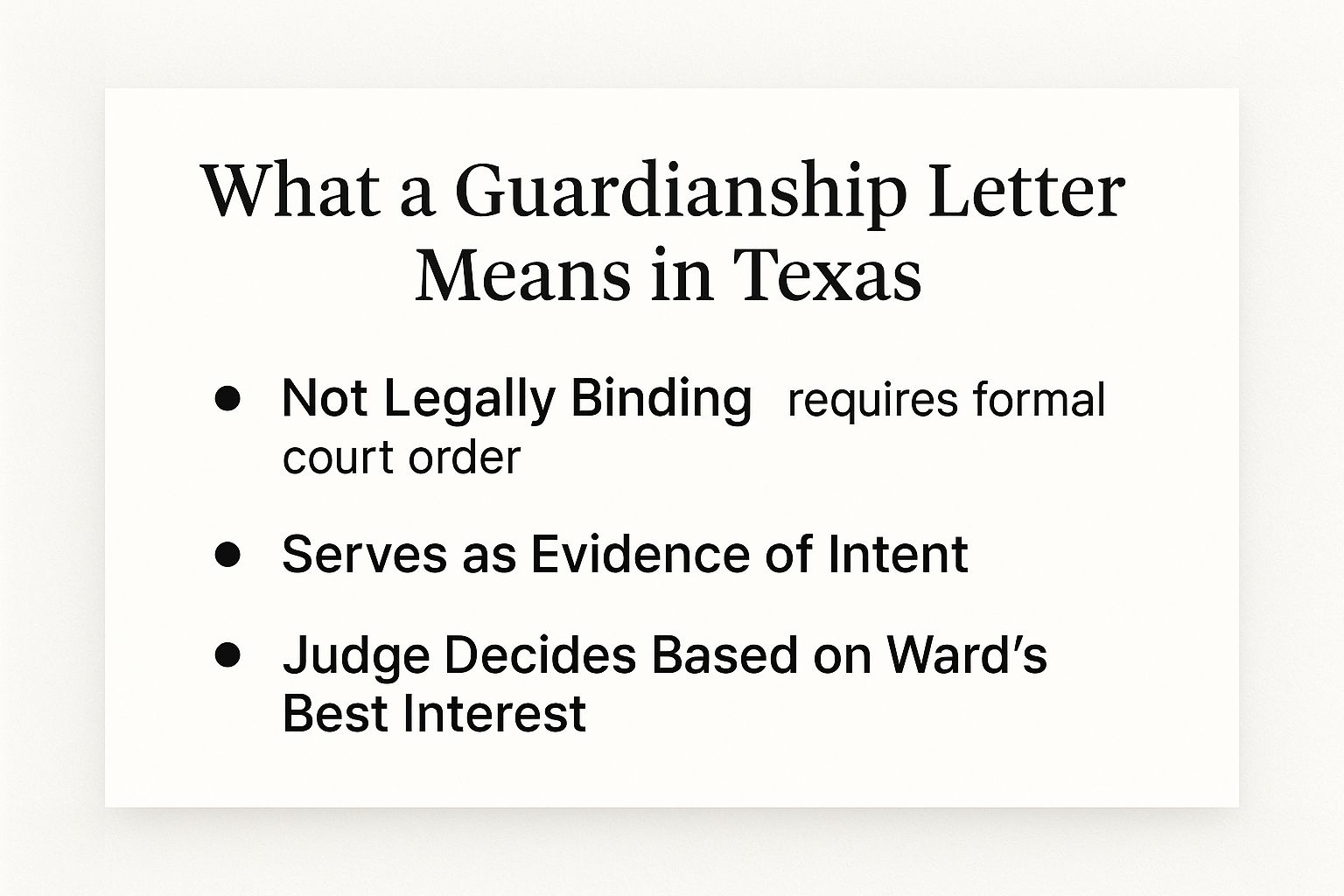
The most important thing to understand is that in Texas, a guardianship letter is not legally binding on its own. While writing one is a responsible and caring step, it does not automatically grant someone guardianship powers.
Think of it as a powerful piece of evidence for a judge. The letter’s main purpose is to clearly communicate your wishes and, more importantly, the reasons behind them. A Texas probate court always makes the final decision, guided by one principle: the “best interest” of the person needing care (the “ward”). This standard is the foundation of the Texas Estates Code, especially Title 3, Chapters 1001-1204, which governs guardianships. Your letter gives the judge critical insight into what you believe serves that best interest.
The Letter's Role in a Guardianship Proceeding
This letter is your formal recommendation to the court and can be incredibly influential during a guardianship hearing. Here’s how it helps:
- It demonstrates foresight. A well-drafted letter shows the judge you have thoughtfully considered your loved one's future and well-being.
- It can prevent family disputes. Clear, well-reasoned wishes often reduce the chance of family members disagreeing over who should serve as guardian, which can sometimes lead to Probate Litigation.
- It provides crucial context. The letter explains why you believe your chosen guardian is the right person, detailing their relationship with the ward, their stability, and their values.
This infographic neatly sums up the legal realities of a guardianship letter in Texas.
Ultimately, your letter guides the court; it does not command it. The letter is one part of a larger legal process. To see how it all fits together, learn more about how to become a guardian of a minor in Texas. The formal court proceeding is what legally establishes the Guardianship and makes it official.
What Every Texas Guardianship Letter Must Include
To be effective in a Texas court, your guardianship letter must tell a clear and compelling story. It is about more than just naming someone; it’s about building a persuasive case for why your choice is in the best interest of the person needing care.
Think of it as the foundation of your guardianship request. Each piece of information strengthens the overall structure, making it easier for a judge to understand and respect your wishes. Vague statements or missing details can weaken its impact, potentially complicating the process.
Clearly Identifying Everyone Involved
First, leave no room for ambiguity. Your letter must clearly state the full legal names and relationships of every person involved. This is critical information the court needs to establish the context of your request.
- You (The Declarant): State your full name and your relationship to the ward (e.g., parent, grandparent, current guardian).
- The Proposed Guardian: Provide their full legal name, current address, and relationship to you and the ward.
- The Ward: Identify the full name and date of birth of the child or incapacitated adult who needs a guardian.
For example, if you’re a grandparent writing a letter for your grandchild, you would start by identifying yourself, your daughter (the child's mother), and your grandchild using full legal names. This simple step prevents confusion from the start.
Articulating the “Why” Behind Your Choice
This is the heart of your letter. It’s where you explain exactly why the proposed guardian is the ideal person for this immense responsibility. A judge needs to see concrete reasons, not just emotional appeals.
Describe the proposed guardian’s suitability by detailing their:
- Financial Stability: Mention their stable employment or ability to provide for the ward's needs without hardship.
- Home Environment: Describe their home. Is it a safe, nurturing, and suitable place for the ward?
- Personal Values: Explain how their values and, for a child, their parenting style align with your own. This shows a plan for continuity of care.
- Existing Relationship: Detail the bond they already share with the ward. Do they spend holidays together? Is there a loving, trusting relationship already in place?
Key Insight: The Texas Estates Code requires the court to prioritize the ward's best interest above all else. Your letter’s primary goal is to provide specific, factual evidence demonstrating how your chosen guardian fulfills this critical requirement.
To help you organize these crucial details, here’s a quick summary of what you need to include.
Key Information for Your Texas Guardianship Letter
| Component | What It Means and Why It Matters | Example Detail |
|---|---|---|
| Declarant Information | Who you are. The court needs to know your identity and legal standing to make this request. | "I, Jane Marie Smith, the mother of the ward…" |
| Ward Information | The person needing a guardian. Full name and date of birth are non-negotiable for identification. | "…for my minor son, John David Smith, born on June 15, 2014." |
| Proposed Guardian Info | Who you've chosen. Full name and address are needed to identify them and establish jurisdiction. | "I nominate my sister, Emily Ann Jones, residing at 123 Oak Lane, Houston, TX 77002…" |
| The "Why" | The justification. This is where you build your case for why this person is the best choice for the ward. | "…Emily has a stable job as a teacher, a safe home, and has always been a loving aunt to John." |
| Signatures & Notary | The legal formalities. A signed and notarized letter carries significant weight in court proceedings. | A proper signature block followed by a notary public's seal and signature. |
Making sure these elements are clearly and thoughtfully presented is your best shot at having your wishes honored by the court. To ensure your letter is both professional and persuasive, adhering to the principles outlined in an essential legal writing style guide can make a significant difference.
A Realistic Scenario: The Sanchez Family
Theory is one thing, but seeing how it all comes together in practice is another. Let’s consider the Sanchez family. Maria and Carlos Sanchez have a 10-year-old son, Leo. They are planning a trip overseas and want to ensure Leo is cared for by Maria’s sister, Sofia, if something happens to them. They decide to write a guardianship letter to include with their Wills & Trusts.
Their letter doesn't just say, "We want Sofia to be the guardian." Instead, it details how Sofia has been a constant, loving presence in Leo's life, helping with his homework every week and coaching his soccer team. It mentions that Sofia is a financially stable accountant who lives in the same school district, ensuring continuity in Leo’s education and friendships. By providing these specific, reassuring details, they are building a strong case for Sofia that aligns with the “best interest” standard a Texas judge must follow.
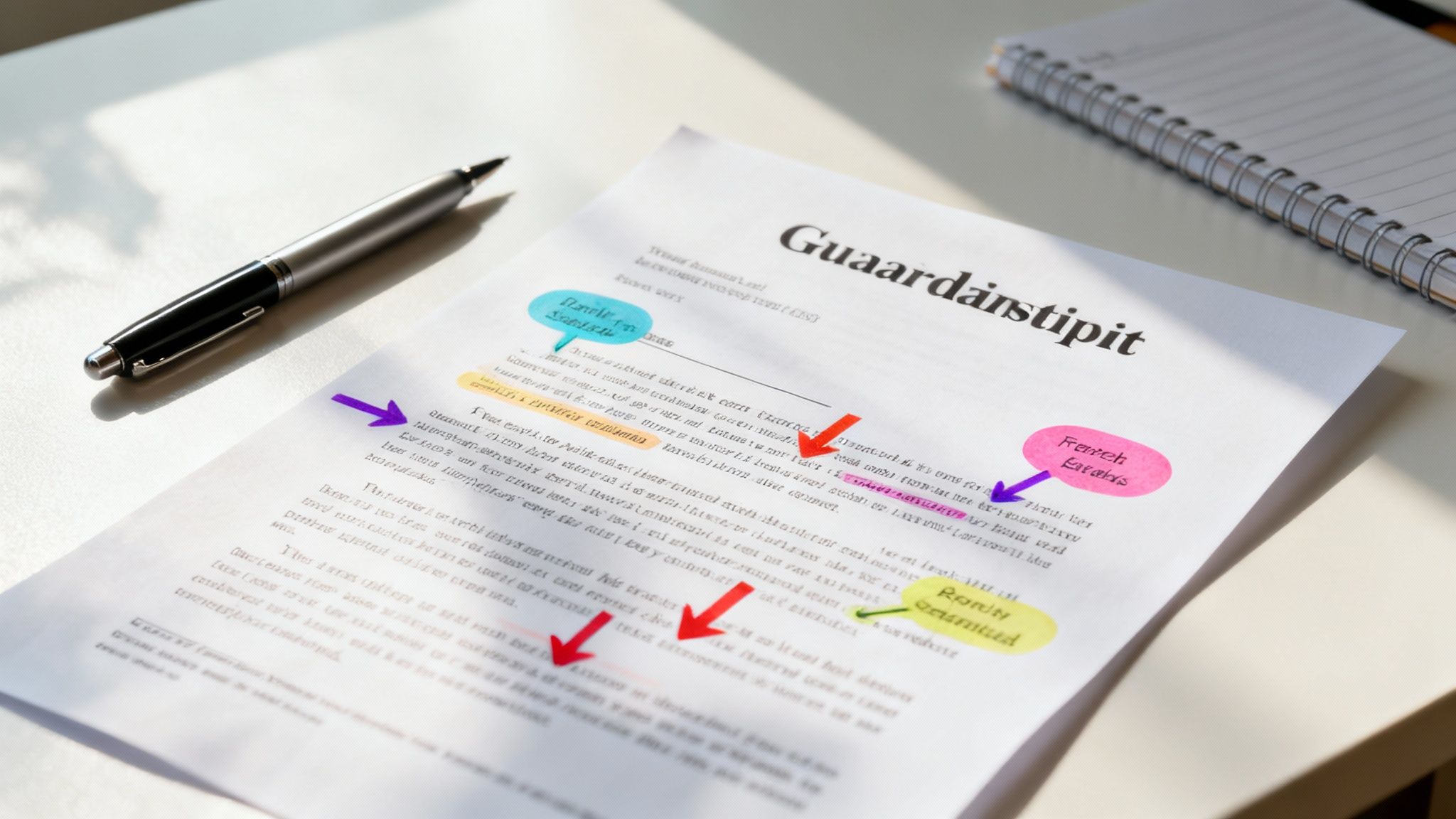
Sample Letter With Explanations
Here is a sample letter structured to be clear and persuasive for a Texas probate judge.
[Your Full Name(s)]
[Your Address]
[City, State, Zip Code]
[Date]
To the Honorable Judge of the Probate Court,
Re: Nomination of Guardian for Minor Child, [Child’s Full Name]
We, [Parent 1 Full Name] and [Parent 2 Full Name], are the biological and legal parents of our minor child, [Child’s Full Name], born on [Child’s Date of Birth].
- Annotation: Right away, you must identify everyone with full legal names and dates of birth. This clarity is essential for the court.
In the unfortunate event of our incapacitation or death, we respectfully nominate our trusted sister and brother-in-law, [Guardian’s Full Name] and [Spouse's Full Name, if applicable], who reside at [Guardian’s Full Address], to be appointed as the legal guardian of the person and estate of our child.
- Annotation: Be specific. Naming them as guardian of both the “person” (covering daily care and well-being) and the “estate” (covering finances) is crucial for comprehensive protection under the Texas Estates Code.
We have known [Guardian’s Name] for over [Number] years and have witnessed her exceptional character, stability, and deep love for our child. She and our child share a close, nurturing bond, spending significant time together during holidays, birthdays, and family gatherings.
- Annotation: This is where you build your case. Highlighting an existing, positive relationship is powerful evidence that your choice is genuinely in the child's best interest.
Key Insight: The Texas Estates Code is laser-focused on the "best interest of the ward." Think of your letter as a collection of facts that prove your choice meets that critical legal standard.
[Guardian’s Name] is financially responsible, employed as a [Guardian’s Profession], and owns a safe, stable home in a community with excellent schools. Most importantly, her values regarding education, faith, and family mirror our own, which would ensure our child is raised in an environment consistent with our deepest wishes.
- Annotation: Practical details matter. Mentioning financial stability, a safe home, and shared values gives the judge concrete, reassuring reasons to approve your nomination.
For those just starting out, tools like an AI legal template generator can sometimes help organize your initial thoughts, but a personalized, detailed letter is what makes it truly effective.
We have discussed this immense responsibility at length with [Guardian’s Name], and she has lovingly agreed to serve as guardian. We have full confidence that she will provide our child with the love, support, and stability needed to thrive.
We declare under penalty of perjury that the foregoing is true and correct.
Sincerely,
[Parent 1 Signature]
[Parent 1 Printed Name]
[Parent 2 Signature]
[Parent 2 Printed Name]
(Notary Block to be added here)
This annotated sample provides a solid framework. But remember, the letter is just one piece of the puzzle. The entire Texas Probate Process involves formal court proceedings to make your nomination official and legally binding.
Common Mistakes That Weaken Your Letter
A well-intentioned guardianship letter can be weakened by simple, avoidable mistakes. Crafting this document requires precision. Avoiding common pitfalls is critical if you want your voice to be heard and respected in a Texas probate court.
One of the most frequent errors is using vague language instead of clear, factual statements. A judge needs concrete reasons why your chosen guardian is the right fit, focusing on their stability, character, and relationship with the ward.
Critical Legal Formalities
Another major misstep is overlooking legal formalities. Failing to have the document properly signed and notarized is a common error. Notarization acts as a sworn statement, confirming your identity and intent, which adds significant weight to your nomination in court. Without it, the letter’s authenticity can be questioned.
Equally damaging is creating a conflict with another legal document, like your will.
- Conflicting Documents: If your will names one person as guardian and your letter names another, you have created grounds for a legal battle. This forces a judge to resolve the inconsistency, potentially leading to a result you never wanted.
- Lack of Specificity: Ambiguous terms create confusion. Your letter must be a clear, consistent part of your overall estate plan.
These conflicts can spiral into stressful and costly legal fights. If you find yourself in a situation where documents are at odds, it's important to understand how to contest a guardianship in Texas probate court.
Key Insight: Consistency across all your legal documents is paramount. A guardianship letter should reinforce your will and other estate planning documents, not contradict them.
The scale of guardianship in the U.S. is substantial, with an estimated 1.3 million adults under arrangements controlling roughly $50 billion in assets. Yet, a surprising lack of comprehensive national data highlights why clear, precise, and legally sound documentation in individual cases is so vital. You can discover more about this guardianship data reform effort if you're interested. By avoiding these common errors, you help ensure your letter stands as strong, clear evidence of your wishes.
What Your Letter Can and Cannot Do (A Reality Check)
Let's be very clear, because this is where many people get confused. A guardianship letter is a powerful tool to make your voice heard, but it is not a court order. It is compelling evidence for a Texas judge to consider, but it does not have the final say.
Every decision a judge makes comes down to one overriding standard: the "best interest of the ward." Understanding this distinction is critical to navigating the guardianship process. Your letter gives you a seat at the table, but the judge holds the gavel.
Setting Realistic Expectations
Once you accept that reality, you can see why building a comprehensive case is so important. Think of your letter as a key piece of the puzzle—influential and persuasive, but not the whole picture. Its job is to inform and guide, not to command.
This is a world away from other legal documents. It’s not like a power of attorney, which can grant someone immediate authority to act on your behalf. If you want to dive deeper into that, you can learn more about what is a power of attorney to see just how different these tools are.
Key Takeaway
A well-crafted legal guardianship letter is an essential tool for any Texas family. It is your opportunity to provide a clear, thoughtful recommendation to the court, ensuring your voice is heard in the decision-making process. While not legally binding on its own, its power lies in its ability to present compelling evidence about the best interests of your loved one. By being specific, avoiding common mistakes, and ensuring consistency with your other estate planning documents, you create a powerful guide for the judge, offering peace of mind that your wishes are understood and respected.
Common Questions About Guardianship Letters in Texas
Planning for the future brings up many questions. Here are some of the most common ones we hear from Texas families, answered in plain English.
Is a Notarized Guardianship Letter Legally Binding in Texas?
No. Getting your letter notarized is a smart move because it adds a layer of authenticity. A notary public verifies your identity, which makes the letter much stronger evidence in court. However, the letter itself does not replace a formal court order. A Texas judge must still review all the facts, consider the ward's best interest, and issue a legal order to officially appoint a guardian. Think of the letter as your formal recommendation to the court—not the final word.
Should I Name an Alternate Guardian?
Absolutely. We strongly recommend it. Life is unpredictable. Naming a backup ensures your wishes are still considered if your first choice is unable or unwilling to serve. This simple step provides an essential safety net. It's as easy as adding a sentence like: "If [Primary Guardian's Name] is unable to serve, I nominate [Alternate's Name] as guardian."
What Happens if No Guardianship Letter Exists?
If you do not state your preference in a letter or a will, the court is left to make the decision on its own, guided by the Texas Estates Code. A judge will typically look to close family members first, like grandparents or adult siblings. The problem is, without your input, the person the court chooses might not be who you would have wanted. This is exactly why proactive planning is so important—it's your chance to guide the decision even when you can't be there.
If you’re facing probate in Texas, our team can help guide you through every step — from filing to final distribution. Schedule your free consultation today.