Skip to content
Making decisions about your family’s future after you’re gone can feel overwhelming, but understanding your options is the first step toward creating a plan that brings peace of mind. A revocable living trust is a powerful estate planning tool that allows you to control your assets while you’re alive and then pass them on privately after your death, often sidestepping the public, court-supervised probate process. The biggest advantage is privacy and efficiency. On the flip side, the main drawback is the upfront cost and administrative work needed to set it up and fund it correctly.
This guide will walk you through the revocable living trust pros and cons in plain English, helping you understand if this is the right choice for your Texas family.
Understanding Revocable Living Trusts in Texas
A revocable living trust is a legal arrangement that holds your assets—like your home, bank accounts, or investments—for your benefit during your lifetime. After you pass away, it directs those assets to your loved ones according to your instructions, without the need for court intervention.
Think of it as a private instruction manual for your property. Under Texas law, specifically outlined in the Texas Property Code, the person creating the trust (the grantor) is almost always the initial manager (the trustee). This setup gives you complete control to change, add to, or even cancel the trust at any time. That flexibility is why it’s called “revocable.”

How a Living Trust Works in Plain English
So what does a trust actually do? It serves two critical functions: managing your assets if you become unable to do so yourself (incapacitated) and distributing them privately—outside the public court system—when you die. It’s a distinct legal entity that technically “owns” the property you place into it.
To help you decide which path best protects your family, let’s compare a trust to a traditional will. The table below breaks down the key differences between these two foundational estate planning documents.
| Feature | Revocable Living Trust | Traditional Will |
|---|---|---|
| Probate Process | Bypasses the public probate court process, saving time and money. | Must go through the Texas Probate Process to be validated. |
| Privacy | Kept private; not filed with the court. Your assets and beneficiaries remain confidential. | Becomes a public record once filed for probate. |
| Incapacity Plan | Your designated successor trustee can manage assets immediately if you become unable. | Requires a separate Durable Power of Attorney; otherwise, court intervention may be needed. |
| Upfront Cost | Generally higher initial cost to create and fund. | Lower initial cost to draft. |
The Three Key Roles in a Texas Trust
Every trust has three main parties. When you first set it up, you’ll likely wear all three hats yourself.
- The Grantor (or Settlor): This is you—the person who creates the trust and transfers assets into it.
- The Trustee: This is the manager. You will act as your own trustee during your lifetime, managing the trust’s assets for your own benefit.
- The Beneficiary: This is the person who benefits from the trust. Initially, this is also you. After you pass away, your chosen loved ones become the beneficiaries.
Why Texas Families Choose Revocable Living Trusts
For many Texas families, the decision to create a revocable living trust boils down to one powerful motive: keeping their affairs out of probate court. Probate is the court-supervised process for validating a will and settling an estate. While Texas probate can be more streamlined than in other states, it can still be a long, expensive, and surprisingly public ordeal for a grieving family.
A revocable living trust offers a private and efficient path forward. It allows your chosen successor trustee to manage and distribute your assets based on your instructions, all without court intervention. This direct approach can save your beneficiaries a great deal of time, money, and stress during an already difficult time.

Bypassing the Texas Probate System
The number one reason families establish a trust is to sidestep the probate system. Under the Texas Estates Code, even a simple probate can drag on for months, while more complicated estates can be tangled up in court for over a year. During this entire time, your assets are essentially frozen, which can leave your family waiting for resources they need.
When you place assets into a trust, they are no longer part of your “probate estate.” This simple re-titling means your successor trustee can step in almost immediately after your death to manage and distribute them according to the private rules you’ve laid out.
Maintaining Your Family’s Privacy
Here’s something many people don’t realize: when a will goes through probate in Texas, it becomes a public court record. That means anyone—from a nosy neighbor to a predatory solicitor—can look up sensitive details about your estate, including:
- The total value of your assets.
- Who your beneficiaries are.
- The specific instructions for how your property will be divided.
For families who cherish their privacy, this level of public exposure is a major drawback. A revocable living trust, on the other hand, is a completely private document. Its terms stay confidential between your trustee and beneficiaries, shielding your family’s financial affairs from public view.
Planning for Incapacity Seamlessly
Another huge advantage of a living trust is its built-in plan for incapacity. If you ever become unable to manage your own finances due to illness or an accident, the successor trustee you named can step in right away to pay bills, handle investments, and take care of other financial matters for you.
This transition is seamless and happens entirely outside of the courtroom. Without a trust, your family would likely have to go to court to seek a Guardianship, a process that is often expensive, time-consuming, and emotionally draining for everyone involved. You can learn more about the many revocable living trust benefits in our detailed guide.
A Real-World Scenario in Texas
Let’s look at a Houston-area couple, Maria and David. They have two adult children, a home, savings, and an investment portfolio.
- Scenario with a Will: If they only have wills, their children must hire an attorney and file the wills with the Harris County probate court after they pass. This kicks off a process involving court hearings, mandatory waiting periods under the Texas Estates Code (Title 2), and a public inventory of all their assets. The entire settlement could easily take 9 to 12 months, with legal and court fees chipping away at the inheritance.
- Scenario with a Trust: If Maria and David had placed their assets into a revocable living trust, their successor trustee (perhaps their eldest daughter) could take control immediately. She could pay final bills, work with a financial advisor on the investments, and distribute the assets according to the trust’s private instructions—all within a matter of weeks, not months.
This stark difference shows why so many see the upfront work of creating a trust as a smart investment in their family’s future. While most Americans lack an estate plan, and even fewer have a trust, the benefits are compelling. Data shows only 11% of Americans have a trust, while 55% have no plan at all, leaving their families to navigate the complexities of probate. This court process can eat up 4% to 8% of an estate’s value, but a well-funded trust helps preserve those assets for your loved ones. For more insights, check out Trust & Will’s 2025 Estate Planning Report.
The Limitations and Drawbacks of Living Trusts
While a revocable living trust is a powerful tool for many Texas families, it’s not a magic wand. Before you jump in, it’s critical to look at the whole picture—the good, the bad, and the administrative headaches. Understanding the potential downsides ensures you’re making a decision that truly fits your life, not just following a trend.
The two biggest hurdles are almost always the upfront cost and the ongoing effort required to make the trust actually work. Creating a trust is a more detailed legal dance than drafting a simple will, which means it costs more to get started. But honestly, the bigger pitfall isn’t the initial fee; it’s the follow-through. A trust is just an empty box until you fill it, and that’s where many people stumble.
The Critical Task of Funding Your Trust
“Funding” is the legal term for transferring ownership of your assets into the name of your trust. This isn’t optional—it’s the whole point. If an asset isn’t legally owned by the trust when you pass away, it will most likely get dragged into probate court, defeating one of the primary reasons you created the trust in the first place.
Here’s a step-by-step look at what funding involves:
- Real Estate: Prepare and file new deeds for your home, rental properties, or land. The ownership needs to change from your name to the trust’s name.
- Bank Accounts: Close your personal accounts and open new ones in the name of the trust, or work with your bank to formally re-title your existing accounts.
- Investment Accounts: Coordinate with your financial advisor to change the ownership title on your brokerage and mutual fund accounts.
- Business Interests: Formally transfer your ownership stake in any LLC or partnership you’re a part of.
It takes organization and a bit of persistence. This is a hands-on process you have to see through to the end if you want to get the probate-avoidance benefits you’re paying for.
Common Misconceptions About Tax and Creditor Protection
Let’s clear the air on two of the biggest misunderstandings about revocable living trusts: taxes and asset protection. Getting this wrong can lead to some seriously misplaced expectations.
First, a revocable living trust, on its own, gives you no direct tax advantages. Because you keep complete control over the assets—you can take them out, put them in, or cancel the trust entirely—the IRS sees them as yours. All income the trust assets generate is reported on your personal tax return. This is very different from other trust structures. You can learn more about these distinctions in our guide on revocable trust vs. irrevocable trust in our guide.
Along the same lines, a revocable trust offers almost no protection from your creditors while you’re alive. Since you can get to the money whenever you want, so can a court or a creditor with a legal judgment against you.
The Financial Realities of a Living Trust
A significant drawback of revocable living trusts is their lack of direct tax benefits, a common misconception. Unlike irrevocable trusts, they do not shield assets from federal estate taxes. Since the grantor retains control, all income is reported on their personal tax return, meaning the trust does not reduce estate tax liability, even for large estates. For example, in 2025, the federal estate tax exemption is substantial, but it is set to decrease significantly in 2026. For estates exceeding these thresholds, a revocable trust alone won’t reduce the tax burden.
The cost to set up a revocable trust can also be considerable, ranging from $1,000 to $4,000 for most situations, with highly complex trusts costing more. These costs, combined with the absence of tax savings, mean these trusts are best for those prioritizing probate avoidance over tax minimization.
Revocable Trust vs. Will: A Practical Texas Comparison
Deciding between a will and a revocable living trust really comes down to your family’s specific situation and what you want to accomplish long-term. While both are pillars of estate planning, they work in completely different ways. This head-to-head comparison is designed to cut through the noise and show you how each tool handles the issues that matter most to Texas families.
To make the right call, you have to weigh things like privacy, cost, and what happens if you can no longer manage your own affairs. Think of a will as a straightforward set of instructions for the probate court. A trust, on the other hand, is a private vehicle for managing and transferring your assets completely outside of the court’s purview.
This diagram offers a simple look at the main reasons people lean toward a trust.
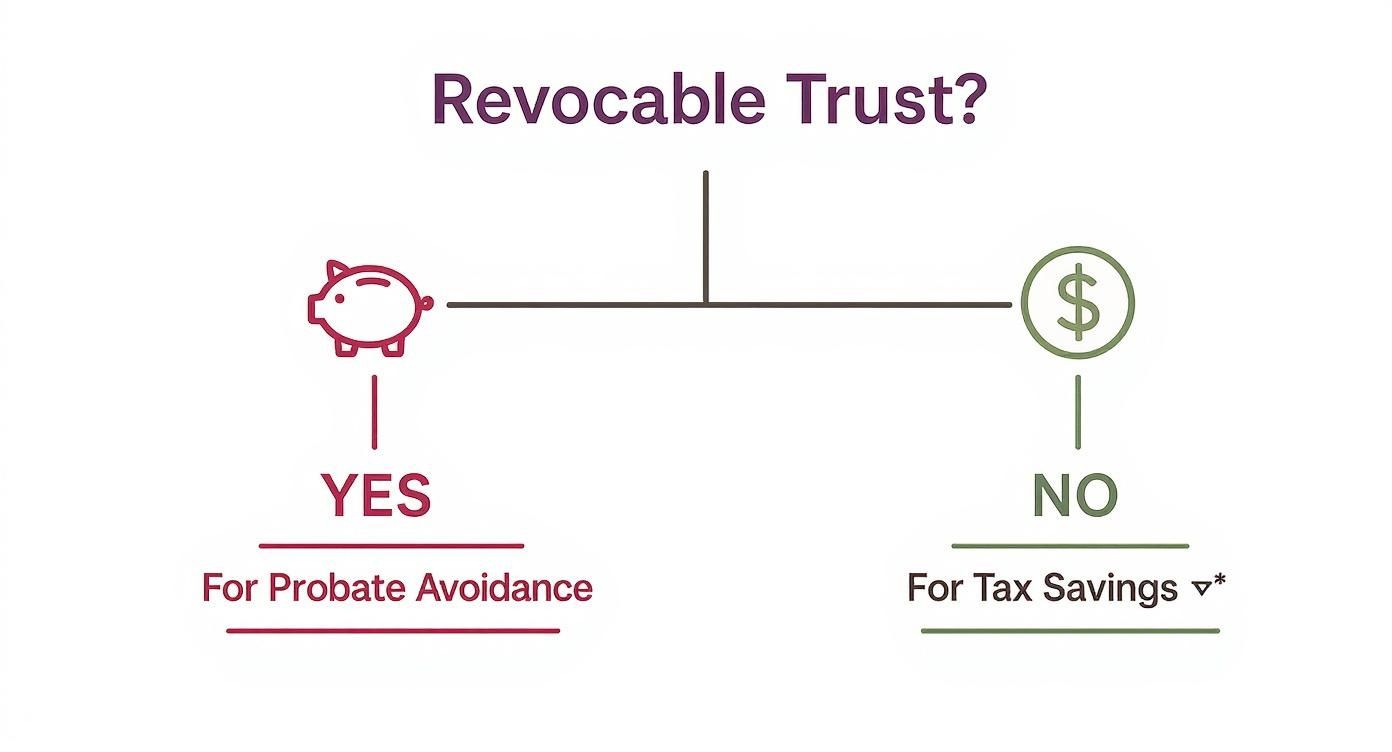
As you can see, the biggest driver for choosing a revocable trust is almost always probate avoidance. A common myth is that they’re primarily for tax savings, but that’s rarely the case for most families.
Revocable Living Trust vs Will: A Side-by-Side Comparison for Texans
To see the differences in black and white, it helps to compare them directly. This table breaks down how each estate planning tool functions in the real world.
| Feature | Revocable Living Trust | Traditional Will |
|---|---|---|
| Probate Process | Avoids probate entirely when properly funded. | Must go through the Texas probate court system. |
| Privacy | Completely private. Asset details and distribution are not public record. | A public record. Anyone can view the will and asset inventory. |
| Upfront Cost | Higher. More complex to create and requires funding. | Lower. Simpler and less expensive to draft. |
| Long-Term Cost | Lower. Avoids probate court fees and related attorney expenses. | Higher. Probate costs can significantly reduce the estate’s value. |
| Incapacity Planning | Built-in. Successor trustee manages assets if you become incapacitated. | Requires separate documents, like a Durable Power of Attorney. |
| Asset Control | You maintain full control during your lifetime. | You maintain full control during your lifetime. |
| Effective Date | Effective immediately upon signing and funding. | Effective only upon your death and after court validation. |
| Time to Distribute | Fast. Assets can be distributed in weeks. | Slow. Probate can take months or even years. |
Ultimately, a trust is an investment in efficiency, privacy, and future cost savings, while a will is a more traditional, court-directed approach.
Probate Avoidance and Privacy
The single biggest difference between a will and a trust is how they interact with the Texas probate court. A will is made for probate; it’s essentially a letter of instruction to the judge. The whole process, from filing the will to the final inventory of your assets, becomes a public record that anyone can look up.
In stark contrast, a properly funded revocable living trust sidesteps probate completely. Since the trust legally owns the assets—not you—there’s nothing for the court to oversee after you pass. This keeps your family’s financial affairs private and helps them avoid the statutory waiting periods and administrative red tape of the court system.
Upfront Cost vs. Long-Term Expense
It’s true: drafting a will is almost always cheaper upfront than setting up a revocable living trust. A will is a simpler document, so it requires less work from an attorney to create. But those initial savings can be a bit of a mirage when you look at the total cost to your estate down the road.
The expenses that come with probate—court filing fees, attorney’s fees, and other administrative costs—can easily eclipse the initial cost of creating and funding a trust. It’s best to view a trust as an investment in avoiding those future costs for your heirs. For a deeper analysis of the financial trade-offs, you can learn more about the differences between a living trust vs. a will in Texas.
Planning for Incapacity
Here’s where a trust really shines. A revocable living trust provides a seamless plan for managing your affairs if you become incapacitated. Your chosen successor trustee can step in immediately to handle your finances without any court intervention whatsoever.
A will, however, only kicks in after you die. If you have a will-based plan, you’ll need separate legal documents like a Durable Power of Attorney to manage incapacity. Without one, your family would have to go to court to establish a guardianship—a process that is public, expensive, and often emotionally draining.
A Tale of Two Texas Families
Let’s make this real. Imagine two neighboring Austin families, the Jacksons and the Garcias. Both own a home, have some savings, and hold a few investments of similar value.
- The Jacksons use a will. When Mr. Jackson passes away, his executor has to hire an attorney and submit the will to the Travis County Probate Court. The entire process takes nearly a year, and all the details of their estate become public information. Legal fees and court costs end up taking a noticeable bite out of the children’s inheritance.
- The Garcias use a trust. When Mrs. Garcia passes, her daughter steps in as the successor trustee and takes control of the trust assets privately. She pays the final bills and distributes the inheritance according to the trust’s instructions in just a few weeks. There’s no court, no public record, and no unnecessary stress.
This simple scenario shows the real-world differences in time, cost, and emotional strain that these two paths create for a grieving family.
Putting It All Together: Making the Right Call
Boiling down the pros and cons of a revocable living trust comes down to this: what are you trying to accomplish for your family? The right choice isn’t found on a simple checklist; it’s defined by your unique goals.
If your number one priority is to shield your loved ones from the public, potentially slow, and often expensive Texas probate process, then a revocable living trust is almost always the better tool for the job. It creates a private, efficient path for distributing your assets. On the other hand, if your estate is modest and uncomplicated, the simplicity and lower upfront cost of a traditional will might be a much more practical fit.
The Pour-Over Will: Your Critical Safety Net
A common myth is that a trust makes a will obsolete. That’s just not true. Even with a perfectly drafted trust, you absolutely need a special type of will called a “pour-over will.”
Think of this document as a vital safety net. Its only job is to “catch” any assets you forgot to transfer into your trust while you were alive and “pour” them into it after you pass away. Without one, those overlooked assets get stuck in the public probate system, completely undermining one of the biggest reasons you created the trust in the first place.
How to Make an Informed Choice
You can’t make a good decision without a clear picture of what you’re protecting. As you start this process, tools for creating a comprehensive estate inventory can make this crucial first step much simpler, giving you a full accounting of your assets.
Ultimately, the trust-versus-will decision hinges on your personal priorities. Is avoiding the public eye and the delays of the Texas Probate Process worth the higher initial investment and the administrative work of funding a trust? Or does the straightforward, court-supervised process of a will better suit your needs? Answering those questions honestly is the key to having a productive conversation about what real protection for your family looks like.
Key Takeaway
A solid estate plan is not just one document; it’s a combination of tools working together. A revocable living trust handles the assets you’ve properly funded into it, providing privacy and efficiency. The pour-over will acts as a critical safety net, ensuring nothing gets left behind to face the public probate court. Together, they create a comprehensive and secure plan that protects your family’s future and honors your wishes.
Common Questions About Texas Living Trusts
When you start digging into revocable living trusts, a few key questions always seem to pop up. Texas families want to know how these tools really work on the ground, not just in theory. Let’s walk through some of the most frequent inquiries we get and give you some clear, straightforward answers.
Do I Still Need a Will If I Have a Revocable Living Trust?
Yes, absolutely. It’s a common myth that a trust completely replaces a will, but the reality is they’re designed to be partners. Even with a well-funded trust, you’ll need a special kind of will called a pour-over will.
Think of this document as your estate plan’s safety net. Its job is to “catch” any assets you might have forgotten to transfer into your trust during your lifetime and “pour” them in after your death. This simple step ensures everything is managed under one private plan, keeping those overlooked assets out of the public Texas Probate Process.
What Does a Revocable Living Trust Cost in Texas?
Setting up a revocable living trust definitely costs more upfront than drafting a simple will. That’s because a trust is a more sophisticated legal instrument that demands careful design and the extra step of funding it with your assets.
But it’s better to see this not as an expense, but as an investment in your family’s future. The initial cost of a trust is almost always dwarfed by the combined court fees, attorney bills, and administrative headaches your estate would face in a long probate battle. By keeping your estate out of court, a trust can ultimately preserve far more of your assets for the people you love.
Can a Revocable Trust Protect My Assets From Creditors?
For the most part, no. Since a revocable trust gives you total control over the assets—you can pull them out or even dissolve the trust whenever you want—the law still sees them as yours. That means creditors can reach those assets to satisfy debts you owe during your lifetime.
For families whose main objective is asset protection, an irrevocable trust is often a much better fit. This is a critical distinction to talk through with an attorney when you’re building a plan that needs to do more than just avoid probate. For more on this, you can compare Wills & Trusts on our site.
What Happens If I Move Out of Texas?
One of the best features of a living trust is its portability. A trust properly created in Texas is valid in all 50 states, so you won’t have to start from scratch if you decide to move.
That said, it’s always a good idea to have your trust documents reviewed by an estate planning attorney in your new home state. Laws can differ on certain specifics, and a quick check-up will make sure your trust continues to operate exactly as intended and stays compliant with local rules.
When to Contact a Texas Estate Planning Attorney
While this guide on the revocable living trust pros and cons gives you a solid starting point, the truth is that every Texas family’s story is different. Off-the-shelf templates and generic advice just can’t account for the personal details that make your estate plan truly yours. Professional legal guidance isn’t just a luxury—it becomes absolutely essential when your life involves more than a simple transfer of assets.
An experienced attorney does more than just draft documents. They help you weigh your options against the backdrop of your unique circumstances, ensuring your final wishes are not only heard but are also legally ironclad.
Navigating Complex Family and Financial Situations
Some situations almost always demand a custom legal strategy. It’s time to call in a professional if you find yourself:
- Navigating a blended family: Second marriages, stepsiblings, and children from previous relationships create a delicate balance. A well-crafted plan is crucial to protect everyone’s interests and head off future Probate Litigation.
- Providing for a beneficiary with special needs: A specialized trust is the key to providing for your loved one without accidentally disqualifying them from critical government benefits. This is not a DIY project.
- Planning for business succession: Handing down a family business is a massive undertaking. A detailed succession plan ensures a smooth transition and protects the company’s future.
- Owning real estate in multiple states: Property outside of Texas can trigger a whole separate probate process in that other state, known as ancillary probate. A trust is one of the most effective tools to sidestep this costly and time-consuming headache.
As you consider your next steps, exploring different Top Estate Planning Attorney Marketing Strategies can offer a glimpse into how these professionals communicate their expertise. Understanding what makes a good fit is just as important as deciding you need help in the first place.
This final point gets to the heart of our firm’s commitment: providing compassionate, no-pressure guidance to help you make the best decision for your loved ones. From drafting foundational Wills & Trusts to managing complex Guardianship matters, we are here to provide clarity and support.
If you’re facing probate in Texas, our team can help guide you through every step — from filing to final distribution. Schedule your free consultation today.