When a loved one passes away, the legal world suddenly introduces a lot of new terms, and one of the most important is "probate court jurisdiction." It sounds complicated, but in plain English, it just means one thing: figuring out which specific court in Texas has the legal power to handle your loved one's estate.
Getting this right from the very beginning is the single most critical step you can take. Filing in the wrong court isn't just a simple mistake—it's a costly one that can lead to frustrating delays and legal fees you shouldn't have to pay. We know this is the last thing you want to deal with while grieving, and this guide is here to provide clarity and compassionate direction.
Your First Step in the Texas Probate Process
Losing a family member is overwhelming enough without having to navigate a legal maze. The first, and most important, step in settling an estate is identifying the correct court. Think of it like this: if you show up to the wrong courthouse, you're not just in the wrong room; you're in the wrong building entirely. Your case will be dismissed, and you'll have to start all over again.
Our goal is to give you a straightforward, compassionate map of the Texas court system. It might seem complex at first, but it follows a clear and logical set of rules designed to bring order to a difficult time.
Understanding the Basics of Jurisdiction in Plain English
At its core, jurisdiction is about authority. In probate, it means a court has been granted the power by Texas law—specifically Title 2 of the Texas Estates Code—to hear cases about a deceased person's property, will, and debts. This isn't a suggestion; it's a hard-and-fast legal rule.
Filing in a court that lacks jurisdiction is like trying to deposit a check at the post office. It simply won't work. The case will be rejected, forcing you to refile in the proper court. This mistake adds to your family's emotional and financial burden during an already difficult time.
So, where do you start? The most important factor is your loved one’s domicile—the county where they had their permanent home when they passed away. This one piece of information is the key to unlocking the entire Texas Probate Process.
Why the Right Court Matters
Choosing the correct court is about more than just checking a box. It's about ensuring the entire process is fair, final, and efficient.
- The process is efficient: Filing correctly from day one prevents your case from being dismissed or transferred, saving months of valuable time.
- Decisions are valid: Only a court with proper jurisdiction can issue legally binding orders that banks, title companies, and other institutions will recognize.
- You avoid unnecessary costs: Starting over means paying new filing fees and legal expenses, turning a manageable process into a costly one.
A Realistic Scenario: The Domicile Mistake
Imagine your father lived his whole life in Travis County but spent his final months in a nursing facility in Williamson County. You might assume you should file where he passed away, but his legal domicile is almost certainly still Travis County. Filing in Williamson County would be a critical error, leading to a dismissal that forces you to start from scratch, delaying asset distribution and adding stress when you least need it.
The Different Courts That Handle Probate in Texas
Texas doesn't have a one-size-fits-all system for probate. The court you'll work with depends largely on where you live. In major metropolitan areas, you'll find specialized courts created for the sole purpose of handling estate matters. In more rural counties, these duties fall to a different set of courts that handle a wider variety of cases.
To make this clearer, here’s a quick breakdown of the courts you're most likely to encounter.
Quick Guide to Texas Probate Courts
| Court Type | Where They Are Found | What They Handle |
|---|---|---|
| Statutory Probate Courts | Major metro counties (Harris, Dallas, Travis, etc.) | Exclusively probate, Guardianship, and related estate matters. These judges are specialists. |
| Constitutional County Courts | Most rural and mid-sized counties. | A wide range of legal issues, including probate. The judge may not be a probate specialist. |
| County Courts at Law | Many counties across Texas. | Handle probate cases alongside other civil and criminal matters, but only if granted that power by statute. |
| District Courts | All counties. | Can handle probate matters, but usually only in contested cases or when there is no other court with jurisdiction. |
Understanding this structure is your first step toward confidently identifying the right starting point for your family's probate journey. While the system can feel a bit tangled, knowing which courthouse door to knock on makes all the difference.
The Four Kinds of Courts That Handle Texas Probate
When you start the Texas probate process, one of the first and most confusing hurdles is figuring out where to file your case. It’s a common source of frustration. You'll quickly find that not just any courthouse will do. The authority—or jurisdiction—to handle your loved one's estate almost entirely depends on which of the 254 Texas counties they called home.
But once you understand the system, it’s not as intimidating as it seems. Texas has a unique four-part court structure for probate. Let's walk through each one, so you know exactly where your case will likely be heard.
1. Statutory Probate Courts
Think of these as the specialists. Statutory Probate Courts exist for one main reason: to handle all matters related to a person's estate. You’ll only find these courts in Texas's most populated urban counties—think Harris, Dallas, Travis, and Bexar.
If your loved one lived in a county with a statutory probate court, the rule is simple: you must file your case there. These courts have what’s known as exclusive jurisdiction, which means they are the only courts legally allowed to oversee Wills & Trusts, guardianships, and anything else Title 2 of the Texas Estates Code calls "matters appertaining to or incident to an estate." The judges here are experts in probate law, which is a huge advantage if the estate is complicated.
The hierarchy below shows how the system is designed to funnel your case to the right court.
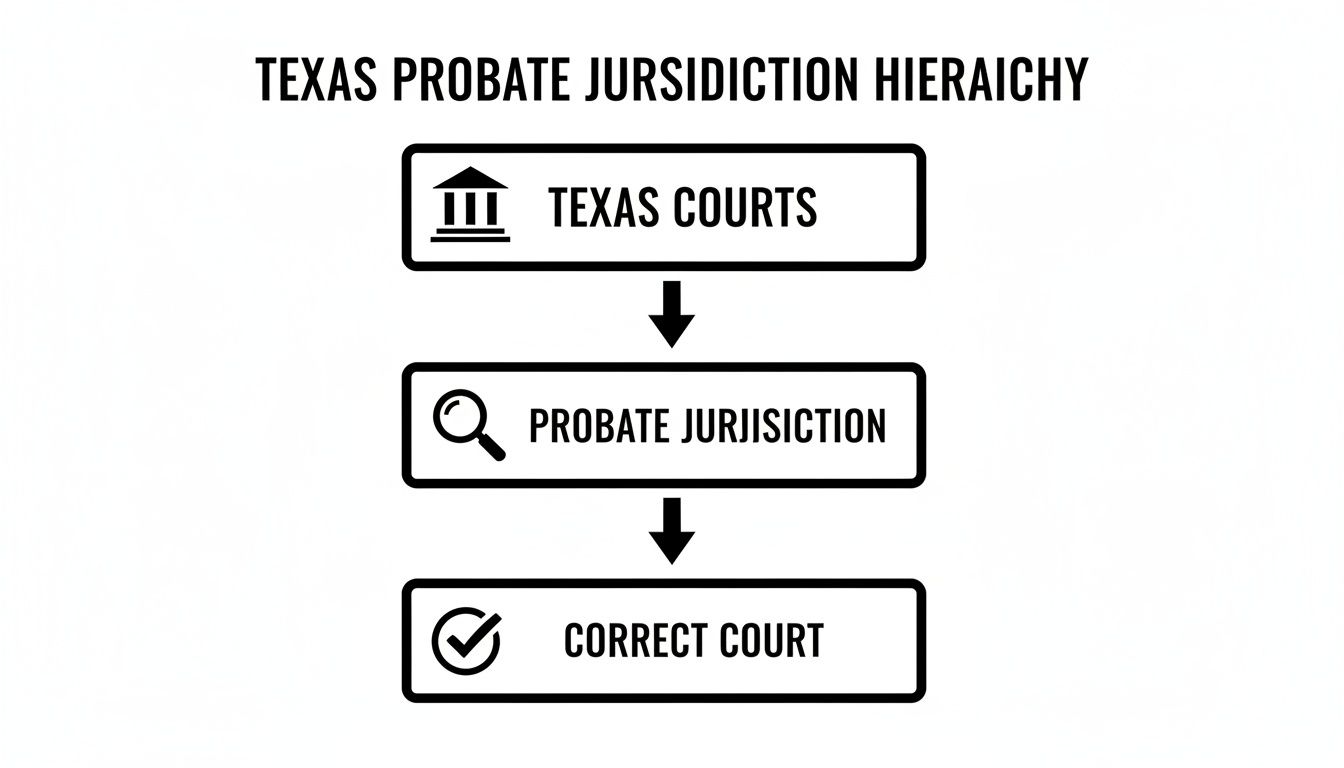
As you can see, getting this middle step right is critical. It ensures your probate journey starts on solid legal ground.
2. County Courts at Law
Move into many of the suburban and mid-sized counties, and you'll find that a County Court at Law often handles probate cases. These courts are generalists, hearing a mix of civil and sometimes criminal cases, not just probate.
A County Court at Law can only hear a probate case if the Texas Legislature has specifically granted it the statutory power to do so. In these counties, they often share jurisdiction with the Constitutional County Court. An experienced attorney can help you figure out which one is the proper venue for your specific situation.
3. Constitutional County Courts
This is the default court for probate in most of Texas's rural and less-populated counties. A Constitutional County Court is established by the Texas Constitution in all 254 counties.
The county judge presiding over this court is mainly an administrator for the county. And here’s a crucial point: this judge is not required to be a lawyer. While they are well-versed in handling routine, administrative probate matters, they may not have the deep legal background needed for complex Probate Litigation or a heavily contested will.
4. District Courts
District Courts are the highest-level trial courts in Texas, but they play a very limited and specific role in probate. A District Court usually only gets involved when a contested issue is transferred from a county court that doesn't have the statutory authority to hear it. This happens most often in rural counties where the Constitutional County Judge isn’t equipped to oversee a complicated will contest.
Key Insight
The Texas probate court system is highly fragmented. As of 2026, there are only 22 statutory probate courts spread across just 11 of Texas’s 254 counties. This means for the vast majority of counties, probate matters fall to generalist courts that are also managing busy civil and criminal dockets. Finding the right court is the first, and most vital, step in the process. If you want to dive deeper, you can check out our guide on how to find the right court for your case.
Jurisdiction vs. Venue: What's the Difference?
When you step into the legal world of probate, it's easy to get tangled up in the terminology. Two words that trip people up constantly are jurisdiction and venue. They sound similar, but getting them mixed up is one of the quickest ways to derail a probate case before it even starts.
Let’s clear this up with a simple travel analogy.
Think of jurisdiction as your passport. It’s what gives Texas courts, as a whole, the fundamental legal power to hear a probate case in the first place. Without this "passport," no court in the state has the authority to act, just like you can't enter a foreign country without valid documentation. The Texas Estates Code grants this authority only to specific courts.
Venue, on the other hand, is your flight ticket to a specific city. Once you know Texas courts have jurisdiction (your passport is valid), venue tells you which county courthouse is the right one to file in. Picking the right city—or county—is crucial for a smooth journey.
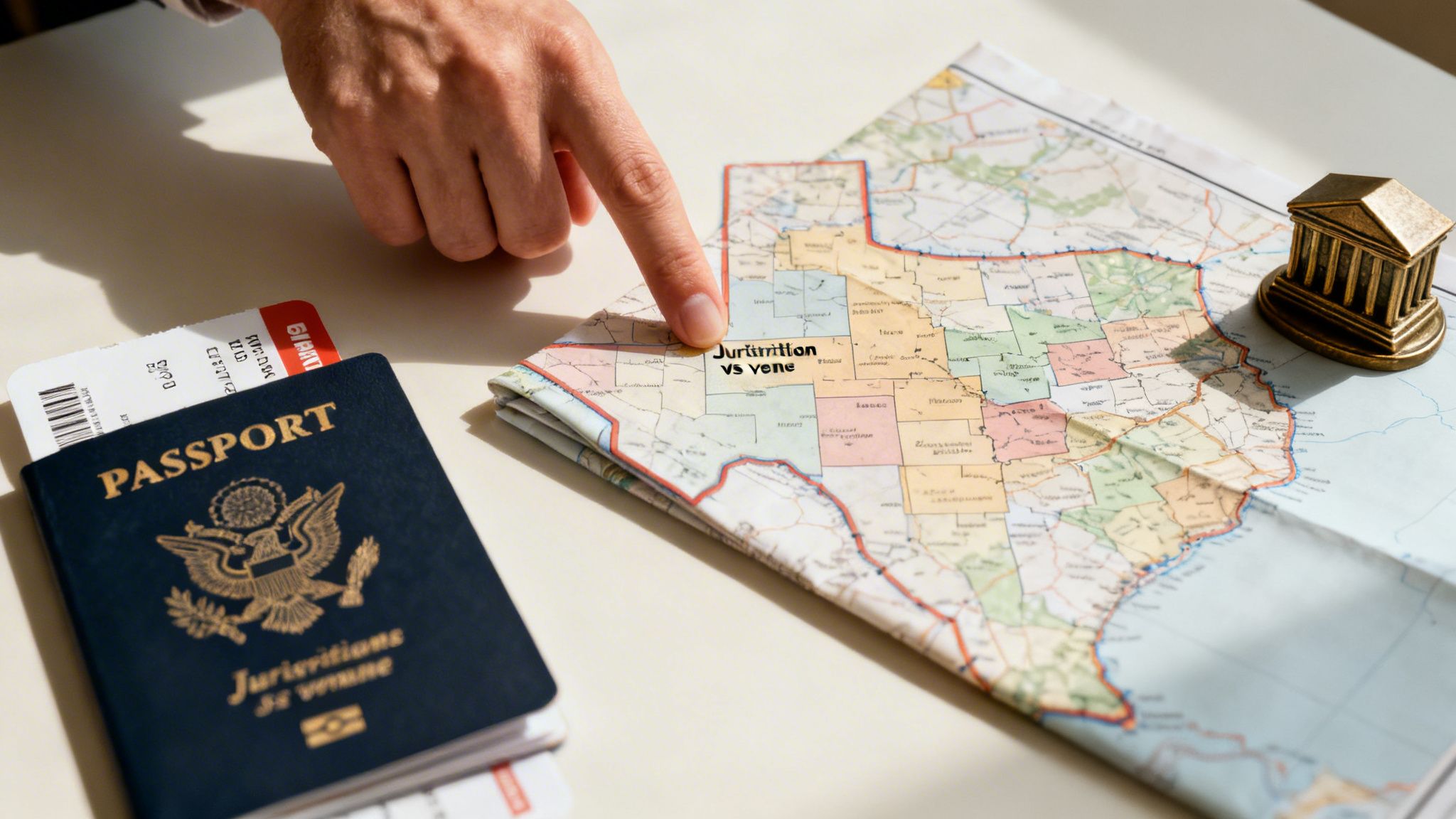
If you file in a court that lacks jurisdiction, your case will be thrown out. If you have jurisdiction but file in the wrong venue, the case can be moved, but not before causing frustrating delays and racking up unnecessary legal fees.
Step-by-Step Guidance for Finding the Right Venue
So where do you file? Title 2, Subtitle C, Chapter 33 of the Texas Estates Code lays out a clear, logical roadmap. The primary rule—the one that applies to most cases—is found in Section 33.001(a)(1). It states that the correct venue is the county where the deceased person had their domicile, or fixed place of residence.
Here’s how to determine the correct venue step-by-step:
- Start with Domicile: Identify the county where your loved one considered their permanent home. This is where they voted, paid taxes, and intended to return, even if they were temporarily living elsewhere (like a hospital, a relative's house, or a nursing home). This is the correct venue in most cases.
- No Domicile, But Died in Texas: If your loved one didn't have a fixed residence in Texas but passed away here, you have a choice. You can file in either the county where their main assets were located OR the county where they passed away.
- Died Outside of Texas: If they died outside of Texas, the case should be filed in any Texas county where their "nearest of kin" (closest relatives) live.
- No Kin in Texas: If they have no kin in Texas either, the venue falls to the county where their principal property was located when they died.
These backup rules ensure there is always a correct place to file. You can dig deeper into these specifics and see how they might apply to your family’s circumstances in our detailed guide on choosing the proper venue for a probate case in Texas.
Key Insight
Filing in the wrong venue is one of the most common—and avoidable—mistakes I see in probate. The court won’t dismiss the case outright, but any interested party can file a motion to transfer it. This forces you to pay more legal fees and start the waiting game all over again in the correct county.
Why Statutory Probate Courts Have the Final Say
If your loved one passed away in one of Texas's major metro areas—think Harris, Dallas, Travis, or Bexar County—the rules for where to file for probate aren't just a suggestion. They're set in stone. Understanding this one fact can save you from making a costly and time-consuming filing mistake.
These counties have what are called Statutory Probate Courts, and when it comes to estate matters, their authority is absolute. These courts have what the law calls exclusive jurisdiction. Think of it like a dedicated, VIP-only entrance to the courthouse. It means this court, and only this court, can hear any case related to a deceased person's estate. No other court, whether it’s a District Court or a County Court at Law, gets to weigh in.
What Does Exclusive Jurisdiction Really Mean?
So, what exactly falls under this "exclusive" umbrella? The Texas Estates Code casts a wide net, covering "all probate proceedings" and anything "appertaining to or incident to an estate." In plain English, that means if it has anything to do with settling the estate, it belongs in this court.
This includes just about everything you can think of:
- Submitting a will for probate
- Getting an executor or administrator appointed
- Approving the inventory of the estate's assets and debts
- Handling claims filed by creditors
- Sorting out fights between heirs
- Giving the final green light to distribute property
This system was put in place for a very practical reason: expertise. The judges in these courts live and breathe probate and Guardianship cases. It's all they do. Their specialized knowledge ensures that even the most tangled family and financial issues are handled correctly, which brings a level of predictability that families can rely on. To learn more about how these specialized courts operate, you can explore our detailed overview of Statutory Probate Courts in Texas.
A Realistic Scenario: An Expensive Mistake in Action
Let's walk through a common scenario. Sarah's father passed away in Harris County, and she is the executor of his will. A distant cousin, Mark, suddenly appears, claiming their father owed him $25,000 from an old personal loan. Instead of filing his claim in the statutory probate court handling the estate, Mark hires a lawyer and files a lawsuit against the estate in a Harris County District Court.
What happens next is swift and predictable: the lawsuit is dead on arrival. Sarah's probate attorney will file a motion to dismiss the case for lack of jurisdiction, and the District Court judge will have no choice but to grant it. The law is crystal clear. Mark just wasted precious time and money filing in the wrong court, and now he has to start the entire process over again—this time, in the right place.
Key Insight
In a county with a Statutory Probate Court, filing somewhere else isn't a strategic option; it's a legal impossibility. These courts are the sole gatekeepers for every estate-related matter, from a straightforward administration to a heated Probate Litigation battle. Any attempt to sidestep them will only lead to dismissal and delay. This isn't just a local court rule; it’s cemented in Texas Estates Code § 32.005, which gives these courts their exclusive power.
Common Jurisdictional Challenges and How to Solve Them
Losing a loved one is overwhelming enough on its own. The last thing you need is to get bogged down in legal red tape. While the rules for probate court jurisdiction in Texas are designed to be logical, real-world family situations rarely fit into clean, simple boxes.
It’s incredibly common for families to run into jurisdictional snags that blur the lines of which court has authority. This can cause a ton of stress and confusion, but don't worry. These challenges are almost always solvable once you know what you're looking at. Let’s walk through some of the most frequent jurisdictional headaches families face and, more importantly, how to fix them so the probate process can move forward.
Property in Multiple Texas Counties
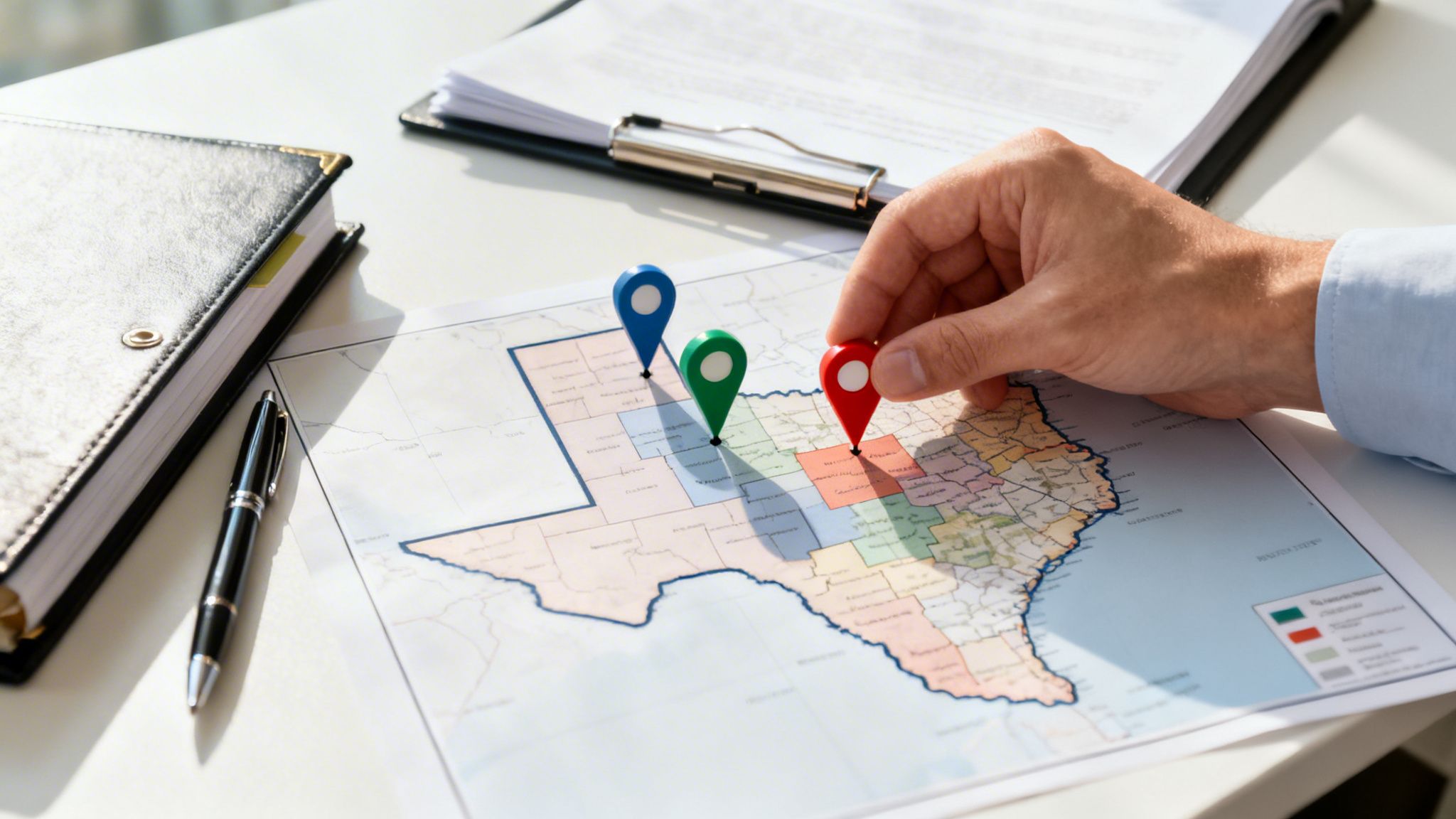
One of the first questions I often get is about property scattered across Texas. Let's say your mother's permanent home—her domicile—was in Harris County, but she also owned a little vacation spot in Galveston County and some undeveloped land out in Montgomery County. Executors often assume this means they'll have to open three separate probate cases.
Thankfully, that’s not how it works. The primary probate administration happens in just one place: the county of the decedent's domicile. In this story, that would be Harris County. The statutory probate court there has the power to oversee the entire estate, including every piece of property located elsewhere in Texas.
Takeaway
You only need to file for probate in one Texas county—the one where your loved one had their permanent home. That single court has jurisdiction over all their Texas-based assets, no matter where they're physically located.
Out-of-State Residents with Texas Property
What about when your loved one lived and passed away in another state, like Florida or California, but still owned property back here in Texas? This is a very common scenario, especially with real estate like a second home, a ranch, or valuable mineral rights.
In this situation, you’ll need to open what’s called an ancillary probate in Texas. Think of it as a secondary, supporting probate process. The main probate will happen in the decedent's home state, but that court's authority stops at the state line. It can't legally transfer the title to Texas property.
To kick off an ancillary probate, you'll generally file a certified copy of the will and the court order from the other state that admitted it to probate. The proper venue for this filing is the Texas county where the property is located. While it's an extra step, this process is usually much more streamlined than a full, from-scratch probate.
Conflicts Between Probate and District Courts
Sometimes, the jurisdictional confusion isn't about geography but about the type of court. This gets tricky when complex legal fights are tied to the estate, like a trust dispute or a wrongful death lawsuit. While a statutory probate court has sweeping authority over "all matters incident to an estate," some legal actions might also fall under a District Court's jurisdiction.
This overlap has been a source of procedural headaches for a long time. The Texas probate system got a major tune-up back in 1973 to help clarify these roles, but conflicts still pop up, tying estates in knots. If you're interested in the backstory, you can dive deeper into the evolution of probate court jurisdiction at St. Mary's Law Journal.
Actionable Solution: So what do you do if a lawsuit involving the estate gets filed in the wrong court? Your attorney can file a Plea to the Jurisdiction. This is a powerful motion that basically tells the court, "You don't have the legal authority to hear this case." It forces the other side to dismiss the case and refile it in the proper court, keeping all the estate-related matters together under one roof where they belong.
Knowing When You Need a Texas Probate Attorney
Trying to navigate the Texas probate system while grieving is overwhelming. While this guide can give you a map, some terrain is just too treacherous to cross without an expert. Recognizing when you're in over your head isn't a sign of weakness—it's the smartest move you can make.
Making that call to a lawyer is an investment in your family’s future and peace of mind. An experienced probate attorney can immediately see the path forward and make sure every jurisdictional rule is followed to the letter. This single step can save you from months of stressful delays and costly mistakes.
Red Flags That Signal You Need an Attorney
Some situations are immediate red flags, signaling that you need legal help right away. If your family’s circumstances involve any of the following issues related to probate court jurisdiction in Texas, it’s time to consult an attorney.
- Property in Multiple Locations: As we've covered, when an estate holds property in different Texas counties or even different states, you’re looking at extra layers of legal work, like ancillary probate. This requires careful, professional coordination.
- Contested Wills or Heirs: The moment a family member challenges the will or heirs start fighting, you’ve stepped into the world of Probate Litigation. A lawyer is absolutely essential to protect your rights and the estate itself.
- Uncertainty Over Jurisdiction: If you’re not 100% sure whether your case belongs in a statutory probate court, a county court at law, or a constitutional county court, a quick call to an attorney can prevent you from filing in the wrong place and wasting months.
- Complex Assets or Debts: Estates with business interests, tangled investments, or significant debts are not DIY projects. A skilled attorney is needed to manage these complexities correctly within the court’s framework.
Your first step toward finding the right probate attorney usually starts with an initial consultation, which is often set up by an intake specialist. This conversation is your chance to find a firm that truly gets what you're going through and can offer clear, compassionate guidance from day one.
The Value of Compassionate Expertise
The probate process isn't just a checklist of legal filings. It’s a deeply personal and emotional journey that unfolds during a time of loss, and you don’t have to walk that path by yourself. Having an attorney who not only knows the law inside and out but also understands what you're feeling is invaluable.
Whether you're dealing with creditor claims, untangling complex Wills & Trusts, or needing to establish a Guardianship, a good lawyer is your advocate, your guide, and your shield.
Key Insight
Hiring a probate attorney isn't admitting defeat. It’s a strategic decision to protect your loved one’s legacy and your family’s future. It gives you clarity and confidence, allowing you to focus on what really matters—healing. Our firm is committed to providing exactly that kind of support. We pair our deep expertise in the Texas Estates Code with a human-centered approach, making sure you feel heard and supported at every turn. We’ll handle the legal burdens so you can navigate this transition with peace.
Frequently Asked Questions About Texas Probate Jurisdiction
Dealing with probate brings a tidal wave of questions, and we know you need clear, straightforward answers, not legal jargon. Let’s tackle some of the most common concerns families have when it comes to figuring out probate court jurisdiction in Texas.
What Happens If I File for Probate in the Wrong Texas County?
Filing in the wrong county—what lawyers call "improper venue"—is a common and frustrating mistake. The good news is it won't get your case thrown out, but it will cause significant delays and rack up unnecessary costs.
Instead of dismissing the case, the court will wait for someone involved to file a motion to transfer it to the right county. This means more paperwork, more legal fees, and a long wait while your case gets moved to a new docket. The simplest way to avoid this headache is to confirm the decedent's permanent home (their domicile) before you file anything. An experienced attorney can verify the proper venue from the get-go, preventing a needless and expensive setback in the Texas Probate Process.
My Loved One Lived in a Small County. Who Hears the Case?
In many of Texas's smaller or more rural counties that don't have a dedicated statutory probate court, your case will likely be heard by a judge in either the constitutional county court or a county court at law. For most folks in rural areas, this means the constitutional county court judge is the one handling probate.
It's a little-known fact that these judges aren't required by law to be attorneys. While they have plenty of experience with routine, straightforward probate matters, they might not be the best fit for a highly complex estate or a contested case that turns into Probate Litigation. A lawyer can help you figure out the right court and navigate the local system, which is especially critical if there are complicated assets or family disputes involved.
Does a Statutory Probate Court Handle Everything for an Estate?
Yes, for the most part. In the major Texas counties that have these specialized courts, they hold what’s known as "exclusive jurisdiction" over "all probate proceedings," as defined in the Texas Estates Code. This means they are the one-stop shop for almost everything related to settling an estate.
This powerful authority covers a huge range of issues, including:
- Admitting a will to probate and confirming it’s valid.
- Appointing an executor to take charge of the estate.
- Approving the inventory of assets and the list of creditor claims.
- Resolving fights between heirs or challenges to Wills & Trusts.
- Overseeing all claims made by creditors against the estate.
Exceptions are incredibly rare. Whether you're an executor, heir, or beneficiary, nearly every issue you'll face—from simple administration to a full-blown lawsuit over the estate—will land in that statutory probate court. This system ensures one judge sees the whole picture, which usually leads to more consistent and efficient results.
Key Insight
Understanding jurisdiction isn't just a legal box to check; it's the foundation of a smooth probate process. Getting this right from day one—whether it's determining venue, establishing a Guardianship, or just filing the first application—is what protects your family’s time, money, and peace of mind.
If you’re facing probate in Texas, our team can help guide you through every step — from filing to final distribution. Schedule your free consultation today.