Skip to content
When a loved one passes away, their property gets sorted into two main categories: probate and non-probate assets. It’s a distinction that sounds technical, but we understand that grasping this one concept is the first step toward navigating the path ahead. Probate assets are those that require a court’s guidance to be passed on, following either a will or Texas state law. Non-probate assets, on the other hand, are set up to transfer directly and automatically to a designated person—like a life insurance policy naming a spouse—and can skip the formal court process entirely.
What Are Probate and Non-Probate Assets in Texas?
Navigating the loss of a family member is emotionally draining, and the legal responsibilities that follow can feel overwhelming. At the heart of settling an estate in Texas is one fundamental distinction: what qualifies as a probate asset versus a non-probate asset? This single concept determines which parts of your loved one’s estate must go through the court-supervised Texas probate process and which can be transferred directly to the people they intended to have them.

Let’s use a simple analogy to make this clear. Imagine the estate is a collection of packages ready for delivery.
- Probate assets are like packages that must be sent to a central processing center—the probate court. There, they’re opened, inventoried, and approved before finally being delivered to the recipient.
- Non-probate assets are like packages with a special “direct delivery” label. They go straight to the recipient’s doorstep, without ever stopping at that central processing center.
This distinction is crucial. It directly impacts how quickly beneficiaries receive their inheritance, the costs involved in settling the estate, and the level of privacy the family maintains throughout the process.
Defining Probate Assets
A probate asset is any piece of property that was owned solely in the deceased person’s name at the time of their death and does not have a beneficiary designation or a survivorship right attached to it. Because there’s no automatic, legally binding instruction for who gets it, the court must step in to direct the transfer.
The probate court’s job, as laid out in the Texas Estates Code, is to ensure everything is handled correctly and fairly. The court validates the will (if one exists), formally appoints an executor to manage the estate, ensures creditors are paid, and finally, confirms the remaining property is distributed to the correct heirs.
Defining Non-Probate Assets
Conversely, a non-probate asset is property that has a built-in mechanism for transfer upon death. This mechanism is a legal shortcut that bypasses the will and the probate court altogether. The ownership transfer is automatic, dictated by legal arrangements made while the person was still alive.
These arrangements act as a direct command, telling the financial institution or other entity exactly who should receive the asset. This is why thoughtful estate planning, often involving tools like Wills & Trusts, is so powerful.
To give you a clearer picture, here’s a quick comparison of the two.
Probate vs. Non-Probate Assets at a Glance
This table breaks down the key differences, helping you quickly identify which category an asset might fall into.
| Characteristic | Probate Assets | Non-Probate Assets |
|---|---|---|
| Ownership | Titled solely in the decedent’s name | Jointly owned with survivorship rights or has a named beneficiary |
| Transfer Process | Requires court supervision (probate) | Transfers automatically upon death based on contract |
| Governing Document | The will (or state intestacy laws if no will) | Beneficiary designations, joint tenancy agreements, trust documents |
| Speed of Transfer | Slower; can take months or even years | Faster; often takes just weeks with proper paperwork |
| Privacy | Public record; court filings are accessible | Private; transfers happen outside of court |
| Common Examples | Solely owned bank accounts, real estate, personal property | Life insurance, 401(k)s, jointly owned homes, assets in a trust |
Understanding this table is the first step toward creating a clear inventory of an estate and mapping out the path forward.
Key Insight
A common misconception is that having a will lets your estate avoid probate. In reality, a will is a set of instructions for the probate court. It is the type of asset—not the existence of a will—that determines whether probate is necessary.
Grasping this difference empowers you to begin the process with clarity and confidence. It helps you create an initial inventory of your loved one’s estate by sorting everything into these two essential columns. This first step provides a roadmap for what lies ahead, turning a daunting task into a manageable set of actions.
Which Assets Go Through Texas Probate
When it’s time to settle an estate, the first real job is figuring out what must go through the Texas court system and what doesn’t. The items that need a judge’s approval are called probate assets.
In simple terms, these are any property owned only in the deceased person’s name, with no beneficiary named or other legal shortcut in place. These assets are essentially paused, waiting for a probate court to give the green light before they can be passed on to the heirs.
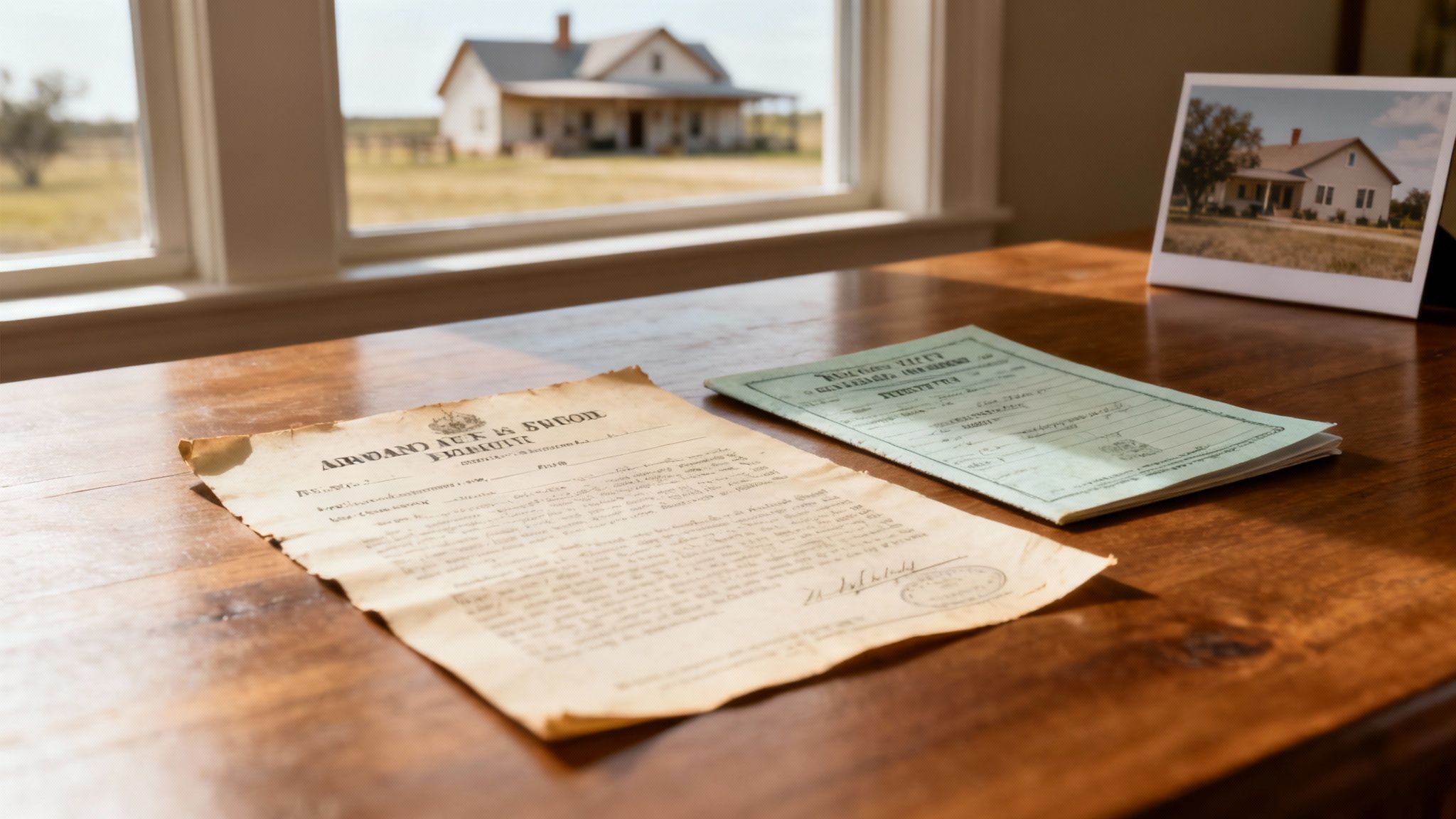
The reason for this is straightforward: the chain of ownership is broken. The title is a dead end. With no clear, legally binding instructions on who gets the property next, the court must step in. It will either follow the directions in the will or, if there’s no will, apply Texas’s intestacy laws to determine the rightful heirs, as laid out in Title 2 of the Texas Estates Code.
Common Examples of Probate Assets
Most estates in Texas have at least a few probate assets. Knowing how to spot them is crucial for understanding the scope of the Texas Probate Process. Here are the usual suspects:
- Solely Owned Real Estate: A house, a plot of land, or a condo titled only in the decedent’s name is a classic probate asset. Without a joint owner who has survivorship rights or a transfer-on-death deed, only a probate court can authorize a change in title.
- Bank Accounts in One Name: A checking or savings account held just by the deceased—without a “Payable on Death” (POD) designation—is frozen. The bank cannot release those funds until an executor provides official Letters Testamentary from the court.
- Vehicles Titled Solely to the Decedent: Cars, boats, and RVs titled exclusively in the name of the person who passed away are probate assets, unless a “Transfer on Death” (TOD) form was filed with the Texas DMV.
- Personal Possessions: Tangible belongings like jewelry, furniture, art, and family heirlooms do not have titles. They are automatically considered probate assets, and the will (or state law) dictates their distribution.
Probate often becomes necessary because of a simple gap in planning. A 2025 report found that only about 24% of Americans have a will. That means a huge number of estates end up in court simply because no other arrangements were made to direct where property should go. You can find more data on the estate administration market on natlawreview.com.
A Family’s Story: The Unplanned Probate of a Texas Ranch
Let’s look at a realistic scenario. Consider the story of the Miller siblings. Their father, a proud Texan, owned a sprawling ranch that had been in the family for generations. He always said, “This ranch will be for you kids,” but he never put it in writing in a will or a trust.
When he passed away, the siblings discovered the deed was in their father’s name and his alone. This meant they had no legal authority to manage the property, pay its taxes from his funds, or make decisions about its future. Their father’s heartfelt promise, unfortunately, carried zero legal weight.
Because the ranch was a probate asset, the Millers had to go to court. This involved these steps:
- Hiring a lawyer to file an application for probate.
- Waiting for a court hearing to get the will validated and an executor officially appointed.
- Creating a full inventory of the ranch and all other assets for the court.
- Placing a notice in the newspaper for any potential creditors.
Only after these steps were completed could the court finally give the executor permission to sign a new deed transferring the ranch to them. The whole process took months and incurred legal fees, but it was the only way to secure their inheritance. This scenario perfectly illustrates why identifying probate and non probate assets from the very beginning is so important for managing expectations and knowing what lies ahead.
Assets That Can Avoid Texas Probate
While some assets must go through the court system, many can be passed to your loved ones through a much simpler, more direct route. These are non-probate assets, and they are the cornerstone of effective estate planning. They offer peace of mind by allowing property to transfer quickly, privately, and without the formal probate process.
Think of these assets as having a built-in GPS. They are legally programmed to go directly to a specific person upon death, thanks to instructions put in place during life. This setup completely bypasses the need for a will or a court to direct the transfer.

Key Types of Non-Probate Assets
Understanding these common non-probate assets is the first step toward safeguarding your legacy and simplifying things for your family. Each uses a different legal tool to achieve the same goal: direct transfer.
- Assets with Beneficiary Designations: This is one of the most common ways to avoid probate. Financial accounts like life insurance policies, 401(k)s, IRAs, and annuities allow you to name a primary and a contingent beneficiary. Upon your death, the funds are paid directly to the person you named, no matter what your will says.
- Payable-on-Death (POD) Bank Accounts: Texas law allows you to add a POD designation to your checking and savings accounts. It’s a simple form you fill out at your bank, naming who should receive the funds when you pass away. Until then, you have full control over the money.
- Property Held in a Living Trust: A living trust is an incredibly powerful estate planning tool. When you transfer ownership of assets—like your home, investments, or bank accounts—into a trust, they are no longer part of your personal estate. The trust owns them, and the trust document dictates exactly how they should be distributed after your death, completely outside of probate court.
Key Insight
Beneficiary designations on accounts like an IRA or a life insurance policy act as a contract that legally supersedes a will. Even if your will leaves everything to one person, the beneficiary named on the account will receive that specific asset.
The Power of Proactive Planning: A Real-Life Example
Consider Sarah, a retired teacher who wanted to make things as easy as possible for her two adult children. Years ago, she set up her bank account as “Payable on Death” to her son and made her daughter the direct beneficiary of her life insurance policy. She also worked with an attorney to place her home into a living trust.
Every few years, Sarah would review these designations to ensure they still reflected her wishes. When she passed away, her children were grieving, but they weren’t burdened with a complicated legal mess.
Her daughter simply filed a claim with the insurance company, and her son presented a death certificate at the bank. The house was managed according to the clear instructions in the trust. Because Sarah planned ahead, her most important assets were transferred privately and efficiently, honoring her memory without adding stress to her family’s lives.
Modern estate planning relies heavily on these non-probate tools. Research shows that while only 45% of Americans have any estate plan, those who do are increasingly using non-probate strategies. For instance, over 60% of individuals with assets between $3-5 million have established trusts to bypass probate. For those with over $10 million in assets, that number jumps to 81%.
These tools aren’t just for the wealthy; they are available to any Texan who wants to ensure a smooth transition for their loved ones. If you are interested in learning more, you can read our detailed guide on unlocking the secrets of non-probate assets.
How Texas Law Classifies Your Property
When it comes to settling an estate, Texas law doesn’t treat all property the same. Certain rules can dramatically change how an asset is handled after death, determining whether it’s a probate or non probate asset. These aren’t just technicalities—they’re the fundamental principles that decide if a piece of property must go through court.
For Texas families, two concepts are especially powerful: joint ownership with survivorship rights and the state’s community property laws. Each one plays a huge role in whether an asset can sidestep the formal probate process.
Joint Ownership and the Right of Survivorship
In Texas, the way you title a shared asset can make all the difference. When property is owned as Joint Tenancy with Right of Survivorship (JTWROS), it has a non-probate transfer built right in.
This legal setup means that when one owner dies, their share automatically and immediately passes to the surviving joint owner. The transfer happens outside of the will and the courtroom, making it a popular and effective strategy for married couples owning a home or a joint bank account.
Key Insight
To create a right of survivorship in Texas, you need more than just two names on a title. The agreement must be in writing and signed by all joint owners, explicitly stating the intent to create these rights as required by the Texas Estates Code, Section 112.051.
Community Property Considerations
Texas is a community property state, which adds another important layer to how assets are classified. In simple terms, almost any property acquired by either spouse during the marriage is considered community property, meaning it belongs equally to both of them.
When one spouse passes away, their half of that community property becomes part of their estate. If they left a will, it dictates where that half goes. If they didn’t, Texas intestacy laws make the decision. This is a critical detail many families miss. For a closer look at these rules, you can explore our Texas probate community property guide.
Simplified Probate Alternatives in Texas
The good news is that not every estate in Texas needs to endure a full-blown, formal probate. The Texas Estates Code offers several streamlined options for smaller or less complicated estates, which can save your family a tremendous amount of time, money, and stress.
Here are the two most common alternatives:
- Small Estate Affidavit (SEA): This is a sworn statement filed with the court to collect and distribute assets from a small estate without formal probate. It’s a great option if the person died without a will and the value of their probate assets (not counting the homestead) is $75,000 or less.
- Muniment of Title: This unique Texas procedure is perfect for situations where someone dies with a valid will but has no outstanding debts (other than those secured by real estate). The court simply recognizes the will as the legal document transferring ownership. It basically functions like a deed, clearing title to assets without needing an executor or a full administration.
Choosing the right path forward requires understanding how these options stack up against each other.
Texas Probate Alternatives Comparison
To help you see which route might be the best fit for your family’s situation, this table offers a clear, side-by-side look at the different probate procedures available in Texas.
| Procedure | Best For | Key Requirement (Simplified) | Court Involvement |
|---|---|---|---|
| Full Administration | Larger, more complex estates or when there are debts and disputes. | An executor is appointed to manage the entire estate settlement process. | High |
| Muniment of Title | Estates with a valid will and no unsecured debts. | Proving the will is valid and that there are no debts to be paid. | Moderate |
| Small Estate Affidavit | Small estates (under $75,000) with no will. | All heirs must agree and sign the affidavit under oath. | Low |
Ultimately, the best path depends entirely on your specific circumstances—from the mix of probate and non probate assets to the existence of a will and the estate’s total value.
Your First Steps as an Executor or Heir
Finding out you’re an executor or an heir can feel overwhelming, especially while you’re also grieving. It’s a moment filled with responsibility, and it’s completely normal to wonder where to even begin. The good news is, your first job isn’t to have all the answers—it’s to start gathering information.
The very first step is to become a document detective. You’ll need to locate and organize all the essential paperwork you can find. This includes the will, of course, but also things like real estate deeds, car titles, bank and investment statements, insurance policies, and recent tax returns. Every single one of these documents contains a clue that will help you tell the difference between probate and non-probate assets.
Creating Your Initial Asset Inventory
Once you’ve gathered the paperwork, it’s time to start a preliminary list of everything the deceased owned. Don’t worry about perfecting it right away; just create a simple inventory of each asset as you come across it.
Think of this list as your roadmap. It’s what will guide you through the entire estate settlement process, giving you a clear picture of what you’re dealing with and helping you choose the right legal path forward under the Texas Estates Code.
Here is a step-by-step guide to classifying each item on your list as either a probate or non-probate asset:
- For bank accounts: Look for any “Payable on Death” (POD) or “Transfer on Death” (TOD) language. If you see it, that account is a non-probate asset.
- For real estate: Check the deed. Do you see the phrase “Joint Tenancy with Right of Survivorship” (JTWROS)? If so, the property likely passes directly to the surviving owner outside of probate.
- For retirement accounts and life insurance: The beneficiary designation form is everything. The person named on that form gets the asset, making it non-probate.
- For vehicles and personal items: If they were owned solely in the decedent’s name with no special titling, they are almost always probate assets.
This flowchart gives you a great visual of how Texas law provides different routes depending on the estate’s size and complexity.
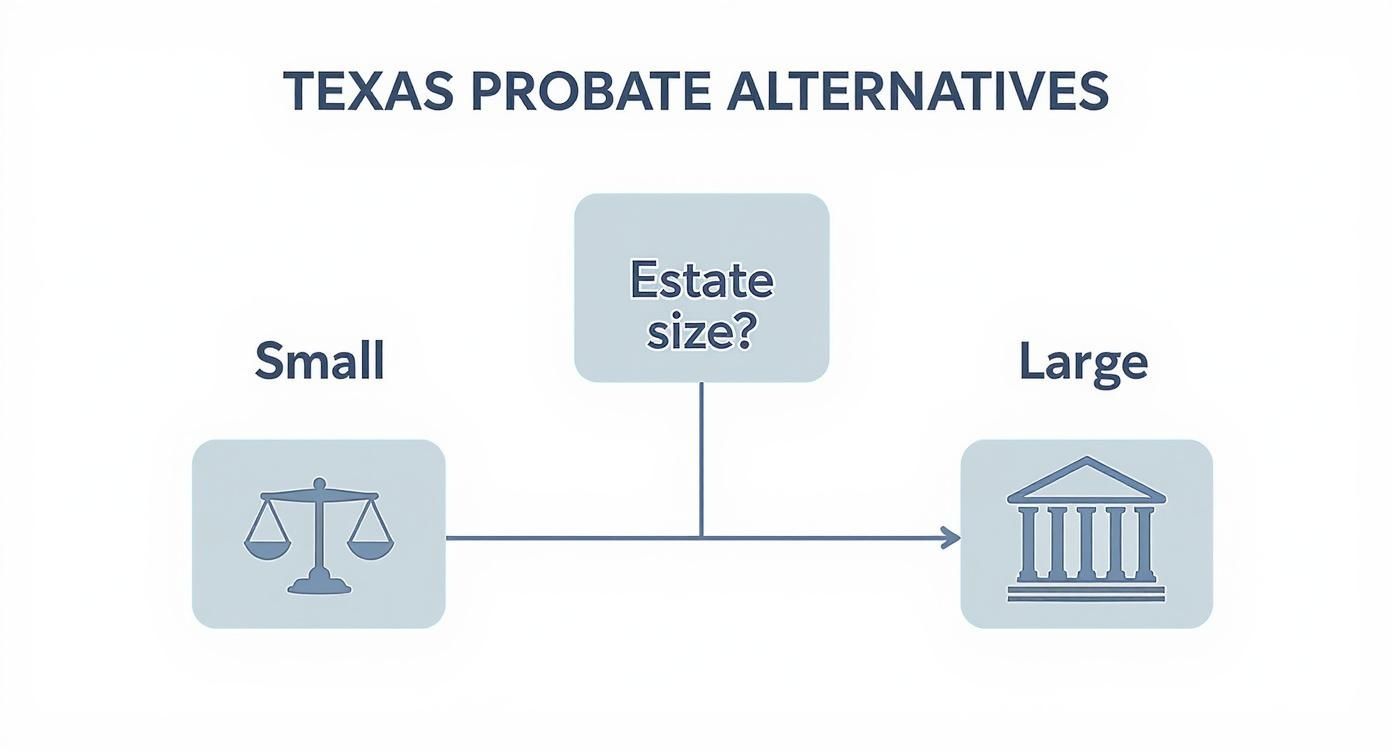
As you can see, Texas offers streamlined alternatives like a Small Estate Affidavit for estates that fall under a specific value, which can help you avoid a full, formal probate process altogether.
Outlining the Next Steps for Each Category
With your list sorted into two columns—probate and non-probate—you can now see two distinct paths emerging. The non-probate assets can be handled directly. Beneficiaries can usually claim them simply by presenting a death certificate and their ID to the bank or financial institution.
Probate assets, on the other hand, are headed for court involvement.
Key Insight
This initial classification is the foundation for everything that comes next. Getting it right from the start saves time, prevents legal missteps, and ensures you’re following the correct procedures right out of the gate.
Beyond the legal and financial duties, executors often have to deal with the immediate and emotional task of managing the deceased’s personal belongings. You can find practical advice on clearing out a loved one’s home that can help make this heavy responsibility a bit more manageable.
Unfortunately, this is also the stage where family disagreements can surface. If disputes arise over the will’s validity or how assets are being managed, the process can get complicated quickly. This is when professional guidance becomes essential, as you may need to navigate Probate Litigation to protect the estate and honor the decedent’s true wishes. Taking these first steps methodically creates a clear, actionable plan to move forward.
Takeaway for Texas Families
Going through the loss of a loved one is one of the hardest things life asks of us. Figuring out the difference between probate and non-probate assets is a huge first step in handling their final affairs with a clear head and a bit more confidence. This guide is meant to give you that solid footing during a tough time.
Every family’s situation is unique, but a few core truths apply to almost everyone. Keeping these points in mind can reduce stress and help ensure your loved one’s wishes are followed just as they intended.
Your Most Important Takeaways
Here’s a quick summary of the essential lessons to keep with you:
- Beneficiary Designations Trump Everything: The names you put on life insurance policies, retirement accounts (like 401(k)s and IRAs), and Payable-on-Death (POD) bank accounts will always override what’s written in a will. Checking and updating these designations is perhaps the single most powerful probate-avoidance tool you have.
- A Will Is a Roadmap for Probate, Not Around It: This is a major point of confusion. Many people think having a will means you get to skip court. In reality, a will is your set of instructions to the probate court on how to hand out your probate assets. It doesn’t avoid the process; it directs it.
- Living Trusts Are Your Detour Around Probate: When you place assets like your house or investment accounts into a living trust, you’re setting them up to be managed and distributed privately and efficiently—completely outside the probate system. It’s a proactive step that can create a seamless transition for your family. Learn more about our approach to Wills & Trusts.
- Texas Has Shortcuts for Simpler Estates: Not every estate needs to go through the full, formal probate process. The Texas Estates Code offers simpler paths like a Small Estate Affidavit or a Muniment of Title for smaller estates, which can save a tremendous amount of time and money.
Key Insight
The best estate planning is done long before it’s ever needed. Taking a little time now to title your assets correctly and double-check your beneficiaries can give your family an incredible amount of peace of mind down the road.
This guide gives you a strong foundation, but applying these ideas to your own family’s circumstances requires careful thought. Getting professional guidance ensures you’re on the right legal path and that every detail is handled with care.
Frequently Asked Questions About Texas Estates
When you’re navigating the details of settling an estate, a lot of questions pop up. We’ve put together some straightforward, compassionate answers to the concerns we hear most often from Texas families, helping to clear up the confusion around probate and non probate assets.
Does a Will Let My Family Avoid Probate in Texas?
This is probably the biggest misconception out there. Many people believe having a will means you get to skip probate, but that’s not how it works. A will is an absolutely essential legal document, but its main job isn’t to avoid probate—it’s to direct it.
Think of your will as an instruction manual for the probate court. It clearly states exactly how you want your probate assets divided among the people you’ve chosen. The assets still have to go through the court-supervised process to be legally transferred.
On the other hand, non-probate assets—like a life insurance policy or an IRA with a named beneficiary—pass directly to that person, completely outside of the will and the court’s oversight.
What Happens If Someone Dies Without a Will in Texas?
When a person passes away without a will, the legal term is that they died “intestate.” In this scenario, probate is still necessary to legally settle their estate and transfer their property. The big difference is that instead of following the deceased’s wishes laid out in a will, the court must follow a rigid succession plan written into the Texas Estates Code, Chapter 201.
The court will oversee a formal process called a “determination of heirship.” It’s a legal proceeding designed to officially identify the deceased person’s rightful heirs according to state law. This is typically a spouse, children, or other close relatives. Once the heirs are identified, the court authorizes the distribution of the probate assets to them.
Key Insight
Dying without a will doesn’t mean the state gets your property, but it does mean you lose all control over who inherits it. The court, not you, makes the final call based on a strict legal formula.
Can a Car Be a Non Probate Asset in Texas?
Yes, absolutely. A vehicle can easily be set up as a non-probate asset, allowing it to bypass the often lengthy and expensive court process. Texas law provides a simple and effective tool just for this purpose.
It’s done through a “Transfer on Death” (TOD) designation. By filling out a specific form with the Texas Department of Motor Vehicles (DMV), a vehicle owner can name a beneficiary. When the owner dies, that beneficiary can claim the vehicle directly—usually just by presenting a death certificate. It makes the transfer seamless and private.
Retirement accounts function in a similar way, using beneficiary designations to avoid probate. To learn more, you can check out our guide on whether IRAs or 401(k)s go through probate in Texas.
If you’re facing probate in Texas, our team can help guide you through every step — from filing to final distribution. Schedule your free consultation today.