When you can't speak for yourself, who will? It’s a tough question, but planning for it is one of the most important things you can do for your family. A living will and a power of attorney are the legal tools that give you a voice, ensuring your wishes for medical care and financial matters are honored, no matter what happens.
Think of it this way: a living will is your script for end-of-life medical care, detailing what you want and don't want. A power of attorney, on the other hand, is like casting a trusted director—someone you appoint to make decisions for you when you're unable. Together, they make sure your story unfolds exactly as you intended.
Your Future, Your Voice: Understanding Texas Advance Directives

No one likes to think about a time when they might be incapacitated. It's unsettling. But preparing for that possibility is one of the kindest and most responsible things you can do for the people you love. In Texas, these planning tools are officially known as advance directives.
Instead of seeing them as complicated legal documents, view them as your personal instruction manual. They give your family and doctors a clear roadmap to follow, guaranteeing that your values and preferences are respected when it matters most. These documents are a crucial part of the Texas Probate Process when planning an estate.
Why Proactive Planning Is So Critical
Putting these documents in place is far more than a box-ticking exercise; it's a profound act of care. It lifts the soul-crushing weight off your family's shoulders, freeing them from having to make agonizing decisions during an already stressful time. Without your written instructions, they’re left guessing what you would have wanted, which often leads to guilt, anxiety, and even family conflict.
By clearly stating your wishes in a living will and designating a trusted agent through a power of attorney, you provide both clarity and peace of mind. You ensure that the person you trust most is legally empowered to advocate for you.
This forward-thinking approach is more important than ever. While the market for advance directives is expected to hit $11.3 billion by 2033, a staggering 55% of Americans still don't have any estate planning documents in place. That's a huge gap between knowing you should plan and actually doing it. You can explore the advance directives market trends to see just how crucial this type of planning has become.
Living Will vs. Power of Attorney At a Glance
To make things even clearer, here’s a quick rundown of how these two essential documents differ.
| Document | Primary Purpose | When It Takes Effect | Who It Empowers |
|---|---|---|---|
| Living Will | Outlines specific end-of-life medical treatments you want or don't want. | Only when you are terminally ill or in an irreversible condition and unable to communicate. | Your medical team, by giving them direct instructions from you. |
| Power of Attorney | Appoints a trusted person (your "agent") to make decisions on your behalf. | As soon as you sign it (for financial matters) or when you're declared incapacitated (for medical matters). | Your chosen agent, to act in your best interest across specified areas. |
This table shows that while both documents plan for incapacitation, they serve distinct and complementary roles. A living will speaks for you about specific treatments, while a power of attorney empowers someone to speak on your behalf more broadly.
Key Benefits of Texas Advance Directives
Taking the time to create these documents gives you and your family invaluable protection and comfort. Here’s what you gain:
- Preserves Your Autonomy: You stay in the driver's seat of your medical and financial life, even if you can no longer communicate your wishes directly.
- Reduces Family Conflict: Clear, written instructions prevent disagreements among loved ones over what the "right" decision is, reducing the risk of stressful Probate Litigation.
- Provides Legal Clarity: Your chosen agent has the undisputed legal authority to act for you, which helps avoid frustrating delays or having a court step in.
- Offers Peace of Mind: There is immense comfort in knowing your wishes are formally documented and your affairs are in trusted hands—both for you and your family.
The Texas Living Will Explained

You’ve probably heard the term "living will," but in Texas, we have our own official name for it: the Directive to Physicians and Family or Surrogates. Its purpose is incredibly focused and vital. This is the document where you get to state your wishes about end-of-life medical care, especially when it comes to life-sustaining treatments.
Think of it as your voice when you can no longer speak for yourself. It only kicks in if a doctor certifies that you’re in a terminal or irreversible condition and are unable to communicate your own decisions. It's your personal instruction manual for your healthcare providers.
Globally, interest in these advance directives is on the rise. Technology is making them more accessible, and societal views are shifting towards proactive end-of-life planning. The market for these tools is growing, with North America leading the way. You can read more about the growing advance directives market to see the trends.
What Texas Law Says
The specific rules for a Directive to Physicians are laid out in the Texas Health and Safety Code, Chapter 166. This is where the law gets very precise about the two legal triggers that allow your living will to take effect: a "terminal" or "irreversible" condition.
- Terminal Condition: An incurable illness that, even with treatment, is expected to cause death within six months.
- Irreversible Condition: A condition that can be managed but never cured. It leaves you unable to care for yourself or make decisions, and without life-sustaining treatment, it would be fatal.
This legal framework is designed to prevent any gray areas. It ensures your wishes are respected under very specific medical circumstances, right when it matters most.
A Story of Clarity: Maria’s Gift
To truly grasp the power of a living will, let’s talk about Maria. She had to watch her father linger for months on life support after a devastating illness. The entire family was torn apart, agonizing over what he would have wanted. That uncertainty became a heavy burden for everyone.
Haunted by that experience, Maria created her own Directive to Physicians. In it, she clearly stated that she would not want artificial nutrition or a ventilator if she were ever in a similar, irreversible state.
By putting her wishes on paper, Maria gave her children an incredible gift: clarity. She made sure they would never have to suffer through the same painful guesswork her family faced. Her living will was an act of love, protecting them from a future of doubt and giving them peace of mind.
This is the real power of a living will and power of attorney plan. The directive lifts the soul-crushing weight of life-and-death decisions from your loved ones. It lets them focus on honoring you, not debating your medical care in a hospital room.
Choosing Your Agent with a Power of Attorney

While a living will is your direct set of instructions, a Power of Attorney (POA) is all about choosing a trusted person—your agent—to make decisions for you. Think of your agent as a co-pilot, someone you trust implicitly to take the controls if you’re ever unable to navigate your own affairs. It’s a role that demands immense trust and rock-solid reliability.
But in Texas, it’s crucial to know that not all POAs are the same. For a complete plan, you really need to understand two key types: the Medical Power of Attorney and the Statutory Durable Power of Attorney.
The Medical Power of Attorney gives your agent the authority to make healthcare decisions, while the Statutory Durable Power of Attorney covers your financial and property matters. Getting a firm grip on what a power of attorney can do is the first step toward safeguarding your future.
Why Durable Matters So Much
That little word "durable" is arguably the most important part of your financial Power of Attorney. A standard POA actually becomes invalid the moment you become incapacitated—the exact time you need it most. A durable power of attorney, however, stays in effect even if you can no longer make decisions for yourself. It’s a critical safety net.
This distinction isn't just legal jargon; it's a game-changer. Without a durable POA, your family could be forced into a lengthy and expensive court process to establish a Guardianship just to handle routine tasks like paying your bills or managing your assets.
The legal foundation for Powers of Attorney is laid out in Title 3 of the Texas Estates Code, specifically Chapters 751 and 752. This framework outlines an agent's responsibilities, confirming they must always act in your best interest—a legal standard known as a fiduciary duty.
The Agent’s Responsibilities
The person you choose as your agent is taking on a significant weight. They are legally and ethically bound to step into your shoes and act as you would, making choices that honor your values and wishes.
Depending on how you structure the document, their authority can be incredibly broad. It often includes:
- Healthcare Decisions: Talking with doctors, reviewing medical records, and making treatment choices that your living will might not cover.
- Financial Management: Paying bills, managing bank accounts, filing your taxes, and handling investments.
- Real Estate Transactions: Buying or selling property on your behalf.
- Business Operations: Keeping your business running smoothly to ensure continuity.
Choosing your agent is one of the most vital decisions you’ll make in your estate plan. You need someone you trust without a shadow of a doubt—a person who is responsible, level-headed, and truly willing to take on this profound duty for you.
How a Living Will and Power of Attorney Work Together
While a living will and a power of attorney are powerful documents on their own, their real magic happens when they work as a team. Many Texas families get tripped up on this point, but it’s actually a simple concept once you see how they perfectly complement each other.
Think of it like this: your living will is your direct voice. It’s a written script that tells your doctors exactly what you want—and don’t want—for end-of-life care. A Medical Power of Attorney, on the other hand, appoints your trusted advocate. This is the person who makes sure your script is followed and has the authority to improvise when unexpected medical situations pop up.
Filling in the Gaps for Total Protection
Let's be realistic—no living will can possibly predict every single medical scenario that might arise. It’s great for setting the big-picture boundaries, but countless smaller decisions will almost certainly need to be made along the way.
This is where your agent, appointed through your Medical Power of Attorney, becomes absolutely essential. They step in to manage all the details your directive doesn’t cover. For a deeper dive into how these documents differ from the will that handles your property, our guide comparing a power of attorney vs. a will in Texas is a great resource.
Your agent is empowered to:
- Talk with different specialists to get second opinions.
- Decide which hospital or rehabilitation facility is best for your care.
- Access your private medical records and share them with your healthcare team.
- Make real-time decisions about things like pain management or palliative care options.
The living will provides the "what," and your agent handles the "how," making sure every single choice stays true to your core values.
A Real-World Scenario: David’s Complete Shield
Imagine David, a retired teacher here in Texas. He drafted a living will that clearly stated he did not want to be kept alive on a ventilator if he were ever in an irreversible condition. He also appointed his daughter, Sarah, as his agent in a Medical Power of Attorney.
Tragically, David suffers a severe stroke and can no longer communicate. His living will immediately informs the hospital of his wishes about ventilation, lifting that terrible burden of choice from Sarah’s shoulders.
But Sarah’s job as his agent is just beginning. She uses her authority to consult with his neurologists, approve his transfer to a specialized stroke recovery center, and consent to specific physical therapy plans—all critical decisions that weren't specified in the living will but were vital for his comfort and quality of care.
David’s plan is the perfect example of how a living will and power of attorney work together to create a complete shield. The living will declared his non-negotiable wishes, while the power of attorney gave his trusted daughter the flexibility to manage everything else, honoring his values at every turn.
Creating Your Texas Advance Directives
Alright, let's move from theory to action. It’s one thing to understand what these documents do, but it’s another thing entirely to create them. The good news is that turning these legal concepts into a solid plan is a very manageable process. I'll walk you through exactly how to set up a valid living will and power of attorney here in Texas, step by step.
This visual gives you a great overview of how the two key documents—the living will and the medical power of attorney—fit together to create a unified plan.
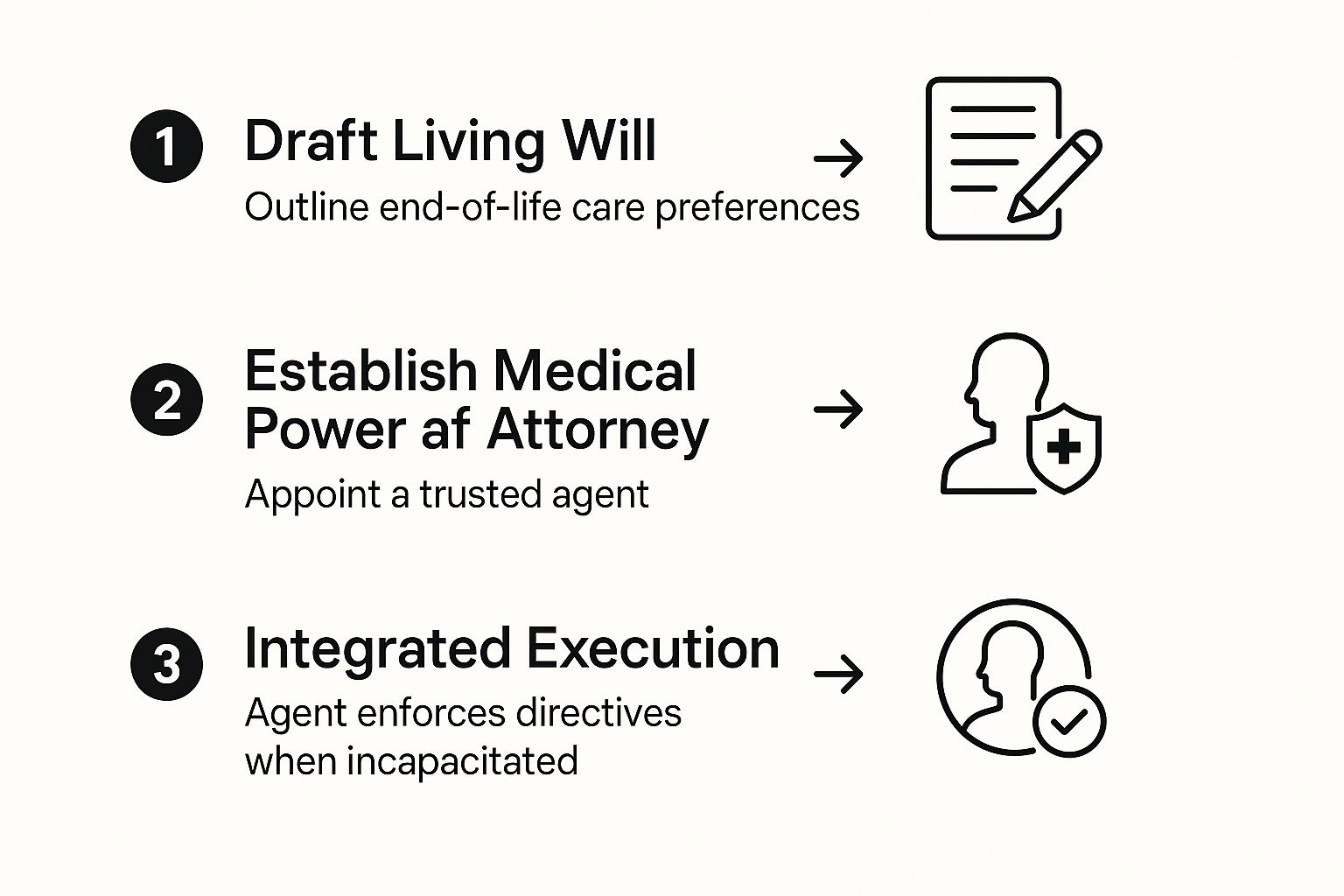
As you can see, you’re essentially doing two things at once: defining your wishes and appointing the person who will enforce them. These are separate actions, but they lead to one cohesive strategy for your future care.
Your Step-by-Step Guide
Getting the procedure right is non-negotiable if you want your documents to hold up when they're needed most. Texas law, especially the Texas Estates Code and Health and Safety Code, lays out some very specific rules you have to follow.
Choose Your Agent Carefully: This is arguably the most important decision you'll make. Your agent for your Medical and Durable Powers of Attorney needs to be someone you trust implicitly—someone who gets your values and won't hesitate to advocate for you, even when things get tough.
Define Your Wishes: Get specific in your Directive to Physicians (Living Will). Think through the treatments you would or would not want, like being on a ventilator or receiving nutrition through a tube. When it's time to formalize those thoughts, tools like legal dictation software can help you draft your Texas Advance Directives with precision and clarity.
Complete the Official Forms: This part is easier than you might think. Texas actually provides official statutory forms for advance directives, which takes a lot of the guesswork out of the process. Using these state-approved templates is the best way to ensure you're ticking all the legal boxes. These documents are a core part of understanding the basics of estate planning in Texas.
Execute the Documents Correctly: Pay close attention here—this step is critical. For your directives to be legally valid in Texas, you must sign them in front of either two credible adult witnesses or a notary public. Your witnesses can't be your agent, your doctor, or anyone who stands to inherit from you.
Store and Share Your Directives: A perfectly executed document is useless if no one can find it. Store the originals in a safe but accessible place. Then, give copies to your agent, your backup agents, your family doctor, and key family members. Make sure everyone knows where the original is located.
To make sure you've got all your bases covered, I've put together a simple checklist that breaks down the execution requirements for these documents in Texas.
Texas Advance Directive Execution Checklist
This table simplifies the legal hoops you need to jump through to make your Living Will and Powers of Attorney official and legally binding in the state of Texas.
| Step | Living Will (Directive to Physicians) | Power of Attorney (Medical & Financial) | Key Consideration |
|---|---|---|---|
| Drafting | Use the statutory Texas form to state your end-of-life wishes clearly. | Use the statutory Texas forms for both Medical and Financial POAs. | Using the state-provided forms is highly recommended to ensure compliance. |
| Signing | You (the "principal") must sign the document. | You (the "principal") must sign the document. | Your signature is what makes the document yours. |
| Witnesses or Notary | Must be signed in the presence of two credible adult witnesses OR a notary. | Must be signed in the presence of a notary public. | This is a crucial difference. A Medical POA requires a notary, while a Living Will offers the choice of witnesses or a notary. |
| Witness Restrictions | Witnesses cannot be your agent, a relative, an heir, your doctor, or an employee of your healthcare facility. | N/A (Notary required) | The law ensures witnesses are impartial and have no conflict of interest. |
| Distribution | Provide copies to your agent, physician, and close family. | Provide copies to your agent, financial institutions, and physician. | Your documents can only work if the right people have them. |
Following these steps meticulously is your best defense against future legal challenges. An improperly signed document can be thrown out by a court, which is the last thing your family needs during a crisis. It could leave them without clear instructions, forcing them into a difficult and expensive court process to make decisions for you. Don't let a small mistake unravel all your careful planning.
Key Insight: A Living Will is Your Voice, a Power of Attorney is Your Advocate
Let's be honest, diving into estate planning can feel like learning a new language. But when you cut through the legal jargon, the core purpose of a living will and a power of attorney is refreshingly simple. Think of them as your personal instruction manual and your chosen advocate, working together to make sure your voice is heard when you can't speak for yourself.
A living will (known in Texas as a Directive to Physicians) lays out your exact wishes for end-of-life medical care. A power of attorney appoints a trusted person—your agent—to step in and make critical decisions for you. Having both isn't redundant; it's a complete layer of protection.
This Isn't Just Paperwork; It's an Act of Love
So many people think these documents are only for the elderly. That’s a dangerous myth. The truth is, a sudden illness or a serious accident can happen to anyone at any age. Without these directives in place, you leave your family facing gut-wrenching decisions—or worse, legal battles—during what is already an impossibly difficult time.
Proactive planning is more than a legal strategy; it's an act of love. It provides your family with clarity, prevents conflict during emotional moments, and guarantees your voice is always heard, no matter the circumstances.
This preparation gives everyone involved—you, your family, and your medical team—a profound sense of peace of mind.
To continue building that protective shield for your family, the next logical steps are to create comprehensive Wills & Trusts to safeguard and manage your assets. Taking these steps ensures every piece of your future is buttoned up and secure.
If you’re facing probate in Texas, our team can help guide you through every step — from filing to final distribution. Schedule your free consultation today.
Answering Your Questions About Texas Advance Directives
Even with the best intentions, it’s completely normal to have a few lingering questions when creating a living will and power of attorney. Let’s walk through some of the most common concerns we hear from Texas families just like yours.
What Happens If I Don’t Have These Documents?
Without a living will or medical power of attorney, decisions about your care can fall into a painful legal gray area. If you become unable to speak for yourself, your family might disagree on the best path forward, which often leads to heartbreaking disputes during an already stressful time.
When that happens, a court may have to step in and appoint a legal guardian to make those decisions for you. That process, laid out in Title 3 of the Texas Estates Code, can be slow, expensive, and incredibly draining for your loved ones. Worst of all, it means a judge—a stranger—gets the final say on your care, not you.
Can I Change My Living Will or Power of Attorney?
Absolutely. Think of these documents as living things—they’re not set in stone. Major life events like a marriage, divorce, or even a significant change in your health are perfect reasons to pull them out, dust them off, and make sure they still reflect what you want.
You can revoke your existing documents and create new ones at any time, as long as you are still legally competent. This flexibility is key; it ensures your wishes always align with your current values and life circumstances, keeping you firmly in control.
Who Should I Choose As My Agent?
This is one of the most critical decisions you'll make, so take your time. The person you choose as your agent for a power of attorney should be someone you trust without a single reservation.
When you're thinking about who to ask, consider these traits:
- Trustworthiness: They must be someone who will always, without fail, act in your best interest.
- Assertiveness: You need a strong advocate who can stand up for your wishes, even when facing pressure from doctors or other family members.
- Availability: Is this person willing and able to step into this role when needed? It’s a significant responsibility.
Always sit down and have an honest conversation with your potential agent before you put their name on paper. Make sure they understand the role and are truly comfortable accepting such a profound duty.
Navigating the details of advance directives can feel overwhelming, but you don't have to figure it all out on your own. The experienced team at The Law Office of Bryan Fagan, PLLC is here to bring clarity to the process and give you peace of mind.
If you’re facing probate in Texas, our team can help guide you through every step — from filing to final distribution. Schedule your free consultation today.