When you’re named the executor of a will after a loved one has passed, one of the first and most critical documents you’ll need from a Texas court is a Letter of Testamentary.
Think of it as your official authorization. It’s the court-issued certificate that gives you the legal authority to manage the deceased person’s estate. Without it, you are essentially powerless—it’s the key that unlocks your ability to act on the estate’s behalf. We understand that this is a difficult time, and our goal is to provide clear, step-by-step guidance to help you navigate your responsibilities with confidence.
Your First Step in Managing a Texas Estate
Losing a loved one is hard enough. Stepping into the role of executor on top of that can feel completely overwhelming. You’re grieving, but suddenly you’re also faced with significant financial and legal responsibilities.
The cornerstone of this entire role is obtaining a Letter of Testamentary, a process rooted in the Texas Estates Code. A common misconception is that this is a simple “letter” you can write yourself. It is not. In reality, it’s a formal order signed by a probate judge.
This court order officially validates the will and confirms your appointment as the executor. Without this sealed document, banks, government agencies, and other financial institutions will not recognize your authority.
That means you won’t be able to:
- Access the deceased’s bank accounts to pay bills or consolidate funds.
- Sell property, like a house or car, to distribute assets or settle debts.
- Talk to mortgage lenders, credit card companies, or the IRS on behalf of the estate.
- Transfer assets to the beneficiaries named in the will.
Simply put, you’ll be stuck at the starting gate.
What a Letter of Testamentary Allows You to Do
The authority granted by a Letter of Testamentary is extensive and absolutely essential for fulfilling your duties as an executor. It serves as legal proof that you are the person in charge of carrying out the final wishes outlined in the will. To put it in perspective, here’s a breakdown of the powers this single document unlocks.
| Area of Responsibility | Specific Actions Authorized | Why It Matters for the Estate |
|---|---|---|
| Financial Management | Access bank accounts, open an estate account, pay bills, and manage investments. | Allows you to secure the estate’s cash, prevent fraud, and keep finances in order while settling debts. |
| Property Transactions | Sell real estate, vehicles, and other personal property. | Necessary for liquidating assets to pay debts or to distribute the proceeds to the beneficiaries as intended. |
| Debt and Tax Settlement | Communicate with creditors, negotiate debts, and file final tax returns with the IRS. | Protects the estate from invalid claims and ensures all legal and financial obligations are met before closing. |
| Asset Distribution | Legally transfer property, funds, and other assets to the beneficiaries named in the will. | This is the final and most important step of your duties, ensuring the decedent’s wishes are honored. |
As you can see, without the Letter of Testamentary, the entire process of administering an estate grinds to a halt. It’s the legal instrument that transforms you from a person named in a will into a recognized representative with the power to act.
This concept isn’t new; these letters trace their roots back to medieval English common law, first appearing in statutes way back in 1357. This historical precedent shaped American probate, and today in Texas, these documents are non-negotiable for tasks like filing IRS taxes for the estate or transferring a vehicle title.
Before diving into the specifics of obtaining this letter, it helps to have a solid grasp of the entire court-supervised journey. We recommend understanding the broader probate process to see how each piece fits together.
The journey begins with filing the correct paperwork, and you can learn more about the key documents for a Texas probate petition in our detailed guide.
Securing a Letter of Testamentary Step by Step
Obtaining a Letter of Testamentary is a formal court process, but it is manageable with the right guidance. Think of it as a series of defined steps, each one moving you closer to fulfilling your loved one’s final wishes. This roadmap will guide you from the initial filing to the moment you hold that crucial document in your hand.
The journey begins by filing a formal document with the court called an “Application to Probate Will and for Issuance of Letters Testamentary.” This is the official starting point for the probate process in Texas.
It’s critical to file this application in the right place. According to the Texas Estates Code, Section 33.001, the proper venue is the county where the deceased person resided. For example, if your loved one lived in Harris County, your application must be filed with the Harris County court that handles probate matters. Filing elsewhere will only lead to delays and frustration.
The Initial Filing and Waiting Period
Once you’ve identified the correct court, your attorney will prepare the application. This legal document lays out the essential facts, including your details as the named executor, the date of the decedent’s death, and a statement confirming a valid will exists.
Along with the application, you must submit two indispensable documents:
- The original, signed will. A copy usually will not be accepted without a much more complex court proceeding to prove its validity.
- A certified copy of the death certificate. This officially documents the person’s passing for the court’s record.
After your application is filed, a mandatory waiting period kicks in. The county clerk will post a notice at the courthouse—a step known as “posting citation.” This notice informs the public that a will has been submitted for probate. Under Texas law, the court hearing cannot take place until at least the first Monday after a 10-day period from the posting date has passed. This public notice ensures any interested parties, like potential heirs or creditors, have an opportunity to see that the probate process has started.
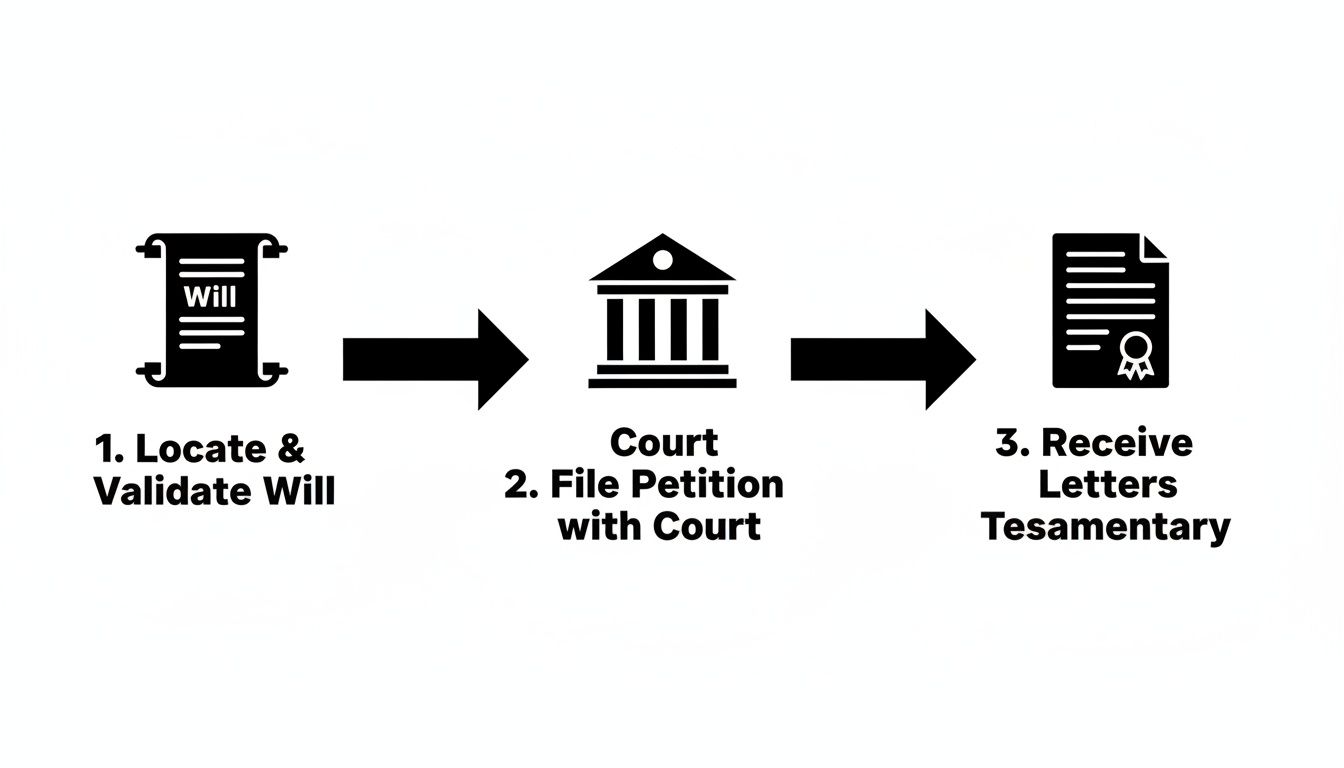
This visual shows a simplified flow of how you gain executor authority, starting with the will and ending with the official letter from the court.
What Happens at the Court Hearing
The court hearing is a formal but typically brief proceeding. It’s not the dramatic courtroom scene you might see on television. In most uncontested cases, the hearing is straightforward and over in minutes.
You, as the applicant, will need to attend and provide testimony. The judge will ask a series of questions to confirm the details in your application and to establish the validity of the will. These questions usually cover:
- Confirming the identity and residence of the person who passed away.
- Verifying that the document presented is their last will.
- Establishing that you are the person named as executor.
- Confirming that you are qualified and not disqualified by law from serving.
This testimony is given under oath and is necessary to create a legal record. If everything is in order, the judge will sign an “Order Admitting Will to Probate and Authorizing Letters Testamentary.” This order is the court’s official green light, but it’s not the final step.
It’s also important to be aware of a critical deadline. Texas Estates Code, Section 256.003, generally requires that a will be filed for probate within four years of the decedent’s death. Missing this deadline can significantly complicate matters, often making it impossible to get a Letter of Testamentary at all.
Your Final Steps to Become Executor
After the judge signs the order, two final tasks remain before the clerk will issue the Letter of Testamentary. These steps must be completed within 20 days of the judge signing the order, so it’s important to act promptly.
First, you must take the Oath of Executor. This is a sworn statement where you promise to faithfully perform all the duties required of you as the executor of the estate. The oath is typically signed right there at the county clerk’s office.
Second, you may need to post a bond. A bond is a type of insurance policy that protects the estate’s beneficiaries and creditors from any potential mismanagement on your part. Thankfully, many Texas wills include a provision that waives the bond requirement, especially for an independent executor. If the will waives bond, and the judge agrees, you can skip this step, saving the estate time and money.
Once you have taken the oath and filed any required bond, the county clerk will issue the official Letter of Testamentary. This one-page document, bearing the court’s seal, is the proof of authority you’ll need. It’s wise to request several certified copies, as different financial institutions and agencies will each require an original certified copy for their records.
While this process is for estates with a valid will, the path is different when someone dies without one. For a clear comparison of the documents issued in each scenario, learn more about the differences between Letters Testamentary vs. Letters of Administration in our detailed guide. Understanding this distinction is fundamental to knowing which legal path your family needs to follow.
Independent vs Dependent Administration in Texas
Once you have your Letter of Testamentary, the real work begins. How you’ll manage the estate falls into one of two paths laid out by Texas law: independent administration or dependent administration. The difference between them is one of the single biggest factors that will shape the speed, cost, and complexity of the entire probate process.
Think of it this way: independent administration is like being given the keys and a map, with the freedom to drive the route yourself. Dependent administration is like having to stop at every intersection and get permission from a judge before you can proceed.
The Freedom of Independent Administration
Here in Texas, independent administration is by far the most common and preferred method. As laid out in the Texas Estates Code, Title 2, Subtitle I, this approach gives an executor the freedom to do their job without constant court supervision.
If the will specifically calls for independent administration—and most well-drafted Texas wills do—you can get right to work on crucial tasks like:
- Paying the estate’s debts and bills.
- Selling property, whether it’s a house or a car.
- Distributing assets to the beneficiaries as instructed.
You can handle these duties without having to ask a judge for permission first. This autonomy is a game-changer. It makes the whole process faster, keeps costs down, and is far less of a burden on everyone involved. It’s a clear sign of the trust the person who passed away placed in you.
The Oversight of Dependent Administration
Dependent administration is the complete opposite. It’s a formal, heavily court-supervised process where the executor must get a judge’s green light for nearly every action they take. This includes routine things like paying a final utility bill or selling a piece of real estate.
This level of oversight usually comes into play when:
- The will is silent on independent administration.
- All the beneficiaries cannot agree to it.
- There’s serious conflict or mistrust among the heirs, making a judge’s involvement necessary to protect the estate.
While this system provides a strong safety net against bad decisions or mismanagement, it comes at a steep price in both time and money. Every request for court approval means filing motions and attending hearings, which can easily add months—or even years—to the probate timeline and drive up attorney fees and court costs.
Historically, the need for formal court processes was often tied to the kind of assets someone owned. Before 1900, only about 25% of U.S. estates were probated, but that number was much higher in rural areas where land ownership required a clear, legal transfer of title. This mirrors the situation in Texas today, where the complexity of an estate can push it toward closer court supervision. You can discover more about the history of probate records in the U.S. to see just how much these practices have evolved.
Independent vs Dependent Administration in Texas at a Glance
To make it even clearer, here’s a quick comparison. This table breaks down the key differences between the two paths you might take as an executor in Texas.
| Feature | Independent Administration | Dependent Administration |
|---|---|---|
| Court Supervision | Minimal; executor acts freely. | High; judge must approve most actions. |
| Speed & Timeline | Much faster; months instead of years. | Significantly slower due to court hearings. |
| Cost | Less expensive; fewer attorney fees and court costs. | More expensive; costs for motions, hearings, and legal fees add up. |
| Common Use Case | When the will requests it or all heirs agree. | When the will is silent, heirs disagree, or there’s conflict. |
| Executor’s Role | Empowered to manage the estate efficiently. | Restricted; must seek permission for most tasks. |
Ultimately, understanding which path your estate is on from day one is crucial. It helps you set realistic expectations and prepare for the road ahead.
If you’re facing a complicated situation with potential family disputes, it’s worth exploring related topics like Guardianship or getting a better handle on Wills & Trusts. In highly contentious cases, things could even escalate into Probate Litigation. Navigating the Texas Probate Process is always simpler when you know exactly which road you’re traveling.
Navigating Common Roadblocks in the Probate Process
Even the most carefully planned estate can encounter challenges during probate. While these moments feel overwhelming, especially when you’re grieving, they’re often more common than you’d think and completely manageable with the right guidance. Knowing what to do when things go sideways can give you a sense of control and reduce stress.
By anticipating these potential hurdles, you’ll feel more prepared to tackle them if they arise, keeping the process from grinding to a halt. Let’s look at some of the most frequent roadblocks executors encounter and the practical steps you can take to move forward.

What to Do if the Original Will Is Missing
It’s a moment of panic for many new executors: you can’t find the original, signed will. You might have a copy, but Texas courts have a strong preference—and often a requirement—for the original document. But don’t despair. A missing will doesn’t automatically mean the estate proceeds as if no will ever existed.
Under Texas Estates Code Section 256.054, you can probate a copy of a will. Be aware, though—it’s a more involved court proceeding. To succeed, you have to prove two key things:
- There’s a valid reason the original cannot be produced (for example, it was lost, accidentally destroyed, or you suspect someone is wrongfully withholding it).
- The contents of the will can be proven by a credible witness who has either read it, heard it read, or can identify the copy as being accurate.
This scenario highlights the importance of knowing where your loved one stored their critical documents. If you find yourself in this situation, seeking legal guidance right away is essential. You’ll need to build a strong, convincing case for the court.
Handling a Contested Will
Another major challenge is when an heir or beneficiary decides to contest the will’s validity. This can bring the probate process to a halt, turning what should be a straightforward administrative task into a stressful and expensive legal battle.
A will contest usually involves a few common claims:
- Lack of Testamentary Capacity: The argument that the person was not of sound mind when they signed the will.
- Undue Influence: The claim that someone else coerced or manipulated the person into creating or changing their will.
- Improper Execution: The assertion that the will wasn’t signed or witnessed correctly according to Texas legal standards.
When a will is contested, your path to getting a letter of testamentary becomes much more difficult. The court will schedule hearings to listen to evidence from both sides before making a decision. This is where having an experienced attorney is absolutely essential, as these disputes often escalate into formal Probate Litigation.
When the Named Executor Cannot Serve
It happens. The person named as executor in the will is either unable or unwilling to take on the job. Perhaps they have passed away, become incapacitated, or are simply overwhelmed by the responsibility.
Fortunately, most well-drafted wills name an alternate or successor executor to step in. If there’s an alternate, that person can file the probate application and move forward just as the original nominee would have.
But what if there is no alternate named, or the alternate cannot serve either? In that case, the court must appoint a suitable administrator. Texas law has a priority list for who gets considered, usually starting with the surviving spouse, then the main beneficiary, and so on. The court’s goal is always to appoint someone who can manage the estate capably and impartially, ensuring the deceased’s wishes are still honored, even if their first choice for executor is not the one to do it.
Your Duties After Receiving the Letter of Testamentary
Getting that official Letter of Testamentary in your hands is a huge milestone. It might feel like you’ve crossed the finish line, but in reality, it’s the true starting point for your work as executor. With this document, you finally have the legal authority to manage the estate, and your responsibilities kick off in earnest. This is where your attention to detail and commitment to fulfilling your loved one’s wishes come into play.
Think of yourself as the project manager for the estate. Your job is to systematically identify assets, notify the right people, pay legitimate debts, and finally, ensure what’s left gets to the correct beneficiaries. It’s a significant responsibility, but you can tackle it with a clear, step-by-step approach.

Notifying Creditors and Marshalling Assets
One of your very first legal duties is to publish a “Notice to Creditors.” As required by the Texas Estates Code, Section 308.051, you must publish a notice in a local newspaper within one month of receiving your letters. This notice is a formal announcement that the estate is open and informs anyone the deceased owed money to that their time to submit a claim is limited.
This step is absolutely critical. It protects the estate from old or unknown debts appearing later by creating a clear, legal deadline for creditors.
At the same time, you’ll begin the process of identifying and gathering—or “marshalling”—all of the estate’s assets. This means creating a complete list of everything the deceased owned.
You’ll need to locate things like:
- Bank and investment account statements
- Deeds to any real estate
- Vehicle titles
- Life insurance policies
- Personal property like jewelry, art, or valuable collections
This core task of gathering and accounting for property has deep historical roots. For example, probate records from 19th-century England and Wales show that farmers had a 100% relative probability of their estates being probated, while laborers were at just 4%. It’s a reminder that estate administration has always been tied to the nature and value of a person’s assets. The work you do today—inventorying, paying debts, and distributing property—is a direct continuation of this long-standing principle.
Preparing the Estate Inventory
Within 90 days of your appointment, you must file a sworn document with the court called an “Inventory, Appraisement, and List of Claims.” This is one of the most important documents you’ll create. It’s a detailed, itemized list of all the estate’s property and its estimated fair market value on the date of death.
The inventory must be thorough and accurate. It serves as your official accounting to both the court and the beneficiaries of what the estate contains. The court relies on this document to understand the estate’s scope, and it provides crucial transparency for everyone involved.
A Real-World Scenario in Action
Let’s imagine an executor named Sarah who is managing her father’s estate in Harris County. Her father owned a house, two bank accounts, a car, and a small investment portfolio.
After receiving her Letter of Testamentary, Sarah’s attorney helps her publish the Notice to Creditors in a local Houston newspaper. Next, Sarah methodically gathers all the key documents: the deed to the house, the latest bank and investment statements, and the car title. To determine values, she works with a real estate agent for a house appraisal and uses public resources for the car.
She then compiles everything into the Inventory, Appraisement, and List of Claims, listing each asset with its value. She signs it under oath and files it with the court well within the 90-day deadline. This careful work creates a clear and defensible record for the court and provides peace of mind for her siblings, who are the other beneficiaries.
Paying Debts and Distributing the Estate
Once the inventory is filed and the time for creditors to submit claims has passed, your next major task is to pay the estate’s legitimate debts and taxes. This includes final medical bills, credit card debts, utility bills, and filing the deceased’s final income tax return.
Only after all valid debts, administrative expenses (like attorney fees and court costs), and taxes are paid can you move to the final step: distributing the remaining assets to the beneficiaries as directed by the will. It is critical that you do not give assets to heirs before settling the debts. If you do, you could be held personally liable for those unpaid bills.
This final phase requires clear communication with the beneficiaries, keeping them informed of your progress. Once all distributions are made, you will file a final accounting or affidavit with the court to formally close the estate. For a more detailed look at these responsibilities, you can learn about the full duties of a will executor in our guide.
Key Takeaway
A Letter of Testamentary is the legal document that officially empowers you, as the named executor, to manage and settle a loved one’s estate according to their will. Obtaining this court order is the essential first step in the Texas probate process. It allows you to access bank accounts, pay debts, manage property, and ultimately distribute assets to the rightful heirs. The process involves filing a formal application with the will, attending a court hearing, and taking an oath. Understanding this process and your duties is critical to honoring your loved one’s wishes and protecting yourself from personal liability.
Your Top Questions About Texas Probate Answered
When you’re grieving, the last thing you want to deal with is legal uncertainty. It’s completely normal to have questions about what comes next. To provide some clarity, we’ve put together answers to the most common questions we hear from families about Letters of Testamentary and the Texas probate system. Before diving in, it helps to have a good handle on what is probate and how it works.
These are straightforward, plain-English answers designed to help you feel more confident as you navigate this process.
How Long Does It Take to Get a Letter of Testamentary in Texas?
In a smooth, uncontested case, you can generally expect to have Letters of Testamentary in hand within one to three months from the day you file the application. This timeline accounts for the required court posting period, the hearing date, and the time it takes the judge to officially sign the order.
Of course, this is an estimate. Delays can occur. A busy court docket, difficulty locating all the heirs, or someone deciding to contest the will can all slow things down. Having an experienced probate attorney is the best way to keep the process moving forward efficiently.
What if There Is No Will?
If a person passes away without a will, it’s called dying “intestate,” and the estate goes through a process known as an intestate administration. In this scenario, you cannot get a Letter of Testamentary.
Instead, the court appoints an administrator to handle the estate. This person receives a similar document with a different name: Letters of Administration. The responsibilities are much the same, but the key difference is how assets are distributed. Without a will to provide instructions, the administrator must divide the property according to Texas’s strict intestacy laws, which dictate exactly who inherits the property.
How Much Does It Cost to Get a Letter of Testamentary?
The total cost depends on the complexity of the estate, as no two situations are exactly alike.
Generally, you should budget for:
- Court Filing Fees: These usually run between $300 and $500, though it varies by county.
- Notice Publication Fees: The cost to publish a formal Notice to Creditors in a local newspaper.
- Attorney Fees: This is the biggest variable. A simple, uncontested estate will cost far less than one that’s complex or involves family disputes that require significant legal work.
A knowledgeable probate attorney can give you a much more accurate cost estimate after learning about the specifics of your case during a consultation.
Do I Need a Lawyer to Get a Letter of Testamentary?
While some Texas counties might technically allow you to file on your own (this is called appearing “pro se”), it is almost always a bad idea and we strongly discourage it.
Probate is a formal legal proceeding guided by the complex Texas Estates Code. One small mistake on a form or a missed deadline can lead to expensive delays or complications. More importantly, it could leave you personally liable for the estate’s debts.
Hiring a probate attorney isn’t just an expense; it’s an investment in your peace of mind. It ensures everything is handled correctly, protects you from personal liability, and frees you to focus on what matters most—your family.
If you’re facing probate in Texas, our team can help guide you through every step — from filing to final distribution. Schedule your free consultation today.