
An irrevocable trust is a powerful estate planning tool, but it's not for everyone. Think of it as a one-way street: once you put assets into it, you generally can't take them back. The significant benefit is robust protection for those assets, shielding them from creditors and helping to minimize estate taxes. The trade-off? You give up control. You can't simply change the terms or reclaim your assets once the trust is established.
Navigating this decision can feel overwhelming, especially when you are planning for your family's future or coping with the loss of a loved one. Our goal is to provide clear, compassionate guidance to help you understand if this tool is right for your family.
Understanding the Basics of an Irrevocable Trust
When you create an irrevocable trust in Texas, you are transferring assets into a separate legal entity that you no longer personally own. In plain English, it’s like putting valuables in a locked box and giving the key to a trusted person—the trustee—who manages everything for your chosen loved ones, the beneficiaries. This finality is both its greatest strength and its most significant weakness.
For Texas families, this decision carries significant weight. It directly impacts your financial flexibility and shapes your family's legacy. This strategy is often used for specific goals, like protecting a family business from a future lawsuit or ensuring a child with special needs is cared for without jeopardizing their government benefits.
Irrevocable Trust Pros vs Cons at a Glance
For families navigating the complex world of estate planning, a clear picture of the pros and cons is the first step. The decision often comes down to a single question: do you value long-term asset security more than immediate personal control?
This table breaks down the main trade-offs you'll need to consider.
| Feature | The Upside (Pro) | The Downside (Con) |
|---|---|---|
| Control | A trustee manages the assets, protecting them from impulsive decisions. | You permanently give up control and ownership of the assets. |
| Asset Protection | Shields assets from future creditors, lawsuits, and legal judgments. | Those assets are no longer available to you for personal use or emergencies. |
| Flexibility | Provides certainty and prevents future disputes by locking in your exact wishes. | Extremely difficult and costly to modify, even if family circumstances change. |
| Estate Taxes | Removes assets from your taxable estate, which can lower potential tax bills. | May create other tax complications, like compressed income tax brackets for the trust. |
| Medicaid Planning | Can help you qualify for long-term care by reducing your "countable" assets. | The transfer is subject to a five-year "look-back" period, requiring early planning. |
The table makes it clear: an irrevocable trust is a serious commitment. You are trading flexibility for security.
Deciding between this permanent structure and more flexible options is a critical part of estate planning. While a will directs where your assets go after death, an irrevocable trust changes their ownership during your lifetime. To better understand these differences, you can learn more about how irrevocable trusts vs. wills work in our detailed guide.
Ultimately, speaking with an experienced attorney is the only way to know if this path aligns with your family’s unique circumstances and long-term goals.
Key Advantages of an Irrevocable Trust
For Texas families, creating an irrevocable trust is a significant decision. Giving up control over your assets can feel like a huge leap of faith. But when your goals are centered on long-term security and preserving what you've built, the benefits can be profound.
An irrevocable trust is a specialized tool designed to solve specific, high-stakes problems that other estate planning documents can't handle. The core concept is legally separating assets from yourself, the grantor (the person creating the trust). Once you transfer property into the trust, it's no longer considered yours for most legal and financial purposes. This unlocks three powerful advantages: shielding assets from creditors, reducing estate taxes, and helping you qualify for long-term care.

Unmatched Asset Protection
One of the most common reasons families seek our help with an irrevocable trust is for asset protection. This tool acts as a legal fortress around your most important property.
Scenario: Imagine a successful surgeon in Houston. She has spent decades building her practice but knows her profession carries a high risk of litigation. To protect her family’s home and personal savings from any future lawsuits, she transfers them into an irrevocable trust. Now, if her practice ever faces a legal judgment, those assets held by the trust are generally off-limits to creditors because, legally, she no longer owns them. This strategy is a cornerstone of legacy protection for professionals and entrepreneurs.
Strategic Estate Tax Reduction
For families with significant wealth, the federal estate tax can take a substantial portion of the assets you hope to pass down. An irrevocable trust is one of the most effective tools for minimizing this tax burden.
When you transfer assets into an irrevocable trust, they are removed from your taxable estate. This means their value isn't counted when calculating your estate's total worth upon your death. For a high-net-worth family, this can be the difference between preserving a legacy and losing a large part of it to the IRS. There are many strategies to avoid estate taxes, and using a trust is among the most powerful. This foresight ensures more of your hard-earned wealth reaches your beneficiaries.
A study on how irrevocable trusts benefit wealth preservation strategies on tontine.com highlights their effectiveness in preserving wealth for future generations, a common goal for many Texas families.
Planning for Long-Term Care and Medicaid
The staggering cost of long-term care in Texas can deplete a lifetime of savings. An irrevocable trust can be a vital part of a Medicaid planning strategy, helping you qualify for assistance without impoverishing your family.
Consider a retired couple in San Antonio looking ahead to potential nursing home care. To qualify for Medicaid, their "countable" assets must be below a certain threshold. By transferring their home and a portion of their savings into a specially designed irrevocable trust—well in advance of needing care to comply with Medicaid's five-year "look-back" period—they can legally reduce their countable assets. This move helps them qualify for the care they need while preserving their hard-earned assets for their children. It’s a compassionate way to prepare for the future.
These advantages highlight why so many families turn to our firm for guidance on Wills & Trusts. While the decision is permanent, the protections an irrevocable trust offers are powerful and lasting.
Understanding the Downsides and Very Real Risks
While the advantages of an irrevocable trust are powerful, they come with equally significant drawbacks. For Texas families, it's essential to understand the risks. The very permanence that provides protection also creates rigidity and a profound loss of personal control.
Understanding these cons is not meant to be intimidating; it is about making a fully informed choice. Once this legal structure is in place, attempting to undo it is difficult, expensive, and sometimes impossible.
The Permanent Loss of Control
The single biggest drawback of an irrevocable trust is the complete surrender of control. Once you transfer assets—whether it's the family ranch, an investment portfolio, or your home—they are no longer legally yours. You can't decide to sell them, refinance them, or use them as collateral for a loan.
This loss is absolute. The assets are now owned by the trust and managed by a trustee for your beneficiaries. While that is the very mechanism that shields the assets from creditors and lawsuits, it can be a difficult reality for anyone used to managing their own financial affairs.
Inflexibility in a Changing World
Life is unpredictable, yet an irrevocable trust is, by nature, rigid. Family situations can change in unexpected ways. A beneficiary might go through a difficult divorce, struggle with addiction, or simply prove to be irresponsible with money.
Trying to modify an irrevocable trust to adapt to these new realities isn't simple. As outlined in the Texas Estates Code, Title 3, making changes often requires the unanimous consent of all beneficiaries or a formal court proceeding. Both routes can be complex and costly.
This inflexibility is a serious risk. By design, these trusts are difficult to amend or revoke. You can learn more about the dangers of this inflexibility at dominion.com. When a trust's strict terms no longer fit a family’s current needs, disputes can arise, sometimes leading to painful disagreements that require help with Probate Litigation.
The Potential for Higher Tax Bills
While irrevocable trusts are excellent tools for reducing estate taxes, they can create income tax complications if not structured carefully. Trusts have what are known as compressed income tax brackets.
In simple terms, a trust hits the highest federal income tax rate with far less income than an individual would need to earn to reach the same bracket. For 2024, a trust hits the top 37% tax bracket after retaining just over $15,200 in income.
Let that sink in:
- Individuals: A single person needs to earn over $609,350 to reach the 37% tax rate.
- Trusts: A trust reaches that rate with only $15,200 of income that isn't distributed to beneficiaries.
If the trust generates income—from investments, rental properties, or a business—and that money is not paid out to the beneficiaries in the same year, it can be taxed at a much higher rate inside the trust. This demands careful management by the trustee to avoid unnecessarily high tax bills.
Evaluating the Financial Costs of an Irrevocable Trust
Setting up an irrevocable trust is a significant financial commitment, and the cost goes beyond drafting the document. For Texas families, it's crucial to look at the full picture—both the initial investment and the ongoing expenses.
Unlike a simple will, creating a customized irrevocable trust is a more involved legal process. The initial fees reflect the expertise needed to build a trust that achieves your specific goals, whether it's asset protection, Medicaid planning, or estate tax reduction. This initial investment is the foundation; if it’s not solid, the entire structure could fail.
Breaking Down the Upfront and Ongoing Expenses
The costs of an irrevocable trust fall into two categories: initial setup fees and long-term administrative expenses.
While a more detailed analysis of the cost of an irrevocable trust at greinerlawcorp.com is available, here's a general breakdown:
- Initial Setup Fees: Attorney fees can range from $2,000 for a straightforward trust to $10,000 or more for highly specialized trusts, such as those for special needs planning or complex asset protection.
- Annual Trustee Fees: The trustee manages the trust and is compensated for their work. The fee is typically a percentage of the trust's total value, usually between 0.5% and 2% annually.
- Tax Preparation Fees: An irrevocable trust is a separate legal entity and must file its own annual income tax return (IRS Form 1041). Professional preparation can add another $500 to $3,000 to your yearly costs.
A Real-World Cost Example
Let’s walk through a realistic scenario for a Texas family.
Imagine a couple places $1 million in assets into an irrevocable trust. They hire a professional corporate trustee who charges a standard 1% annual fee.
- Annual Trustee Fee: 1% of $1,000,000 is $10,000.
- Annual Tax Preparation: A conservative estimate is $1,500.
This family would need to budget approximately $11,500 in administrative costs every single year. Over a decade, that's more than $100,000 in ongoing fees, not including the initial setup cost.
These costs are necessary to keep the trust compliant and effective. They pay for professional management, accurate tax filings, and adherence to the strict duties laid out in the Texas Estates Code.
When an Irrevocable Trust Makes Sense for Texas Families
The legal theory behind irrevocable trusts can feel abstract. It's one thing to read about asset protection, but another to see how these tools work for families like yours. An irrevocable trust isn't an everyday solution; it's a specialized instrument designed for specific, high-stakes challenges.
Here are a few common scenarios where Texas families find an irrevocable trust to be the right fit.
The Plano Entrepreneur Protecting Her Family
A small business owner in Plano has poured her life into her company, but she works in an industry where lawsuits are common. Her biggest fear is that a business dispute could jeopardize her personal assets—the family home and the college funds she’s saved.
By placing her home and savings into an irrevocable trust, she legally severs her ownership of them. Those assets now belong to the trust. If a creditor ever targets her business, those protected assets are shielded. This move offers profound peace of mind, allowing her to run her business without constant worry.
The Dallas Retirees Planning for Long-Term Care
A retired couple in Dallas has saved a modest nest egg and owns their home. They worry that the staggering cost of nursing home care could wipe out everything they’ve worked for. They want to be eligible for Medicaid without spending down their life savings.
After consulting an attorney, they set up a Medicaid Asset Protection Trust. They transfer their home into this irrevocable trust well before they anticipate needing care, which is critical because of the five-year Medicaid "look-back" period. This strategic transfer reduces their "countable" assets, helping them qualify for Medicaid while ensuring their home can one day pass to their children. To learn more, explore our guide on how to protect assets from Medicaid.
This infographic provides a simplified look at the costs you can expect when setting up and maintaining a trust.
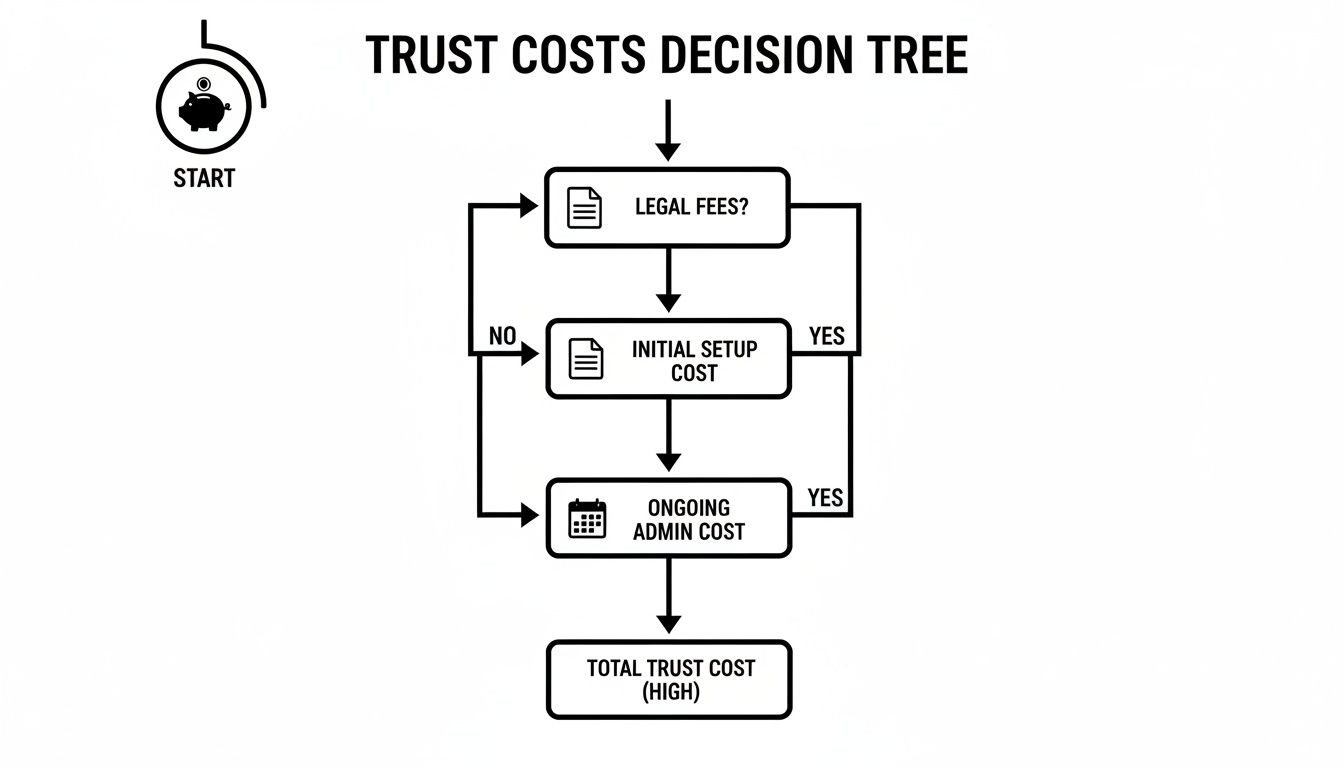
As you can see, both initial legal fees and recurring administrative costs are significant factors in the total expense.
The Austin Grandparents Creating a Lasting Legacy
Grandparents in Austin want to leave a meaningful inheritance to their grandkids. They're concerned about what might happen if a grandchild goes through a divorce, accumulates debt, or is not ready to handle a large sum of money.
They create an irrevocable trust with specific instructions. The trustee is legally bound to make distributions only for approved purposes, like paying university tuition directly or providing a down payment on a house. Because the assets are held safely in the trust, they are out of reach of a grandchild’s creditors or a future ex-spouse. This allows the grandparents to build a protected legacy that supports and guides their family for generations.
While these scenarios highlight the benefits, an irrevocable trust isn't a one-size-fits-all solution. If flexibility is your top priority, a revocable trust or a comprehensive will might be a better choice. The key is matching the right tool to your family's specific goals.
Takeaway: Key Insights for Your Texas Estate Plan
An irrevocable trust is a powerful tool, but its permanence means it’s not for every family. The decision boils down to one critical question: are you willing to give up control in exchange for maximum security?
If your main goals are shielding substantial assets from creditors, reducing your estate tax burden, or planning for long-term care costs, then an irrevocable trust is a compelling option. It builds a legal fortress around your assets that other estate planning tools cannot replicate. For many Texas families, that security brings invaluable peace of mind.
However, if you need flexibility, a revocable trust or a well-drafted will might be a better fit. The biggest drawback of an irrevocable trust is its rigidity—it is not designed to adapt easily to life’s unexpected changes.
The single most important takeaway is the absolute need for expert legal counsel. A poorly structured trust can create more problems than it solves. A knowledgeable attorney will ensure your trust not only aligns with the Texas Estates Code but also works for your family without causing unintended consequences. For example, deciding how to handle property is a complex issue, and you can learn more by reading our guide on using trusts to manage real estate in Texas and avoid probate.
Choosing an irrevocable trust is a major commitment that should only be made after a thorough review of your assets, goals, and family dynamics with a trusted legal advisor. Our firm is committed to providing the clarity and reassurance your family deserves during this process.
Common Questions We Hear About Irrevocable Trusts
When Texas families explore irrevocable trusts, many important questions arise. Understanding these powerful tools is the first step toward making a confident, informed decision. Below are answers to some of the most common questions we hear.
Can an Irrevocable Trust Be Changed in Texas?
The word "irrevocable" sounds permanent, which can be intimidating. While the name implies it’s set in stone, Texas law does provide limited ways to make changes.
It’s difficult, but not always impossible. The Texas Estates Code (specifically Title 3, Chapter 112) allows for modifications through specific legal avenues, such as:
- Decanting: This process allows a trustee to "pour" the assets from an older, inflexible trust into a new one with more suitable terms.
- Judicial Modification: You can ask a court to approve changes if unexpected circumstances make the original terms of the trust impractical to follow.
- Non-Judicial Settlement Agreement: If the trustee and all beneficiaries agree, they can modify certain administrative terms without going to court.
These are not simple DIY fixes; they are complex legal maneuvers that require skilled legal guidance.
Who Should I Pick as the Trustee?
Choosing a trustee is one of the most critical decisions you will make. This person or institution is legally responsible for managing the trust’s assets and following your instructions for the benefit of your heirs.
You could appoint a trusted family member, but this can sometimes create family friction or burden someone who lacks financial expertise. For this reason, many people choose a corporate trustee, like a bank or a dedicated trust company. A professional trustee brings impartiality, expert asset management, and continuity, ensuring the trust is managed properly for generations. Our guidance in matters of Guardianship can also provide insight into choosing a responsible party.
How Is This Different from a Revocable Trust?
The fundamental difference between an irrevocable and a revocable trust is control.
A revocable trust is flexible. You can change its terms, add or remove property, or cancel it entirely. Because you retain control, the law considers its assets to still be yours. This means it offers no protection from creditors or estate taxes.
An irrevocable trust is permanent. Once you transfer assets into it, you have given up control. That is the trade-off. But it is precisely that loss of control that unlocks the powerful asset protection and tax benefits that make it so attractive. The right choice depends entirely on your primary goal: flexibility or maximum protection. Understanding the Texas Probate Process can further clarify how these tools help families avoid court intervention.
If you’re facing probate in Texas, our team can help guide you through every step — from filing to final distribution. Schedule your free consultation today.