When a loved one passes away without a will, it’s known as dying “intestate.” This simply means the State of Texas must decide how their property gets divided according to a default legal plan. A Texas intestacy chart is a visual guide that helps you understand this plan, showing exactly who inherits based on their relationship to the person who passed away.
Facing the loss of a family member is deeply challenging. Discovering they didn’t leave a will can add a layer of confusion and stress to an already painful time. We want to offer some reassurance: Texas has a clear, predictable roadmap in place for this exact situation.
What Happens When You Die Without a Will in Texas
Many families worry about chaos, conflict, or losing everything they believe their loved one wanted them to have. It’s a valid concern, but Texas law provides an orderly, if impersonal, process to prevent a free-for-all and ensure assets are distributed to the closest surviving relatives.

The State’s Default Plan for Your Loved One’s Estate
The laws that kick in are found in the Texas Estates Code, specifically in Title 2, Subtitle E. Think of these laws as the state's backup estate plan. They were created to provide an orderly transfer of property when a person hasn't left their own instructions.
The Texas intestacy chart is a tool that visually lays out these laws. It helps answer the most pressing question on everyone's mind: "Who gets what?" The chart outlines inheritance rights based on different family scenarios, such as whether the deceased was:
- Married or single
- Had children from one or multiple relationships
- Was survived by parents or siblings
Why Understanding Intestacy Matters
While the state’s plan provides structure, it’s crucial to understand its limitations. The law is impersonal and follows rigid formulas. It can't account for your loved one’s unique relationships, specific wishes, or promises they may have made over the years.
For example, a lifelong best friend who was like family, a devoted caregiver, or a favorite charity will receive nothing under intestacy laws because they are not considered legal heirs. You can learn more about who inherits in Texas when there is no will in our detailed guide.
This is why understanding the intestacy chart is so important. It gives you the clarity needed to navigate the Texas Probate Process, but it also highlights why the state’s default plan is rarely a substitute for a thoughtfully prepared will. Our goal is to help you understand the path ahead, making sure you feel informed and supported every step of the way.
How to Read the Texas Intestacy Chart
At first glance, a Texas intestacy chart can look like a complicated legal puzzle. But it’s much simpler than it seems. It works by asking a series of simple questions about family structure, and the two most important ones are:
- What kind of property are we dealing with—community or separate?
- Who are the surviving relatives?
By answering those two questions, you can follow the chart to see exactly how Texas law divides an estate. For a clear visual, this Texas Intestacy Chart is an invaluable resource to have on hand.
Community Property vs. Separate Property Explained
Understanding the difference between community and separate property is the single most important part of this process. Texas is a community property state, and these plain-English definitions drive everything that follows.
Community Property: This is everything a couple acquires during their marriage. It doesn't matter whose paycheck bought it or whose name is on the title. If it came into the picture while they were married, the law presumes it belongs to both of them.
Separate Property: This category includes anything one spouse owned before the marriage. It also includes gifts or inheritances given specifically to just one spouse, even if they received it during the marriage.
These distinctions are critical because the law, laid out in Texas Estates Code, Chapter 201, treats these two types of property very differently when it’s time to distribute them.
Texas Intestate Succession At a Glance
Here's a quick summary of how Texas intestate succession law works for different family situations.
| If the Deceased is Survived By | Who Inherits Separate Property | Who Inherits Community Property |
|---|---|---|
| Spouse and Children (from the same marriage) | Spouse gets 1/3; children share the remaining 2/3. | Spouse inherits the deceased's entire 1/2 share. |
| Spouse and Children (from a previous marriage) | Spouse gets 1/3; children share the remaining 2/3. | Spouse keeps their 1/2; children inherit the deceased's 1/2. |
| Spouse and Parents (no children) | Spouse gets all personal property, 1/2 of real estate. Parents get the other 1/2 of real estate. | Spouse inherits all community property. |
| Children (no spouse) | Children inherit everything, split equally. | Children inherit everything, split equally. |
| Parents (no spouse, no children) | Parents inherit everything, split equally. | Parents inherit everything, split equally. |
| Siblings (no spouse, no children, no parents) | Siblings inherit everything, split equally. | Siblings inherit everything, split equally. |
This table provides a high-level overview, but the real-world application often involves more nuance. Always refer to the full intestacy chart or consult an attorney for specific scenarios.
Tracing the Lines of Inheritance
With property types sorted out, the intestacy chart becomes your guide. It walks you through different family scenarios, spelling out the exact percentage of community and separate property each heir receives based on a clear, state-mandated hierarchy.
For instance, the chart lays out specific outcomes for a person (the decedent) who is survived by:
- A spouse and children they had together.
- A spouse and children from a previous relationship (a blended family).
- Children but no spouse.
- A spouse and parents, but no children.
- Only parents, siblings, or even more distant relatives.
These rules are spelled out in the Texas Estates Code, specifically Sections 201.001 through 201.003. This rigid structure ensures there's a predictable answer for nearly any family situation, preventing a free-for-all when a person's wishes weren't written down in a will.
At The Law Office of Bryan Fagan, our team brings deep experience to the table, guiding families through the complexities of probate. We’ve seen firsthand how our Wills & Trusts services can prevent the uncertainty and potential for Probate Litigation that dying without a will so often creates.
Real-World Intestacy Scenarios for Texas Families
Legal charts and definitions can feel cold and abstract, especially when you’re grieving. To bring the Texas intestacy rules to life, let’s walk through a few realistic scenarios that Texas families often face. These examples show exactly how the laws for community and separate property play out on the ground.
Before we dive in, this infographic breaks down the fundamental split between an estate's community and separate property.
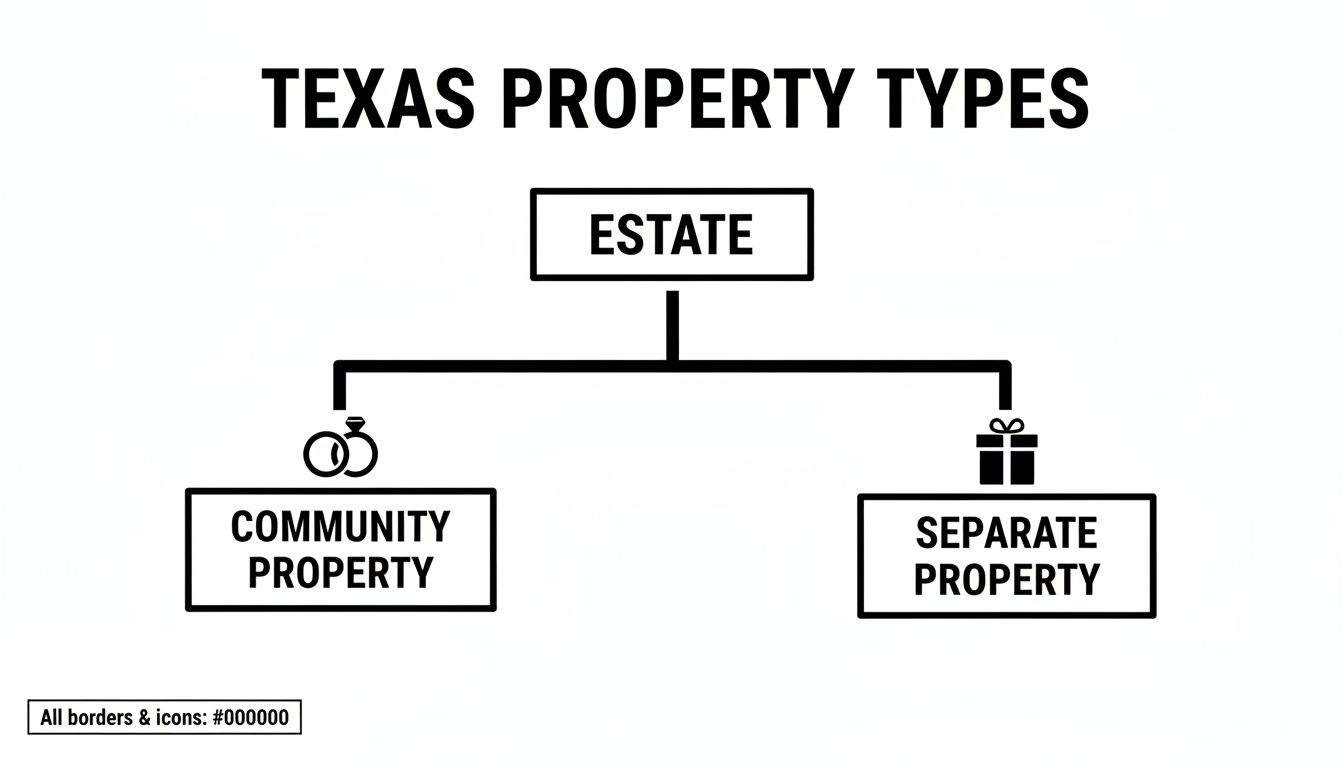
This simple distinction is the starting line for every intestacy case. Correctly identifying which assets fall into which category is the key to understanding who inherits what.
Scenario 1: Married with Children from the Same Marriage
Let's imagine David passed away without a will. He was married to Sarah for 20 years, and they had two children together during their marriage.
Community Property: Their family home, cars, and joint bank account are all community property. Under Texas law, Sarah, as the surviving spouse, inherits David’s entire half of the community property. She now owns 100% of these assets.
Separate Property: David also owned a small plot of land his parents gifted only to him. That’s his separate property. Here, the rules change. Sarah receives a one-third interest in this separate real estate for her lifetime, and their two children split the remaining two-thirds equally.
Scenario 2: A Blended Family Situation
Now, let’s look at Maria, who passed away leaving behind her husband, Leo, and her two children from a previous marriage. This detail—children from outside the current marriage—changes the community property outcome dramatically.
Community Property: The assets Maria and Leo bought together are still community property. Leo automatically keeps his 50% share. However, Maria’s 50% share does not go to Leo. Instead, her two children from her first marriage inherit her entire half, splitting it equally.
Separate Property: Maria also had an inheritance she received before she met Leo. For this separate property, the distribution is the same as in our first scenario: Leo receives one-third, and Maria’s children share the remaining two-thirds. This is a critical distinction for blended families and often a source of shock and confusion.
Scenario 3: Married with No Children but Living Parents
What happens if a married person dies without any children? Let’s say James passes away, survived by his wife, Chloe, and both of his parents.
Community Property: Because there are no children, this part is simple. Chloe, the surviving spouse, inherits all of the community property.
Separate Property: This is where things get complicated. Chloe is entitled to all of James's separate personal property—things like cash, cars, or investments. But for separate real property, like a house he owned before they got married, Chloe only receives one-half. James’s parents inherit the other one-half. This can create an awkward co-ownership situation between a surviving spouse and their in-laws.
Scenario 4: Unmarried with Children
If someone is single when they pass away and has children, the intestacy rules are direct. Imagine an unmarried father, Michael, dies leaving behind three children.
In this case, his entire estate is considered his separate property. His three children will inherit his entire estate in equal shares. It makes no difference if the children are from different partners; they all have the same inheritance rights.
Scenario 5: Single with No Children or Parents
Finally, let's look at a situation where the closest relatives are siblings. Suppose Emily, who never married and had no children, passes away. Her parents have also passed on, but she is survived by her two brothers.
Since there is no surviving spouse, children, or parents, her estate passes to the next level of heirs. Her two brothers would inherit her entire estate, splitting it equally. This is where family disputes can flare up. When siblings can't agree on what to do with an inherited property, it can lead to significant conflict, underscoring the need for clear legal guidance.
The Step-by-Step Process for an Intestate Estate
Understanding the intestacy chart is the first step. The next is navigating the court process to make it all official. When a loved one dies without a will, their estate still has to go through a court-supervised process. This isn't just red tape; it's a necessary step to give someone the legal power to gather assets, pay debts, and make sure the right people inherit according to Texas law.

The Formal Path: An Heirship Proceeding
For most estates without a will, the primary legal step is an Application to Determine Heirship. This is a formal lawsuit filed with the probate court that results in an order officially declaring who the decedent's legal heirs are. The application lays out the deceased's family history—marriages, divorces, children, and a general snapshot of their property.
A unique part of this process is the appointment of an attorney ad litem. The court appoints a neutral attorney whose only job is to investigate the family history and search for any unknown or missing heirs, ensuring no one with a legitimate claim is left out.
Simpler Alternatives for Smaller, Uncomplicated Estates
Not every situation calls for a full-blown court proceeding. The Texas Estates Code offers a few simpler, more affordable options for certain estates.
Here are the two most common alternatives:
- Small Estate Affidavit (SEA): This is a great option if the estate's value is $75,000 or less (not counting the homestead and other exempt property). An SEA can often be used to collect assets like bank accounts without needing a full administration.
- Affidavit of Heirship: This is a sworn statement, usually signed by family members and witnesses, that identifies the heirs. While it doesn't have the power of a court order, it's frequently used to transfer title to real estate when the situation is straightforward and all heirs agree.
Figuring out the right path depends on the specific assets, debts, and family dynamics. For a deeper look, you can learn more about how to file for probate without a will in our dedicated article.
From Administration to Distribution: Getting It Done
Once the heirs are legally identified, the court usually appoints an administrator. This person is given a document called Letters of Administration, which grants them the legal authority to manage the estate.
The administrator's job includes:
- Gathering and Inventorying Assets: They must track down and take control of all property.
- Paying Debts and Taxes: The administrator is responsible for notifying creditors and using estate funds to pay valid bills.
- Distributing Property: After all debts are settled, the administrator distributes what's left to the heirs according to the court's order.
Beyond decoding the intestacy chart, many families also face the challenge of managing and selling a house during probate. It’s a common hurdle, but one that can be managed with the right guidance. Knowing these steps can take a lot of the mystery—and stress—out of the process.
Common Problems When There Is No Will
While the Texas intestacy chart provides a legal road map, it's a road littered with emotional and financial potholes. Dying without a will hands everything over to a rigid, one-size-fits-all legal formula. This can create massive, and entirely avoidable, hardships for your family.
The Risk of Unintended Heirs
One of the most jarring outcomes of intestacy is watching assets go to relatives your loved one barely knew—or worse, didn't want to inherit from. The intestacy chart texas only follows bloodlines, not relationships.
For example, a married person with no children passes away, and suddenly their parents inherit half of the separate real estate. This could force a surviving spouse to co-own their home with their in-laws, creating an awkward and financially tangled mess.
Loss of Control Over Who Manages the Estate
Without a will, you have zero say in who will manage your estate. The court appoints an administrator based on a strict legal priority list. That could mean someone you wouldn't trust with your checkbook is suddenly in charge of all your finances. This loss of control is a breeding ground for family feuds that can quickly escalate into expensive and emotionally draining Probate Litigation.
No Say in Guardianship for Minor Children
For parents of young children, this is the most critical issue. If both parents die without a will that names a guardian, the court is forced to decide who will raise their kids. A judge will do their best to act in the children’s best interests, but they don't know your family, your values, or your wishes. This can lead to bitter custody battles among relatives. Designating a guardian in your will is the only way to make your choice legally binding.
Increased Costs and Delays
The probate process for an intestate estate is almost always more complicated and expensive. The court has to go through a formal heirship proceeding, appoint an attorney ad litem, and may require the administrator to post a costly bond. These extra legal hurdles drain the estate of assets that should have gone to your family and make your family’s financial affairs a matter of public record.
These painful situations can be completely avoided with solid estate planning. By creating simple but powerful documents like a will or a trust, you ensure your wishes are followed, your family is protected, and your legacy is secure. Our firm specializes in crafting Wills & Trusts that prevent these common disasters.
Key Takeaway
The best way to protect your family and control your legacy is through proactive estate planning. A will or trust ensures your voice is heard, taking these critical decisions out of the state's hands and putting them back in yours. It is one of the kindest things you can do for the people you love.
If you’re facing probate in Texas, our team can help guide you through every step — from filing to final distribution. Schedule your free consultation today.
Frequently Asked Questions About Texas Intestacy
When you're dealing with the loss of a loved one, the last thing you need is a mountain of confusing legal questions. Below, we’ve answered some of the most common questions Texas families ask when a relative passes away without a will. Our goal is to give you clear, practical information you can use right now.
Does My Spouse Automatically Get Everything If I Die Without a Will in Texas?
This is one of the biggest and most dangerous misconceptions in Texas law. The answer is no, not always. Who inherits what depends entirely on your family tree and whether the property is community or separate.
- Community Property: If you only have children with your current spouse, then yes, they inherit your half of the community property. But if you have children from a previous relationship, they get your half. Your spouse is left with only their original 50% share.
- Separate Property: Your surviving spouse only gets a fraction of your separate property if you also have children or even living parents.
The specific rules are laid out in the Texas intestacy chart, and they often lead to shocking outcomes. Many people are horrified to learn their spouse could end up co-owning the family home with their stepchildren or even their in-laws.
Who Gets Custody of My Children If I Die Without a Will?
If you're the last surviving parent and you die without a will naming a legal guardian, you give up your voice in one of life’s most critical decisions. A Texas court will have to step in and appoint a guardian for your minor children.
A judge will do their best to act in the children’s best interests, but they won’t know your family, your values, or who you trusted most. This uncertainty can ignite emotional, lengthy, and expensive court battles among relatives. The only way to guarantee the person you trust will raise your children is to name them in a valid will. Our firm handles Guardianship matters with the sensitivity they require.
How Long Does the Probate Process Take Without a Will?
On average, settling an intestate estate takes significantly longer than probating a will. The biggest delay comes from a required court process called a Determination of Heirship. This is a formal legal proceeding where a judge must officially identify and declare who the decedent's legal heirs are. This step alone can add several months to the timeline.
From the first filing to the final distribution of assets, the whole ordeal can easily take anywhere from six months to well over a year. The timeline gets even longer if there are complications, such as:
- Heirs who are hard to find.
- Disagreements and fighting among family members.
- Complex assets or debts that need to be sorted out.
While a Small Estate Affidavit can speed things up for very small estates, most will be stuck in this more formal, time-consuming process. Getting familiar with the Texas Probate Process will help you set realistic expectations from the start.
If you’re facing probate in Texas, our team can help guide you through every step — from filing to final distribution. Schedule your free consultation today.