To revoke a Power of Attorney (POA) in Texas, you must create a formal written document called a "Notice of Revocation." This document needs to be signed, notarized, and delivered to your agent and any institutions, like banks or doctors, that have relied on the original POA. This formal process, outlined in the Texas Estates Code, officially terminates the legal authority you granted and puts you back in complete control of your personal and financial affairs. It's a critical step to take when your life circumstances change.
Understanding Why You Might Revoke a Power of Attorney
Deciding to revoke a Power of Attorney is a significant choice. While the idea might feel uncomfortable, it’s a fundamental right that allows you to adapt your estate plan to your current needs. Life is rarely static, and the person you trusted to act as your agent years ago may no longer be the right fit today.
This decision is about ensuring the person managing your affairs truly aligns with your best interests. Think of it not as an act of distrust, but as a proactive step toward maintaining your own control and security, especially during a time of transition or grieving.
Common Reasons for Revocation
People choose to revoke a Power of Attorney for many valid reasons, usually stemming from major life events or shifts in relationships. Recognizing these common triggers can help you see when it might be time to reassess your own arrangements.
Some of the most frequent reasons include:
- Changes in Relationships: A divorce, a major falling out, or even just growing apart can understandably lead you to reconsider who holds such a powerful role.
- Loss of Trust: If your agent has acted irresponsibly, made decisions you disagree with, or you simply no longer feel confident in their judgment, revocation is essential to protect yourself.
- A New Choice for Agent: You might realize someone else in your life is now better suited for the job because of their location, financial savvy, or simple availability.
- The Agent is Unable to Serve: Your chosen agent may have passed away, become incapacitated themselves, or informed you they no longer wish to serve in that capacity.
A Realistic Scenario
Imagine Sarah, a retired teacher in Houston who appointed her son, David, as her agent a decade ago. At the time, David lived nearby. Today, he has a demanding job, a young family, and has moved out of state.
Sarah realizes that if she needed him to manage her finances or healthcare decisions, the distance and his own responsibilities would make it incredibly difficult. After a heartfelt conversation, she decides to revoke David’s authority and appoint her local, detail-oriented daughter, Emily, instead. This isn't a reflection of her love for David, but a practical decision to ensure her needs can be met efficiently.
The Official Process for Revocation in Texas
Deciding to revoke a Power of Attorney is the first step, but to make it legally binding in Texas, you must follow a specific formal process. Simply telling your agent their authority is terminated is not enough. The Texas Estates Code requires a clear, documented action to protect you and your assets.
This formal process leaves no room for doubt about your intentions. It creates an official legal record that terminates the agent’s authority, preventing them from acting on your behalf and giving you back your peace of mind.
Crafting the Notice of Revocation
The heart of this process is a written document called a Notice of Revocation. This is a simple, straightforward legal document that must contain specific information to be effective.
Under Title 2 of the Texas Estates Code, your written revocation must include:
- Your full legal name, as the "principal" (the person who created the POA).
- The full legal name of your agent whose powers you are revoking.
- The date the original Power of Attorney was signed. This identifies exactly which document you’re canceling.
- A clear, unmistakable statement declaring that you are revoking all authority granted in that specific POA, effective immediately.
Your language should be direct and firm. This is not the time for ambiguity.
The Critical Role of Notarization
Once you’ve drafted the Notice of Revocation, the next step is signing it. In Texas, for the revocation to be valid, you must sign it and have it acknowledged before a notary public. This is a mandatory step.
Notarization serves as official proof that you are who you say you are and that you signed the document willingly. It’s a layer of legal protection that makes it very difficult for a former agent or anyone else to challenge your decision later.
This infographic breaks down some of the most common reasons that lead people to take this formal step.
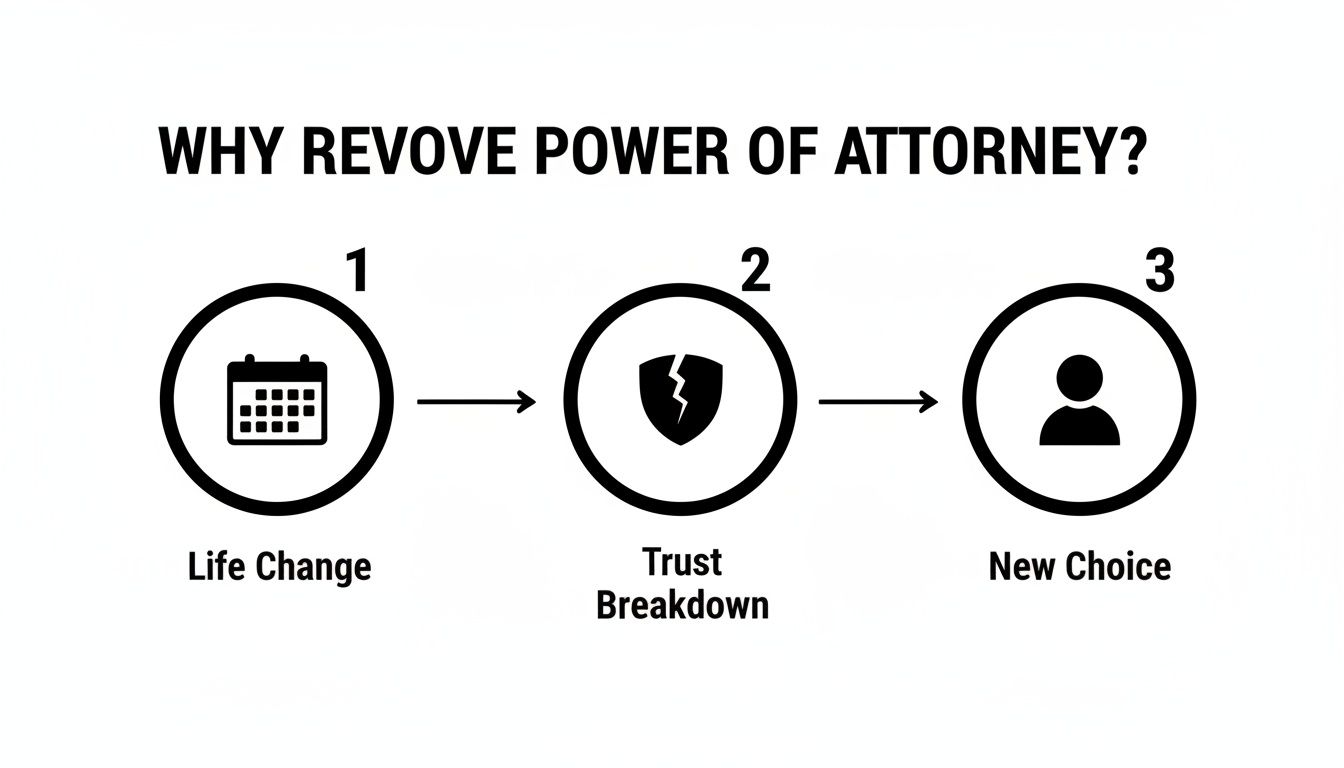
As you can see, major life changes, a complete breakdown of trust, or simply deciding someone else is a better fit are the primary drivers for this important legal move.
Unfortunately, the need for this formal process is only growing. The rise of POA fraud has become alarming, with FBI data revealing a staggering 11% increase in fraud cases targeting individuals over 60 between 2022 and 2023 alone. This surge in elder financial abuse highlights why a formal, properly executed revocation isn't just a good idea—it's essential protection.
Notifying Everyone Who Matters
Creating a signed and notarized Notice of Revocation is a powerful first step, but it is legally incomplete on its own. Your revocation is only effective once the right people and institutions know about it. The Texas Estates Code operates on an "actual notice" standard, meaning your agent’s authority only ends once they are officially aware it has been revoked.
Simply filing the document away does nothing. You must actively communicate this change to everyone who might have relied on the old Power of Attorney. If you don't, you leave yourself vulnerable, as banks, doctors, and others could unknowingly continue to honor your former agent’s instructions.

Informing Your Former Agent
Your first and most critical notification must go to your former agent. This is the action that officially severs their legal authority. While a simple letter or email might seem sufficient, you need to create a verifiable record proving they received the notice.
We always recommend sending the signed, notarized Notice of Revocation via certified mail with a return receipt requested. This service provides a postcard or electronic signature confirming the exact date and time of delivery. It gives you undeniable proof that your agent was officially notified. Keep this receipt with your other important legal papers—it’s your evidence.
Creating a Comprehensive Communication Plan
Beyond your agent, you need a plan to inform every third party who has a copy of the old POA or has done business with your agent. This includes a surprisingly wide range of individuals and organizations. When dealing with sensitive matters, using secure eFax services can be a great way to ensure the confidential and instant transmission of your official notice.
Take a moment and think through every institution where your former agent might have acted for you. A forgotten bank account or an old investment advisor could become a serious liability if they aren’t brought up to speed. Your goal is to methodically replace the old document with the new reality across the board.
This checklist can help ensure you don't miss anyone important in your communication efforts.
Who to Notify When Revoking a Power of Attorney
After you've drafted and executed your revocation, the next step is to create a list of everyone who needs a copy. This isn't just about your former agent; it's about every financial, medical, and legal entity that may have the old POA on file. Failing to notify even one of them can leave a door open for unauthorized actions. Use this table as a starting point.
| Who to Notify | Why It's Critical | Recommended Method |
|---|---|---|
| Your Former Agent | To legally terminate their authority under the Texas Estates Code. | Certified mail with return receipt requested. |
| Financial Institutions (Banks, Credit Unions) | To prevent unauthorized withdrawals, transfers, or changes to your accounts. | In-person visit with the notarized revocation or secure upload to their online portal. |
| Investment and Retirement Advisors | To block any trades, sales, or management of your investment portfolio. | A phone call followed by a mailed or faxed copy of the revocation notice. |
| Healthcare Providers (Doctors, Hospitals) | To ensure medical decisions are not made by someone you no longer authorize. | Provide a copy for your medical file during your next visit or via their patient portal. |
| Government Agencies (IRS, Social Security) | To prevent the former agent from filing taxes or managing benefits on your behalf. | Follow the specific agency's procedures for updating representative information. |
Once you’ve made your list and sent out the notifications, keep a record of who you contacted and when. This diligence creates a paper trail that confirms you took every necessary step to make your revocation legally binding and effective.
Handling Complex Situations Like Real Estate and Incapacity
Revoking a Power of Attorney is usually straightforward, but situations involving real estate or questions about mental capacity require extra care to ensure your revocation is legally solid.
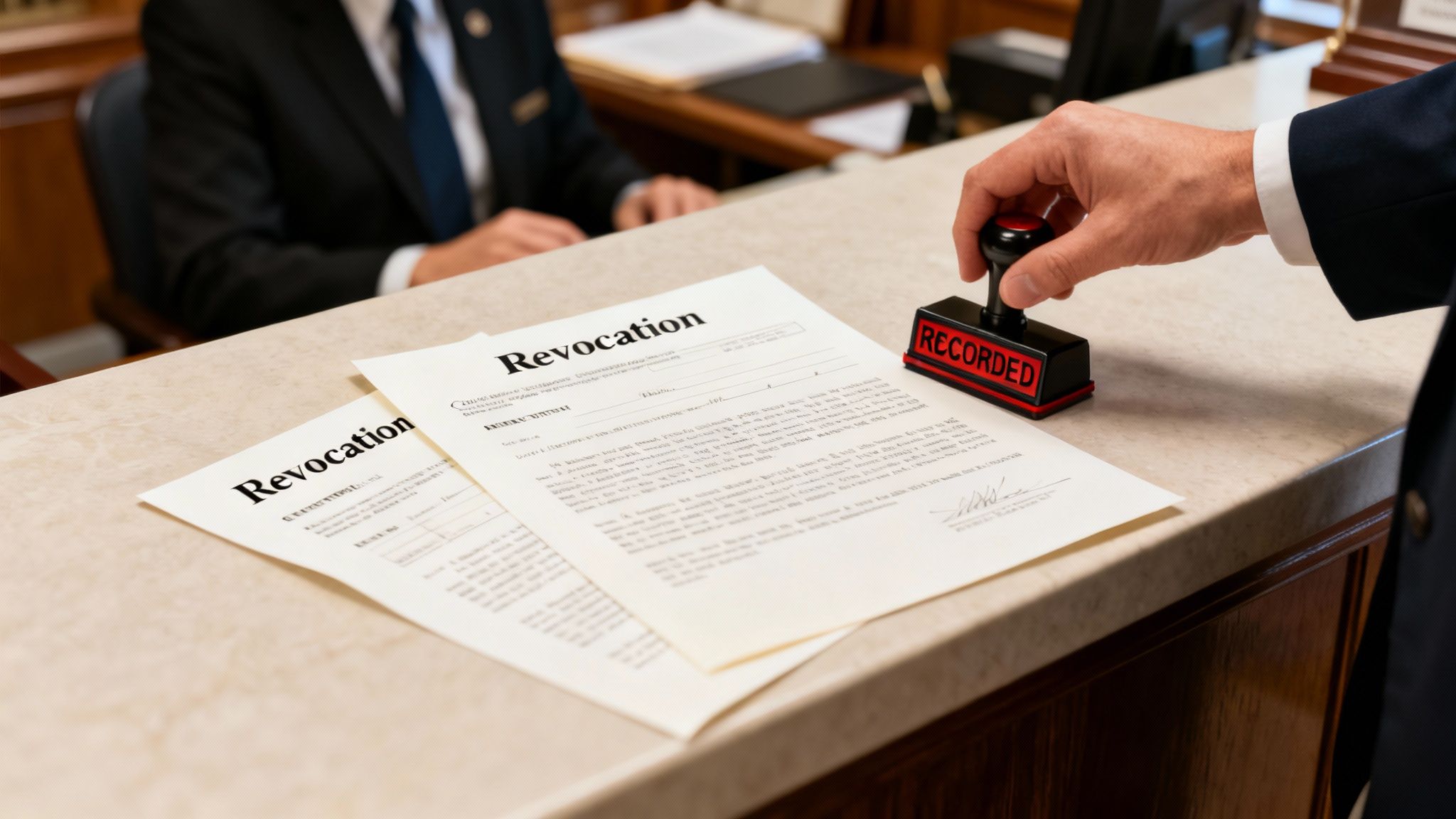
If your original Power of Attorney was recorded with the county clerk—a necessary step for an agent to manage real estate transactions—your revocation must also be recorded. You are legally required to file the notarized Notice of Revocation with the same county clerk's office where the original POA was filed.
This public filing serves as official notice to the world. It alerts title companies, potential buyers, and anyone checking the public record that your former agent no longer has the authority to sell, mortgage, or otherwise transact with your property. Failing to record the revocation leaves a dangerous legal loophole open.
When Incapacity Becomes a Factor
The most challenging scenario arises when a person's mental capacity is in decline. A Durable Power of Attorney, as defined in the Texas Estates Code, is specifically designed to remain effective even if you become incapacitated. This feature is a great strength, but it becomes a major hurdle if the POA needs to be revoked and you no longer have the legal capacity to make that decision.
The law is clear: you must have the same level of mental capacity to revoke a POA as you did to create it. Once a person is deemed legally incapacitated, they lose the right to revoke it. This is why acting decisively is so important if you have doubts about your agent. Waiting could mean it becomes too late.
If the principal is incapacitated and cannot revoke a problematic POA, the family's only option is often to seek a court-ordered Guardianship. This court-supervised process can remove the agent's authority and appoint a guardian to manage the person's affairs instead. For families facing this difficult situation, understanding when and how to obtain guardianship of a parent is a critical next step.
What to Do After the Revocation
You’ve successfully revoked your Power of Attorney. This is a crucial step for your personal and financial security, but the process isn't finished.
Think of it this way: you’ve cleared the board. While that protects you from a former agent, it also leaves a temporary void in your estate plan. Taking the right steps now is about more than tying up loose ends—it’s about building a stronger, more reliable plan for the future.
Create a New Power of Attorney
This is, without a doubt, the most critical next step. Revoking an old POA without creating a new one is like locking a door but throwing away the key. You have secured the situation for now, but you have also removed your own ability to get help if you need it later.
Without a designated agent, your family could be forced into a costly and public guardianship proceeding just to gain the authority to pay your bills or manage your care if you become unable to make decisions for yourself.
When selecting a new agent, look for someone who is:
- Trustworthy: This is non-negotiable. Choose someone with unwavering integrity.
- Organized: Your agent will manage records, deadlines, and important financial details.
- Willing and Able: Have an honest conversation with them. Ensure they understand the responsibility and are comfortable taking it on.
This is also an excellent opportunity to review your entire estate plan. Creating new Wills & Trusts at the same time ensures all your documents are cohesive and reflect your current wishes.
Secure Your Documents and Records
Once the revocation is signed, notarized, and delivered, it's time for some administrative cleanup. Your next priority is retrieving all relevant documents and assets from your former agent to prevent any lingering access or future confusion.
You should politely but firmly request the return of:
- The original Power of Attorney document.
- Any copies of the POA they may have.
- Financial records like bank statements and checkbooks.
- Keys to your home, cars, or safe deposit boxes.
It's also wise to follow up with your financial institutions a week or two after you’ve sent them the revocation notice. A quick call or visit to your bank can confirm they have updated their records and officially removed the former agent’s authority from all your accounts. This simple verification step closes the final loop and provides peace of mind.
Dealing with the aftermath of a revocation can become complicated, especially if a breach of trust was involved. If you suspect your former agent misused their power, you may need to explore your options within Probate Litigation to recover assets. The entire Texas Probate Process has mechanisms to address these issues, but proactive planning is always your best defense.
Key Insight: Your Takeaway on Revocation
Revoking a Power of Attorney isn’t just about canceling a document; it’s about taking back control and ensuring your affairs are in the hands of someone you completely trust. The process is a protective measure designed to align with your current life circumstances and relationships. A successful revocation hinges on three key actions: creating a written Notice of Revocation, getting it notarized, and notifying your former agent and all relevant institutions. This formal process ensures there is no ambiguity and provides legal certainty for your future.
Final Thoughts: Taking Back Control of Your Future
Deciding to revoke a Power of Attorney can feel like a heavy weight, but under Texas law, it's your absolute right to take back control. The steps we've walked through are designed to give you a clear path forward, empowering you to protect your own interests with confidence. Just remember, while the process itself is straightforward, getting every detail right is what makes the revocation legally binding.
This is often an emotional decision, not just a legal one. It's okay to acknowledge that. Taking these formal steps isn't a sign of failure; it’s a smart, responsible move to secure your future and your peace of mind.
Working with a compassionate legal professional can help ensure every detail is handled correctly, safeguarding your assets and your autonomy. Ultimately, this isn't just about canceling a document. It's about making sure the person with authority over your life is someone who has your complete and current trust. It's a decision that puts you back in the driver's seat of your own legacy.
Common Questions About Revoking a POA in Texas
When it comes to revoking a Power of Attorney, many questions arise. Most people have never done this before, and the process can feel confusing. Let’s clear up some of the most common concerns we hear from Texas families.
Can I Just Tell My Agent They Are Fired?
It seems like a simple conversation should be enough, but in Texas, it’s not. A verbal notice is not legally sufficient. The Texas Estates Code is very clear: you need a written, notarized revocation to officially end an agent's authority.
Relying on a conversation leaves the door open for problems. The agent could later claim they were never properly notified or that they misunderstood. A formal, written document removes all ambiguity and gives you undeniable proof of your decision.
What If I Cannot Locate My Former Agent?
This happens more often than you would think. If you cannot find your former agent to deliver the notice, you must still demonstrate that you made a good-faith effort to inform them. This is a critical step for the revocation to be legally sound.
Here’s what that looks like in practice:
- Send the notarized revocation by certified mail with a return receipt to their last known address. This creates a paper trail.
- Keep a detailed record of all your attempts to contact them, including dates, times, and the methods you used.
This diligence proves you took every reasonable step to provide notice, which is what a court would look for if a dispute ever arose.
If you’re facing probate in Texas, our team can help guide you through every step — from filing to final distribution. Schedule your free consultation today.