Skip to content
When a loved one passes away in Texas without leaving a valid will, figuring out who inherits their property can quickly become confusing and stressful. The solution Texas law provides is called a heirship proceeding—a formal court process that officially identifies the decedent's rightful heirs and their specific share of the estate. This court judgment is the legal key needed to transfer assets like real estate, bank accounts, and vehicles to the correct family members.
Losing a family member is hard enough; you shouldn’t have to navigate a complex legal system alone. This guide offers plain-English explanations and step-by-step advice to bring clarity during a difficult time.
What Is a Texas Heirship Proceeding?

When someone dies "intestate"—a legal term that simply means they passed away without a will—Texas law provides a structured path to bring order to their estate. That path is the heirship proceeding, a court-supervised process designed to provide certainty and peace of mind.
Think of it as the court creating an official, legally recognized family tree for inheritance purposes. The main goal is to obtain a formal court order, called a Judgment Declaring Heirship, which serves as the final, definitive answer to the question, "Who gets what?"
The Purpose of a Formal Heirship
This court process isn't just a formality; it's absolutely critical in many situations. Banks, title companies, and other financial institutions require legal proof of ownership before they’ll transfer assets. A court's judgment provides that undeniable proof, preventing future family disputes and ensuring a clean transfer of title for property.
A formal heirship proceeding becomes necessary when:
- The deceased owned real estate that needs to be sold or transferred.
- There are significant assets locked in bank accounts, investment portfolios, or retirement funds.
- The family tree is complicated, perhaps involving children from different relationships, or if an heir is a minor.
- Heirs cannot agree on who is entitled to inherit.
The process is designed to be thorough and protect everyone involved. The court even appoints a special attorney, known as an "attorney ad litem," whose job is to represent the interests of any unknown or incapacitated heirs. This ensures the final judgment is fair and complete according to the rules laid out in the Texas Estates Code, specifically Title 2, Subtitle E, Chapter 202. If you're facing this, it's vital to understand what happens when a person dies without a will and how Texas intestate inheritance rights are applied.
A Reassuring and Structured Path
While the idea of going to court might sound intimidating, an heirship proceeding is designed to provide clarity and finality during an emotional time. It replaces guesswork and uncertainty with a clear, legally binding map for distributing your loved one's estate. It is the state’s way of ensuring fairness and preventing the chaos that can erupt from informal agreements.
Key Takeaway
An heirship proceeding is not a lawsuit against your family; it's a collaborative legal tool to officially document your family's inheritance rights when no will exists to guide the process. By following this structured path, you can honor your loved one’s legacy by making sure their property is distributed exactly as Texas law intends.
When Is an Heirship Proceeding Required?
While a formal heirship proceeding is a critical part of the Texas Probate Process, it isn’t needed every time a loved one passes away without a will. The answer almost always comes down to one thing: a third party, like a bank or title company, refusing to transfer assets without a court order.
A Realistic Scenario: The Title Company Roadblock
Imagine your father passes away in Texas, and his only major asset is the family home, titled solely in his name. He didn't have a will. You and your siblings are the obvious heirs and agree you want to sell the house. You might try filing an Affidavit of Heirship—a sworn statement identifying the heirs—hoping it’s enough.
But then you hit a brick wall. The title company reviewing the sale refuses to issue title insurance based on that affidavit alone. They see it as too risky. What if there's a long-lost child? What if a creditor has a valid claim against the estate? Without title insurance, a buyer can’t get a mortgage, and your sale is dead in the water. This exact scenario plays out every day in Texas, leaving families frustrated and confused.
Common Triggers for a Formal Proceeding
This is precisely where a formal heirship proceeding becomes unavoidable. The goal is to get a Judgment Declaring Heirship—a legally binding court order that provides the certainty that banks and title companies need. It’s often the only key that will unlock frozen assets or clear the title to real estate.
Generally, a formal heirship proceeding is required when:
- Real Estate Is Involved: Selling or transferring a house almost always requires a court-ordered judgment to establish a clean and insurable title.
- Financial Institutions Demand It: Banks and brokerage firms often won't release funds from frozen accounts without a court order, especially when the accounts hold significant assets.
- There Are Disagreements Among Heirs: If family members can't agree on who the rightful heirs are, only a judge can make the final, binding decision.
- Minor Heirs Exist: When a child under 18 stands to inherit property, the court steps in to protect their interests, often requiring a formal heirship and sometimes a guardianship to manage their inheritance.
- An Heir Cannot Be Located: The court appoints an "attorney ad litem" to conduct a search and represent that missing person's interests during the proceeding.
The entire process is governed by the Texas Estates Code, Chapter 202. This is a formal lawsuit where a judge oversees an investigation to officially identify a person's legal heirs. For a deeper look at the process, you can discover further insights about Texas heirship proceedings on langefirm.com.
Key Insight
Think of an Affidavit of Heirship as a sworn statement from the family. A Judgment Declaring Heirship is a legally binding ruling from a court. One is an educated guess; the other is a legal fact. Financial institutions will almost always demand the latter.
Ultimately, knowing whether you need a formal heirship proceeding is the first step toward settling your loved one's estate. If you’re facing a title company roadblock or a frozen bank account, this court-supervised process is likely the only path forward.
If you’re facing probate in Texas, our team can help guide you through every step — from filing to final distribution. Schedule your free consultation today.
Your Step-by-Step Guide to the Heirship Process
Facing a court proceeding while grieving can feel overwhelming, but a heirship proceeding in Texas is a structured, logical process. Once you understand the roadmap, that uncertainty can be replaced with confidence. When someone dies without a will, assets are essentially frozen. A court order is the only key that can unlock them.
Let's walk through the exact steps you can expect.
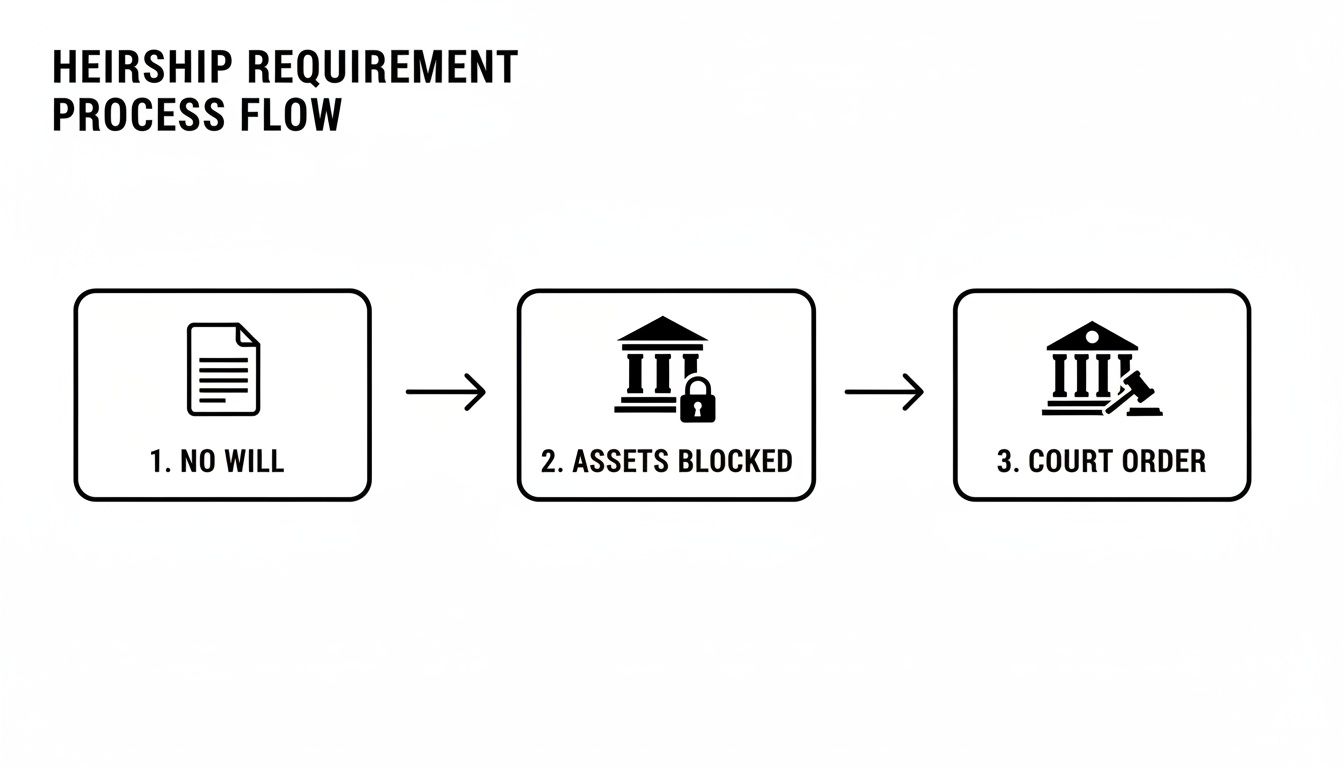
Key Stages of a Texas Heirship Proceeding
The journey involves several distinct phases, each designed to build a clear, legally sound case for the judge to review.
| Stage | Key Action | Plain-English Purpose |
|---|---|---|
| 1. Application | An heir files an Application to Determine Heirship with the probate court. | To formally start the case and give the court the decedent's family and property details. |
| 2. Ad Litem | The court appoints an attorney ad litem. | To independently verify the heirs and represent anyone unknown or unable to represent themselves. |
| 3. Evidence | The applicant gathers testimony from two disinterested witnesses. | To provide unbiased confirmation of the decedent's family history from people who won't inherit. |
| 4. Hearing | A final court hearing is held where evidence is presented. | To allow the judge to review all information, hear testimony, and make a final ruling. |
| 5. Judgment | The judge signs a Judgment Declaring Heirship. | To create the legally binding court order that identifies heirs and their inheritance shares. |
These stages form the backbone of the process, guiding the case from initial filing to a conclusive court order.
Step 1: Filing the Application to Determine Heirship
The process kicks off when an heir, with the help of an attorney, files a formal document called an Application to Determine Heirship. This detailed petition is the foundation for the whole case.
Your attorney will work with you to compile all the information required by the Texas Estates Code, § 202.005, including:
- The decedent’s name, date of death, and where they lived.
- A complete list of every known heir, their relationship to the decedent, and their current address.
- A thorough description of the estate’s property, especially any real estate.
Step 2: Appointment of the Attorney Ad Litem
Once the application is filed, the court appoints an attorney ad litem. This is a neutral, third-party attorney whose only job is to represent the interests of any heirs who are "unknown" or legally incapacitated (like minors).
This attorney acts as an independent investigator for the court, digging through records and making calls to verify the family history you provided. This critical step protects the integrity of the process and ensures the final judgment is legally solid.
Step 3: Gathering Testimony from Disinterested Witnesses
A cornerstone of a heirship proceeding in Texas is testimony from two disinterested witnesses. These are people who knew the decedent and their family but have zero financial stake in the estate. They cannot inherit anything.
A longtime neighbor, a close family friend, or a trusted colleague are all great examples. Your attorney will prepare them to testify in court about:
- How long and how well they knew the decedent.
- The decedent’s marital history (marriages, divorces, deaths of spouses).
- The names and number of children the decedent had.
This unbiased, third-party verification gives the judge the proof needed to make a confident ruling.
Step 4: The Court Hearing and Final Judgment
After the attorney ad litem finishes their investigation and the witnesses are ready, a final hearing is set. The judge reviews the application, the ad litem’s report, and listens to the live testimony from your witnesses.
If everything is in order, the judge signs the Judgment Declaring Heirship.
Key Insight
This judgment is the "grand prize" of the heirship proceeding. It is a powerful court order that officially and legally identifies every single heir and spells out the exact percentage of the estate they are entitled to under Texas law. This document is the legal key needed to finally transfer property to you and your family.
Heirship Proceeding vs. Affidavit of Heirship
When settling an estate without a will, you will encounter two similar-sounding terms: the heirship proceeding and the Affidavit of Heirship. They are fundamentally different tools, and choosing the wrong one can lead to frustrating delays and wasted money.
An Affidavit of Heirship is a sworn statement where heirs and two disinterested witnesses outline the deceased's family history. It is filed in public records to create a paper trail claiming who the heirs are.
In contrast, a formal heirship proceeding is a lawsuit filed in probate court that results in a Judgment Declaring Heirship. This is a legally binding court order that officially establishes who inherits the property.
When an Affidavit Might Work (and When It Won't)
Why would anyone use an affidavit if a court order is stronger? Speed and cost. For an extremely simple estate—say, a paid-off car or a tiny bank account—an affidavit might be enough. It’s a tool that works only when third parties, like a small local bank, are willing to accept it.
Here’s the problem: most institutions won’t. Title companies, mortgage lenders, and major banks almost always refuse to transfer real estate or release large sums based on an affidavit alone. The risk is just too great for them. While authorized by Texas Estates Code §203.001, affidavits are a gamble. You can discover more insights about when affidavits of heirship work on barsalou-law.com.
Key Insight
An Affidavit of Heirship is a family's claim to ownership. A Judgment Declaring Heirship is a legal fact established by a court. If you need to sell a house or access significant funds, you will almost certainly need the court’s judgment.
Comparing the Two Paths
The right choice boils down to legal authority, time, and cost.
| Feature | Affidavit of Heirship | Heirship Proceeding |
|---|---|---|
| Legal Power | A sworn statement; not legally binding on third parties. | A binding court order (Judgment Declaring Heirship) that all parties must honor. |
| Acceptance | Often rejected by banks, title companies, and financial institutions. | Universally accepted as conclusive proof of heirship. |
| Certainty | Can be challenged by a newly discovered heir or creditor at any time. | Provides final, legal certainty and a clean chain of title. |
| Time | Prepared quickly, but may need a 5-year waiting period to be considered strong evidence. | Typically takes 3-6 months to get a court order, but provides immediate legal power. |
| Best For | Very small estates with no real estate and no disputes. | Estates with real estate, significant bank accounts, or complex family situations. |
There's a rule in Texas Estates Code §203.001 that says an affidavit on file for five years becomes "prima facie evidence" (presumed true), but few families can afford to wait five years to sell a house or access savings. For this reason, the formal heirship proceeding is often the only practical option. You can learn more about the affidavit of heirship Texas form in our article to see if its limited scope applies to your unique situation.
If you’re facing probate in Texas, our team can help guide you through every step — from filing to final distribution. Schedule your free consultation today.
Navigating Family Disputes in Heirship Cases

When a loved one passes away, emotions run high. Throwing inheritance disagreements into the mix can turn a difficult time into a deeply painful one. A heirship proceeding in Texas, while designed to bring clarity, can easily become the arena where old family tensions flare up.
Without a will to provide the final word, ambiguity can breed disputes. If left unchecked, these disagreements can spiral into costly and emotionally draining probate litigation.
Common Sources of Conflict in Heirship Cases
Disputes can bubble up from anywhere, often rooted in complicated family histories or simple misunderstandings. Some of the most common conflicts we see include:
- Identifying All Heirs: A surprise child from a past relationship might emerge, or siblings might argue over whether a half-sibling has the same inheritance rights.
- Asset Valuation: One heir may insist the family home is worth far more than another believes, creating a roadblock to splitting the proceeds fairly.
- Estate Management: Heirs often clash over who is best suited to be the estate administrator.
- Disagreements Over Property: One sibling may want to keep the family home for sentimental reasons, while others need to sell it to access their inheritance.
These fights don't just delay the process; they can shatter family relationships for good. This is where the compassionate guidance of an experienced probate attorney becomes crucial.
A Realistic Scenario: Sibling Disagreement
Picture three adult siblings in Texas—Maria, David, and Sarah—whose father passed away without a will. The main asset is the paid-off family home. Maria, who cared for their father, wants to keep the house. David lives out of state and needs his share for his kids' college tuition. Sarah feels stuck in the middle.
Their disagreement has brought everything to a halt. A skilled probate attorney can step in not as an aggressive fighter, but as a problem-solver. The attorney can help them walk through practical solutions:
- Getting a neutral, third-party appraisal of the home to set a fair market value.
- Exploring financing options for Maria to see if she can qualify for a mortgage to buy out David and Sarah.
- Drafting a settlement agreement with a clear timeline.
In cases where family disputes are resolved through mutual agreement, you may find it helpful to consult various contract templates to formalize these arrangements. By guiding these tough conversations, the attorney de-escalates the conflict and helps the family find a solution that respects everyone's needs.
Heirship proceedings, governed by Texas Estates Code Chapter 202, are necessary when there's no will. Yet complications can arise, from needing a guardianship for minor heirs to creditor claims that delay everything. You can learn more about mediating probate disputes in our article.
Key Insight
In an heirship proceeding, a probate attorney’s most important job is often that of a peacemaker. By providing legal structure and mediating emotional disputes, they can protect both your inheritance and your family relationships from collapsing under the weight of conflict.
Common Questions About Texas Heirship Proceedings
When you find yourself facing an heirship proceeding, the legal jargon can feel overwhelming. Families often want to know a few practical things: How much will this cost? How long will it take? And what happens if we can’t find everyone? Let's get you some straight answers.
How Much Does an Heirship Proceeding Cost in Texas?
There’s no one-size-fits-all price tag, as the cost is tied directly to the complexity of your family's situation. If all heirs are known and in agreement, the process will be far less expensive.
The total cost is a sum of a few key parts:
- Court Filing Fees: A standard fee charged by the county to file the case.
- Attorney's Fees: Covers your lawyer's time to draft documents, manage the case, and represent you in court.
- Attorney Ad Litem Fees: The estate pays for the court-appointed independent attorney who represents unknown or missing heirs. The judge determines this fee.
- Service Costs: Expenses for formally notifying every known heir about the proceeding.
For a simple, uncontested case, costs might range from $5,000 to $7,500. However, if family members fight or an extensive investigation is needed to find lost relatives, those costs can climb quickly.
How Long Does an Heirship Proceeding Take?
It’s important to set realistic expectations. Even in a smooth, uncontested case, you're typically looking at a timeline of about three to six months from filing until you have a final Judgment Declaring Heirship.
Any complication will stretch that timeline. The biggest culprits for delays are trouble locating an heir, disagreements among family, or a backed-up court schedule. Contested proceedings can easily drag on for a year or longer.
What Happens If an Heir Cannot Be Found?
It’s common for families to lose contact with a relative. Texas law is built for this. When filing the Application to Determine Heirship, you must list every known heir and show you've made a real effort to find them.
This is where the attorney ad litem plays a crucial role. This neutral attorney conducts a diligent, independent search for the missing person. Their investigation might include sifting through public records, using online search tools, or tracking down distant relatives. The process doesn't stop because someone is missing. The attorney ad litem files a report with the court and protects the missing heir's interests, ensuring the final judgment is legally solid.
Key Takeaway
An heirship proceeding isn’t a roadblock; it’s a formal process that brings finality. It connects your family from a place of legal confusion to a future with clear ownership and true peace of mind. Grasping this is the most important step you can take.
You don’t have to navigate these complex estate matters on your own. Our firm handles all aspects of the Texas Probate Process, including heirships, Wills & Trusts, guardianship, and even contested probate litigation. We are here to provide the compassionate and professional guidance needed to see you through.
If you’re facing probate in Texas, our team can help guide you through every step — from filing to final distribution. Schedule your free consultation today.