Skip to content
While it's not always a legal requirement in Texas, the simple answer is that most families will benefit tremendously from hiring a probate lawyer. Dealing with an estate is much more than just filling out forms; it’s a formal legal process guided by the Texas Estates Code. It can quickly become complicated and stressful, especially when you’re already grieving the loss of a loved one.
Guiding Your Family Through the Texas Probate Process
After a loved one passes away, the last thing you want to face is a complex legal system. The word "probate" itself can sound intimidating, but its purpose is straightforward: to legally settle your loved one's final affairs in a fair and orderly way.
In plain English, probate is the official roadmap for transferring assets from the person who passed away to their rightful heirs. This legal journey involves several critical steps, each with strict rules and deadlines defined under Texas law. Partnering with a probate lawyer isn't just about avoiding mistakes; it's about having an experienced guide who knows the map, the shortcuts, and every potential roadblock along the way.
Why Expert Guidance Matters from the Start
An experienced probate attorney offers more than legal advice; they provide peace of mind during an incredibly difficult time. Their primary role is to ensure every action taken on behalf of the estate is correct, compliant with the law, and serves the best interests of the beneficiaries.
Here are a few ways a lawyer can help your family right from the start:
- Clarifying Your Role: If you've been named the executor in a will, a lawyer will immediately explain your specific duties and legal obligations under Title 2 of the Texas Estates Code. This is not a role you want to learn as you go.
- Determining the Right Path: Texas law offers several different ways to administer an estate. An attorney will assess your unique situation and recommend the most efficient and cost-effective method, whether that's formal probate or a simpler alternative.
- Protecting Estate Assets: From day one, a lawyer helps secure property, manage debts, and prevent costly errors that could shrink the value of the inheritance for everyone involved.
Deciding whether you need a probate lawyer is a crucial first step. Their support lets you focus on what truly matters—your family—while they ensure your loved one’s final wishes are honored with precision and care.
When to Hire a Texas Probate Lawyer: A Quick Guide
Use this table to quickly assess your family's situation and see if hiring a probate lawyer is recommended.
| Your Situation | Is a Lawyer Recommended? | Why It's Important |
|---|---|---|
| The will is complex or unclear | Yes, strongly | Prevents disputes over interpretation and ensures the decedent's true intent is followed. |
| There are disputes among beneficiaries | Yes, immediately | A neutral legal expert can mediate conflicts and prevent costly litigation that can drain the estate. |
| The estate has significant debts or assets | Yes | Proper management of liabilities and complex assets (like businesses or real estate) is critical to preserving value. |
| The executor lives out of state | Yes | An in-state lawyer understands local court rules and can handle filings and appearances efficiently. |
| The estate qualifies for a simpler process | Maybe | A lawyer can confirm eligibility for processes like a Small Estate Affidavit and ensure it's filed correctly. |
| You simply feel overwhelmed | Yes | Grieving is hard enough. A lawyer provides peace of mind and handles the legal burdens for you. |
While this guide offers a starting point, every family's circumstances are different. When in doubt, a brief consultation with an attorney can provide clarity and save you from making irreversible mistakes.
What a Probate Lawyer Actually Does for Your Family

Many families wonder if they really need a probate lawyer. The attorney’s role can feel a bit mysterious from the outside, so let’s clear that up.
Imagine you've been named the captain of a ship responsible for delivering precious cargo, but you’ve never navigated these waters before. A probate lawyer is your expert navigator. Their primary job is to steer the estate through the entire probate journey, making sure every single step complies with the complex requirements of the Texas Estates Code. They bring clarity and direction when emotions are high, transforming an overwhelming legal maze into a series of manageable steps.
Your Legal and Administrative Partner
A probate lawyer does more than give advice; they handle the heavy administrative lifting. This hands-on management protects the estate from costly mistakes and ensures all legal duties are met.
Here is a step-by-step look at their core responsibilities:
- Validating the Will: They file the necessary application with the probate court to legally recognize the will as valid and get the executor formally appointed.
- Inventorying the Estate: Your attorney helps create a complete and accurate inventory of all estate assets and liabilities—a critical step required by Texas law.
- Managing Debts and Taxes: They handle the legal requirements for notifying creditors, settling legitimate debts, and filing the deceased’s final income tax returns.
- Overseeing Asset Distribution: Most importantly, they make sure all property is legally transferred to the correct heirs and beneficiaries according to the will or state law.
Their role goes far beyond paperwork. They act as a crucial buffer if family disagreements arise, helping to mediate disputes before they escalate into painful and expensive legal battles. You can learn more by exploring the specific role of a probate attorney in Texas in our detailed guide.
By taking on these detailed tasks, a lawyer allows you and your family to focus on grieving and healing, secure in the knowledge that your loved one’s final affairs are in capable hands.
When a Probate Lawyer Is Absolutely Essential
While a legal guide is helpful in most cases, some situations are just too complex or emotionally charged to handle on your own. Think of these as "red flag" scenarios where going without a probate lawyer isn't just a bad idea—it's a massive risk. Trying to navigate these high-stakes circumstances alone can lead to devastating mistakes, permanent family rifts, and serious legal trouble.
The infographic below offers a quick decision-making guide to help you see if an attorney's expertise is a must-have.
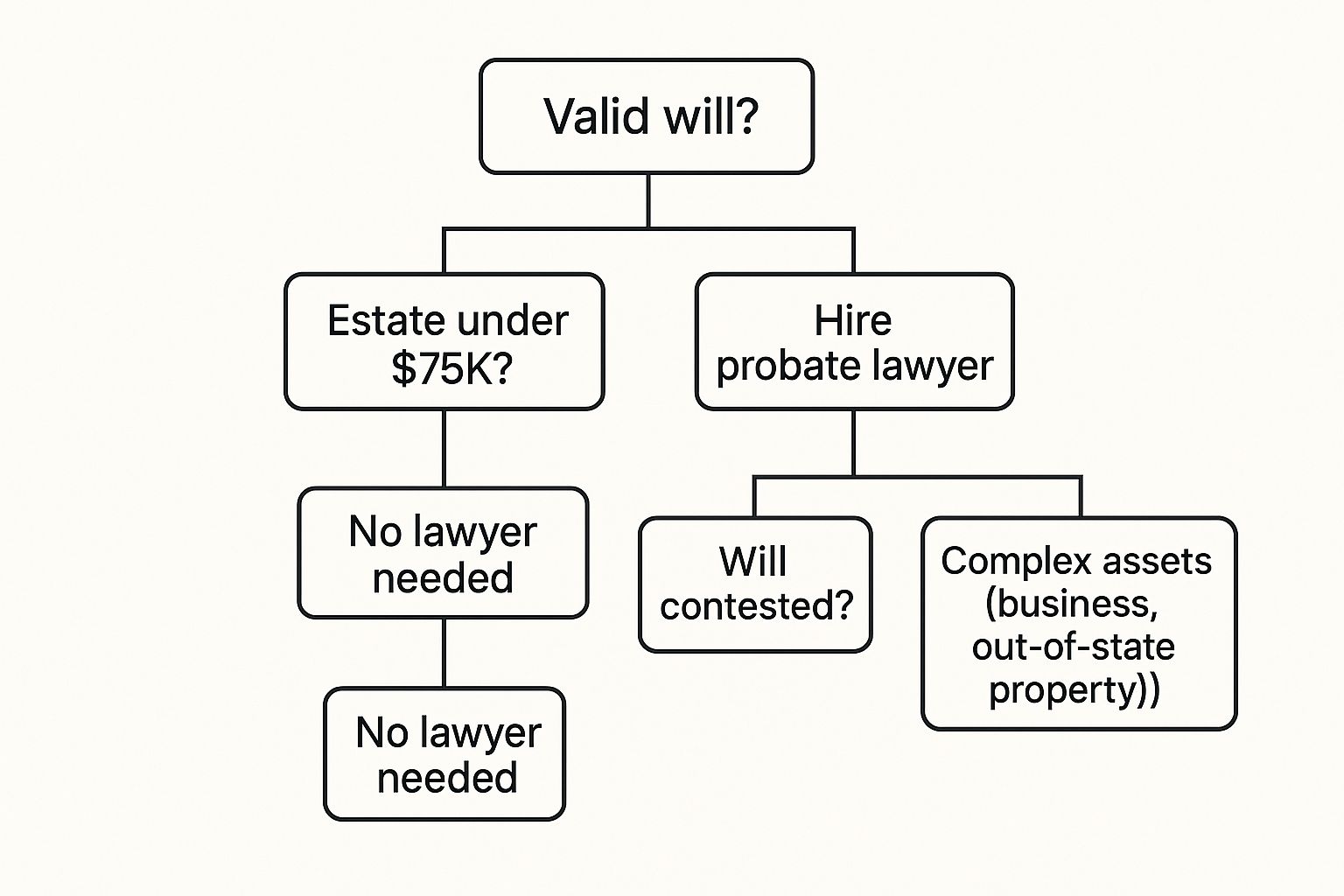
As you can see, a missing will, feuding heirs, or complicated assets are all immediate signs that you need professional legal guidance.
When There Is No Valid Will
If your loved one died without a will, the estate is legally considered intestate. This single fact complicates the entire process. Texas law has a rigid formula in the Estates Code that dictates exactly who gets what, and it often doesn't match what the person would have wanted.
In an intestate estate, the court must legally determine all rightful heirs in a formal proceeding called a Determination of Heirship. This process can be slow and requires extensive evidence to prove family relationships, making a lawyer’s involvement critical.
Without a will, there's also no named executor. This often leads to family members fighting over who should be in charge, forcing the court to appoint an administrator. A lawyer is crucial for navigating this appointment and ensuring a capable person is at the helm.
Family Disputes and Will Contests
Unfortunately, grief can bring old family tensions to the surface. If relatives are already disagreeing, you absolutely need a probate lawyer to act as a neutral guide.
Common flashpoints include:
- Disagreements over the Will: One sibling might claim a will is invalid because of undue influence, while another is determined to uphold it.
- Executor Disputes: Beneficiaries may feel the person named as executor is untrustworthy or is mismanaging the estate's money.
- Vague Language: A poorly written will can cause confusion, leading to different family members interpreting it in ways that benefit them.
Realistic Scenario: Imagine a will leaves the family's valuable antique collection "to be divided among my children as they see fit." Two children agree on how to split it up, but the third feels they're getting the short end of the stick and threatens to sue. Without an attorney to mediate and apply Texas law, this could easily explode into a full-blown legal battle, draining the estate of its funds and shattering family bonds.
Complex Estate Assets or Debts
Not all estates are just a house and a bank account. Some assets and financial situations demand specialized legal expertise. You'll need an attorney if the estate involves:
- A Family Business: Figuring out the value of a business, keeping it running, and distributing ownership shares is incredibly complex.
- Out-of-State Property: Managing real estate located in another state—a process known as ancillary probate—requires a separate court case with its own set of rules.
- Significant Debts: If the estate owes more money than it has, a lawyer is essential for prioritizing creditors and negotiating settlements according to strict legal guidelines.
Trying to manage these issues alone is a serious gamble. If you're considering it, take a moment to understand the risks of a DIY probate in Texas; it might provide some much-needed perspective.
Common Myths About the Texas Probate Process
Misinformation can turn a straightforward legal process into a stressful ordeal. When it comes to probate in Texas, a few persistent myths cause families unnecessary grief. Let's clear the air and look at what really happens.
Myth 1: A Will Lets You Avoid Probate
This is easily the biggest misunderstanding. Many people believe that if their loved one had a will, the family gets to skip the probate process entirely. That couldn't be further from the truth.
The reality is that a Last Will and Testament is the primary instruction manual for the probate court. It doesn't bypass the process; it directs it.
As outlined in Title 2 of the Texas Estates Code, a judge must formally validate the will before its instructions can be legally followed. Think of probate as the official stage where the will gets the court's stamp of approval, the executor is appointed, and the estate's business can legally begin. Without that court validation, the will is just a piece of paper with no power to transfer assets.
Myth 2: Probate Is Always a Long, Expensive Nightmare
Another common fear is that probate will drag on for years, slowly draining the estate's assets with endless legal fees. While it’s true that messy or contested estates can be lengthy, that isn't the reality for most families in Texas.
Texas law provides several streamlined options for simpler estates. Procedures like a Muniment of Title or a Small Estate Affidavit can be much faster and less expensive than a full probate administration. An experienced attorney can spot right away if your loved one's estate qualifies for one of these simpler paths, saving you time and money.
The looming intergenerational wealth transfer highlights another reason to seek clarity. Surveys show that while 48% of Americans know inheritance isn't automatic, a surprising 35% mistakenly believe it is. This confusion often leads to estates entering probate without a clear plan, which can get costly without the right legal guidance. You can discover more about how families are preparing for inheritance from recent studies on the topic.
Understanding Probate Costs and Lawyer Fees

When you’re thinking about hiring a lawyer, the first question is probably, "How much will this cost?" It’s a completely fair question. For most families, budget is a real concern, and legal bills feel like one more weight on your shoulders during an already heavy time.
However, we encourage families to see this differently: hiring a probate lawyer isn't a drain on the estate. It's an investment in protecting its value. A simple administrative mistake—like failing to notify a creditor correctly or missing a court deadline—can end up costing an estate far more than any legal fee. A good lawyer’s job is to preserve assets, not deplete them.
How Are Probate Lawyers Paid?
One of the biggest reliefs for most executors is learning that legal fees are typically paid directly from the estate's assets. This means you generally do not have to pay for the lawyer’s services out of your own pocket. An attorney's fee is considered an administrative expense of the estate, just like court filing fees or funeral costs.
In Texas, probate attorneys usually work with one of two common fee structures:
- Flat Fees: For straightforward estates where the path forward is clear, many attorneys offer a flat fee. This gives you predictability and peace of mind because you know the total cost right from the start.
- Hourly Rates: When a case is more complex—perhaps there’s a family dispute or tangled financial issues—an hourly rate is more common. The attorney will track their time and bill the estate for the work performed.
This payment structure is incredibly important, especially when you consider that only about 33% of Americans even have basic estate documents like a will in place. It’s no wonder so many families feel caught off guard. We offer a more detailed look at how much a probate attorney costs in Texas to help you understand the options.
Key Takeaway
The real value of a probate lawyer is peace of mind. Their expertise ensures every "i" is dotted and every "t" is crossed, preventing expensive mistakes and safeguarding the inheritance for its rightful beneficiaries. They take on the complex legal work, freeing you to focus on what truly matters: grieving, healing, and supporting your family.
A Final Word for Texas Families
Going through the loss of a loved one is hard enough without getting tangled in legal knots. The Texas probate process is there to make sure everything is settled fairly, but figuring out if you need a lawyer is the first, and most important, step you'll take.
A probate attorney is your family's best ally when things feel uncertain. Think of their guidance not as an expense that drains the estate, but as an investment in protecting its value and making sure the final wishes of the person you lost are honored. From getting the will validated to paying off debts and making sure assets get to the right people, their entire job is to bring clarity and direction to a confusing time.
Your Path Forward
As you think about what to do next, keep these critical points in mind:
- A Will Is a Roadmap for Probate, Not a Detour Around It: A will doesn't avoid probate—it directs it. A lawyer makes sure the will is recognized as valid under the Texas Estates Code so those directions are followed.
- Red Flags Mean It's Time to Act: If there’s no will, if family members are starting to argue, or if the estate has complex assets like a business, a lawyer isn't just a good idea—they're essential.
- Costs Are Handled by the Estate: Legal fees are almost always paid from the estate's funds, not out of your own pocket. This protects your personal finances while the estate is being settled.
Of course, the legal side of things is just one part of the journey. For some beautiful ideas on how to honor and remember those who've passed, you might find comfort in reading about Soulful Ways to Memorialize Loved Ones.
Whether you're facing the straightforward steps of the Texas Probate Process or need help with Wills & Trusts, our firm is here to walk with you. From simple administration to difficult Probate Litigation or the need to establish a Guardianship, we provide compassionate, step-by-step guidance.
If you’re facing probate in Texas, our team can help guide you through every step — from filing to final distribution. Schedule your free consultation today.
Common Questions About Working with a Probate Lawyer
Navigating the Texas probate process for the first time brings up many questions. We get it. You're looking for clear answers to help you feel more confident during a tough time. Here are a few of the most common questions our firm hears from families like yours.
How Long Does Probate Take in Texas If I Hire a Lawyer?
While every estate is different, hiring an experienced attorney can definitely speed things up. A relatively simple, uncontested probate in Texas can often wrap up within 6 to 12 months.
A good lawyer helps you sidestep the common pitfalls that cause delays. They make sure paperwork is filed correctly the first time, legal notices are sent out properly, and all court deadlines are met. These are the details that often trip up people handling an estate on their own, leading to frustrating delays.
Can I Be the Executor and Still Hire an Attorney to Help?
Yes, absolutely. In fact, this is the most common—and highly recommended—way to administer an estate. As the executor, you are legally responsible for managing the estate correctly. It's a heavy responsibility.
A probate lawyer acts as your personal guide and legal counsel, protecting you from personal liability if mistakes are made. They ensure you fulfill all your duties according to the Texas Estates Code, and their fees are paid by the estate, not out of your own pocket.
What Happens If My Family Disagrees Over the Will?
Family disputes are a flashing red light telling you to call a probate lawyer immediately. Disagreements over a will's validity, its terms, or the executor's actions can spiral out of control fast.
An attorney can step in to mediate these conflicts, offer an objective legal interpretation of the will, and work toward a fair resolution that keeps everyone out of a costly court battle. If the conflict does escalate into a formal will contest, you will need a lawyer with probate litigation experience to represent the estate's interests and defend the will in court.
Is Probate Always Required in Texas if There Is a Will?
Generally, yes. A will has to be officially validated by a probate court before its instructions can be used to legally transfer assets. This judicial stamp of approval is the heart of the probate process.
However, not all assets have to go through probate, and some very small estates might qualify for a simpler path, like a Small Estate Affidavit. A probate attorney can look at the estate's entire financial picture and figure out the most efficient and cost-effective legal route for your family.
At The Law Office of Bryan Fagan, PLLC, our goal is to make this process as clear and stress-free as possible for you and your family.
If you’re facing probate in Texas, our team can help guide you through every step — from filing to final distribution. Schedule your free consultation today.