Yes, executors in Texas are entitled to be paid for their work. This isn’t just a courtesy; it’s a right that acknowledges the significant effort and legal responsibility that comes with the job. When you’re grieving a loved one, the last thing you need is the financial strain of managing their final affairs. Thankfully, Texas law provides a clear framework for compensation, ensuring that the person entrusted with this critical role is fairly compensated for their time and effort.
Understanding Executor Compensation in Texas
Stepping into the role of an executor, also known as a personal representative, is a serious commitment. It’s a demanding job that requires you to juggle legal, financial, and administrative duties with meticulous attention to detail. You become legally responsible for safeguarding the estate’s assets, paying its debts, and ensuring beneficiaries receive what is rightfully theirs. This journey through the Texas Probate Process can easily stretch on for months and, in complex cases, even years.
Because this is such a substantial undertaking, the Texas Estates Code specifically allows for executor compensation. This law is designed to ensure the person entrusted with this critical role is paid fairly for their time, skill, and effort. However, payment isn’t automatic; it must be claimed correctly and approved by the probate court, which keeps the process transparent and fair for everyone involved.
Why Compensation Is Legally Provided
The legal framework for paying executors exists for a few important reasons. It recognizes just how complex and risky the role can be. An executor has a fiduciary duty, a legal term meaning they must act with the absolute highest level of integrity and in the best interests of the estate and its beneficiaries. Fair pay encourages executors to be diligent and helps prevent potential conflicts of interest.
In Texas, there are two primary ways an executor’s fee is determined:
- Instructions in the Will: The person who passed away (the testator) can specify exactly how the executor should be paid in their Wills & Trusts. This could be a flat fee, an hourly rate, or a set percentage of the estate’s value.
- Statutory Commission: If the will is silent on payment, Texas law provides a default formula. This statutory fee is based on a percentage of the cash transactions the executor handles for the estate.
Understanding which of these methods applies to your situation is the first step. It ensures you are compensated correctly and ethically while honoring your loved one’s final wishes. This guide will provide the clarity you need to handle this responsibility with confidence.
What a Texas Executor Actually Does
Before discussing how an executor gets paid, it’s essential to understand that this is a real job. Serving as an executor in Texas isn’t an honorary title; it’s a demanding, hands-on role with significant legal and financial responsibilities.
Think of the executor as the person responsible for managing the deceased’s final affairs. They navigate the entire probate process, from start to finish, to ensure everything is settled correctly. It’s a job that requires organization, patience, and compassion.
An executor is also a fiduciary. This is a plain-English way of saying they must act with the highest degree of good faith and loyalty. Legally, they must put the estate’s interests ahead of their own. This isn’t just a suggestion; it’s a legal standard with real consequences if breached.
The Core Duties of an Executor
The Texas Estates Code outlines a comprehensive list of duties for an executor. From the moment they are officially appointed by a judge, they are personally responsible for managing every aspect of the estate until the last asset is distributed. While no two estates are exactly alike, the core responsibilities remain the same.
Here’s a step-by-step look at what the job involves:
- Locating and Securing Assets: The executor must find and take control of everything the deceased owned—bank accounts, stocks, real estate, cars, furniture, and sentimental items.
- Creating a Detailed Inventory: Within 90 days of being appointed, the executor must file a formal document with the court called an “Inventory, Appraisement, and List of Claims.” This is a meticulously detailed list of every asset and its value on the date of death.
- Notifying Creditors and Paying Debts: The executor must publish a notice to potential creditors and manage any claims filed against the estate. Their job is to verify which debts are legitimate and pay them using estate funds.
- Managing Estate Finances: This includes opening a dedicated bank account for the estate, paying ongoing bills (like a mortgage or property taxes), and keeping a perfect record of every dollar that comes in and goes out.
- Filing Final Tax Returns: The executor is responsible for filing the deceased’s final personal income tax return and, if the estate is large enough, an estate tax return.
- Distributing Assets to Heirs: After all debts and expenses are paid, the executor distributes the remaining assets to the beneficiaries according to the will.
A Real-World Scenario
Let’s make this more concrete with a realistic example. Imagine your uncle passes away in Austin and names you as the executor in his will. His estate includes a home, two cars, several bank accounts, a stock portfolio, and a business he owned.
Your duties begin immediately. You must secure the house, manage the business operations until it can be sold or transferred, and locate his original will. You will then hire a probate attorney to begin the Texas Probate Process, which includes a court hearing to be formally appointed.
From there, you will spend weeks or months gathering financial documents, getting the home and business appraised, communicating with banks and creditors, and keeping the beneficiaries informed. All of this happens while you are also grieving the loss of your uncle. The entire process can easily take over a year. Once you understand the sheer volume of work, it becomes clear why Texas law ensures executors can be fairly paid. You can learn more about the complete list of an executor’s duties in our detailed guide on executor of will responsibilities.
Key Takeaway
The executor role is an active management position, not a passive title. It involves hundreds of administrative tasks, critical financial decisions, and constant communication with heirs, creditors, and the court, often while navigating personal grief.
How Texas Calculates Executor Compensation
So, you’re the executor of an estate. It’s a big job, and it’s natural to wonder if you’ll be paid for your time and effort. The short answer is yes, but the more important question is: how much? Texas law has a default, surprisingly specific way to calculate this, known as the “five percent rule.”
However, this is where a common misconception arises. It’s not5% of the estate’s total value. The fee isn’t based on the price of the house or the value of the stock portfolio. Instead, it’s tied directly to the cash that flows in and out of the estate under your management.
The Statutory Five Percent Rule Explained
Under Texas Estates Code § 352.002, an executor is entitled to a commission of five percent (5%) on all cash they actually receive and another five percent (5%) on all cash they actually pay out on behalf of the estate. Think of it as the “5-in, 5-out” rule.
This structure is designed to compensate the executor for the active financial administration they perform—the real work of gathering funds, paying bills, and keeping the estate’s finances in order. While many other states calculate fees based on the total estate value, Texas focuses on the cash transactions you oversee.
However, not every dollar that passes through your hands counts. The law is very clear about what is excluded from this calculation to prevent the fee from being artificially inflated.
Here’s what you cannot take a commission on:
- Cash that was already in a bank account or on hand when the person passed away.
- Money received from life insurance payouts.
- Funds collected from joint bank accounts with rights of survivorship.
- The final cash payments made to the heirs or beneficiaries when you distribute the estate.
The role of an executor involves inventorying assets, paying debts, and distributing what’s left to the rightful heirs—a process requiring careful management.
This flowchart gives you a high-level look at the core duties that justify this compensation.
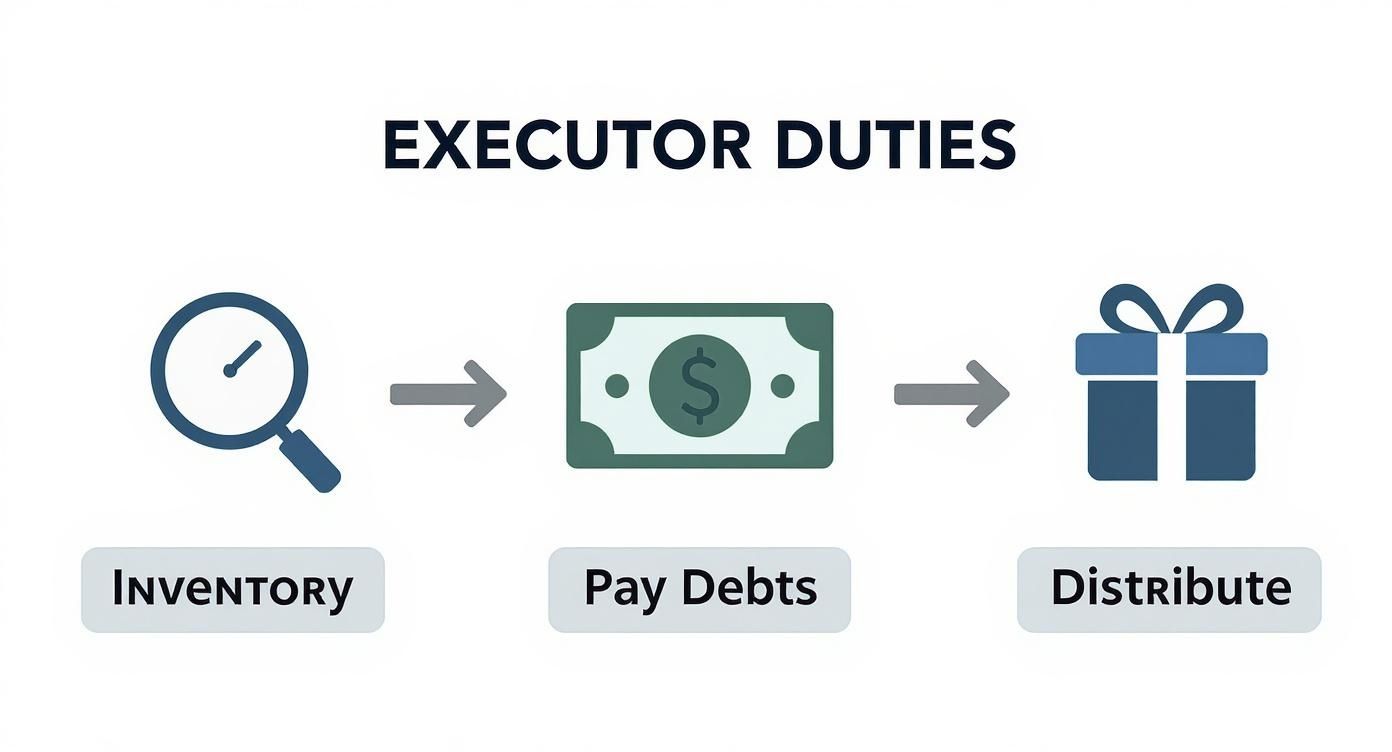
As you can see, it’s far more than just signing a few papers.
A Practical Example of the 5% Calculation
Let’s walk through a quick example to make this crystal clear. Imagine you’re the executor for an estate that has a house, some stocks, and a checking account. Your job is to liquidate some assets, pay the bills, and get the rest to the family.
Here’s how the math might shake out based on the cash you handle.
Example Calculation of Texas Executor Statutory Commission
This table shows how the 5% statutory commission is calculated based on the cash transactions for a hypothetical Texas estate.
| Transaction Type | Amount | Commissionable (Yes/No) | Calculated Commission (5%) |
|---|---|---|---|
| Cash Received (Receipts) | |||
| Sale of Decedent’s Car | $20,000 | Yes | $1,000 |
| Stock Dividends Received | $5,000 | Yes | $250 |
| Cash in Checking Account | $30,000 | No | $0 |
| Cash Paid Out (Payments) | |||
| Funeral Expenses Paid | $12,000 | Yes | $600 |
| Final Credit Card Bill Paid | $3,000 | Yes | $150 |
| Court & Legal Fees Paid | $8,000 | Yes | $400 |
| Distribution to Heirs | $50,000 | No | $0 |
| Total Commission | $2,400 |
In this scenario, your total fee as the executor would be $2,400. This comes from $1,250 (5% of the $25,000 in commissionable money coming in) plus $1,150 (5% of the $23,000 in commissionable money going out). Notice the cash already in the bank and the final inheritance checks to the family are correctly left out of the fee calculation.
When the Will Specifies Different Compensation
The statutory 5% rule is just the default. The will is the primary authority. If the person who passed away (the testator) left specific instructions in their will about how the executor should be paid, those instructions override the state’s formula.
It’s common to see a few different approaches in Wills & Trusts:
- A Flat Fee: The will might simply state the executor gets a specific amount, like $5,000, for their services.
- An Hourly Rate: Some testators prefer to pay their executor a reasonable hourly rate for their time, which means the executor needs to keep detailed records of their work.
- No Compensation: Often, when a close family member is named, the will might specify that they should serve without any payment.
What if the will sets a fee that is unreasonably low for the work involved? An executor has the right to formally renounce the compensation specified in the will and ask the court to award the standard statutory commission instead. Managing these financial details is a big part of understanding the overall costs associated with probate in Texas.
Key Takeaway
A will can completely change the compensation rules. It’s critical for both the testator and the executor to read and understand what the will says about payment before anyone assumes the statutory 5% rule applies.
Covering Your Out-of-Pocket Expenses
When we talk about whether an executor gets paid, it’s crucial to distinguish between compensation for your work and reimbursement for expenses. The fee you earn is for your time and effort. Reimbursement is simply the estate paying you back for costs you covered on its behalf.
You should never have to pay for estate-related expenses out of your own pocket. Under Texas law, you are entitled to be repaid for every reasonable and necessary expense you incur while settling the estate. Think of the estate as a small business you’ve been hired to wind down; that business is responsible for its own operating costs, not you.
This legal protection ensures that fulfilling your duties doesn’t become a financial burden. These reimbursements are completely separate from any commission you might receive.
What Expenses Can an Executor Claim?
So, what exactly counts as a “reasonable and necessary” expense? The list can be long, as every estate is unique. The key is that the expense must be directly tied to administering the estate and preserving its assets.
Common reimbursable expenses often include:
- Court and Legal Fees: This covers court filing fees, the cost of getting certified copies of Letters Testamentary, and attorney’s bills.
- Property Maintenance Costs: If the deceased owned a home, expenses like lawn care, utility bills, homeowner’s insurance, and urgent repairs are all reimbursable.
- Administrative Costs: This includes postage for sending legal notices, office supplies, and fees for professionals like accountants or appraisers.
- Travel Expenses: If you have to drive to meet with a lawyer or attend a court hearing, your mileage and related travel costs can be reimbursed.
The Critical Importance of Meticulous Records
The single most important habit for an executor is meticulous record-keeping. You must keep every receipt, invoice, and statement related to any expense you pay on behalf of the estate.
Get a folder, start a spreadsheet, or use an app—whatever works for you. Just make sure you log:
- The date of the expense.
- The exact amount paid.
- Who the payment was made to.
- A clear description of what the expense was for.
This isn’t just about being organized; it’s your proof. When you present your final accounting to the court and the heirs, this detailed log will justify every reimbursement claim. It’s the best way to prevent disputes and show that you’ve handled your fiduciary duty responsibly. This is a universal best practice in estate management worldwide, as noted by resources like Finglobal.com regarding South African estates.
Key Takeaway
Keep personal finances completely separate from the estate’s. Whenever possible, pay for estate expenses directly from an official estate bank account. This creates a clear paper trail that simplifies the final accounting and builds trust with beneficiaries.
Getting Court Approval and Avoiding Disputes
Can an executor simply write themselves a check from the estate account? Absolutely not. In Texas, every dollar you receive in compensation and every expense you get reimbursed for must be formally documented and approved by the probate court. This isn’t just red tape; it’s a critical safeguard that ensures transparency and protects the best interests of the beneficiaries.

Think of court approval as the final validation of your fiduciary duty. By presenting a detailed accounting, you prove that you’ve managed the estate’s money responsibly. A judge reviews these records to confirm that your request is reasonable and aligns with the will’s instructions or state law.
The Formal Accounting Process
Toward the end of the probate process, before assets can be distributed to heirs, you must submit a final accounting to the court. This comprehensive document is a final financial report for the estate.
Your final accounting must clearly list:
- All assets the estate started with.
- All income the estate received (e.g., from selling property).
- All debts and expenses paid from estate funds.
- A clear calculation of the executor’s fee you are claiming.
- A detailed list of all expenses you’re seeking reimbursement for, complete with receipts.
This document is shared with all beneficiaries for their review, giving them a chance to ask questions and understand how the estate’s funds were handled.
What Happens When Beneficiaries Object
Beneficiaries have a legal right to object to an executor’s fee if they believe it’s unreasonable, inaccurate, or conflicts with the will or law. This is often where family tensions can surface.
Common reasons for disputes include:
- Misunderstanding the Law: Heirs might mistakenly think the 5% commission applies to the entire estate value, leading to surprise.
- Lack of Communication: If an executor has been silent, beneficiaries can grow suspicious.
- Perceived Unfairness: A beneficiary might feel the fee doesn’t match the amount of work performed.
If an objection is filed, the court will schedule a hearing where both sides can present their case. As the executor, you’ll need to provide detailed evidence to justify your compensation. The judge will then make a final decision.
When disagreements can’t be resolved, it can lead to formal Probate Litigation, a stressful and expensive legal battle. This highlights the value of experienced legal counsel to ensure your accounting is flawless and to help navigate sensitive family dynamics. Legal systems vary; for instance, as detailed on greinerlawcorp.com, UK solicitor executors often charge a percentage of the estate’s total value, a different model from Texas.
Key Takeaway
Proactive and transparent communication is the single most effective tool for preventing disputes. Regularly updating beneficiaries on the estate’s status and providing clear financial records can build trust and prevent misunderstandings before they escalate.
Final Thoughts: What Every Texas Executor Needs to Know
Stepping into the role of an executor can feel overwhelming, especially while grieving. However, the rules in Texas regarding compensation are designed to be fair and clear.
You Are Entitled to Be Paid
First and foremost, Texas law values your effort. Serving as an executor is a demanding job with serious legal duties. Unless the will specifically forbids it, you have a legal right to be compensated for your work. This isn’t a gift; it’s earned income for a job well done.
The Will’s Instructions Always Come First
The will is the ultimate guide. If it specifies a compensation plan—a flat fee, an hourly rate, or no fee at all—those are the rules you must follow. The state’s default 5% commission only applies when the will is silent on the matter.
The 5% Rule Is Not 5% of the Entire Estate
This is a critical point. The statutory commission is not5% of the estate’s total value. It is calculated as 5% of the cash that flows into the estate and 5% of the cash that is paid out. This excludes cash already in a bank account at the time of death and the final distributions to beneficiaries.
Fees and Expenses Are Two Different Things
Your compensation is your salary; expense reimbursement is for covering business costs. You are entitled to be paid back for every reasonable dollar you spend managing the estate, including court fees, attorney costs, property upkeep, and administrative expenses. Keeping meticulous records is essential.
The Court Must Approve All Payments
You cannot pay yourself without court approval. All fees and reimbursements must be detailed in a final accounting submitted to the probate court. A judge must sign off on it, ensuring transparency and protecting both you and the beneficiaries.
Understanding these rules is just one piece of the puzzle. Exploring related topics like the rules around Guardianship can provide more context on the court’s protective role in estate and personal affairs.
If you’re facing probate in Texas, our team can help guide you through every step — from filing to final distribution. Schedule your free consultation today.
Frequently Asked Questions About Executor Fees
Serving as an executor raises many questions, especially about compensation. Here are clear, plain-English answers to some of the most common questions we hear from Texas families.
Is My Executor Fee Considered Taxable Income?
Yes, absolutely. The IRS treats executor compensation as taxable income—payment for services rendered. It is not considered a gift or an inheritance.
You will need to report the fee on your personal income tax return for the year you receive the payment. Since the estate will not withhold taxes, it is wise to set aside a portion of your fee to cover your future tax liability.
Can I Choose Not to Accept a Fee?
Of course. It is common for a family member, like a spouse or child, to serve as executor without taking payment. Many view it as a final act of service and prefer the money to remain in the estate for other beneficiaries.
If you choose this path, the best practice is to formally waive your right to compensation in writing. This simple document, filed with the court, creates a clear record and prevents any future confusion among heirs.
What Happens If There Are Two Co-Executors?
When a will names co-executors, they do not each receive a separate 5% commission. Instead, they must share a single commission.
Under Texas law, the court will divide the statutory fee between the co-executors in a way it deems just and fair. Often, it’s split equally. However, if one co-executor performed significantly more work, the court has the discretion to adjust the split to reflect each person’s contribution. Knowing how long an executor has to distribute assets can help co-executors plan their responsibilities from the start.
Can a Court Change the Statutory Fee?
Yes, though it is uncommon. A probate judge has the authority to adjust the standard 5% commission if there is compelling evidence that the fee is unreasonably low or unreasonably high for the work involved.
A court might increase the fee for a particularly complex estate that involved extensive Probate Litigation or required an extraordinary amount of work. Conversely, a judge could lower the fee if the estate was exceptionally simple and the 5% rule would result in excessive compensation for minimal effort. This flexibility ensures that compensation remains fair and proportional to the duties performed.
Key Takeaway
At every step, clear communication and meticulous record-keeping are an executor’s most valuable tools. They build trust with beneficiaries, provide justification for fees and expenses, and ensure a smoother process for everyone involved during a difficult time.
At the Law Office of Bryan Fagan, PLLC, we understand that you’re navigating more than just a legal process—you’re managing a loved one’s legacy. If you’re facing probate in Texas, our team can help guide you through every step — from filing to final distribution. Schedule your free consultation today at https://txprobatelawyer.net.