A common-law spouse can inherit in Texas only if the informal marriage is legally proven under Texas Family Code § 2.401. Once proven, the surviving partner inherits under the same Texas Estates Code Chapter 201 rules that apply to a ceremonial spouse, including a possible one-third share of separate personal property and a life estate in one-third of separate real property when descendants exist.
After a death, families often discover that love, shared finances, and years under one roof don't automatically answer the legal question. A surviving partner may be grieving while also trying to keep the home, locate a will, respond to the decedent's children, and understand why a probate court wants proof that the relationship was a marriage.
Texas does recognize informal marriage, commonly called common-law marriage. But inheritance follows a two-gate process. First, the survivor must establish the informal marriage. Second, the court must classify the assets as community or separate property and apply the family-structure rules that determine who receives them.
That process can feel overwhelming, especially when relatives disagree about the relationship or the estate includes a home, bank accounts, inherited assets, or children from an earlier relationship. The law provides a path forward, but the correct path depends on evidence, property records, and the presence or absence of a will.
Introduction When Love and Texas Law Meet After Loss
Maria and James had built a life together in Texas for years. Neighbors knew them as husband and wife. James identified Maria as his spouse on insurance paperwork, and they shared household expenses. They never held a formal wedding or signed a declaration of informal marriage.
After James died, Maria expected to stay in their home and help handle the estate. James's adult daughter questioned whether Maria was legally his wife. The disagreement was not about how the couple described their relationship. It was about whether Maria could inherit as a surviving spouse.
Living together alone does not create an inheritance right. Texas law requires proof that the couple agreed to be married, lived together in Texas as spouses after that agreement, and represented to others that they were married. Those requirements arise under Texas Family Code § 2.401 and are summarized in Texas guidance on intestate succession and informal marriage.
This creates two legal gates. The first gate is proving the informal marriage. The second is applying Texas property and family rules to the estate. Those rules can change depending on whether an asset is community or separate property, whether the decedent left descendants, and whether children came from an earlier relationship.
If the marriage is established, Texas does not place the surviving informal spouse in a lesser category. The survivor is treated like a ceremonially married spouse under the intestacy rules in Texas Estates Code Chapter 201. If the marriage cannot be proven, the survivor generally is not treated as a surviving spouse in an intestate estate and may receive nothing by default, as explained in Texas probate guidance on informal marriage and intestate succession.
The practical sequence matters. Before asking what a spouse inherits, the family must determine whether the survivor can legally establish that spouse relationship. Only then can the court apply the property classifications and descendant rules that control distribution.
Takeaway: A long relationship may support an informal-marriage claim, but the claim must be legally established before Texas spousal inheritance rules protect the survivor.
What Texas Means by Informal Marriage and Why It Controls Inheritance
Texas law recognizes an informal marriage under Texas Family Code § 2.401. The relationship isn't created merely because two people share a home or combine their finances. The survivor generally must prove three connected facts.
The three required elements
Agreement to be married means the couple agreed that they were married, not merely that they planned to marry later. A future intention, such as “we'll get married someday,” doesn't establish the present agreement Texas law requires.
Living together in Texas as spouses means the couple lived together in Texas after making that agreement. The sequence matters. The survivor must connect the shared home to the claimed marital relationship, rather than relying only on a long period of cohabitation.
Representing to others that they were married is often called “holding out.” In plain English, the couple must have presented themselves publicly as married. Documents, conversations, family relationships, and community interactions may help show how the couple described their relationship to other people.
A separate signed declaration of informal marriage can also provide direct proof of the relationship. It can be especially valuable because it gives a court an official record rather than requiring the survivor to reconstruct the marriage from scattered evidence after death.
Core test: The survivor must show an agreement to be married, cohabitation in Texas as spouses after that agreement, and representation to others that the couple was married.
The test matters because Texas Estates Code Chapter 201 governs intestate succession, meaning the distribution of an estate when a person dies without a will. Under that framework, a proven informal spouse receives the same spousal treatment as a ceremonial spouse. Without proof, the survivor doesn't get to skip directly to the inheritance calculation.
The distinction is easy to miss. A person may have shared a home, paid bills, and cared for a partner for years, yet still face a threshold legal dispute. That doesn't diminish the relationship. It reflects the court's need to determine who has the legal status of spouse before transferring property.
Key Insight: Informal-marriage proof is the gatekeeper. The inheritance rules become available only after the survivor clears that gate.
How Inheritance Shares Work for a Surviving Common Law Spouse
Once an informal marriage is proven, the estate must be analyzed by property type and family structure. Texas doesn't distribute every asset in the same way. Community property and separate property follow different rules, and children from outside the relationship can materially change the outcome.
Community property
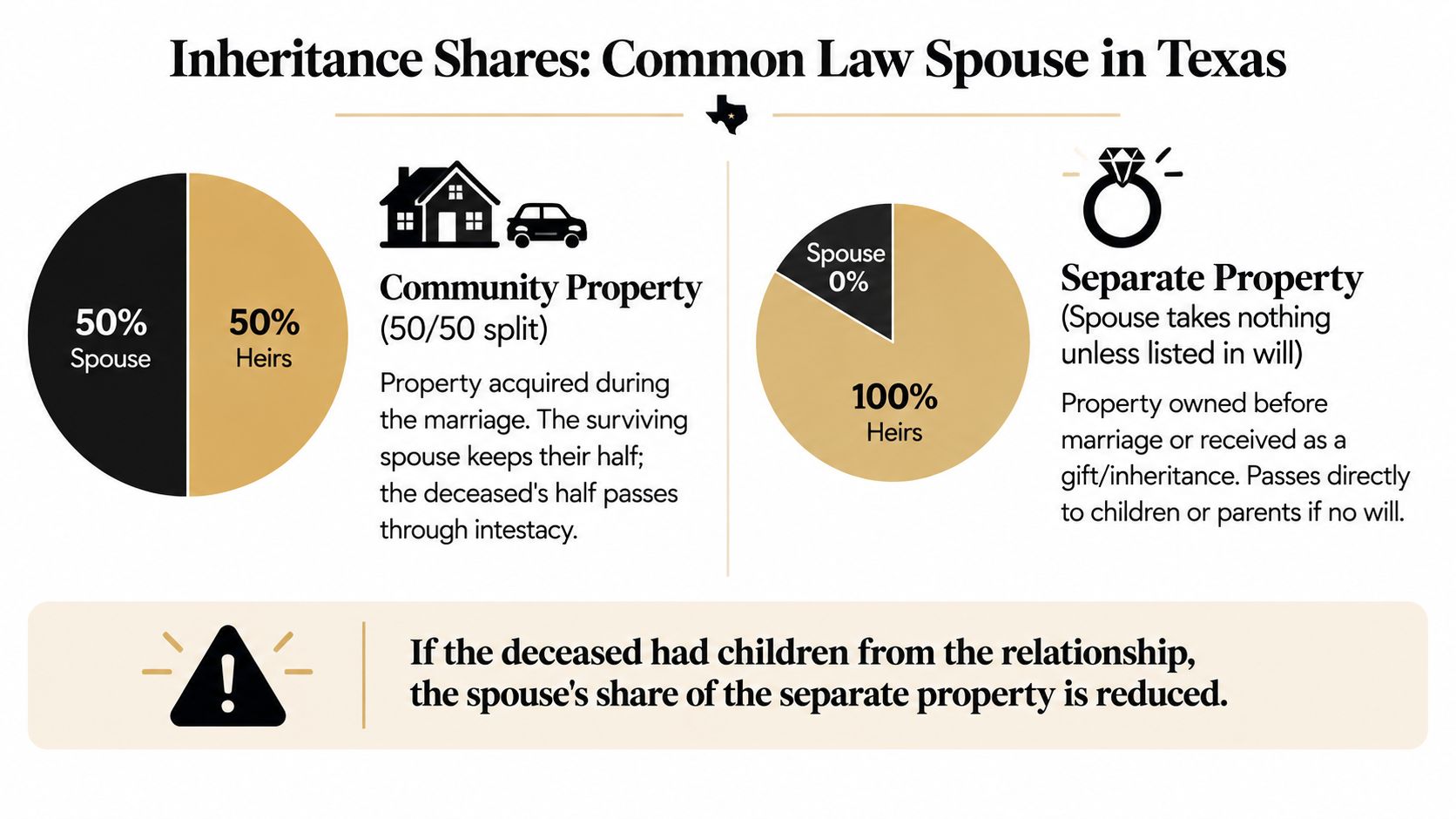
Community property generally refers to property belonging to the marital community under Texas law. Under Texas Estates Code § 201.003, if the decedent leaves no children, or if all surviving children are also children of the surviving spouse, the entire community estate passes to the surviving spouse. The decedent's one-half community interest is the portion that moves through the estate, while the survivor's own interest is treated separately. See the Texas Estates Code provision on community-property succession.
If the decedent has at least one child who isn't also the surviving spouse's child, the decedent's one-half community interest passes to those descendants instead. That means a surviving informal spouse may keep the spouse's own community interest but not receive the decedent's half.
Separate property
Separate property has a different structure. When descendants exist, the surviving spouse receives one-third of the decedent's separate personal property outright and a life estate in one-third of the decedent's separate real property under Texas Estates Code § 201.002. A life estate gives the spouse the right to use or possess the property for life, but it isn't the same as owning it outright. Descendants receive the remaining interests.
If there are no children or descendants, the surviving spouse receives all separate personal property and one-half of the separate land outright, subject to the rest of Texas intestacy rules. If there are also no surviving parents, siblings, or their descendants, the spouse may take the entire estate. The statutory framework appears in Texas Estates Code § 201.002.
Consider a blended family. James leaves Maria, his proven informal spouse, and a daughter from a previous relationship. James's community property and separate property can't be placed into one general “spouse gets everything” category. Maria's rights depend on whether each asset is community or separate, and James's daughter affects the distribution of the decedent's community share and the remainder of separate property.
The home may create a particularly difficult problem. If it is separate real property and descendants exist, Maria may have a life estate rather than full ownership. Selling the property, clearing title, satisfying a lender, or dividing interests may require cooperation or a court proceeding. Families seeking a practical overview can review this guide to surviving-spouse rights in Texas probate.
| Property Type | Family Situation | Surviving Spouse Receives | Who Receives Remainder |
|---|---|---|---|
| Community property | No descendants, or all descendants are also the spouse's children | The decedent's community interest, with the community estate passing to the spouse | No descendant share from the decedent's community interest |
| Community property | At least one child isn't also the surviving spouse's child | The surviving spouse's own community interest | The decedent's one-half community interest passes to those descendants |
| Separate personal property | Descendants exist | One-third outright | Descendants receive the remaining two-thirds |
| Separate real property | Descendants exist | Life estate in one-third | Descendants receive the remaining interests |
| Separate property | No descendants | All personal property and one-half of land outright, subject to further intestacy rules | Other heirs may receive the remaining land |
Evidence and property analysis work together. A survivor can have strong proof of marriage but still face a limited share because the estate includes separate assets or children from a different relationship.
Proving Your Informal Marriage With Evidence Texas Courts Trust
After a death, a surviving partner may know the relationship was a marriage while the probate file contains no marriage license. Texas courts then examine evidence, not just the length of the relationship. The inheritance process has two gates: first, prove the informal marriage; then apply the property rules that determine what the surviving spouse may receive. Those rules can change sharply when the estate includes separate property or children from another relationship.
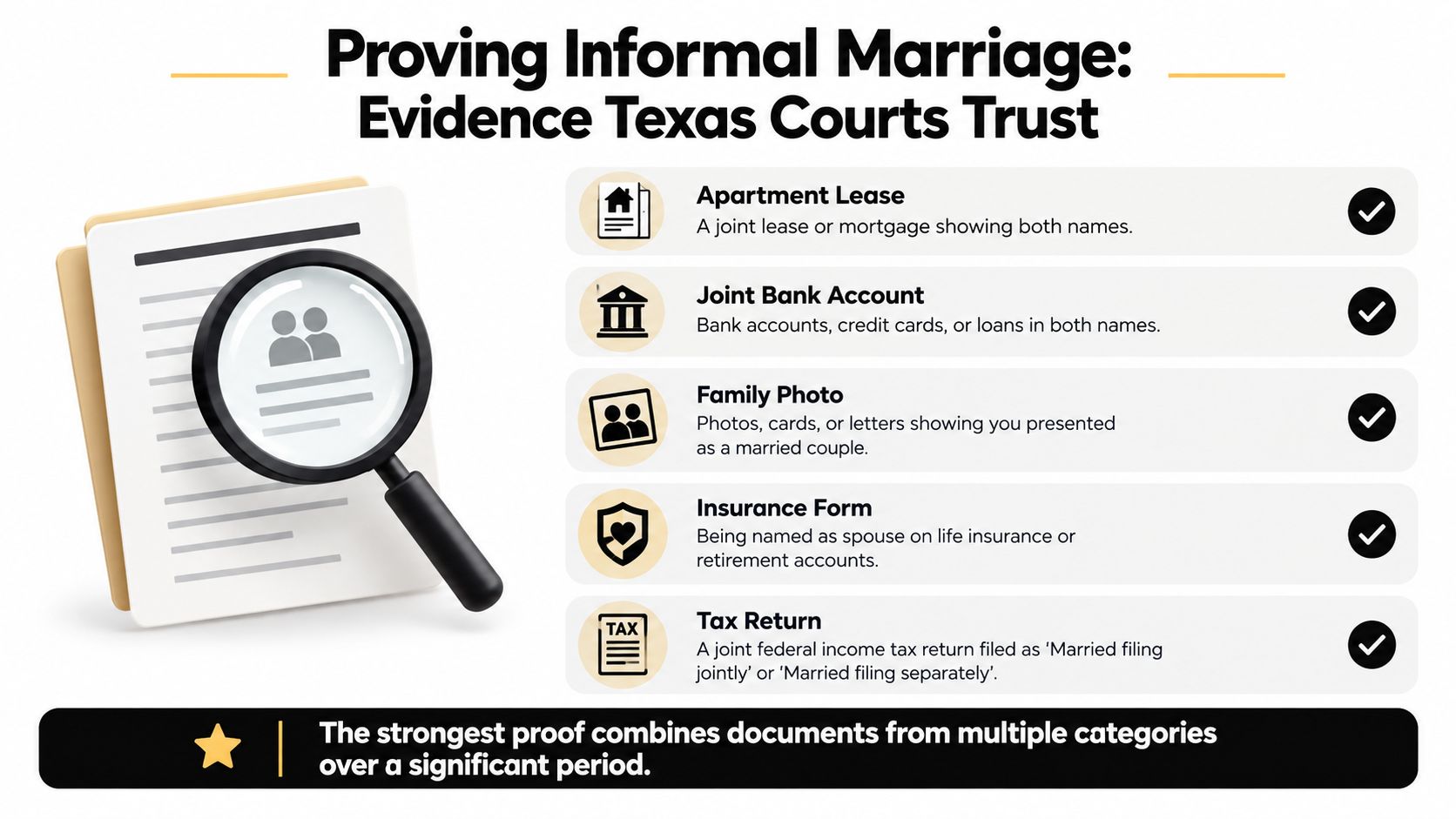
Begin collecting records before anyone transfers or distributes estate property. Useful evidence may include:
- Housing records: Leases, deeds, mortgage papers, and utility records can support the couple's shared-home history.
- Financial records: Joint bank accounts, credit cards, loans, and household accounts may show that the partners conducted their financial lives together. Each record supports part of the story, but none necessarily proves every legal element.
- Tax and insurance records: Tax returns, life insurance forms, retirement accounts, and employer records may show that one partner identified the other as a spouse.
- Public and personal records: Letters, cards, photographs, memberships, and correspondence can help show how the couple represented their relationship.
- Witness accounts: Friends, relatives, neighbors, coworkers, and others may describe how the partners referred to each other and how the community understood the relationship.
Evidence works like pieces of a puzzle. A joint account may show financial cooperation. A beneficiary form naming someone as a spouse may support public representation. Housing records, messages, and witness testimony can fill other gaps. The court considers whether the pieces fit together, rather than treating one document as conclusive.
Families gathering sworn statements and witness testimony may consult the Texas probate evidence guide covering affidavits and witnesses.
The separation rule
Timing can create a separate problem. If no suit to prove the informal marriage is started within two years after the couple separates, Texas presumes there was no agreement to be married, according to Texas guidance on the informal-marriage proof requirement. That presumption can make an already difficult claim harder.
Separation differs from death, and it does not automatically resolve every probate question. If the couple separated before the death, speak with a Texas attorney promptly. Waiting may allow records to disappear or disagreements among heirs to grow.
Prepare a proof file
Create one physical or digital folder containing the death certificate, any will, housing records, tax filings, insurance and retirement documents, financial statements, and names of potential witnesses. Keep original documents secure. Preserve messages, photographs, and account statements in their original form, and do not discard records that may show how the couple presented their relationship.
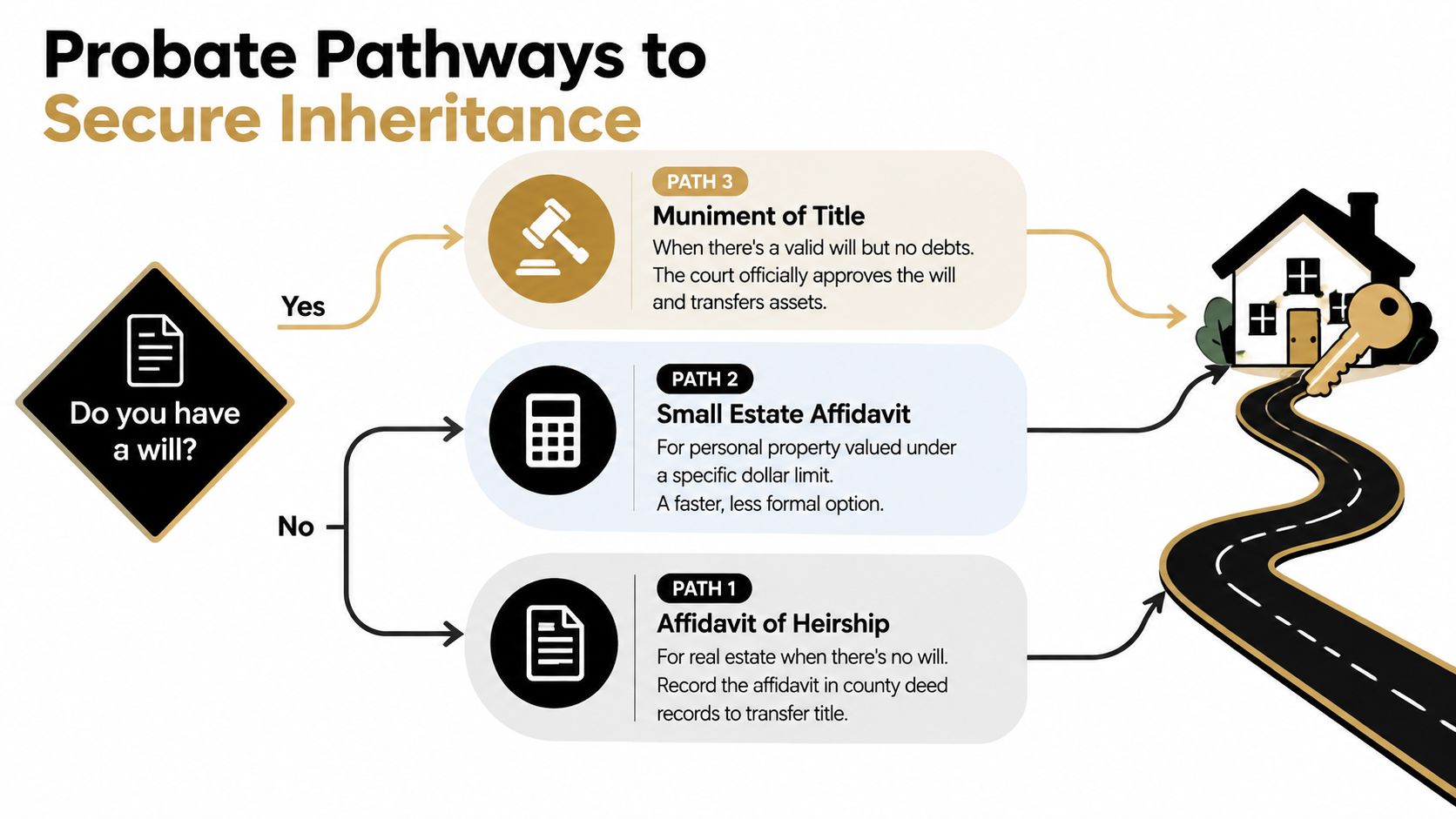
For a modest estate with no will, The Small Estate Affidavit in Texas may provide a simpler procedure when statutory conditions are met. The survivor must still identify the correct heirs and address any dispute over informal-marriage status.
Practical rule: Do not rely on cohabitation alone. Build a record addressing agreement, a shared life in Texas, and public representation as spouses.
Probate Pathways to Secure Title and Inheritance in Texas
The right probate procedure depends on the estate's documents, debts, assets, and level of disagreement. Texas Estates Code Titles 2 and 3 provide the framework for wills, administration, heirship, and estate distribution, but the procedure must match the facts.
An affidavit of heirship is a sworn statement identifying the heirs and family history. It can help establish ownership, particularly for real estate, when no will controls and the family agrees on the facts. Families can review this Texas affidavit of heirship resource while gathering records.
Muniment of title is a simplified probate path for a valid will when the estate doesn't require a full administration for debts. The court admits the will and uses the order to transfer title. If someone claims to be an informal spouse, that status may still need to be resolved before the court can determine who receives property.
A formal administration may be necessary when the estate has debts, disputed heirs, unclear title, or assets requiring an executor or administrator to act. Independent administration can reduce court supervision when the legal requirements and family circumstances support it. Dependent administration involves closer court oversight.
A small estate affidavit may fit a modest estate with no will when the statutory conditions are satisfied. It isn't a universal shortcut, especially when a claimed spouse and descendants disagree about heirship.
A title problem in practice
Suppose Robert leaves a Texas home, personal accounts, and children from an earlier relationship. His surviving partner claims an informal marriage. If the home is separate real property, the survivor may have a life estate rather than outright ownership, while the children hold the remaining interest. A lender or buyer may need clear documentation of those competing interests before a sale can proceed.
That family may need more than a simple transfer document. If the marriage is disputed, the court may need to decide marital status first. If the heirs agree and the will or estate facts permit a straightforward process, a less formal route may be possible. If they don't agree, administration or probate litigation may be necessary.
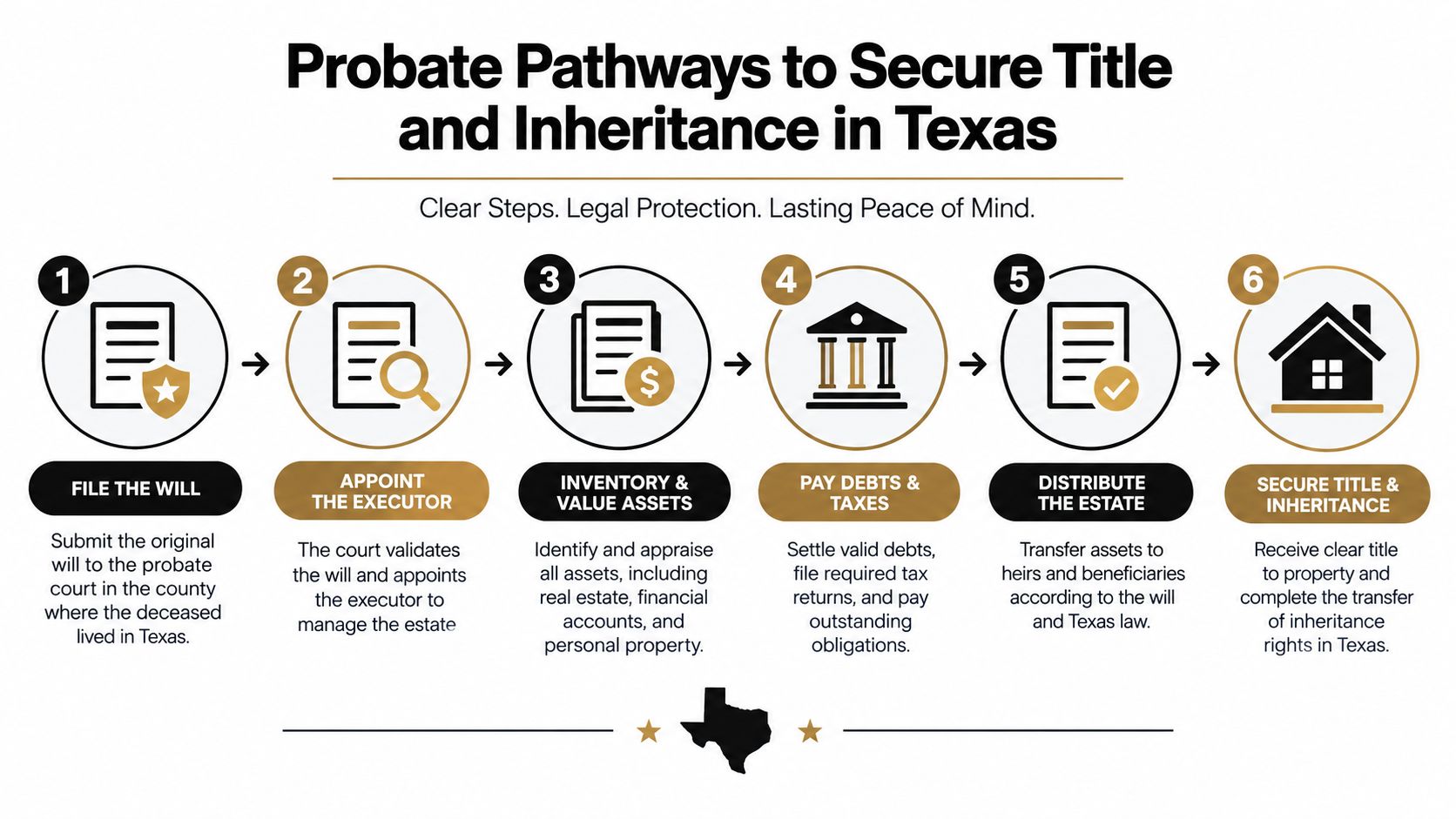
The safest choice comes after reviewing the will, asset classifications, debts, family relationships, and evidence of marriage. Choosing a procedure before answering those questions can create delays or force the family to redo work.
Practical Steps to Claim or Protect Inheritance and When to Get Help
After a death, the surviving partner, executor, and heirs should protect the estate before trying to distribute anything. A careful sequence reduces the risk of selling property, closing accounts, or signing documents that conflict with the eventual heirship determination.
Secure the will and key records. Look for the original will, death certificate, deeds, account statements, insurance forms, tax records, leases, and declarations of informal marriage. Don't assume the absence of a ceremony means there is no estate-planning document.
Separate the property categories. Create an inventory showing what may be community property and what may be separate property. Record how each asset was acquired, whether it came by gift or inheritance, and whose name appears on the title.
Preserve marriage evidence. Save copies of joint records and identify people who can describe how the couple presented themselves. Don't wait until relatives challenge the relationship, because records can disappear and memories can fade.
Pause distributions. Executors and family members should avoid transferring or dividing disputed assets until the estate determines the heirs and the applicable property rules. This is especially important where a home, a life estate, or children from outside the relationship are involved.
Choose a probate route. Review whether the estate may need an affidavit of heirship, muniment of title, small estate procedure, independent administration, or dependent administration. The Texas Probate Process involves court filings and estate duties that should be matched to the facts.
Get help when the status is contested. Warning signs include a relative denying the relationship, conflicting wills, missing financial records, disputed real-estate ownership, or pressure to sign away rights. A contested heirship matter may require Probate Litigation rather than an uncontested filing.
Bring a timeline of the relationship to the consultation. Include when the couple lived together, how they described themselves, which records identify them as spouses, what property they acquired, and which family members may challenge the claim.
Families planning before a crisis can also explore Wills & Trusts and related incapacity documents. A clear estate plan can reduce uncertainty, but it doesn't eliminate the need to confirm ownership and marital status in every situation.
Key Insights and Next Steps for Texas Families
The central lesson is simple: common law spouse inheritance in Texas isn't automatic. It follows two gates.
- Prove the informal marriage. Show the agreement to be married, living together in Texas as spouses, and holding out to others as married, or produce a signed declaration of informal marriage.
- Classify the property. Apply separate rules to community property, separate personal property, and separate real property.
- Identify the family structure. Children from outside the relationship can receive the decedent's community interest and affect the remainder of separate property.
- Select the procedure. Use the probate pathway that fits the will, debts, title issues, and level of agreement.
- Preserve evidence early. Documents and witnesses may decide whether the estate is administered as a spousal inheritance matter or a non-spouse heirship dispute.
A surviving partner shouldn't feel ashamed for not having a ceremony or declaration. The legal process can be demanding, but a careful review of records can clarify the relationship and protect legitimate rights. Families also benefit from planning ahead through services such as Guardianship and estate-planning guidance before a crisis occurs.
If you're facing probate in Texas, our team can help guide you through every step, from proving an informal marriage and classifying property to filing and final distribution. The Law Office of Bryan Fagan, PLLC can review your evidence, explain the available probate pathway, and help you move forward with clarity, so please visit Law Office of Bryan Fagan, PLLC to schedule your free consultation today.