Losing a loved one is hard enough. Finding out you also need to deal with property in another state can make everything feel heavier.
Many families first run into ancillary probate filing Texas after the main probate case has already started somewhere else. An executor in Ohio, Arizona, or Florida may think the estate is underway, then discover a deed to a Texas home, a tract of land, or mineral interests. At that point, one question usually follows fast: “Do we really have to open something in Texas too?”
Often, the answer is yes. Sometimes, the answer is no. The right path depends on the kind of property involved, what the will says, whether anyone needs legal authority in Texas, and whether a simpler title-recording option will work.
Texas probate law, especially under Texas Estates Code Titles 2 and 3, gives a framework for handling these situations. The process is not always easy, but it is usually manageable when you understand what Texas courts are trying to accomplish: making sure Texas property is transferred legally, local procedures are followed, and any valid claims tied to that property are addressed.
Your Loved One Lived Elsewhere But Owned Property in Texas
An Ohio family learns their mother owned a rental house in Austin. Her will has already been admitted to probate back home, and her executor assumes that should be enough to transfer everything. Then the title company says it cannot move forward based on Ohio authority alone.
That is the moment many people first hear the phrase ancillary probate.
In plain English, ancillary probate is a second probate process used for property located in a different state from where your loved one lived. In Texas, this comes up most often when a non-resident dies owning Texas real estate or other Texas-based tangible property. Texas courts handle that property because it sits here.
A few examples make this clearer:
- Vacation property: A New Mexico resident owned a beach condo on the Texas coast.
- Investment real estate: A Georgia resident kept a rental duplex in Dallas.
- Land or ranch property: A California resident inherited undeveloped land in Harris County years earlier and never sold it.
Those assets do not transfer just because another state’s court probated the will. Texas wants a Texas-based legal step before title changes hands.
For families dealing with this from afar, the experience can feel frustrating, but it is common. If you want a broader look at multi-state estate issues, this guide on handling out-of-state property in a Texas probate case helps place ancillary probate in context.
Why this surprises so many executors
Most executors are prepared for paperwork. They are not prepared for a second court system.
The confusion usually starts because “probate” sounds like one single process. It is not. Probate authority often depends on where property is located. Texas courts do not expect grieving families to know that automatically, but they do expect the proper filing once the issue is identified.
Takeaway: Ancillary probate is not a sign that something went wrong. It is the legal tool Texas uses when someone who lived elsewhere owned property here.
Understanding When Ancillary Probate Is Required
The first practical question is simple: what kind of Texas asset are you dealing with?
That matters because Texas treats some assets as local to Texas and some as tied to the decedent’s home state. This is part of the legal idea of situs, which means the place where property is considered to be located for legal purposes.
Real property usually triggers Texas action
If your loved one owned real estate in Texas, ancillary probate is often required unless a non-probate transfer method already avoids it.
Think of assets like these:
- A house or condo: A Florida resident owned a Galveston vacation home.
- Vacant land: A Colorado resident held acreage outside San Antonio.
- Ranch or investment property: A Washington resident owned a rental house in Houston.
Texas courts have authority over land within Texas borders. Another state’s probate court cannot directly change title to that Texas land.
Tangible property can also matter
Texas may also require local action for tangible assets located here. Tangible property means physical property you can touch.
That can include items such as:
- Vehicles
- Boats
- Equipment
- Collections physically kept in Texas
The exact procedure depends on the asset, but the key point is that physical Texas property often needs a Texas solution.
Intangible property is different
Some families assume every asset connected to Texas needs ancillary probate filing Texas. That is not true.
Intangible assets are different. These are rights or accounts rather than physical things. A bank account is the classic example. Under the verified guidance, intangible assets like bank accounts are generally governed by the decedent’s domicile rather than the location of a branch office.
So if a Florida resident had an account at a Dallas bank branch, that fact alone does not automatically create a need for Texas ancillary probate.
For a useful overview of which property categories typically pass through probate, see which assets require probate.
A quick way to think about it
This rule of thumb helps:
| Asset type | Usually points to |
|---|---|
| Texas land or house | Texas court involvement |
| Physical item located in Texas | Possible Texas court involvement |
| Bank account or similar intangible asset | Home-state probate, in many cases |
That table is not a substitute for legal advice, but it gives families a practical starting point.
One realistic example
A woman lived in California and left two assets tied to Texas. One was land in Harris County. The other was a checking account at a bank with a Dallas branch.
The land is the issue that usually drives ancillary probate in Texas. The bank account usually does not, because it is treated as intangible property. The same estate can contain both kinds of assets, and they are not handled the same way.
Key point: The need for ancillary probate usually turns on the nature of the asset, not just whether Texas appears somewhere in the paperwork.
The Ancillary Probate Filing Process in Texas
You have already figured out the first big question. Texas court involvement is probably needed because there is Texas property to deal with. The next question is more practical: what do you file, and what does the court need to see before you can sell, transfer, or protect that property?
Texas probate procedure under Title 2 and Title 3 of the Texas Estates Code provides the framework. For an out-of-state executor, it helps to picture the process as asking a Texas court to recognize authority that started somewhere else, then extend that authority to the Texas asset.
Start with the right county
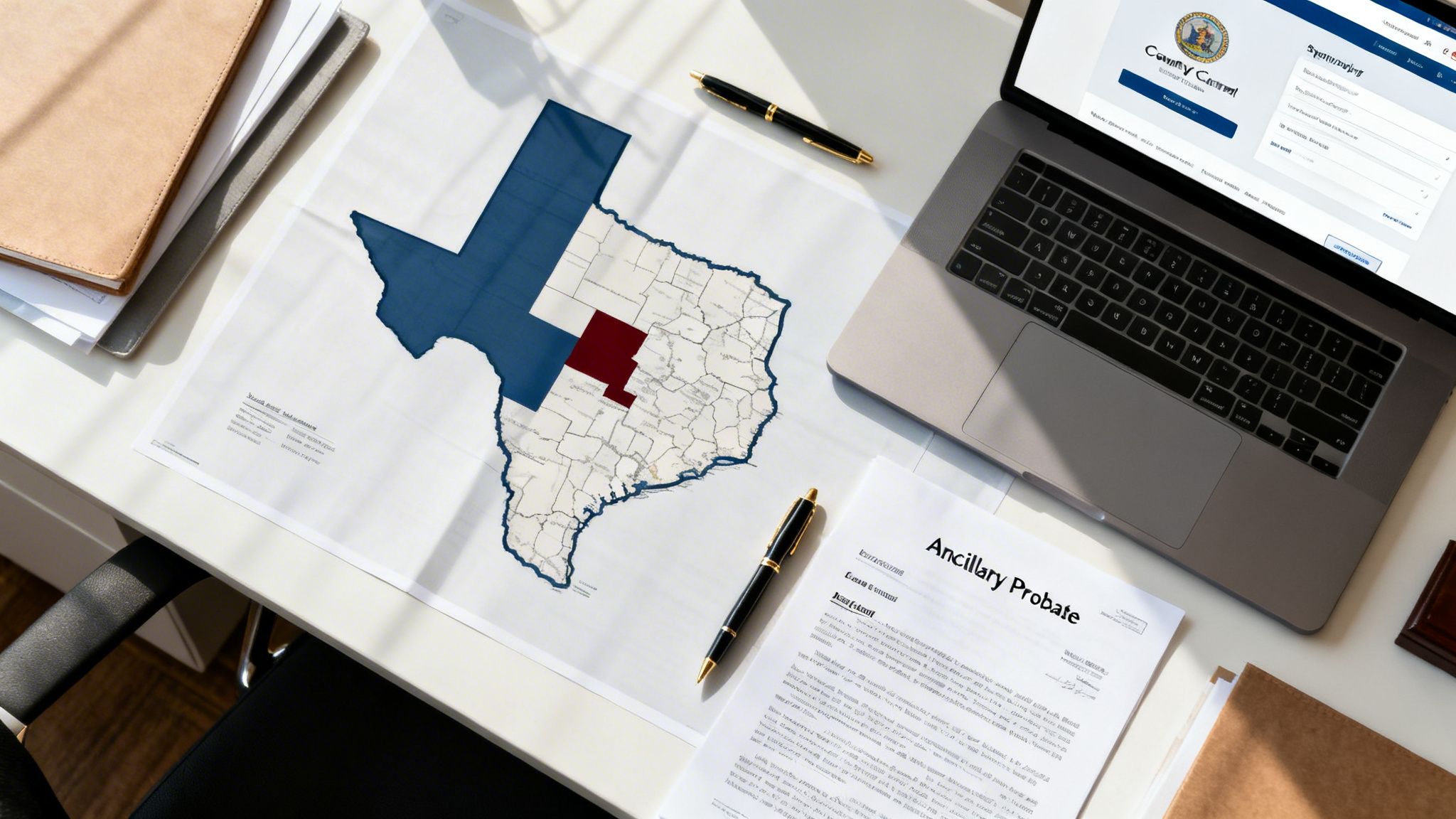
Ancillary probate is usually filed in the Texas county where the property is located.
That point sounds simple, but it causes real confusion for families living elsewhere. If your mother lived in Georgia and owned a house in Tarrant County, the Texas filing usually belongs in Tarrant County, not in the county where you live and not automatically in the county where she died.
For land, the county location often answers the venue question quickly. If more than one Texas property is involved, the filing choice can take a closer look.
Gather the foreign probate papers in the form Texas will accept
Texas courts usually want more than a plain copy of the will. They generally need authenticated copies of the foreign will and the order showing the will was admitted to probate, or other papers proving the out-of-state personal representative has authority.
This is one of the easiest places for a case to stall. A family member may have a scanned will, a case summary, or a photocopy from the home-state file and assume that is enough. Often it is not. Texas courts want documents that clearly come from the issuing court in a form they recognize.
If you want a clearer picture of the paperwork, this guide to how to file a petition for probate in Texas and the key documents involved is a helpful starting point.
Address the resident agent requirement early
Out-of-state executors are often surprised by the resident agent issue.
If the executor does not live in Texas, Texas law may require the appointment of a Texas resident agent to receive notices and court papers. Families sometimes hear that requirement and worry that they are giving someone else control over the estate. That is not what this role means.
A resident agent works more like a reliable mailbox for legal notices. The agent does not become the executor, does not decide whether property should be sold, and does not control distributions. The executor still makes estate decisions. The resident agent gives the Texas court a local person to serve with documents if needed.
That small step can save time. If the designation is missing or defective, the filing may be delayed even when the rest of the paperwork is in good order.
What the Texas court is checking
At a basic level, the court usually wants to confirm four things:
- A probate proceeding exists in another state: There is already a valid will probate or estate administration elsewhere.
- Texas has a connection to the estate: Usually that means Texas real property or another asset that calls for Texas court action.
- The applicant has authority: The person filing in Texas is the executor or other representative with legal authority from the home state.
- The documents are consistent: Names, dates, and property descriptions should line up across the home-state and Texas filings.
That last point matters more than families expect. If the will says one thing, the probate order says another, and the deed uses a slightly different name, the court or title company may ask questions before anything moves forward.
A realistic example
Suppose your uncle lived in Arizona, his will was admitted there, and you are the Arizona executor. He also owned a rental house in Dallas County.
Your Texas filing usually involves collecting the authenticated Arizona probate records, preparing the Texas application in the correct county, addressing the resident agent requirement if you live outside Texas, and asking the Texas court to recognize the foreign probate for purposes of the Dallas property. Once the court is satisfied that your authority is real and the documents fit together, you are in a much better position to deal with title, sale, or transfer issues tied to that property.
This overview may also help if you prefer a visual explanation:
Terms that sound harder than they are
Probate vocabulary can make a manageable process feel larger than it is. A few plain-English translations help:
- Ancillary probate: A Texas probate proceeding connected to an estate that started in another state.
- Foreign will: A will already admitted to probate outside Texas.
- Authenticated copy: A court-certified document Texas is likely to accept as official.
- Resident agent: A Texas person designated to receive court papers for a nonresident executor.
If you are serving from another state, the process often feels less mysterious once you see it for what it is. Texas is not reopening the entire estate from scratch in every case. It is deciding whether to recognize outside authority and how that authority applies to the Texas property.
Setting Expectations for Timelines and Costs
For an out-of-state executor, the hardest part is often not the filing itself. It is figuring out whether Texas needs a full court case at all, or only enough paperwork to clear title to the property.
That question affects both time and cost.
A full ancillary probate usually moves more slowly than families hope, even in a calm estate with no fight over the will. Courts have their own calendars. Certified records have to be gathered from the home state. Title issues sometimes surface only after the case begins. If you are planning a sale, it helps to treat the Texas probate piece as one step in a chain rather than the whole chain.
What can slow the process
Some delays are legal. Some are practical.
Common factors include:
- Incomplete foreign records: If Texas does not receive the right certified or authenticated documents, the clerk or court may require corrections before the case can proceed.
- Type of Texas asset: A simple transfer of one house is usually more predictable than mineral interests, business ownership, or property with title defects.
- County court scheduling: Some counties move faster than others, and hearing dates are not always immediate.
- Problems outside Texas: A pending issue in the home-state probate can spill over and slow the Texas piece.
- Disputes or creditor questions: Even a narrow disagreement can turn a routine matter into a longer one.
Many families hear "several months" and picture constant hearings and urgent deadlines. Most of the time, that is not what is happening. Probate often works like waiting on a series of green lights. One document is filed, then reviewed, then recorded, and only after that can the next step happen.
What costs are usually part of the picture
Court costs are only one layer.
A realistic budget may also include:
- Attorney fees
- Fees for certified or authenticated copies from the home-state court
- Recording fees tied to Texas real property records
- Title-related costs if the property will be sold
- Travel or mailing expenses, if your case requires them
The better question is not, "What is the cheapest way to open something in Texas?" The better question is, "What level of Texas authority do I need to finish the job?"
A practical way to decide what to expect
Here is the decision point many out-of-state executors miss. If you need Texas authority only to help transfer clear title to real estate, your timeline and cost may look very different from an estate that needs someone in Texas to actively collect assets, deal with creditors, or sign closing documents under court-recognized authority.
| What the estate needs | What that usually means for time and cost |
|---|---|
| Clear title to Texas real estate with no active local administration | Often simpler, faster, and less expensive |
| Ongoing Texas authority to manage, sell, or resolve issues tied to property | Often more steps, more filings, and more cost |
That is why early strategy matters. Filing for more probate than the estate needs can waste money. Filing for too little can leave you stuck later, especially if a title company or buyer asks for authority that the simpler option does not provide.
A careful first decision usually saves more time than rushing to file.
Simpler Alternatives to a Full Ancillary Filing
You may be sitting in another state with Letters Testamentary in hand, looking at a Texas house, ranch tract, or mineral interest and wondering whether you really have to open another court case just to deal with that one asset.
Sometimes the answer is no.
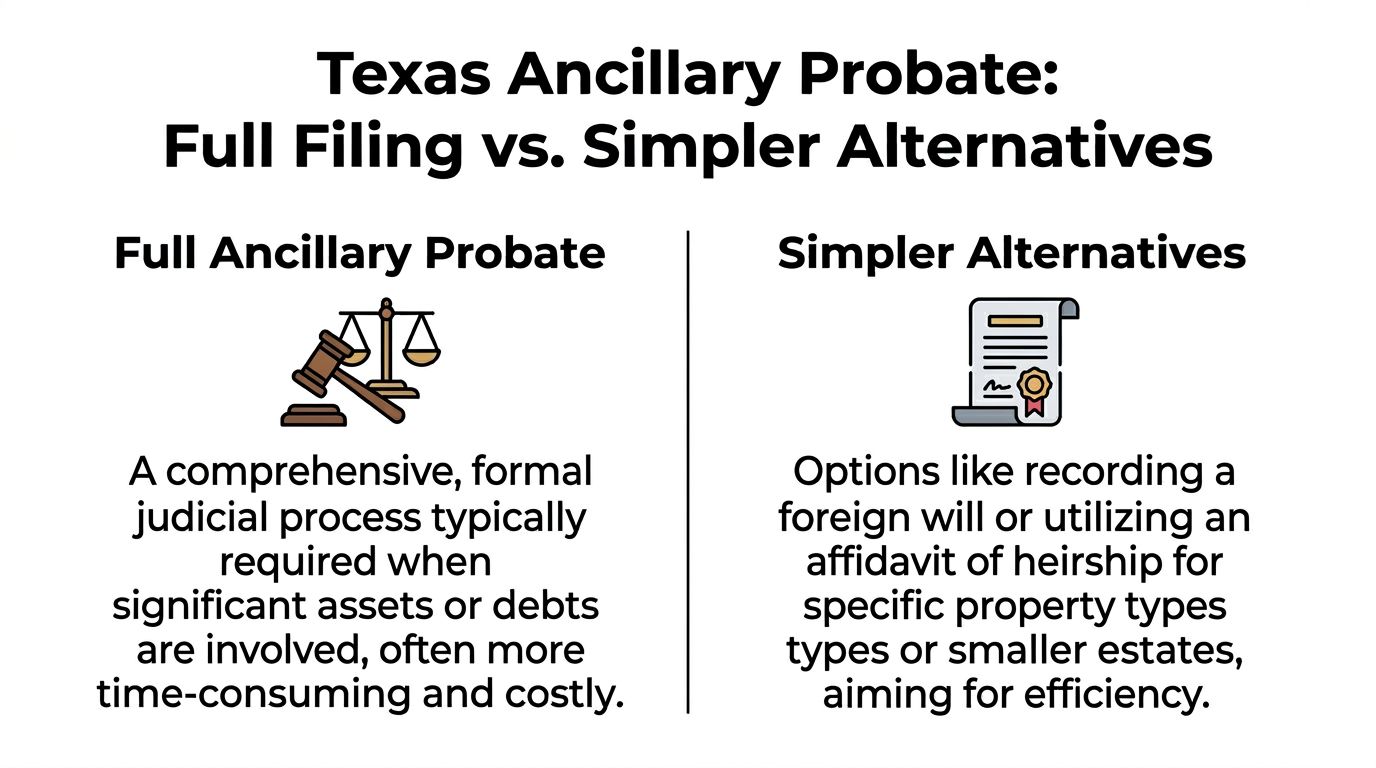
Texas Estates Code §501.002 permits an authenticated copy of a foreign will and the related probate record to be recorded in Texas when the estate does not need a local administration. For some families, that recording route is the simpler answer. It can be enough to place the home-state probate documents into the Texas real property records so the chain of title makes sense.
When recording may be enough
A helpful way to frame the decision is this: are you trying to administer a Texas estate, or are you trying to document what the home-state court already decided?
If the home-state probate is complete enough and the Texas issue is mainly title to real estate, recording may do the job. The foreign probate papers work like a certified translation of the other court's authority into Texas land records. They do not create a full Texas administration, but they may give the county records and a future title examiner what they need.
This option is often worth examining when:
- The Texas asset is real property, not a group of active local assets
- The will clearly says who receives that property
- No one needs ongoing Texas court supervision
- There is no fight over the property or the will
- The goal is to support title work, not to run estate business in Texas
That last point matters. Recording usually fits cases where the estate needs a paper trail, not a Texas-based manager.
When full ancillary probate is still the safer choice
Some estates need more than a recorded set of foreign documents. They need a Texas court order or Texas-recognized authority for someone to act.
That is usually the point where a full ancillary filing deserves serious consideration.
A fuller Texas proceeding may make more sense if:
- The executor must act under clear Texas authority
- There may be Texas creditor issues tied to the property
- A sale is coming and the title company wants more than recorded foreign papers
- Ownership, heirship, or the meaning of the will is disputed
- The estate includes Texas matters that go beyond updating land records
A simple way to understand the difference is this. Recording helps prove what happened elsewhere. Ancillary probate helps someone act here.
A side-by-side comparison
| Option | Best fit | Main tradeoff |
|—|—|
| Recording foreign probate records | Texas real estate needs title support, and no local administration is needed | May be too limited if a buyer, creditor issue, or dispute calls for stronger Texas authority |
| Full ancillary probate | The executor needs formal authority to act in Texas | More paperwork, court involvement, and expense |
A realistic example
Suppose your mother lived in Oklahoma, and her will was admitted to probate there. She also owned a small piece of land in East Texas. There is no tenant, no Texas bank account, no lawsuit, and no disagreement among the children. In that situation, the practical question is often whether recording the authenticated Oklahoma probate papers in the Texas county records will clear the title issue without opening a separate ancillary case.
It might.
Change a few facts and the answer can change with them. If the family plans to sell quickly, if the title company raises concerns, or if someone questions who owns the property, the narrower option may stop short of what the transaction needs. Then a full ancillary filing can save time by giving everyone clearer authority.
Planning tools that may prevent the problem later
Families who own property in more than one state often ask how to spare their children this extra step. Two tools often come up in that conversation: revocable living trusts and transfer-on-death deeds. In the right case, those tools can reduce or avoid the need for a later ancillary probate issue tied to Texas real estate.
They are not automatic fixes, and they do not suit every estate. Still, they are worth discussing during estate planning, especially if crossing state lines is part of the family's property picture.
Common Pitfalls for Out-of-State Executors
You may already have probate papers from your home state, a willing buyer, and a deed for the Texas property. It can feel like the hard part is over.
For many out-of-state executors, that is the point where Texas creates the first delay. The problem is usually not carelessness. It is using the right papers in the wrong place, or choosing a full ancillary filing when recordation might have been enough, or choosing recordation when the sale needs stronger Texas authority.

Assuming home-state authority automatically works in Texas
A common misunderstanding is simple: “I was appointed executor in another state, so I can sign for the Texas property too.”
Sometimes that assumption leads a family into a stalled closing. Texas often requires a Texas-recognized step before a title company, buyer, or county clerk will treat the transfer as ready to go. The home-state probate may be the foundation, but it is not always the final key that opens the Texas door.
Choosing a path before identifying the goal
This is the mistake I see most often. Families ask, “How do we file ancillary probate in Texas?” before asking the more practical question: “What do we need Texas to let us do?”
Those are not always the same question.
If the only issue is placing the foreign probate papers in the county records so title is clearer, a narrower option may work. If the executor needs to sign a deed into a sale, deal with objections from a title company, or address a dispute about ownership, a full ancillary proceeding may be the safer route. Starting with the goal usually saves time and expense.
Trying to sell before Texas authority is settled
Grieving families often want to move quickly, and that is understandable. The house is vacant. Taxes are coming due. Everyone wants closure.
But a signed contract does not solve an authority problem. It often exposes one. If the buyer is ready to close and the title company says the executor still lacks the right Texas documentation, the estate is now fixing a probate issue on the sale calendar instead of on its own timeline.
Overlooking creditor and claim issues tied to Texas property
A simpler recording option can look attractive because it costs less and involves less court activity. Sometimes it is the right answer.
Still, pause if the property may be connected to unpaid taxes, liens, local debts, or other estate obligations in Texas. In that setting, the question is not just how to pass title to the heirs. The question is whether Texas needs a fuller process before the property changes hands.
Missing community property and ownership questions
Out-of-state executors are often surprised here. The deed may list one name, but that does not always end the ownership analysis under Texas law.
Texas community property rules can affect who owned what interest at death and what authority the executor has. A family from a separate-property state may look at the same deed and reach the wrong conclusion. The paperwork can appear straightforward while the legal ownership picture is not.
Letting small document problems create large delays
Ancillary probate problems are often clerical before they are legal. A missing certification, a name that does not match across documents, or a filing in the wrong county can stop progress just as effectively as a dispute in court.
Typical trouble spots include:
- Wrong county: Filing somewhere other than the county where the Texas real property is located
- Incomplete foreign records: Using copies that are not properly authenticated or leaving out part of the probate file Texas needs to see
- Resident agent problems: Failing to address Texas requirements that can apply to a nonresident executor
- Name mismatches: Differences between the deed, the will, the death certificate, and the probate order
- Property description errors: Using a street address when the title records depend on the full legal description
Avoidable mistake: Waiting for the buyer, title company, or county clerk to discover the problem first.
A steadier way to approach it
Start with three questions. What Texas property did your loved one own? What does the estate need to do with it? What proof will the county records office, title company, or court require for that specific task?
That approach works like checking the lock before choosing the key. It helps an out-of-state executor avoid overfiling, underfiling, and last-minute corrections. In many estates, a short early review of the Texas property records and the foreign probate papers prevents the kind of delay that feels mysterious later.
Your Next Steps for Texas Ancillary Probate
You may be sitting in another state with a stack of papers, a Texas deed, and one practical question. What, exactly, do we need to do in Texas so this property can be sold, transferred, or cleared?
Start there.
For an out-of-state executor, the decision usually comes down to authority. Texas does not always require the biggest probate option available. The goal is to choose the least burdensome step that still gives the estate what it needs, whether that is clear title for a sale, authority to sign documents, or proof for the county records.
A useful way to approach this is to separate the problem into two tracks. One track asks, "Do we only need the Texas records to reflect what another state already approved?" The other asks, "Do we need a Texas court order because someone must act here?" Recording a properly authenticated foreign will and probate record may work for some estates. A full ancillary probate filing is often the safer choice if the property must be sold, title is unclear, or a third party wants stronger proof of authority.
If you feel uncertain, that is normal. Families are often trying to answer several questions at once after a death, and those questions tend to pile up fast.
Focus on these four:
- What does the estate need to do with the Texas property
- Will recording foreign probate papers be enough for that goal
- Is a Texas court order needed so someone can sign, sell, or resolve a title issue
- What documents from the home state need to be certified before Texas will accept them
That last point matters more than many executors expect. Ancillary probate works a bit like using an out-of-state driver’s license. It may be valid, but Texas still needs the right form of proof before local officials will rely on it.
When extra legal guidance often helps
Some estates are straightforward. Others look simple until a buyer, title company, or county clerk asks for something the family does not have.
Texas probate help is often useful when the estate needs to sell real estate, the executor lives outside Texas, the property has an old deed issue, creditors may be involved, or family members disagree about what should happen next. It also helps when you are choosing between recordation and a full ancillary filing, because that choice affects cost, timing, and how much authority the executor will have in Texas.
The main goal is to avoid solving the wrong problem. Filing a full case when recordation would work can waste time and money. Recording papers when a court order is needed can stall a sale later, which is often the more expensive mistake.
The good news is that this process is manageable. You do not need to master every Texas probate term before taking the first step. You do need a clear inventory of the Texas property, the home-state probate papers, and a realistic answer to one question: what must the estate accomplish in Texas?
Once that answer is clear, the next step usually becomes clearer too.
If you’re facing probate in Texas, our team can help guide you through every step, from filing to final distribution. Schedule your free consultation today with Law Office of Bryan Fagan, PLLC.